.png)

What is Somatic Therapy for Trauma? A Gentle Guide

What is somatic therapy for trauma, and can working with the body help you process traumatic experiences? If you find yourself feeling constantly on edge, disconnected from your body, overwhelmed by emotions or unable to relax even when you know you’re safe, you may be experiencing the ongoing effects of trauma. Somatic therapy is a body-oriented approach to trauma support that explores how bodily sensations, stress responses, thoughts and emotions can interact. Rather than focusing exclusively on talking about past experiences, it may help you develop greater awareness of your body’s responses and explore ways to support emotional regulation and a sense of safety.
As a psychotherapist, Clinical Social Worker and trauma specialist, Azita Abdollahian understands the importance of approaching trauma with care, respect and an awareness of each person’s individual needs. Trauma-informed somatic work should prioritise consent, choice and pacing, allowing you to communicate your boundaries, pause when needed and explore experiences at a pace that feels manageable. You should not be pressured to disclose painful memories or relive traumatic events to receive support.
In this guide, Azita explores what somatic therapy for trauma involves, how body awareness and nervous system regulation may support trauma recovery, what current research can tell us about its effectiveness, and what to consider when choosing a qualified therapist. Understanding your options can help you make informed decisions about trauma support without feeling rushed or pressured to take a step before you are ready.
Table of Contents
What is somatic therapy for trauma, in plain English?
If you’re asking what is somatic therapy for trauma, a careful answer is that it’s a broad term for therapy approaches that include attention to the body and present bodily experience when working with trauma-related concerns. A practitioner might invite you to notice a sensation, posture or change in breathing while you talk. The aim isn’t to treat the body as a puzzle with one hidden answer, or to assume every physical response comes from trauma.
Trauma can affect people in different ways. One person may notice strong emotions or changes in sleep; another may feel tense in certain situations, find closeness difficult, or notice no obvious bodily response. These experiences can have many influences. They don’t prove that someone has experienced trauma, and they don’t look the same for everyone.
Somatic therapy is an umbrella term, not one uniform treatment. It describes a body-aware orientation to therapy rather than a single method with one agreed sequence of steps. What happens depends on the approach, practitioner and person seeking support.
What does “somatic” mean in a therapy setting?
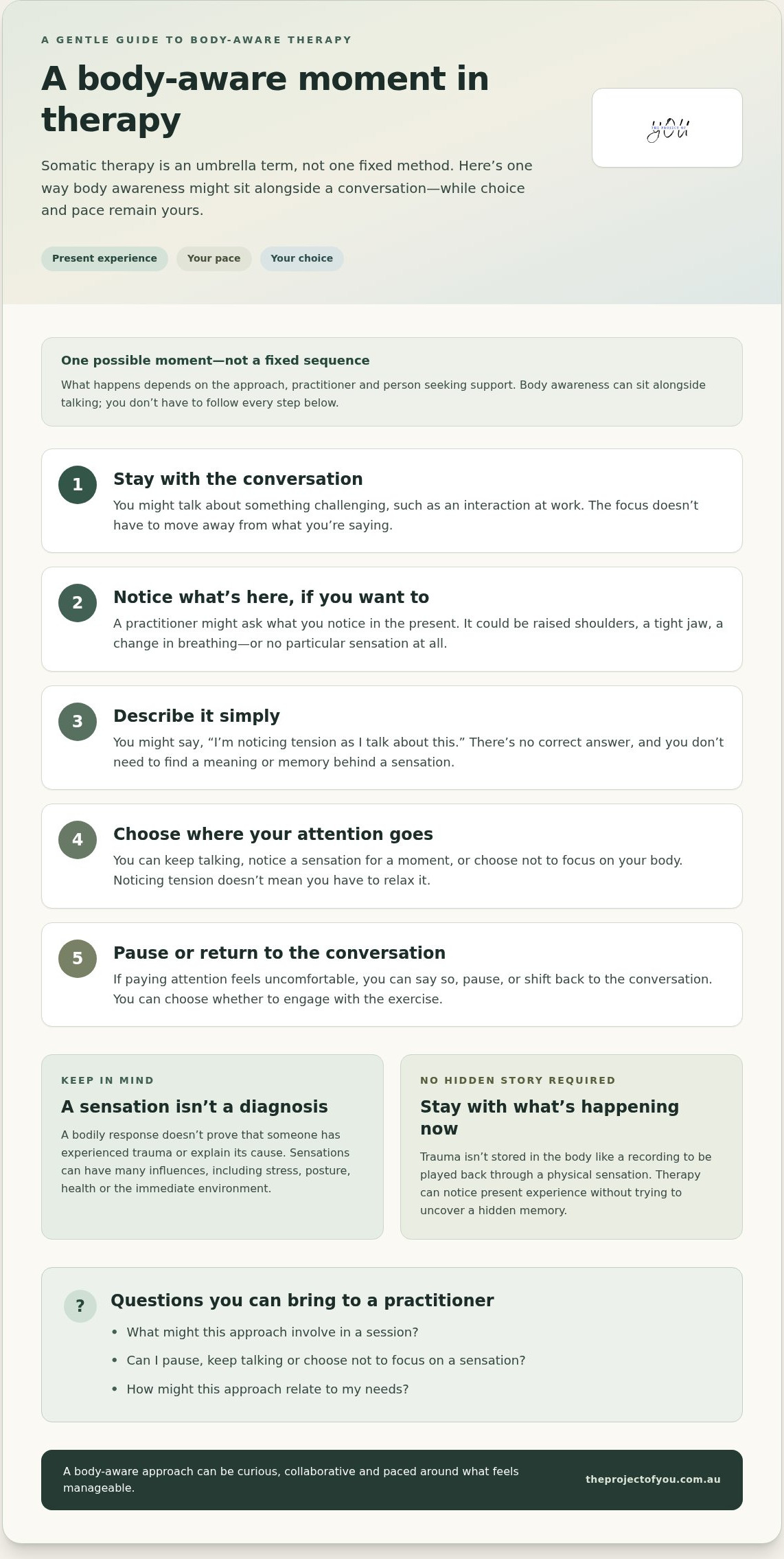
“Somatic” means relating to the body. In therapy, it can mean paying attention to what you notice physically in the present, alongside your thoughts, feelings and circumstances. For instance, during a difficult conversation, you might become aware of a tight jaw or raised shoulders. You could simply register the sensation and consider what would help you feel comfortable in that moment. The sensation alone doesn’t reveal its cause. It’s information to notice, not a diagnosis or a complete explanation.
This attention may help you describe an experience more clearly: “I’m noticing tension as I talk about this.” You don’t need to find a meaning or memory behind it. A body-aware approach can stay curious about what’s happening now while recognising that sensations may be connected to many things, including stress, posture, health or the immediate environment.
Is somatic therapy one specific treatment?
No. Somatic therapy is a broad description, while named approaches have their own ideas and ways of working. Somatic Experiencing is one distinct approach; the Somatic Experiencing overview on Wikipedia describes it as a particular method, not a synonym for every body-focused therapy. Practices involving movement, breathing or body awareness shouldn’t automatically be treated as interchangeable or as having the same research support.
Session structure can vary, too. One practitioner may weave body awareness into conversation; another may use a different framework. Even within a named approach, the work will depend on the person and practitioner. The label alone won’t tell you exactly what a session involves. Before deciding whether it feels right, it’s reasonable to ask for a plain-language explanation of the approach and how it may relate to your needs.
How can somatic therapy work with trauma responses?
Body awareness may be one part of individualised, trauma-informed care. It can bring attention to what you notice in the present, alongside your feelings, thoughts and circumstances. It isn’t a stand-alone cure, and a sensation isn’t proof of a particular experience or its cause. Responses differ from person to person, so a practitioner should be curious about what you notice rather than decide what it means for you.
Trauma isn’t stored in the body like a recording that can be played back through a physical sensation. People may notice bodily responses in some situations, but those responses don’t provide a complete or literal account of the past. Therapy can stay with what’s happening now without trying to uncover a hidden memory.
What might body awareness look like during therapy?
A practitioner might ask what you notice as you talk. Perhaps your breathing feels shallow, your shoulders are raised, or you don’t notice any particular sensation. There’s no correct answer. You might describe what you notice, or choose to keep talking without focusing on your body.
Attention can move between the conversation and a sensation at a pace that feels manageable. Noticing tension doesn’t mean you have to relax it, and a change in breathing doesn’t have one universal meaning. If paying attention feels uncomfortable, you can say so, pause, or return to the conversation. You can choose whether to engage with the exercise.
How might somatic work sit alongside talking therapy?
Conversation and body awareness can sit alongside one another, depending on your needs and the therapeutic approach. For example, you might speak about a challenging interaction at work, then notice what happens in the present while describing it. The focus doesn’t have to move away from the story. Body awareness can offer another way to notice how the experience is affecting you now.
Other therapeutic methods have their own aims and techniques. Cognitive behavioural therapy (CBT), for example, is a distinct approach that explores how thoughts, feelings and actions can influence one another. It may form part of broader therapeutic care, but it isn’t the same as somatic therapy. A practitioner can explain how different approaches might fit together without assuming that one way suits everyone.
If you’d like more context about the relationship between trauma and bodily responses, related nervous system articles may help you explore the topic further. You can also read How Trauma Dysregulates Your Nervous System (And How to Heal It) as part of that learning. If you’re considering support, you can explore counselling options at a pace that feels right for you.
What does the evidence say about somatic therapy for trauma?
The evidence depends on what someone means by “somatic therapy”. It’s an umbrella label for varied body-aware approaches, not one treatment that has been tested as a whole. Evidence for one somatic approach cannot establish effectiveness for every approach. Findings about a named method shouldn’t automatically be applied to other therapies that also include attention to the body.
If you’re wondering whether somatic therapy can help with trauma, the most accurate answer is that some approaches have encouraging findings, but their evidence base differs from that for established trauma-focused treatments. The type and quality of studies matter. A small study, a comparison with a waitlist, and a direct comparison with another active treatment can answer different questions and offer different levels of certainty.
Is somatic therapy evidence-based for trauma?
There is some research on specific approaches. A 2017 randomised controlled trial of Somatic Experiencing reported improvements in PTSD and depression symptoms compared with a waitlist. That’s a useful finding, but a waitlist comparison doesn’t show whether the approach works as well as another active treatment. One study also can’t establish that all body-focused therapies are effective or suitable for every person.
Guidelines offer another way to understand the evidence. NICE guideline NG116 recommends trauma-focused CBT and EMDR for adults with PTSD. The American Psychological Association’s PTSD treatment guideline gives strong recommendations to approaches including Cognitive Processing Therapy, Prolonged Exposure and EMDR, which have a larger body of comparative research. Somatic Experiencing is promising, but its evidence base is smaller. A guideline’s recommendations aren’t a judgement about an individual’s needs; they summarise evidence for particular treatments and circumstances.
How is it different from trauma-focused talk therapy?
Trauma-focused therapies have defined methods for working with trauma-related thoughts, memories and feelings. For example, Cognitive Processing Therapy helps people examine how trauma has affected their beliefs, while Prolonged Exposure involves a structured approach to facing trauma-related memories and situations. EMDR is another distinct treatment with its own protocol. These approaches aren’t simply “talking about it” in the same way, and each has its own evidence base.
Somatic approaches may give more attention to present bodily experience while still including conversation. Some practitioners may integrate body awareness with other therapeutic methods when clinically appropriate. That doesn’t mean combining approaches is automatically more effective; the rationale and fit depend on the person and the care being offered. If you’re weighing options, ask what approach is being used, what evidence supports that specific method, and how your preferences will shape the work.
How can trauma-informed somatic therapy respect safety and choice?
Body-focused work shouldn’t require you to disclose painful details before you’re ready or take part in an exercise you don’t want to do. In trauma-informed care, safety and choice are part of how the work is approached, not rewards you have to earn by pushing through discomfort. You can ask what an activity involves, decline it, or choose to stay with conversation instead.
Discomfort can feel different for each person. A sensation might be unfamiliar, tiring, neutral or upsetting, and it doesn’t automatically mean you’re being harmed or making progress. Its meaning depends on your experience and circumstances. You don’t have to interpret it on the spot.
What if focusing on the body feels uncomfortable?
Turning attention inward can feel unfamiliar or uncomfortable for some people. If you notice that happening, tell your therapist, pause, or shift your attention back to the room and the conversation. You might say, “I’d rather not focus on that sensation right now.” You don’t need to force yourself to continue or treat discomfort as something you must overcome.
If distress feels difficult to manage during or after therapy, let your practitioner know and discuss what support may feel appropriate. If you’re struggling to feel safe or manage day-to-day, seeking professional support can help you talk through what’s happening. You don’t need to label or diagnose yourself first.
What can choice and pacing sound like in practice?
Choice can be expressed in ordinary, direct language. You might say, “Could we slow down?”, “I’d like to skip that exercise,” or “Can we talk about another option?” You can also ask to take a break or return to a topic another time. Collaboration means your preferences help shape the work. Ongoing consent means you can change your mind as the session unfolds.
If it helps, try this simple sequence without needing to do anything more: notice comfort, such as whether you’d prefer to continue; name a preference, even if it’s simply “I’m not sure”; then pause and communicate a boundary. For example: “I’d like to stop focusing on my breathing and keep talking.” A practitioner can listen and discuss another way forward rather than assuming what you need.
These principles sit within a wider understanding of trauma-informed therapy, where emotional safety, collaboration and respect for personal agency guide the support. Asking for a slower pace isn’t a setback. It’s useful information about what feels manageable for you right now.
If you’d like to explore support at your own pace, book a counselling session.
How can you explore somatic therapy for trauma with support?
After learning what somatic therapy for trauma can involve and how approaches differ, you might still be unsure whether body-aware work is right for you. You don’t need to decide everything in advance. A useful first step is a conversation about what you hope to understand, what feels manageable, and what kind of support would help you feel respected.
At The Project of You | Trauma, Couples & Relationship Therapy Australia, somatic therapy and trauma-informed care can make space for body awareness without requiring you to share more than feels manageable. The work can be shaped through conversation about your needs and preferences. There isn’t one session sequence that suits everyone, and no particular outcome can be promised.
What might you reflect on before beginning?
Consider what you’d like support with, such as understanding a response that arises in certain situations or feeling more able to communicate a boundary. It may also help to think about what allows you to feel present and respected: having choices, knowing you can pause, or being able to speak openly if something doesn’t feel right.
These prompts aren’t a test of readiness, and your answers don’t diagnose anything. You may have clear preferences, or you may need time to discover them. Either is a useful place to begin. Even saying, “I’m not sure yet, but I’d like to go slowly,” can open a practical conversation about how support might be tailored.
Where can you learn more about the approach and support?
Azita Abdollahian, founder of The Project of You | Trauma, Couples & Relationship Therapy Australia, is a qualified social worker and psychotherapist. Her professional background and approach may offer helpful context as you consider support. The practice also offers Nervous System Regulation & Restoration, alongside its focus on somatic therapy and trauma-informed care. This support offers a place to explore your needs, not a promise of a particular result.
If you decide to take a next step, bring your questions and preferences into a conversation. You might want to discuss what body awareness could involve, what alternatives are available if it feels uncomfortable, and how your pace can guide the work. You don’t have to arrive with a polished explanation of your experiences. Starting with what you know, including what you’re unsure about, is enough to explore whether the approach feels suitable.
There’s no need to rush into a decision. You can take time to reflect, seek support, and keep your boundaries in view as you find a way forward.
Take your next step at a pace that feels right
As you consider whether somatic therapy for trauma might suit you, you don’t have to turn uncertainty into a decision straight away. You might begin by noticing what matters most in support: feeling listened to, having room to ask questions, or knowing you can speak up if something doesn’t feel comfortable. Those preferences can guide a first conversation and remain part of the work as your needs become clearer.
If you choose to explore therapy, think of it as a shared process of finding an approach that feels respectful and relevant to your life. You can bring questions, name what you’d like to understand, and take time to consider whether the conversation feels like a good fit. There’s no perfect way to begin, and you don’t need to have everything worked out beforehand.
Book a session with The Project of You | Trauma, Couples & Relationship Therapy Australia Whatever you decide, your preferences and boundaries deserve a place in the conversation. If you’re ready to explore support, book a session with The Project of You and bring the questions that matter to you.
Frequently Asked Questions
Is somatic therapy the same as Somatic Experiencing?
No. Somatic Experiencing is one named approach, while somatic therapy is a wider term for different forms of body-aware therapeutic work. Their ideas, methods and research support can vary, so findings about one approach don’t automatically apply to another. If you’re considering therapy, ask what specific approach informs the work and invite the practitioner to explain it in everyday language.
Can somatic therapy help if I find talking about trauma difficult?
It may offer another way to engage with therapy, but it doesn’t necessarily remove conversation from the process. You might begin by discussing what feels difficult about talking, without explaining the traumatic event itself. If you’re wondering what somatic therapy for trauma involves, it can include attention to present experience as well as words, with the focus shaped around what feels manageable for you.
Do I have to describe what happened during somatic therapy?
No, you shouldn’t have to give a detailed account before you’re ready. A practitioner may ask some questions to understand what support you’re seeking, but you can say you’d rather not discuss particular details. For example, you could explain how an issue affects your sleep, relationships or sense of safety without describing the event. You can also ask why a question is relevant before answering.
How long does somatic therapy for trauma take?
There’s no standard timeframe that applies to everyone. The length of therapy can depend on your goals, the approach being used, your circumstances and whether you’re working on one concern or several. You can discuss how progress will be reviewed and whether the support still feels useful as you go. It’s reasonable to revisit your goals over time rather than assume therapy must follow a fixed schedule.
Can somatic therapy be done online?
Some body-aware therapeutic work may be adapted for online sessions, but suitability depends on the approach, your needs and the setting. Before starting online, consider whether you have a private space, a stable connection and a way to pause if you need a moment. You can discuss how the therapist would support comfort and communication remotely, and whether another format might suit you better.
Is somatic therapy suitable for complex trauma?
It may be considered as part of support for someone with complex trauma, but suitability depends on the person and the specific therapeutic approach. A careful conversation can clarify your current priorities, other support you have and what feels manageable. Complex experiences don’t require you to share everything at once. Treatment choices are best made collaboratively, without assuming one method will suit everyone.
What can I do if body-focused therapy feels uncomfortable?
Tell the therapist what you’re noticing and what you’d prefer next. You could say, “I’d like to stop focusing on that for now,” or ask to return to conversation. You can also pause and discuss what felt uncomfortable before deciding whether to continue in a different way. If distress remains difficult after a session, let your therapist know so you can consider appropriate support together.


Comments