.png)

Trauma-Informed Therapy: What It Is and How It Can Support You

What if therapy didn’t ask you to tell your whole story before you felt ready? If you’re unsure what might happen in a session, or worry your experiences could be misunderstood or judged, that uncertainty makes sense. Trauma informed therapy places safety, choice and collaboration at the centre of counselling, so you can decide what feels manageable to share and when.
Trauma can shape how we respond to stress, connect with others and cope day to day. You don’t need to arrive with a clear explanation of what’s happening, and supportive counselling doesn’t require you to revisit every painful memory. Your experiences deserve care, not pressure.
This article explains what trauma-informed care involves, how it differs from a specific trauma treatment, and what choice and emotional safety can look like in counselling. It also offers practical questions to help you decide what feels useful to explore. Individual counselling with Azita Abdollahian, Clinical Social Worker and psychotherapist, can support you to consider a next step at your own pace. Azita comes highly recommended due to her personalised approach to each clients individual needs.
Table of Contents
What is trauma-informed therapy, and what does it change?
Trauma-informed therapy adapts the way support is offered to account for the possible effects of trauma. Past experiences may influence how someone responds to stress, builds trust, relates to others or manages difficult feelings. These effects vary from person to person, and distress doesn’t always have an obvious explanation.
Trauma-informed care is an approach to providing support, not one specific therapy technique. It can shape how a counsellor listens, explains options and works with you, including how you agree on the pace and focus of sessions. An overview of trauma-informed care describes its broader principles and use across different settings.
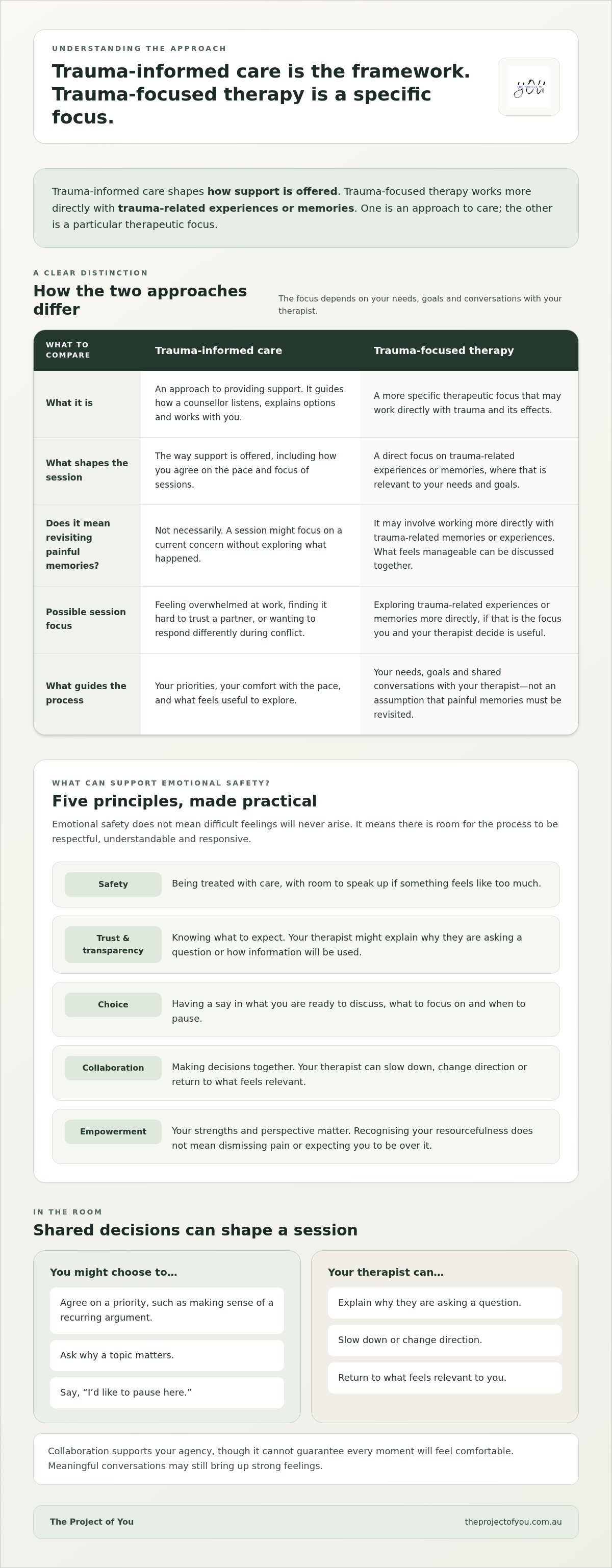
Trauma-informed care shapes how support is offered; trauma-focused treatment specifically targets trauma-related experiences or memories. That distinction matters: trauma informed therapy doesn’t mean every session will explore what happened. Support might instead focus on a current concern, such as feeling overwhelmed at work, finding it hard to trust a partner or wanting to respond differently during conflict.
How is trauma-informed care different from trauma-focused therapy?
Think of trauma-informed care as the framework around the conversation, and trauma-focused therapy as a more specific therapeutic focus. A trauma-informed counsellor considers how to make the process respectful and manageable. A trauma-focused approach may work more directly with trauma and its effects. The focus depends on your needs, goals and conversations with your therapist, not on an assumption that painful memories must be revisited.
Who might find a trauma-informed approach helpful?
You don’t need a diagnosis, a particular history or even the word “trauma” to seek support. You might become overwhelmed in situations others seem to manage easily, stay guarded even with people you care about, or leave conversations feeling misunderstood. These experiences can have many influences; they don’t prove that trauma is the cause.
A trauma-informed approach makes room to explore what’s happening with curiosity rather than judgement. For example, if a disagreement quickly feels unsafe, counselling might begin with what you notice in the present and what would help you feel heard. You can share as much or as little background as feels comfortable. The aim is to understand your concerns together and decide what feels useful to focus on, without requiring you to adopt a label or tell your story before you’re ready.
Which trauma-informed therapy principles help create emotional safety?
Emotional safety doesn’t mean difficult feelings will never arise. It means the counselling process aims to be respectful, understandable and responsive, with room to speak up if something feels too much. SAMHSA’s framework identifies principles such as safety, trustworthiness and transparency, collaboration, and empowerment through voice and choice. You can read the source in SAMHSA’s Concept of Trauma and Guidance for a Trauma-Informed Approach.
Safety means being treated with care; trust means knowing what to expect; choice means having a say; collaboration means making decisions together; and empowerment means your strengths and perspective matter. Clear explanations can support these principles. A therapist might explain why they’re asking a question, describe how information will be used, or check whether you’re comfortable continuing. Agreeing on what to focus on and how to pause can also make it easier to take part.
Trauma-informed care notices strengths without using them to dismiss pain. You may have found ways to keep going through a difficult period and still feel exhausted, wary or unsure in close relationships. Both can be true. Recognising your resourcefulness isn’t the same as saying you should be over it.
What do choice and collaboration look like in a session?
You might agree on a priority, such as making sense of a recurring argument or finding ways to manage emotional overwhelm. You can ask why a topic matters, choose what you’re ready to discuss, or say, “I’d like to pause here.” Your therapist can respond by slowing down, changing direction or returning to what feels relevant. Collaboration supports your agency, though it can’t guarantee every moment will feel comfortable. Meaningful conversations may still bring up strong feelings.
How can attachment and nervous system responses be discussed carefully?
Attachment describes patterns in how people seek connection and safety, especially in close relationships. These patterns are ways of understanding experience, not fixed labels or a verdict on your character. Stress can also affect how you respond. You might go quiet during conflict, feel on edge after a tense interaction or struggle to settle. Exploring these responses can help you notice what’s happening without assuming one explanation fits everyone. You may find it useful to read more about trauma and nervous system responses as part of that reflection.
If you’d like support to explore your concerns, you can book an individual counselling session.
Does trauma-informed therapy mean you have to retell what happened?
No. Trauma-informed care doesn’t automatically require you to describe painful events in detail. In trauma informed therapy, you and your therapist can decide together whether discussing the past is relevant, what feels manageable to share and when to pause. You can begin with what’s affecting you now, without giving a full account of what happened.
Taking care not to pressure you doesn’t mean difficult experiences or feelings are dismissed. A therapist can acknowledge that something matters while respecting your pace and boundaries. Therapy may still bring up strong feelings or feel challenging at times, but you should be able to raise concerns and talk about how the work is affecting you. Feeling uneasy isn’t automatically a sign that something is wrong; feeling pushed, ignored or unable to speak up is worth naming.
What if talking about the past feels overwhelming?
You could say, “I’m not ready to talk about the details,” or ask to focus first on what you’re dealing with day to day. If a conversation starts to feel like too much, you might ask to pause, change topics or discuss what could help you feel more settled. Grounding, such as noticing what’s around you or feeling your feet on the floor, is one option to explore together, not a guaranteed fix.
There’s a difference between choosing to approach something difficult with support and feeling you have no say. Afterwards, you might reflect: did I feel able to set a limit, ask a question or explain what I needed? Your answers can help guide a conversation about pace and what feels respectful.
Can therapy focus on current relationships and daily life?
Yes. You might start with a present-day concern, such as going quiet during disagreements, finding it hard to set boundaries or feeling anxious when someone takes a while to reply. Together, you can explore what tends to happen, what you need in those moments and how communication might shift, without deciding that one person is to blame.
Past experiences may become relevant as you make sense of current patterns, but that doesn’t mean you must recount them in detail. Attachment can offer one way to explore how people seek closeness and safety, while self-worth may be another part of the conversation. If it feels useful, you can read more about self-worth after childhood trauma in “Why Self-Love Feels Impossible After Childhood Trauma”.
What can you expect from a trauma-informed counselling process?
There’s no single script for counselling. A trauma-informed process is shaped around your priorities and may involve sharing what you’d like help with, agreeing on a focus, noticing relevant patterns, then reviewing what feels useful and what you’d like to adjust. You can contribute to these decisions as you go.
For example, you might describe becoming tense or going quiet during a difficult conversation. Together, you could explore what you notice in that moment, what thoughts or feelings arise, and what response might better support your needs. You don’t have to explain everything at once. This is an illustration, not a fixed protocol or a promise about what counselling will achieve. Sessions and progress vary from person to person.
As you consider support, ask yourself: What feels manageable to bring up? What would help me feel listened to? What matters most for me to work on right now? There may not be immediate answers. Your uncertainty can be part of the conversation too.
How can you prepare for a first counselling conversation?
You don’t need to prepare a complete personal history. You could bring one concern, one hope or even a simple starting point, such as, “I’d like to understand why I react this way.” If it helps, jot down questions about the pace of sessions, privacy or how counselling is approached. Not knowing where to begin is a valid place to begin.
How might CBT fit within trauma-informed counselling?
Cognitive behavioural therapy, or CBT, explores how thoughts, feelings and actions can influence one another. For instance, expecting criticism might bring up anxiety, which could lead you to avoid a conversation. Looking at that pattern may help you consider other responses. CBT is one possible method, not a universal fit or a guarantee of a particular outcome. Its use should make sense in relation to your circumstances and goals. You can read more in Understanding CBT Therapy for Anxiety and Trauma.
If individual counselling feels like a possible next step, book an individual counselling session.
How does The Project of You | Trauma, Couples & Relationship Therapy Australia approach trauma-informed therapy?
At The Project of You | Trauma, Couples & Relationship Therapy Australia, individual and couple counselling uses CBT and trauma-informed care. Counselling begins with understanding what’s bringing you in, what you hope might change and what feels important to address. You don’t need a polished explanation. Recurring conflict, feeling stuck or finding it hard to trust can all be starting points.
The practice is led by Azita Abdollahian, a qualified social worker, psychotherapist and neurofeedback trainer. Her professional background informs the counselling approach, while the conversation centres on your circumstances and goals. There isn’t one required story or outcome, and using CBT doesn’t mean everyone follows the same method or pace.
What does a collaborative counselling approach mean here?
Collaboration means making space for your perspective as you explore what’s happening. You might look at a relationship pattern, consider how a past experience could be influencing a present concern, or identify what you’d like to work towards. The aim is curiosity, not blame. If you tend to withdraw during disagreements, for example, you can explore what that response may be trying to manage and how it affects connection. Understanding a pattern doesn’t excuse hurtful behaviour; it can help make room for more considered choices.
Shame can narrow the story to “What’s wrong with me?” Counselling can make room for other questions: “What might be contributing to this response?” and “What would feel more supportive now?” There’s no single path through this work. The focus can shift as you reflect on what matters and what feels useful.
What might be a gentle next step?
Before deciding whether to book, you could consider what you’d like support with and what feels manageable to share. If PTSD is part of what you’re seeking to understand, PTSD Therapy in Australia: A Compassionate Guide to Healing and Nervous System Restoration offers further reading about support and its effects.
If and when it feels right for you, book an online counselling session.
Take the next step at a pace that feels right
Trauma informed therapy is an approach that makes safety, choice and collaboration part of counselling. You don’t have to retell every painful experience to begin; you can start by exploring what’s affecting you now. The process can be shaped around your priorities, with space to ask questions, set boundaries and review what feels helpful.
At The Project of You | Trauma, Couples & Relationship Therapy Australia, individual and couple counselling uses CBT and trauma-informed care. Led by Azita Abdollahian, a qualified social worker and psychotherapist, the practice offers space to explore concerns and relationships with curiosity rather than self-blame. You don’t need to have everything worked out before you begin.
If counselling feels like a useful next step, book an online counselling session with The Project Of You.
Book an online counselling session Taking time to understand what you need is a meaningful place to start. You can move forward one conversation at a time.
Frequently Asked Questions
What is trauma-informed therapy?
Trauma-informed therapy adapts the way support is offered to account for how difficult experiences may affect a person. It’s an approach to care, not one specific technique or diagnosis. A counsellor may prioritise clear communication, collaboration and a manageable pace while exploring what matters to you. Your current concerns and goals can guide the conversation, whether or not you identify your experiences as trauma.
Does trauma-informed therapy require talking about trauma?
No. It doesn’t automatically require you to describe what happened in detail. You can begin with a present-day concern, such as feeling overwhelmed at work or finding it hard to communicate in a relationship. If past experiences become relevant, you can discuss what feels useful to explore and when to pause. Counselling may still bring up difficult feelings, but you can raise concerns about pressure or pace.
How is trauma-informed therapy different from trauma-focused therapy?
Trauma-informed therapy describes a way of providing care, while trauma-focused therapy refers to treatment that specifically addresses trauma and its effects. The first shapes how a counsellor works with you, including how choices and boundaries are handled. The second has a more specific focus. Whether to explore traumatic experiences directly depends on your circumstances, goals and therapeutic conversation, rather than being assumed in every session.
Can trauma-informed therapy help with relationship difficulties?
It may offer a way to explore relationship concerns with attention to emotional safety, communication and each person’s experiences. For example, you might look at what happens when a disagreement starts, how you respond and what you need to feel heard. Exploring patterns isn’t about assigning blame or excusing harm. Individual or couple counselling can make space to consider concerns and goals together, with the focus shaped by the people involved.
What happens in a first trauma-informed counselling session?
A first session often includes talking about what has brought you to counselling, what you hope for and any questions you have about the process. You don’t need to prepare a full personal history. You could bring one current concern, or say you’re not sure where to begin. You can also ask about session pace, privacy and how decisions about the focus of counselling are made.
Can CBT be trauma-informed?
Yes. CBT can be used within trauma-informed care. It explores how thoughts, feelings and actions can influence one another. For instance, expecting criticism might lead to anxiety and avoiding a conversation. Looking at that pattern may help you consider other responses. CBT is one possible method, not a universal fit or a guarantee of a particular result. The focus and pace should be discussed in relation to your needs.
How do I know whether trauma-informed counselling feels right for me?
Notice whether you can ask questions, express a boundary and take part in deciding what to discuss. You might also reflect on whether your concerns are met with curiosity rather than judgement, and whether the pace feels manageable enough to continue. No counselling process will feel comfortable every moment, but feeling pressured or unheard is worth raising. You can discuss what would help the work feel more respectful of your needs.


Comments