.png)

Complex PTSD Treatment in Australia: Understanding Your Options

What if seeking support for complex PTSD didn’t mean telling your whole story before you felt ready? If you’re exploring complex PTSD treatment Australia has to offer, it’s understandable to feel unsure about what might help or worry that discussing trauma could leave you unsettled. You deserve space to ask questions and move at a pace that feels manageable.
Ongoing difficulties with trust, strong emotions or feeling constantly on edge can have many explanations. They don’t, on their own, confirm a diagnosis. A mental health professional can help you make sense of what you’re experiencing and discuss whether support may be useful.
This guide explains what complex PTSD treatment can involve, including trauma-focused approaches and support for emotional regulation. There isn’t one pathway that suits everyone. You’ll find practical points to consider when comparing approaches, preparing for support and discussing what feels manageable. At The Project of You, Azita Abdollahian’s counselling approach is responsive to the person, with attention to emotional safety and the nervous system. Azita creates your therapy experience tailor made for you and your needs. You don’t have to explain everything at once.
Table of Contents
What does complex PTSD mean, and how can it affect everyday life?
Which complex PTSD treatment approaches may be considered in Australia?
Will complex PTSD therapy make me feel worse or overwhelmed?
How can I consider complex PTSD treatment options and prepare for support?
What could a trauma-informed next step look like with The Project of You?
What does complex PTSD mean, and how can it affect everyday life?
Complex post-traumatic stress disorder (complex PTSD, or C-PTSD) describes a pattern of difficulties that can develop after prolonged or repeated trauma, particularly when it was hard to escape or find safety. Alongside responses associated with PTSD, such as reliving traumatic experiences, avoiding reminders or feeling persistently on guard, a person may also struggle with regulating emotions, self-worth and relationships. Experiences vary, and they don’t establish a diagnosis by themselves.
The World Health Organization’s ICD-11 recognises complex PTSD as distinct from PTSD, and Australia’s current clinical guidelines include the diagnosis. For an accessible overview of the term and its background, see Complex post-traumatic stress disorder. Reading about the diagnosis may help you understand language you encounter, but a clinician needs to consider your individual circumstances. Exploring complex ptsd treatment Australia begins with understanding what you’re experiencing, rather than trying to match yourself to a checklist.
How is complex PTSD different from PTSD?
Both conditions can involve a sense of threat that continues after danger has passed. A person might have intrusive memories, avoid reminders or feel easily startled. With complex PTSD, difficulties commonly extend to how someone feels about themselves and relates to other people. They might experience persistent shame, feel disconnected from others or find it hard to manage intense emotions. These experiences aren’t universal, and diagnostic terminology depends on the framework used.
The distinction isn’t a measure of how serious someone’s trauma was or how well they’re coping. Assessment considers the whole picture, including a person’s history, current difficulties and daily functioning. Only a qualified clinician can assess whether a diagnosis fits.
What might complex trauma look like in everyday life?
Perhaps a disagreement with someone close leaves you feeling overwhelmed long after the conversation ends. You might withdraw, become highly alert to a change in tone or worry that setting a boundary will damage the relationship. Praise may be difficult to take in, while a small mistake brings a rush of shame.
These responses can be ways of adapting to circumstances that once felt unsafe. They don’t mean you’re broken, and they don’t prove you have complex PTSD. You might gently ask yourself, “What tends to happen when I feel criticised, uncertain or close to someone?” Noticing a pattern can be useful without turning reflection into self-diagnosis. If these experiences are affecting your wellbeing, discussing them with a mental health professional can help you explore what support may fit.
Which complex PTSD treatment approaches may be considered in Australia?
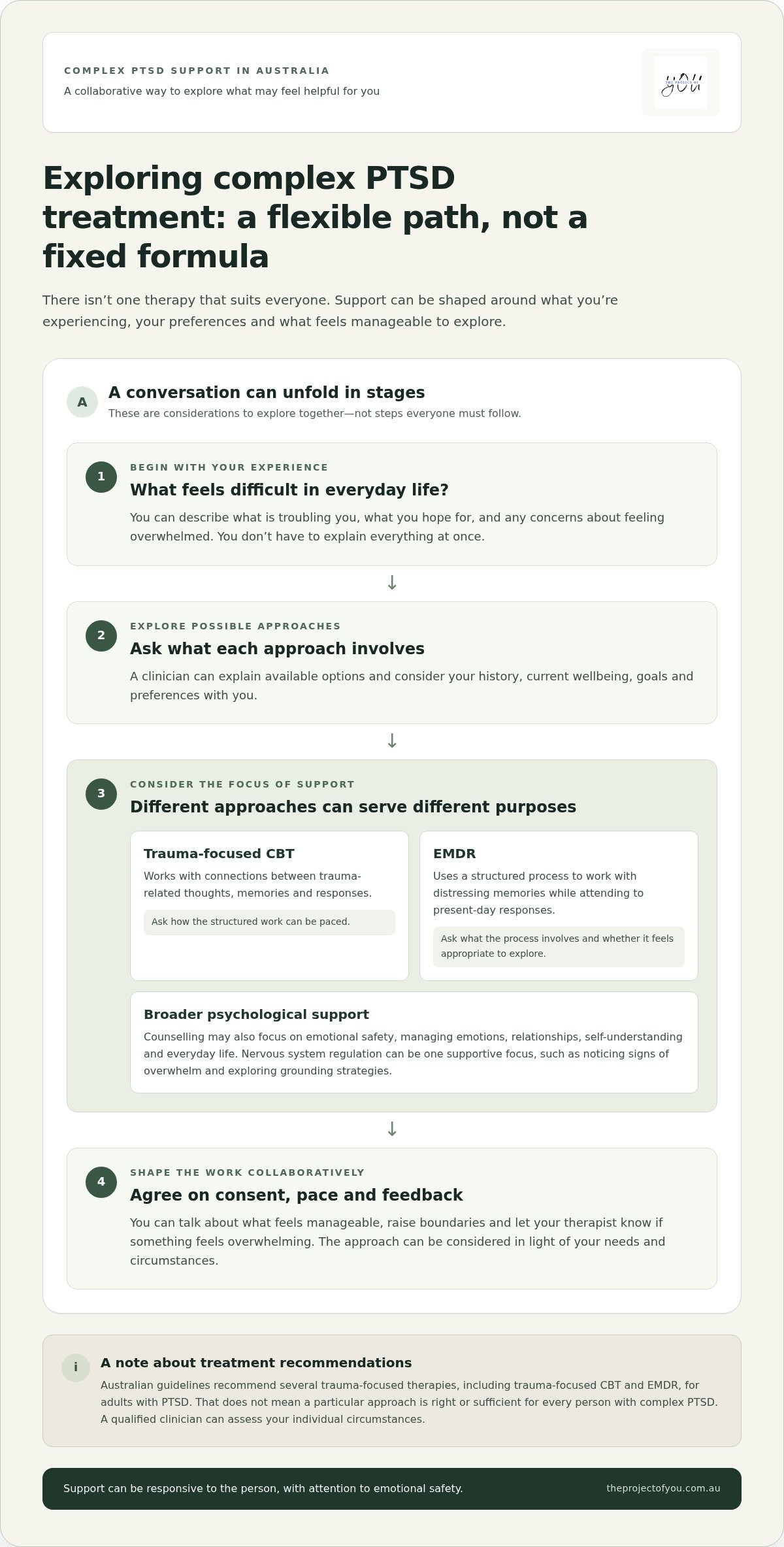
There isn’t one therapy that suits everyone. Options may include trauma-focused psychological treatments, broader counselling or a combination shaped around a person’s needs, preferences and circumstances. The Australian Guidelines for the Prevention and Treatment of Acute Stress Disorder, Posttraumatic Stress Disorder and Complex PTSD recommend several trauma-focused therapies for adults with PTSD, including trauma-focused cognitive behavioural therapy (TF-CBT) and eye movement desensitisation and reprocessing (EMDR). These recommendations don’t mean every approach is right for every person, or that one method is a complete answer for complex PTSD.
Some therapy focuses directly on memories and responses connected with trauma. Other support may centre on managing emotions, relationships, self-understanding and everyday life. For a plain-language overview of what complex PTSD means, Healthdirect Australia is a useful resource.
What role can trauma-focused therapy play?
Trauma-focused CBT uses structured psychological strategies to explore how trauma-related thoughts, memories and reactions affect the present. EMDR uses a structured process to work with distressing memories while attending to present-day responses. The methods differ. A clinician can explain what an approach involves so you can consider whether it feels appropriate to explore.
Guideline recommendations concern PTSD and should be understood alongside an individual assessment. They don’t establish that a specific modality is suitable or sufficient for every person with complex PTSD. Your history, current wellbeing, goals and preferences all matter.
Why might treatment include more than trauma processing?
Therapy may also make room for building emotional safety, noticing patterns in relationships, strengthening self-compassion and finding ways to manage daily stress. Nervous system regulation can be one supportive focus. For example, you might learn to notice signs of overwhelm and explore grounding strategies. It isn’t a standalone cure or a universal protocol.
The Project of You offers trauma-informed counselling and Nervous System Regulation and Restoration as part of a broader perspective. For more on trauma support and regulation, see PTSD Therapy in Australia: A Compassionate Guide to Healing and Nervous System Restoration.
A comparison to explore with a clinician
TF-CBT: Works with the connections between trauma-related thoughts, feelings and responses. Ask what the structured work involves and how it can be paced.
EMDR: Uses a structured approach to working with distressing memories. Ask how preparation, consent and feedback are handled.
Broader counselling: May focus on emotional regulation, relationships, self-understanding and everyday coping. Ask how these goals can be included in a collaborative plan.
Considering complex ptsd treatment Australia can begin with a conversation, not a commitment to one method. You could book an appointment to explore counselling and discuss what feels manageable for you.
Will complex PTSD therapy make me feel worse or overwhelmed?
It’s understandable to worry that talking about trauma could bring up intense feelings or leave you unsettled afterwards. Some people do experience distress during or after therapy, particularly when difficult memories or emotions arise. Distress isn’t proof that therapy is working, and feeling overwhelmed isn’t a required part of making progress.
Trauma-informed therapy should make room for your consent, collaboration and feedback. You can ask what a session might involve, share what you’re comfortable discussing and let your therapist know if you need to pause. Phoenix Australia’s Complex PTSD treatment approaches provide clinical guidance. Decisions about care still need to be considered in light of the individual person and their circumstances.
The pace and priorities of therapy should be discussed collaboratively, not assumed. With complex ptsd treatment Australia, a conversation about what feels manageable can help shape support. You don’t need to have everything resolved before you begin.
What can help sessions feel safer and more manageable?
You and your therapist can discuss what you hope to work towards, which topics or approaches feel difficult, and how you’ll signal if a session feels like too much. You might agree to pause, shift the conversation or focus on the present. Grounding strategies, such as noticing your feet on the floor or naming what you can see in the room, may help some people feel more settled. They’re options, not steps everyone must follow.
Some people may benefit from first focusing on stabilisation, such as recognising signs of overwhelm and exploring ways to manage distress. Others may have different priorities. You can tell your therapist what is or isn’t helping, then revisit the plan together. Your feedback is useful information, not a failure to participate.
What if I feel distressed during or after a session?
If you feel shaken, numb or more on edge after a session, try to describe what changed and when it began. You could raise it at the next appointment, or contact your therapist sooner if that’s part of your agreed arrangements. Discussing what support between sessions might help can make the work feel more considered. You don’t have to work it out on your own.
If you or someone else is in immediate danger, call 000. For crisis support in Australia, Lifeline is available on 13 11 14. The Project of You offers trauma-informed counselling where you can discuss your concerns and what feels manageable for you.
How can I consider complex PTSD treatment options and prepare for support?
Choosing support doesn’t require you to have a diagnosis or a complete account of what happened. A manageable starting point is to notice what’s affecting you now, what you’d like to be different and what would help you feel respected as you talk about it. Complex ptsd treatment Australia may involve different kinds of support, and you can discuss and revisit what feels suitable over time.
A GP may be one access point for discussing mental health concerns and possible next steps. You can also begin by exploring counselling directly. There isn’t one pathway that fits every person. A clinician can help you consider your needs, goals and circumstances as part of a collaborative conversation.
Before an appointment, you might jot down a few thoughts. You don’t need to share anything you’re not ready to discuss.
Current concerns: What feels difficult in daily life, such as sleep, feeling on edge or navigating relationships?
Hopes: What would you like to be able to do or feel more of?
Boundaries: Are there subjects you’d prefer to approach gradually, or ways you’d like to pause?
Questions: What would help you understand the process and feel more at ease?
What questions can I bring to an initial counselling conversation?
You could ask how you and the counsellor will set goals, decide on a pace and check whether sessions feel emotionally safe. It may also help to ask how you can give feedback if something doesn’t feel useful. You don’t have to recount traumatic events to explain what you hope will change. You might want to feel less overwhelmed during conflict or find it easier to trust your own boundaries. These questions are an invitation to talk together, not a test you need to pass.
What can I expect from individual counselling with The Project of You | Trauma, Couples & Relationship Therapy Australia?
The Project of You offers individual counselling with a trauma-informed focus. Azita Abdollahian is a qualified social worker and psychotherapist, and counselling can respond to your concerns and priorities. The work is an opportunity to explore what support may be relevant to you, with suitability and goals considered together and adjusted as your needs become clearer.
If you’d like to understand more about the body’s responses to trauma, the related article How Trauma Dysregulates Your Nervous System (And How to Heal It) offers further education. The Project of You’s Trauma Informed Therapy: Finding Your Way Back may also be a helpful next read.
What could a trauma-informed next step look like with The Project of You?
There isn’t one treatment path that suits everyone. The approach to complex ptsd treatment Australia may involve depends on your concerns, goals and circumstances, and it can be revisited as you learn what feels helpful. At The Project of You, individual counselling and trauma-informed care offer space to explore your needs collaboratively, without assuming you must begin by describing every traumatic experience.
Azita Abdollahian is a qualified social worker and psychotherapist. You can read more about Azita Abdollahian’s professional background and the perspective she brings to her work.
How does The Project of You approach nervous system regulation and restoration?
After stressful experiences, the body can sometimes remain on alert or find it difficult to settle. Nervous System Regulation and Restoration focuses on noticing these responses and exploring supportive ways to feel more grounded in everyday life. It’s one possible area of support, not a replacement for individual assessment or every other form of care. For further reading, see How Trauma Dysregulates Your Nervous System (And How to Heal It).
You may also find it helpful to read PTSD Therapy in Australia: A Compassionate Guide to Healing and Nervous System Restoration, which explores trauma support and regulation. These resources can inform your questions, but they can’t determine which support is right for you.
How can I take a first step without committing to a particular outcome?
You might begin by asking yourself what you want support with now and what would help you feel heard in a conversation. Perhaps you want to understand a recurring response, feel steadier in relationships or talk through what has been difficult. You don’t need to have the right words ready.
Booking an appointment is a way to begin exploring support. It doesn’t commit you to a particular treatment or promise a specific result. You can bring questions, share your boundaries and talk about what feels manageable.
Take your next step at a pace that feels right
Understanding complex PTSD can offer language for experiences that may have felt confusing, but only an individual assessment can explore what’s behind them. Treatment options vary, and what may suit you depends on your needs, goals and circumstances. Therapy should leave room to discuss your boundaries, ask questions and adjust the pace together.
Exploring complex ptsd treatment Australia doesn’t mean you need to commit to one approach or share everything at once. The Project of You offers individual counselling, PTSD therapy, trauma-informed therapy and Nervous System Regulation and Restoration. The practice is owned and operated by Azita Abdollahian, a qualified social worker, psychotherapist and neurofeedback trainer. These supports can be part of a considered conversation about what feels useful for you, without promising a particular outcome.
If you’d like to talk through a possible next step, book an appointment. You don’t need to have everything figured out first.
One thoughtful conversation can be a beginning. You can move forward one step at a time, with your needs and voice included.
Frequently Asked Questions
Is complex PTSD treatable?
Support is available for people experiencing difficulties associated with complex PTSD, although no particular treatment can promise a specific outcome. Therapy may help someone understand trauma responses, build ways to manage distress and work towards personal goals. The approach depends on the person’s circumstances and preferences. You don’t need to be certain of a diagnosis before talking with a mental health professional about what you’re finding difficult.
What is the difference between PTSD and complex PTSD?
Both PTSD and complex PTSD can involve responses such as intrusive memories, avoidance and feeling on alert. Complex PTSD also includes ongoing difficulties commonly affecting emotional regulation, self-worth and relationships. Not everyone experiences these in the same way. Diagnostic terms and criteria depend on the framework used, so descriptions online can’t determine what applies to you. A clinician can consider your experiences and individual circumstances as part of an assessment.
What treatment is commonly used for complex PTSD?
There isn’t one treatment that suits everyone. Trauma-focused therapies, including trauma-focused cognitive behavioural therapy and EMDR, may be considered alongside counselling that supports emotional regulation, relationships and everyday coping. Australian clinical guidelines recommend trauma-focused therapies for adults with PTSD, but recommendations don’t mean every approach is right for every person or sufficient on its own. A clinician can discuss possible options in light of your goals, needs and circumstances.
Can complex PTSD therapy make symptoms worse?
Some people feel distressed during or after sessions, but this isn’t inevitable and doesn’t prove therapy is working. Feeling overwhelmed isn’t a required part of treatment. Tell your therapist if you notice a change in how you feel, including after appointments. You can discuss pauses, boundaries, pacing and what support might help between sessions. If you feel in immediate danger in Australia, call 000 for emergency assistance.
How long does complex PTSD treatment take?
There’s no set timeframe for complex PTSD treatment. The length of support can depend on your goals, circumstances, the approach used and how the work feels as it progresses. You and your clinician can review what’s useful and adjust the plan over time. It’s reasonable to ask how progress will be discussed, while remembering that progress isn’t always linear and doesn’t follow a universal timetable.
Do I need a diagnosis before seeking complex PTSD treatment in Australia?
No, you can seek counselling to discuss what’s troubling you without first knowing whether complex PTSD is the right diagnosis. A formal diagnosis requires assessment by an appropriately qualified health professional. A GP may be one access point for discussing mental health concerns, but pathways vary. You can begin by describing how your experiences affect daily life, rather than feeling you must arrive with a label or a complete account of trauma.
Can nervous system regulation support complex PTSD therapy?
Nervous system regulation may be one supportive part of therapy. It can involve noticing signs of stress or overwhelm and exploring grounding or settling strategies that feel appropriate to you. It isn’t a standalone cure, a universal protocol or a replacement for assessment and other care that may be relevant. The Project of You offers Nervous System Regulation and Restoration as an area of support, considered in relation to each person’s needs.


Comments