.png)

Consequences of Infidelity on a Marriage: What Changes and What Can Help

What are the consequences of infidelity on a marriage, and can a relationship recover after an affair?
Infidelity can have a profound impact on a marriage, affecting trust, emotional safety, communication, intimacy and the way partners experience their relationship. The consequences often extend beyond the affair itself. You may find that everyday conversations feel different, physical or emotional intimacy becomes difficult, and even ordinary routines can bring up anger, grief, anxiety or suspicion.
As a psychotherapist, relationship expert and couples counsellor, Azita Abdollahian helps couples navigate the complex emotional impact of infidelity and betrayal. She understands that there is no single way to respond to an affair. One partner may feel devastated and desperate for answers, while the other may feel shame, confusion or uncertainty about what happens next. Both people can experience intense emotions as they try to understand what has happened and whether the relationship can be repaired.
The effects of infidelity on a marriage can also become more complicated when children, shared finances, family relationships and years of history are involved. You do not have to immediately decide whether to forgive, reconcile or separate. Taking time to understand what has changed can help you make important decisions from a place of greater clarity rather than reacting in the immediate aftermath of betrayal.
In this article, Azita explores how infidelity can affect marriage, trust, intimacy, communication and family life, why the circumstances surrounding an affair matter, and what can help couples begin navigating the aftermath. We’ll also look at how individual therapy and couples counselling can support you, whether your goal is to rebuild the relationship or determine how to move forward separately.
There is no single “right” outcome after infidelity. The first step is understanding what has happened, what you need, and what is realistically possible from here.
Table of Contents
What consequences can infidelity have on a marriage?
The consequences of infidelity on a marriage can include changes to trust, emotional connection, communication and shared routines. For one couple, the immediate challenge may be uncertainty about what was hidden. For another, it may be the sense that an important relationship agreement has been broken. These effects aren’t the same for everyone, and they don’t determine one inevitable outcome.
The event itself matters, as does what it means within the relationship. Secrecy, broken agreements or questions about unmet needs may shape how each partner understands what happened. Exploring that context isn’t about assigning blame or excusing choices. It can help explain why the impact feels a particular way. A review by Blow and Hartnett, published in the Journal of Marital and Family Therapy in 2005, discusses the varied effects and relationship context of infidelity, while also noting limits in the research.
Possible impacts include difficulty trusting, feeling less close, strained conversations and changes to shared routines. No couple will necessarily experience all of these.
How can infidelity affect trust and emotional intimacy?
Emotional intimacy means being able to share thoughts and feelings, feel heard and experience closeness. When information has been withheld or agreements feel uncertain, openness may become harder. One partner might want answers or reassurance, while the other may need quiet or time before talking. Neither response tells the whole story. Trust can be affected in different ways. If both partners want to explore repair, honest conversations and clear boundaries can help them consider what might support a greater sense of safety.
Can infidelity change everyday married life?
It can. Communication, affection, household routines and plans for the future may all feel different for a time. A previously ordinary question such as “What time will you be home?” might now carry new meaning, prompting worry or defensiveness where there was once simple coordination. Shared responsibilities may continue even while the relationship feels unsettled.
Privacy, boundaries and practical arrangements may need fresh discussion, at a pace each person can manage. Some couples may want to clarify what information they need to feel informed; others may first need space to gather their thoughts. Ask yourself what would make an everyday conversation feel more manageable right now. Small, specific agreements can make room for a conversation without requiring either person to settle every question at once.
Why do the effects of infidelity differ between people and marriages?
The same event can carry different meanings for each person. Personal history, relationship agreements, the circumstances surrounding what happened and the support available afterwards can all shape how it is experienced. That’s one reason the consequences of infidelity on a marriage can’t be predicted from the event alone.
After a painful discovery, someone might find it hard to concentrate, feel on edge, want to talk repeatedly or need time alone. These can be understandable responses to uncertainty and distress. They aren’t proof of a diagnosis, and there isn’t one explanation that fits everyone. Stress can affect sleep, attention and communication, but people respond in their own ways. Feeling unsettled doesn’t mean you’re reacting incorrectly.
What role can attachment and past experiences play?
Attachment describes patterns in how we seek safety and connection with people close to us. Earlier relationships and experiences may influence what helps someone feel secure now, but they don’t determine how a person will respond. One partner might seek frequent reassurance, while the other finds it easier to process feelings privately. These differences aren’t diagnoses, and they don’t make either person responsible for the infidelity.
Past experiences may also affect what feels especially painful or uncertain. For example, someone who has experienced broken trust before may find new questions stirring up old fears. That history can offer useful context without reducing a person’s present feelings to their past.
Why might partners experience the same event differently?
Partners may have understood their relationship agreements differently or attach different meanings to secrecy, emotional closeness or sexual contact. Timing and circumstances can matter too. One person may want a clear account of what happened; the other may need a pause before speaking openly. Different needs for information, space, reassurance and conversation can coexist. Recognising those differences doesn’t minimise the hurt or its impact.
Try asking yourself, “What feels most uncertain for me right now?” If a conversation feels manageable, you might also ask, “What would help you feel able to talk?” Curiosity can make room for each person’s experience while still recognising that choices have effects. If you’d value a supported space to understand your responses and communicate more clearly, you can explore counselling options at your own pace.
How can infidelity affect communication, family life and future decisions?
Infidelity can affect more than the couple’s conversations. It may influence emotional closeness, parenting coordination, household routines and decisions about the future. The table below describes possible changes, not a checklist every couple will experience. The consequences of infidelity on a marriage can look different from one household to another.
What can change in communication after infidelity?
Partners can become caught in a cycle: one asks the same question to make sense of what happened, while the other becomes quiet or defensive. Either person may feel overwhelmed, and the conversation can lose direction. This doesn’t mean the couple can’t communicate. It may mean they need more structure and room to pause.
Agreeing on a time to talk, a topic to focus on and a limit for the conversation can make it more manageable. If either person feels too overwhelmed to continue, pause and agree when to return to it, provided it feels safe to do so. A pause is most helpful when it isn’t used to avoid the conversation indefinitely.
How might family life and shared decisions be affected?
Parenting handovers, school routines, meals and household responsibilities may continue while the relationship feels unsettled. Clear, practical conversations can help keep day-to-day coordination separate from more difficult discussions about the marriage. Children don’t need to be made messengers or drawn into adult conflict. Don’t assume they know what has happened or decide what to tell them without considering your family’s circumstances.
Decisions about the relationship may take time. Unless immediate safety needs require action, it can help to avoid demanding certainty from yourself or your partner before you’ve had space to understand what matters. Consider which choices need attention now, which can wait and what support would help you think clearly. What would make the next family conversation calmer and more focused?
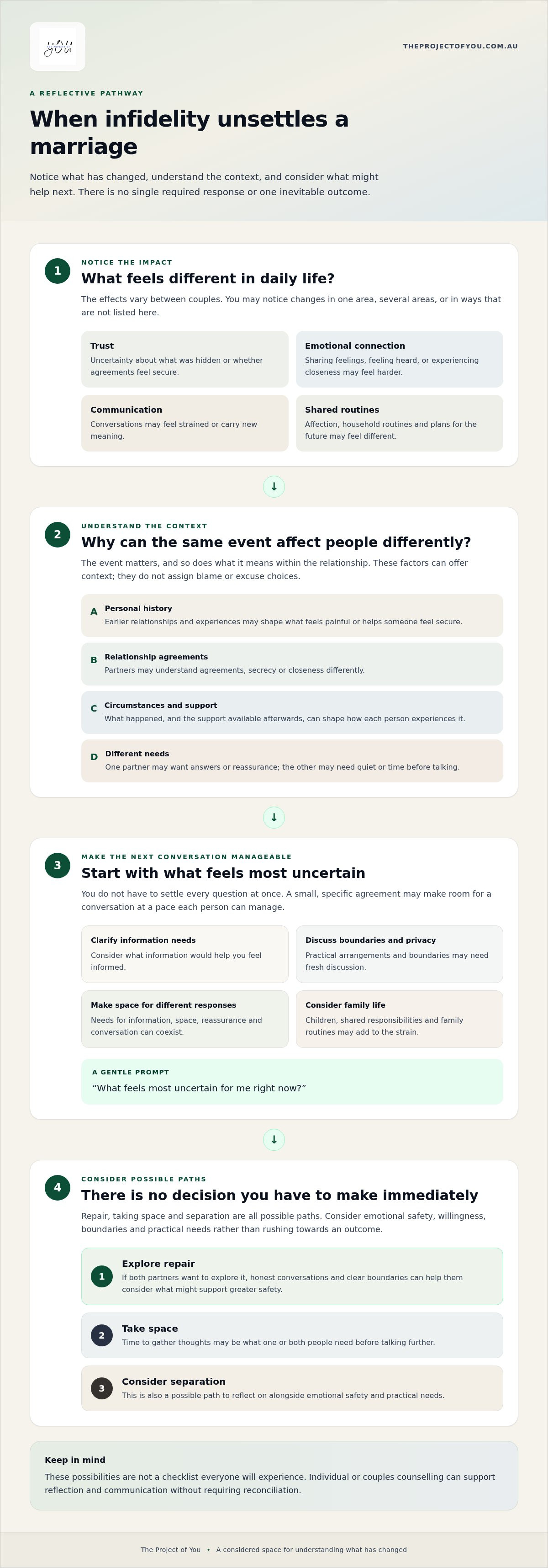
Should a couple try to repair the marriage, take space or consider separation?
There isn’t one right path after infidelity. Repair, taking space and separation are all possible choices, not measures of success or failure. The consequences of infidelity on a marriage may feel urgent, but you don’t have to make every decision at once. Start by considering what feels emotionally safe, what each person is willing to do and which practical needs require attention now.
Repair: Is there willingness to have honest conversations, take responsibility and agree on boundaries? Can both people work towards greater emotional safety?
Taking space: What would space mean in practice? How will you manage contact, parenting or household responsibilities, and when might you revisit the conversation?
Separation: What emotional and practical support would help you consider this option carefully? Which choices need attention now, and which can be approached with more time?
These questions aren’t a test you need to pass. Your answers may change as you understand more about your needs, values and wellbeing.
What might a careful repair process involve?
If both partners want to explore repair, possible areas of work include honest conversations, mutually understood boundaries and gradual attention to trust. Accountability matters. The person who broke an agreement needs to engage with its impact, while the other partner needs room to express what they need without being hurried. There’s no fixed timetable, and forgiveness isn’t mandatory or proof that the hurt has passed.
Counselling doesn’t require you to forgive, reconcile or stay together. It can offer a supported space to communicate, reflect and consider choices, including whether repair feels right. Individual or couples counselling may help clarify needs without promising a particular outcome. You can read more about couples counselling as one form of support.
When might space or separation be part of the decision?
Space may give someone room to think, but it can be confusing if its purpose and boundaries are unclear. Where possible, discuss what contact will look like, how shared responsibilities will be managed and when you’ll check in again. If separation is being considered, emotional support and practical guidance can help you approach decisions with care. This isn’t a substitute for legal advice.
Uncertainty may remain for a while. You might ask yourself, “What do I need to feel safe enough to think clearly?” and “Which choice best aligns with my values and wellbeing right now?” Support can help you explore those questions without being pushed towards one answer.
What support can help you understand the consequences of infidelity?
Understanding the consequences of infidelity on a marriage can take time, especially when feelings and questions shift from day to day. You don’t need a complete account of what happened or a decision about the relationship before seeking support. A gentle starting point is to notice what you need now, name any important boundaries, clarify what remains uncertain and consider what kind of support could help.
Notice immediate needs. What would help you get through today, such as a quieter conversation, time to rest or support from someone you trust?
Identify boundaries. Consider what feels manageable around contact, privacy and difficult conversations for now.
Clarify your questions. Write down what you need to understand without requiring yourself to resolve everything at once.
Consider support. Decide whether individual or couple counselling, or another trusted source of support, feels like a useful next step.
What can you reflect on before a counselling conversation?
You might privately note what feels most painful, what you need in the near term and what is still unclear. Include practical concerns, such as parenting or household responsibilities, if they’re weighing on you. You don’t have to arrive with a settled view about staying or separating. Reflection can be brief, private and paced according to your readiness.
How can trauma-informed couple counselling support next steps?
Trauma-informed counselling pays attention to a person’s sense of safety, choice and pace. Individual counselling can offer space to understand your own responses. Couple counselling can help structure difficult conversations and make room for each person’s experience. Neither requires forgiveness or guarantees reconciliation. The Project of You | Trauma, Couples & Relationship Therapy Australia offers individual and couple counselling with a trauma-informed approach and a focus on infidelity, attachment and communication.
Distress can sometimes make it harder to listen, find words or stay present in a conversation. Nervous system regulation, in plain terms, means noticing signs of stress and using supportive ways to settle enough to choose what to do next. It’s one possible part of support, not a single explanation for how everyone responds. For more context, read about how trauma can affect the nervous system.
You can take one small step without having every answer. If counselling feels useful, you can book a counselling session at your own pace.
Take the next step at your own pace
The consequences of infidelity on a marriage can reach into trust, communication and everyday life, but they don’t dictate a single future. Your experience is personal, and you’re allowed to take time before deciding whether to work towards repair, take space or consider separation.
A useful next step may be to notice what you need now, name the boundaries that matter and identify the questions you’d like help exploring. You don’t have to arrive with a complete decision or a plan to forgive or stay together.
At The Project of You | Trauma, Couples & Relationship Therapy Australia, individual and couple counselling can offer space to reflect on infidelity and attachment concerns. Azita Abdollahian, Clinical Social Worker and Couples Therapist, integrates trauma-informed therapy and CBT to support thoughtful conversations and informed choices, without promising a particular relationship outcome.
Whatever path you choose, you can take it one considered step at a time. You don’t have to have every answer today.
Frequently Asked Questions
What are the most common consequences of infidelity on a marriage?
Possible consequences of infidelity on a marriage include reduced trust, uncertainty, changes in emotional closeness and more difficulty communicating. Shared routines or plans may also feel different as partners work out what has changed and what they need next. These effects aren’t identical for every couple, and they don’t determine whether a marriage will continue. The meaning of the event, personal history and available support can all shape each person’s experience.
Can a marriage survive infidelity?
Some couples continue their marriage after infidelity, while others decide to separate. There’s no guaranteed outcome or single measure of whether a relationship can continue. If both people want to explore repair, honest conversations, accountability, mutually understood boundaries and attention to emotional safety may be important areas of work. You’re not required to decide immediately. Consider what each of you is willing to do and whether the relationship feels safe enough to have those conversations.
How does infidelity affect the partner who was betrayed?
The impact varies. A person may feel grief, anger, numbness or confusion, or have a strong need to understand what happened. Someone else may respond differently or experience changing emotions over time. Stress can also make sleep, concentration or everyday conversations feel harder. These experiences don’t automatically mean someone has a mental health condition. Support can offer space to understand what you’re feeling, identify boundaries and consider what would help you feel steadier.
Can infidelity affect children in a marriage?
Infidelity may affect family routines and the way parents coordinate, but it’s best not to assume what children know or how they’ll respond. Keep them out of adult conflict and avoid asking them to carry messages between parents. Focus on practical, calm communication about their care. If you’re unsure what to share or how to support your family, parenting or individual counselling can offer space to think through your circumstances without rushing a decision.
Does couples counselling mean we have to stay together?
No. Couples counselling doesn’t require you to stay together, forgive or pursue reconciliation. It can provide a structured space to communicate, understand each person’s experience and consider possible next steps, including taking space or separating. Individual counselling may also help you reflect on your own needs and choices. The purpose is not to force a particular outcome, but to support thoughtful decisions that take emotional safety and wellbeing into account.
How long does it take to rebuild trust after infidelity?
There’s no set timetable for rebuilding trust, and no guaranteed result. The time it takes can depend on what happened, whether agreements and boundaries are clear, and how consistently each person engages with the impact. Trust may be affected by small everyday moments as well as larger conversations. Rather than measuring progress against a deadline, you might ask whether communication feels more honest and whether actions are beginning to match agreed expectations.
Should I forgive my partner after infidelity?
You don’t have to forgive your partner, and forgiveness isn’t proof that the hurt has passed or that you must stay together. You can take time to understand what you feel and need without making forgiveness a condition of moving forward. Some people choose to forgive; others don’t, or aren’t sure. Consider what aligns with your values and wellbeing. Individual counselling can offer a private space to explore this at your own pace.


Comments