

Should I Stay or Go After Infidelity? Finding Clarity Without Rushing

Should you stay or leave after infidelity? If your partner has cheated, you may feel torn between the relationship you thought you had and the pain of discovering what happened. You might question whether trust can be rebuilt, whether your partner is genuinely remorseful or whether ending the relationship is the only way to move forward. Psychotherapist and relationship expert Azita Abdollahian explains that you don't have to decide the future of your relationship before you've had time to process the betrayal and understand what you need.
Deciding whether to stay or leave after infidelity is deeply personal, and there is no single answer that suits every relationship. Your emotional and physical safety come first, alongside your partner's willingness to take accountability, demonstrate consistent change and respect your boundaries. While remorse and promises may offer some reassurance, rebuilding trust requires more than words. It takes time, honesty and sustained effort.
In this guide, Azita explores how to navigate the uncertainty after infidelity, assess whether relationship repair may be possible and make decisions that align with your needs and values. You'll learn what to consider before staying or leaving, how individual counselling can help you regain clarity, and when couples counselling may support the process of rebuilding trust. The goal isn't to pressure you into saving your relationship or ending it, but to help you make an informed decision that prioritises your wellbeing and your future.
Table of Contents
Should I stay or go after infidelity? Start with safety, not pressure
How infidelity can affect trust, grief and your sense of clarity
What to look for when weighing repair against leaving after infidelity
How to make a stay-or-go decision without forcing an immediate answer
How counselling can support you after infidelity, whether you stay or go
Should I stay or go after infidelity? Start with safety, not pressure
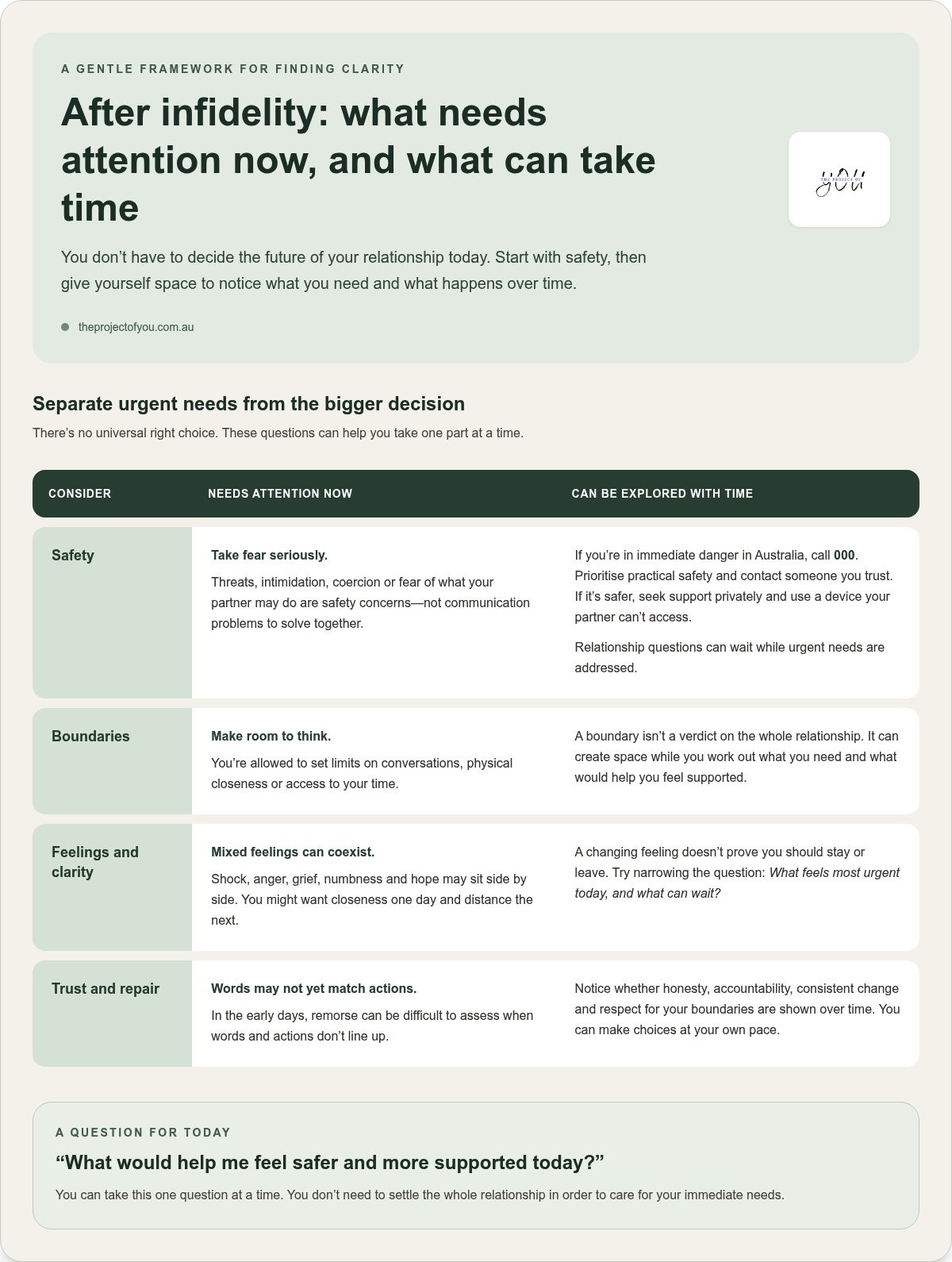
There’s no universal right choice after infidelity, and you don’t have to decide the future of your relationship today. If you’re asking, “should I stay or go after infidelity?”, begin with what’s happening now: are you safe, and do you have enough space to think? Questions about repair can wait while you attend to urgent needs.
Shock, anger, grief, numbness and hope can sit side by side. You might want closeness one day and distance the next, or feel clear in the morning and uncertain by evening. These shifts don’t prove that you should stay or leave. They may simply reflect how much you’re trying to take in. Infidelity can mean different things in different relationships. The Infidelity overview describes some of this range, but your own boundaries and relationship agreements matter too.
A steady place to begin: assess immediate safety first. When you’re ready, consider behaviour, boundaries and your own readiness. You can take these questions one at a time.
Why it can feel impossible to choose straight away
Betrayal can unsettle your sense of what is true, what the relationship means and what might happen next. You may be weighing your shared history against the hurt you feel now, while also worrying about practical changes or the possibility of separation. That’s a lot to hold at once. Difficulty thinking clearly doesn’t mean you’re incapable of making a decision.
Try narrowing the question. Rather than settling the whole relationship, ask: What feels most urgent today, and what can wait? Perhaps today’s priority is getting through a difficult conversation, resting or talking with someone you trust. Your feelings may change as you gain space and information. There’s no fixed schedule for reaching certainty or deciding what comes next.
When safety needs to come before relationship decisions
Painful betrayal and immediate danger are not the same thing. But if you’re experiencing threats, intimidation, coercion or fear of what your partner may do, treat that as a safety concern, not a communication problem to solve together. You don’t need to prove that your fear is justified before taking it seriously.
Prioritise practical safety and contact someone you trust. If you’re in immediate danger in Australia, call 000. If it’s safer, seek support privately and use a device your partner can’t access. You don’t have to share details here or confront your partner to validate your concerns.
Even without immediate danger, you’re allowed to set limits on conversations, physical closeness or access to your time while you work out what you need. A boundary isn’t a verdict on the whole relationship. It can create room to think. For now, ask yourself: What would help me feel safer and more supported today?
How infidelity can affect trust, grief and your sense of clarity
Infidelity can unsettle more than trust in a partner. It may affect emotional intimacy, shared expectations and confidence in your understanding of what happened. You might replay conversations, question details you once took for granted or wonder whether you can rely on your judgement. That uncertainty can make it harder to decide what you want from the relationship.
People’s responses vary. Some notice restlessness, trouble concentrating or disrupted sleep; others feel numb, focus on practical tasks or have no marked change in these areas. These are examples of experiences a person might have, not predictions about what betrayal will cause. They don’t establish a diagnosis or point to a particular decision. If distress is affecting your day-to-day life, a qualified professional can help you explore what support may be useful.
The same discovery may also hold different meanings for each partner. One person may be trying to understand the impact and regain a sense of honesty; the other may be processing shame, fear or the consequences of their choices. Their experiences can differ, but that doesn’t make responsibility for the betrayal equal. Understanding each person’s feelings needn’t minimise the hurt or excuse behaviour.
Distress after betrayal can be understandable without being a clinical diagnosis. No single feeling determines whether you should stay or leave.
Why your thoughts and feelings may shift from day to day
You might wake up feeling resolved, then doubt yourself after a conversation brings back affection, anger or new questions. Mixed feelings can reflect competing needs: wanting connection and truth, or seeking stability while protecting yourself from further hurt. Rather than treating one emotion as the answer, notice what it may be telling you. What do you need more of right now: space, reassurance, honest information or time to think?
What grief can mean whether you stay or leave
Grief can be for trust, the future you pictured or the ease you once felt together. It can arise even if you feel sure about leaving, and it can remain present if you choose to explore repair. Missing your partner doesn’t mean you have to return to how things were; wanting distance doesn’t erase the care or history you shared. Try meeting either feeling with curiosity rather than shame.
If making sense of these reactions feels difficult to do alone, individual counselling can offer space to explore them without directing you towards a particular relationship decision. You can find out more about individual counselling.
What to look for when weighing repair against leaving after infidelity
If you’re weighing whether to stay or leave, look beyond what your partner says they want. An apology may matter, but it can’t by itself show whether trust can be rebuilt or whether the relationship is right for you. Notice what happens in practice, including whether you can speak freely, set limits and make choices without pressure.
The points below can help you organise what you’re observing. They aren’t a test or a formula for deciding should I stay or go after infidelity. Your values, circumstances and sense of what is sustainable matter too.
Safety Repair may have room to develop when you feel physically and emotionally safe to raise concerns. If you feel afraid, intimidated or controlled, prioritise independent support rather than treating repair as the immediate goal.
Honesty Notice whether your partner responds to reasonable questions openly and consistently. Consider whether explanations change, your concerns are minimised or you’re asked to stop asking before you feel ready.
Accountability Look for responsibility-taking without shifting blame onto you or the relationship. Remorse can be part of the picture, but sustained behaviour gives you more to observe than a promise alone.
Boundaries Consider whether your limits around conversations, contact or privacy are respected. A boundary that is repeatedly dismissed may tell you something important about what continuing would feel like.
Willingness Repair requires both people to choose participation freely. One person can’t make the other stay, forgive or take part in counselling.
Meaningful repair depends on sustained responsibility and freely chosen participation. That doesn’t guarantee reconciliation, and it doesn’t obligate you to remain. You may decide that leaving is right for you even if your partner feels remorseful or hopes to rebuild. Their wish to repair and your choice about what you can live with are separate things.
Signs that a repair process may have room to develop
There may be space to explore repair if your partner is willing to answer reasonable questions without demanding that you “move on”, takes responsibility for their actions and respects your boundaries in everyday interactions. These are behaviours to notice over time, not guarantees about the future. You can consider repair without promising that you’ll stay.
Ask yourself: can I express hurt or uncertainty without being punished, rushed or made responsible for managing my partner’s feelings? Couples counselling can support conversations about repair when both people freely choose to participate.
Signs that staying may not feel safe or sustainable
Continued deception, intimidation, blame-shifting or repeated boundary violations deserve attention. They don’t amount to a diagnosis, and no checklist can determine the right decision for you. But if you feel pressured or afraid to think freely, consider speaking with someone independent whom you trust, or seek individual counselling to explore your options at your own pace.
How to make a stay-or-go decision without forcing an immediate answer
You don’t have to solve the whole future at once. A flexible process can help you separate what needs attention now from the bigger decision, while leaving room for your feelings and understanding to change. These steps aren’t a deadline or a formula. Pause, adapt or return to them as needed.
Stabilise immediate needs. Ask what would help you get through today with more steadiness: a quiet place to sleep, a trusted person to talk with, or a pause in difficult conversations. Attend to practical responsibilities too, such as childcare or work, without expecting yourself to have every answer.
Name a boundary. Choose one limit that would support your wellbeing now. It might be asking for space before discussing the relationship, agreeing on when conversations happen or requesting honesty about a particular matter. A boundary is about what you need and what you’ll do, not a way to control your partner.
Observe actions. Notice what happens after you express a need. Does your partner listen and respond respectfully, or do you feel pressured to withdraw the boundary? If useful, keep a private note of relevant observations and questions. This is for your clarity, not an invitation to monitor or investigate your partner.
Revisit the decision. When you feel ready, consider whether what you’ve observed fits with your values and what you need from a relationship. You can revisit the question without setting a fixed date for deciding or forgiving. If the picture is still unclear, that’s information too.
Questions that help bring your needs and values into focus
Consider asking yourself: What do I need to feel emotionally and practically safe at present? Which values do I want my next choice to honour, whether I stay or leave? What do I want, apart from what my partner, family or culture expects of me? You might value honesty, connection, independence or stability. There’s no need to choose the “right” value. The aim is to hear your own voice more clearly.
A small next-step plan for the coming days
Keep the next step manageable. You could tell one trusted person that you’re having a difficult time, set a boundary around relationship conversations or write down what you want to ask before speaking with your partner. If distress feels hard to carry alone, individual counselling can help you explore your needs and choices without directing you to stay or leave. Learn more about couples counselling in Australia.
Couples counselling may provide a supported space to talk if both people freely choose to take part. It shouldn’t be used to pressure either person into a particular outcome. You can also read “Choosing Couples Counselling: A Guide for Australians” as you consider what kind of support feels suitable.
How counselling can support you after infidelity, whether you stay or go
Counselling doesn’t have to be a vote on the future of your relationship. It can offer a private space to sort through what you’re feeling, name what matters to you and consider your options without being told to stay or leave. You can seek support even if you’re still unsure what you want.
After betrayal, it may be hard to separate your own wishes from fear, shame or pressure to make everyone else comfortable. A counsellor can help you slow the conversation down, notice what feels important and consider practical needs alongside emotional ones. You don’t need to arrive with a decision already made.
Individual or couples counselling: what might suit this moment?
Individual counselling may feel like a useful starting point if your partner isn’t ready to attend, or if you want space to reflect on your own before deciding whether to talk together. Sessions can help you clarify boundaries, identify support and explore what you want your next step to honour.
If both partners freely choose to participate, couples counselling can provide a structured setting to discuss communication, the impact of infidelity and whether repair is something you both want to explore. It isn’t a requirement to reconcile, and either person can have questions or uncertainty. The choice to take part should remain voluntary for both of you.
At The Project of You | Trauma, Couples & Relationship Therapy Australia, counselling for infidelity draws on CBT and trauma-informed care. In plain terms, this can mean looking at how thoughts, feelings and actions affect one another, while paying attention to emotional safety and the impact of painful experiences. The approach supports thoughtful exploration, not a guaranteed outcome.
What a supported next step can look like
A first conversation may focus on what’s bringing you in, what feels difficult right now and what you hope support could help you understand. You might explore a boundary you’re struggling to hold, how to communicate a need or what would help you feel more grounded before making a larger choice. You can raise these concerns at a pace that feels manageable.
Azita Abdollahian, Clinical Social Worker, Psychotherapist, Couples Therapist and Founder of The Project of You | Trauma, Couples & Relationship Therapy Australia, provides individual and couples counselling for infidelity and attachment concerns. Support can make room for honest reflection, whether you’re considering repair, preparing to leave or simply not ready to decide.
Read more about how to book a counselling session.
Take your next step at a pace that feels right
You may not feel certain yet, and you don’t need to turn uncertainty into a final answer. For now, let your next choice be small enough to manage: make room to think, speak with someone you trust or notice what helps you feel more grounded. The question “should I stay or go after infidelity” can remain open while you listen for what matters to you.
Clarity doesn’t have to arrive all at once. It can grow as you have space to reflect, understand your needs and consider what kind of future feels consistent with your values. Whatever you decide, you’re allowed to make that choice thoughtfully, without shame or pressure to follow someone else’s timeline.
There’s no need to have every answer before taking a first step. You can begin with the support and care you need today, and find your way forward from there.
Frequently Asked Questions
Is it normal to still love your partner after infidelity?
Yes, love can remain alongside hurt, anger or uncertainty. Your feelings may reflect years of shared life, affection and attachment, not a decision about what you must do next. For example, you might miss a familiar evening routine while also needing space from your partner. Try asking what the feeling is telling you about your needs, rather than treating love as proof that you should stay.
Can a relationship recover after infidelity?
Some couples do rebuild a relationship after infidelity, but recovery isn’t guaranteed and can’t be achieved by one person alone. It may involve agreeing on what honesty and commitment look like now, making space for difficult conversations and finding ways to reconnect that feel comfortable to both people. You can explore whether those changes are possible without promising to forgive, reconcile or remain together.
How long should I take to decide whether to stay or go?
There’s no set number of days or weeks that’s right for everyone. You might make smaller decisions first, such as whether to pause relationship discussions or spend some time apart, while you consider the larger question. If practical pressures make a decision feel urgent, focus on the immediate choice in front of you. You’re allowed to revisit your thinking as circumstances and your understanding change.
What should I do if my partner says sorry but keeps crossing my boundaries?
Pay attention to repeated behaviour, not only the apology. If it feels safe, state your boundary plainly and name what you’ll do if it’s crossed, such as ending a conversation and returning to it later. A boundary describes your own action; it can’t make another person comply. If you feel intimidated or pressured, speak privately with someone you trust before deciding how to respond.
Is staying after infidelity a sign of weakness?
No. Staying doesn’t make you weak, and leaving doesn’t mean you failed. People make different choices based on their values, circumstances and what feels possible or sustainable for them. Instead of judging yourself, consider whether your decision comes from your own wishes or mainly from fear, shame or pressure to please others. You deserve to make a choice without having to prove your strength to anyone.
Can I go to counselling alone if my partner will not attend?
Yes, you can attend counselling on your own. You don’t need your partner’s agreement to talk through your feelings, clarify what matters to you or consider practical next steps. For instance, you could use a session to prepare for a conversation, reflect on a boundary or organise thoughts that feel tangled. Individual support can be useful whether you later choose to attend together or continue independently.
What if I want to leave but feel unable to?
Feeling unable to leave can have emotional or practical roots, such as concern about housing, finances, children or how your partner may react. You don’t have to solve every barrier at once. Consider telling a trusted person what support would help, and identify one practical question to address privately. If fear, threats or control are involved, prioritise your safety and seek confidential support rather than confronting your partner alone.
Should we try couples counselling before deciding to separate?
No, couples counselling isn’t a required step before separation. It may help if both of you freely want support to communicate, understand what has happened or explore whether repair is possible. You can also use it to talk through uncertainty without agreeing in advance to stay together. If one person feels unsafe, intimidated or unable to speak openly, individual support may be a more suitable starting point.



Comments