

Can a Relationship Survive Without Intimacy? Understanding Distance and Repair

Can a relationship survive without intimacy, and what does it mean if you no longer feel close to your partner? Some relationships do continue with little or no intimacy, but staying together is not necessarily the same as feeling connected, loved or fulfilled. If physical affection, emotional closeness or sexual connection has faded, you may find yourself feeling lonely, rejected or uncertain about the future of your relationship. A lack of intimacy doesn't automatically mean love has disappeared, but it can be a sign that something important needs attention.
Intimacy looks different for every couple. It can include emotional openness, everyday affection, physical touch and sexual connection, and these aspects of closeness don't always change at the same pace. Stress, unresolved conflict, parenting responsibilities, life transitions and feeling emotionally disconnected can all affect intimacy. When partners have different needs or expectations, pressure, blame and avoidance can make it even harder to understand what has changed.
In this guide, psychotherapist and relationship expert Azita Abdollahian explores why intimacy can fade, how it affects a relationship and what you can do when you and your partner want different levels of closeness. You'll learn how to communicate your needs, understand each other's boundaries and consider whether rebuilding intimacy, redefining your relationship or choosing a different path is right for you. Couples counselling can help you navigate these conversations with greater understanding, without assuming that every relationship must follow the same path.
Table of Contents
Can a relationship survive without intimacy? Start with what intimacy means
Why can intimacy fade, even when partners still care about each other?
When can a relationship without intimacy still feel workable?
How can you talk about missing intimacy without creating more distance?
How can counselling help when intimacy has become difficult?
Can a relationship survive without intimacy? Start with what intimacy means
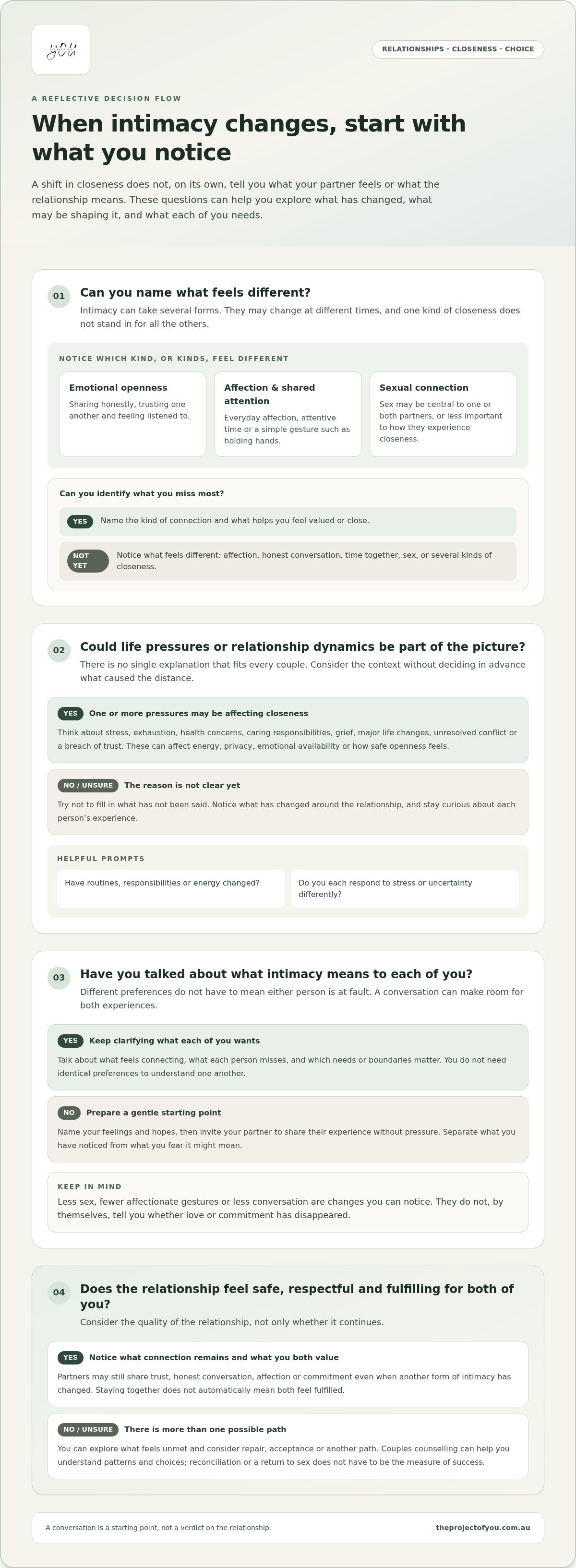
Yes, some relationships continue with little or no intimacy, but staying together does not necessarily mean both partners feel fulfilled. Before deciding what a change means, it can help to clarify what intimacy means to each of you. Partners may share a home, responsibilities and commitment while experiencing very different levels of emotional closeness, affection or sexual connection.
Intimacy is the sense of being close to and known by another person. It might involve speaking honestly, showing affection, trusting each other, giving one another attentive time or connecting sexually. These forms of closeness can overlap, but they are not interchangeable. Every person and couple places different importance on each one.
What counts as intimacy in a relationship?
Emotional openness might mean telling your partner you are worried about a family member and feeling listened to, rather than receiving advice straight away. Affection could be holding hands across the table. Shared attention might mean putting phones aside to talk. Sexual connection may be central to one or both partners, or less important to how they experience closeness.
For example, one partner might have little interest in physical affection at present, while both still share private thoughts and feel understood. Physical closeness has changed, but other forms of intimacy may remain. The Intimate relationship overview also describes closeness as emotional and physical, rather than only sexual.
Does less intimacy always mean less love?
No single change in intimacy can tell you exactly what your partner feels. Less sex, fewer affectionate gestures or less conversation are changes you can notice. “They don’t love me” or “they’re no longer attracted to me” are interpretations that may or may not be accurate. Keeping the difference in mind can be useful when hurt or uncertainty makes it easy to fill in what has not been said.
You also do not have to dismiss your own experience. Feeling rejected or lonely is real, even if you do not yet know what the change means. Your partner may care about you and still not understand how the distance affects you. Curiosity can make room for both experiences without deciding in advance who is at fault.
To begin making sense of the change, consider asking yourself:
What feels different: affection, honest conversation, time together, sex or several kinds of closeness?
What do I miss most, and what helps me feel valued or connected?
Have we talked about what intimacy means to each of us, or are we relying on assumptions?
You do not need identical preferences to understand one another. Naming what has changed and what each person values can help you distinguish a difference in needs from a conclusion about love or commitment. It is a starting point for conversation, not a verdict on the relationship.
Why can intimacy fade, even when partners still care about each other?
Intimacy can change for reasons that have little to do with how much partners care. Exhaustion, health concerns, caring responsibilities, grief and major life changes can affect someone’s energy, privacy or ability to be emotionally present. These pressures can overlap, and each partner may experience them differently. One person might want conversation after a difficult day, while the other needs quiet to recover.
There is no single explanation that fits every couple. Asking whether a relationship can survive without intimacy does not have one universal answer, and identifying the context is more helpful than jumping to conclusions. A general overview of the Impact of a Lack of Intimacy also explores how life circumstances and relationship dynamics may contribute to distance. Each couple’s experience is their own.
How do stress, grief and life changes affect closeness?
Imagine parents managing school drop-offs, work and a child who has been unwell. They may still care deeply for each other, yet have little time or energy for unhurried conversation or affection. Illness, a new caring role, bereavement or a move can also change routines and emotional availability. A shift during a demanding period does not, by itself, prove that a relationship is failing.
Notice what has changed around the relationship without treating circumstances as the whole explanation. Are you both tired, grieving or adjusting to new responsibilities? Do you have different ways of coping? These questions can help you discuss what support or connection might feel manageable now.
How can attachment, conflict or past hurt shape intimacy?
People learn different ways of seeking or protecting closeness. One person might reach for reassurance when uncertain, while another withdraws to avoid feeling overwhelmed. These responses can be shaped by personal experiences. They are not fixed labels or proof that either partner is at fault. Noticing them can be a useful starting point, but they cannot explain every relationship or tell you what a partner feels.
Repeated conflict, a breach of trust or past experiences of harm may also make openness feel less safe. Someone might stay quiet to avoid another argument, while someone else seeks answers urgently because uncertainty feels difficult to bear. Shame can add another layer, especially if a person worries they will be judged for what they want or do not want. A trauma-informed understanding recognises that people may respond to vulnerability by moving closer, pulling back or becoming guarded. This is not a diagnosis, and it does not excuse harmful behaviour.
When a pattern feels hard to shift, support can help you explore what is happening without assigning blame. Understanding nervous system regulation can also help you reflect on how stress responses influence connection. If you would like a supported space to explore relationship patterns and needs, you can book a counselling session. The aim is greater understanding, not pressure to feel close in a particular way.
When can a relationship without intimacy still feel workable?
A relationship with little or no physical or sexual intimacy may feel workable when both partners understand what that means for them and can speak honestly about it. There is no universal level of affection or frequency of sex that every couple should meet. The more useful question is whether the arrangement feels safe, respectful and acceptable to both people, rather than quietly painful for one.
One couple might value companionship and shared routines while neither wants sex. Another might have different desires but agree on boundaries and ways to stay connected that feel comfortable for both. These arrangements are not automatically a problem. Strain can grow when expectations remain unspoken, one person feels they must comply or a partner’s longing is repeatedly dismissed.
How can partners understand whether their needs are compatible?
Each person can reflect on what closeness means to them, what they genuinely want and what they do not want. Then consider whether you can share those answers without being ridiculed, punished or pressured. Compatibility does not require identical preferences, but it does require space for honest differences and respect for each person’s boundaries.
Try asking yourself: “What kinds of closeness feel good to me?” “What am I hoping might change?” “Can I accept our relationship as it is now, or am I waiting for my partner to become someone else?” The answers may take time. They can help you see whether a low-intimacy relationship is a mutual choice or a difficult compromise that needs attention.
What if one partner wants intimacy and the other does not?
Wanting more affection, sex or emotional closeness does not make someone demanding or shallow. Wanting less, or not wanting a particular kind of contact, does not make someone uncaring or defective. Both the longing and the boundary deserve to be heard. Neither partner owes sex or physical affection to preserve the relationship. Consent needs to be freely given, and either person can say no.
A difference in desire can bring grief, frustration or fear of rejection. Those feelings matter, but they do not justify pressure, repeated demands, threats or unwanted touch. If you notice yourself agreeing because you are afraid of your partner’s reaction, take that seriously. You deserve support to think through your choices and safety. If there is immediate danger, contact emergency services.
Where it feels safe, you might agree to talk without trying to settle everything at once. Each person can describe what they feel and need while the other listens without arguing them out of their experience. If conversations repeatedly become coercive, frightening or too difficult to manage alone, individual professional support may be a safer starting point than negotiating as a couple. Couples counselling can help explore differences when both people can participate freely and safely.
If you want support to understand your needs, boundaries and choices, individual and couples counselling is available. The purpose is not to secure a particular outcome, but to help you consider what feels respectful and sustainable for you.
How can you talk about missing intimacy without creating more distance?
Talking about intimacy can feel exposing, especially if you are worried that honesty will lead to conflict, rejection or pressure. A useful conversation begins with understanding, not a demand. The aim is not to persuade your partner to want what you want. It is to make room for both experiences and learn what each of you may be open to.
Choose a time when neither of you is rushing, exhausted or already in an argument. You could ask, “Would you be open to talking about how connected we have been feeling?” This gives your partner a chance to agree and helps set a calmer tone. If now is not a good time, see if you can agree on another time to return to the conversation.
What can you say when you miss feeling close?
Use language that describes your experience rather than assigning motives. For example: “I’ve been missing the closeness we used to share, and I’d like to understand how it feels for you.” Then ask, “What kinds of connection feel comfortable and meaningful to you at the moment?” Listen for concerns or boundaries without immediately debating, defending yourself or trying to fix everything.
A simple structure can help you stay curious and clear:
Share your experience. Try, “I feel lonely when we rarely have time to talk, and I miss feeling like a team.”
Name what you hope for. For example, “I’d like us to understand what closeness could look like for both of us.”
Invite their perspective. Ask what they have noticed and what feels important to them, then listen without interrupting.
Agree on a next step, or pause. You do not need to settle the future of the relationship in one conversation.
If either person becomes overwhelmed, defensive or unable to listen, take a break rather than forcing the discussion to continue. You might say, “I want to understand you, but I’m getting flooded. Can we pause and come back to this after dinner?” A pause works best when you agree to return to the conversation, rather than leaving one partner unsure whether it has ended for good.
How can couples rebuild connection without pressure?
If you both want to explore more closeness, start small and make sure each step is freely chosen. That might mean sharing a cup of tea without phones, having a brief check-in at the end of the day or agreeing that a hug is welcome only when both want one. Check in about how it feels, and adjust if either person’s comfort changes.
There is no required target or deadline. It can help to focus first on whether you can talk openly, respect boundaries and make choices together. If the conversation keeps getting stuck, couples counselling can offer a structured space to explore communication and differing needs. These steps are a starting point, not a promise that intimacy will return.
How can counselling help when intimacy has become difficult?
When conversations about intimacy keep ending in silence, conflict or misunderstanding, counselling can provide a steady space to slow things down. Rather than deciding who is at fault, you can explore the patterns that arise when one person reaches for closeness and the other feels unsure, overwhelmed or has different needs. The aim is greater understanding and informed choices, not a guaranteed return to sex or a promise that the relationship will continue.
Counselling will not give every couple the same answer about whether to stay together. It can help you explore what connection means to each of you, which boundaries matter and whether the relationship feels workable for both. Sometimes this means considering repair; sometimes it means gaining clarity about a different path.
What happens when couples explore intimacy in counselling?
In couple counselling, each partner can describe their experience, hopes and limits without turning the conversation into a contest over whose needs are more valid. A therapist may help you notice how you respond in difficult moments, practise listening and put words to concerns that have felt hard to raise. This is not about requiring either person to agree to touch or sex.
Trauma-informed care pays attention to emotional safety and each person’s pace. If a topic feels too exposing, you can slow down and work out what would make the discussion more manageable. This can be especially important when past hurt or fear affects how safe it feels to be open. The couples counselling support offered by The Project of You | Trauma, Couples & Relationship Therapy Australia can help partners explore relationship patterns and differing needs while respecting each person’s agency.
When might individual support be a useful first step?
You do not have to wait for your partner to be ready before seeking space to reflect. Individual counselling may help you understand what you feel, what you need and how past experiences shape your boundaries or hopes for the relationship. That is not the same as taking responsibility for fixing the relationship alone. It is a way to hear yourself more clearly and consider your choices at your own pace.
Before a session, you might note what you hope to understand, what feels difficult to say and what would help you feel safe enough to talk. You do not need to arrive with a decision made. Azita Abdollahian, Clinical Social Worker, Psychotherapist and Couples Therapist, offers individual and couple counselling through The Project of You | Trauma, Couples & Relationship Therapy Australia, with trauma-informed support for relationship concerns.
A calm space to explore what is happening and what you want to do next can help you consider your options at your own pace.
Take the next step at your own pace
You do not have to decide everything today. A helpful first step may be noticing what you need to feel respected and emotionally safe, then choosing one honest conversation or moment of reflection. Ask yourself: what would I want to understand better, even if the answer is not the one I am hoping for?
If this question still feels difficult to hold alone, support can give you space to explore it without pressure to reach a particular outcome. Counselling can help you consider what matters to you and which choices feel consistent with your values, whether you attend alone or with your partner.
You are allowed to move carefully. A clearer sense of what you need can be a meaningful beginning, whatever direction you choose from here. Book an individual or couple counselling session to explore your next step.
Frequently Asked Questions
Can a relationship survive without sex?
Yes, some couples continue their relationship without sex, but whether it feels sustainable depends on how both people experience that arrangement. Consider whether you and your partner can discuss what you each want without pressure or shame. One couple may feel content with companionship, while another may experience ongoing sadness about an unmet need. Consent and wellbeing matter more than meeting an outside standard.
Is it normal for intimacy to change in a long-term relationship?
Intimacy can change over time, but there is no single pattern that defines what is normal for every couple. A shift might feel welcome to both partners, or it might leave one feeling confused or distressed. Rather than comparing your relationship with others, notice what has changed for you. Perhaps affection feels different, or conversations have become less open. Your feelings deserve attention, even when change is common.
Can a relationship work if partners want different amounts of intimacy?
It can, if both people can talk honestly about the difference and make choices that respect their boundaries. Compatibility does not require matching levels of desire. It does involve understanding what each person hopes for and whether the relationship, as it is, feels acceptable. Partners might agree on forms of closeness that suit them both. If one person is silently waiting for the other to change, that deserves an honest conversation.
What happens if one partner does not want physical intimacy?
A lack of interest in physical intimacy does not, by itself, explain what someone feels about their partner. They may be unsure, uncomfortable, tired or simply not want contact. Ask gently whether they would like to talk about what has been happening, and accept “no” if they do not want touch or discussion at that moment. Do not treat affection as something owed. If the change is distressing, you can explore your own feelings and what support might help.
How do I talk to my partner about feeling unwanted?
Choose a calm moment and try: “I’ve been feeling unwanted lately, and I’d like to understand how we’re both experiencing closeness.” This shares your feeling without claiming to know your partner’s motives. Then give them time to respond. You might ask, “What has this been like for you?” Listen before explaining or correcting. If the conversation gets heated, suggest pausing and agree on when you will return to it.
Can couples counselling help when intimacy has faded?
Couples counselling can help partners understand how they communicate, what each person needs and where they feel stuck. For example, a therapist may help slow down a conversation that quickly turns defensive, so each person has space to speak and be heard. Counselling cannot guarantee that sex will return or that you will stay together. It can support clearer understanding and help you consider your options with care.
Should we stay together if we have no intimacy?
There is no one answer that fits every couple. Consider whether you feel safe and respected, whether your needs can be discussed honestly and whether your shared hopes still feel meaningful. You might ask yourself: “If nothing changed for now, how would I feel about continuing?” and “What would need to be different for this relationship to feel acceptable?” These questions can help you find your own direction without rushing a decision.



Comments