

Breaking Generational Trauma Cycles: A Compassionate, Practical Guide

What is generational trauma, and how can you break painful family patterns without blaming your parents or repeating the past? You might notice yourself reacting in ways you promised you never would, struggling to regulate your emotions during conflict, or repeating relationship patterns that feel strangely familiar. These experiences can be difficult to understand, but they don't mean you're destined to pass the same pain on to the next generation.
Generational trauma can influence how we respond to stress, navigate relationships, express emotions and experience emotional safety. Through early relationships and learned family behaviours, we may carry patterns into adulthood without fully realising it. Breaking generational trauma cycles starts with understanding these patterns, recognising their impact and learning new ways to respond.
In this guide, psychotherapist and trauma specialist Azita Abdollahian explores how generational trauma develops, how childhood experiences can shape adult relationships, and practical ways to regulate your nervous system, build emotional awareness and repair disconnection. You'll learn how to create healthier relationship patterns, strengthen emotional safety and move towards a different future for yourself and your family — without expecting yourself to be perfect.
Table of Contents
What does breaking generational trauma cycles mean in everyday family life?
How can trauma-related patterns carry from one generation to another?
What gets in the way of breaking generational trauma cycles?
What practical steps can help you respond differently and repair?
When can counselling support breaking generational trauma cycles?
What does breaking generational trauma cycles mean in everyday family life?
Breaking generational trauma cycles means noticing a response or relationship pattern that keeps recurring, then gradually practising other ways of responding. A cycle might involve withdrawing during conflict, expecting others to guess what you need, or feeling responsible for everyone’s wellbeing. It’s a learned or repeated response, not a diagnosis or a fixed family destiny.
Patterns can be passed on through ordinary interactions: what people model, what gets left unsaid and what family members come to expect from one another. If disagreement at home was often met with silence, for example, you might find yourself going quiet when a partner raises a concern. That response may once have helped you avoid tension. Noticing it now gives you a chance to ask whether it still supports the kind of relationship you want.
Transgenerational trauma is a term used to discuss how the effects of trauma may shape later generations. In everyday life, however, noticing a behaviour doesn’t prove where it began or mean trauma is the only explanation. Family relationships are complex. Curiosity can help you understand a pattern without turning it into a reason to assign blame.
How can a family pattern show up in ordinary moments?
It might look like anger arriving quickly when a child refuses to get ready, even though the deeper feeling is worry or overwhelm. After an argument, one person might stop speaking while another keeps asking for reassurance. Or you might agree to help a relative when you’re already stretched, then feel resentful because saying no seems unsafe or unkind.
A familiar reaction can happen before you’ve had time to think. That doesn’t make it inevitable, and one difficult moment doesn’t establish a lasting pattern. Look for repetition and impact instead. Does the response regularly make it harder to communicate, feel close or maintain a boundary? Noticing when it happens, and what tends to come before it, can make the pattern easier to understand.
Does recognising a pattern mean you are destined to repeat it?
No. Family history can influence what feels familiar, especially when you’re tired, stressed or in conflict, but it doesn’t determine every choice you’ll make. Awareness can create a small pause between an old impulse and what you decide to do next. Change might mean speaking more openly, setting a respectful limit or returning to a conversation after you’ve had time to settle.
If you’re concerned about how you’ve responded as a parent, partner, adult child or caregiver, that concern deserves care, not a verdict. It doesn’t mean you’ve already caused lasting harm. You might ask yourself: what would I like to feel different in my relationships, and what is one response I’d like to practise? You don’t need to disclose your family history or reach a final explanation before reflecting. Breaking generational trauma cycles can start with noticing what happens and, when possible, choosing a response that better fits the connection you value.
How can trauma-related patterns carry from one generation to another?
Trauma-related patterns may carry forward through what family members observe, experience repeatedly and come to expect in relationships. A child might learn that disagreement can be handled calmly, or that it feels safer to stay quiet. These lessons aren’t always spoken aloud. They can take shape through everyday responses, family rules and the emotional atmosphere at home.
Stress can also affect how quickly someone reacts. Under pressure, a person might become tense, go blank, pull away or try to keep everyone happy. These responses can have many explanations. On their own, they don’t prove someone has experienced trauma. Treating them as a prompt for curiosity, rather than proof of a diagnosis or family history, helps keep the conversation open and non-blaming.
What can children learn from repeated family interactions?
Children build expectations by watching how important adults relate to each other and to them. If a disagreement is followed by listening and a return to warmth, a child may see that people can differ and still reconnect. If disagreements are regularly met with ridicule or prolonged tension, a child may instead come to expect conflict to threaten closeness. These are possibilities, not fixed outcomes. One difficult exchange or parenting choice does not define a child’s future.
Repeated interactions can shape what feels familiar around trust, emotional expression and boundaries. A young person who often sees feelings dismissed might find it hard to name their own needs later, while another might learn to take responsibility for keeping the peace. Family circumstances, culture, community and support also matter. No single explanation accounts for every person.
What do we know about biological explanations?
Researchers are exploring whether severe stress may be associated with biological changes that influence how genes are regulated. Epigenetics is the study of processes that can affect gene activity without changing the DNA sequence itself. A 2025 study involving Syrian refugees examined possible biological markers associated with trauma across generations. This is an evolving field. Such findings don’t show that trauma, memories or a particular response are passed down through genes in a simple, predictable way.
Human studies are complex, and it can be difficult to separate biological influences from upbringing, shared environments and other factors. The APA perspective on trauma’s legacy discusses the effects of historical and cultural trauma alongside ongoing research. This work raises questions for further study; it doesn’t provide a certain explanation for any one person’s behaviour.
Family experiences can influence what feels safe or expected; that influence is not proof of a genetically inherited response. This distinction matters when breaking generational trauma cycles because it leaves room to understand family context without assuming the past dictates what happens next. If exploring these patterns feels difficult to do alone, individual or parenting counselling can offer a supported space to reflect at your own pace.
What gets in the way of breaking generational trauma cycles?
One common misconception is that breaking a cycle means becoming a perfect parent, partner or family member. It doesn’t. People can understand their patterns and still fall back on familiar responses, particularly when tired, stressed or caught off guard. The aim isn’t to never make a mistake. It’s to grow your ability to notice what’s happening, take responsibility where you can and choose a response that better reflects your values.
This work can bring up complicated feelings. You might feel shame about how you acted with someone you love, grief for what you needed and didn’t receive, or loyalty to relatives who did the best they could with what they knew. You might worry that naming a pattern means criticising your family or starting a conflict you don’t feel ready to have. These feelings make sense. They aren’t evidence that you’re failing or that change is impossible.
Why can familiar reactions feel hard to change?
Under pressure, attention can narrow and familiar reactions may arrive quickly. You might withdraw from a conversation because you expect it to escalate, or respond sharply when several demands land at once. Afterwards, you may wish you’d handled it differently. This gap between intention and reaction can feel discouraging, but it’s a reason to meet yourself with curiosity, not a label or diagnosis.
Change can also be difficult if family rules discouraged talking about feelings. Perhaps sadness was brushed aside, disagreement was treated as disrespect or keeping the peace mattered more than expressing a need. If those expectations feel deeply familiar, even noticing them may bring discomfort. You don’t have to bring your whole family history into view at once. It may be enough to ask what feels hard to say, or what you fear might happen if you respond differently.
Can you change a pattern without blaming or confronting your family?
Yes. You can make choices about your own behaviour without deciding that a relative is wholly at fault or assuming you know their intentions. Understanding why a pattern developed may offer context, but it doesn’t require you to excuse hurtful behaviour or make a public accusation.
Taking responsibility for your next response is about your choices; blame is about assigning fault. That distinction leaves room for both compassion and accountability. A boundary can be a choice about what you’ll take part in, rather than a punishment. For example, you might say, “I want to keep talking, but I’m going to pause this conversation if we start shouting.” You can also choose not to discuss a painful subject with a relative or to take time before replying to a message.
If you want a wider view of what care may involve, this guide to trauma-informed support explores supported care in more depth. You can move at a pace that respects your circumstances. Breaking generational trauma cycles doesn’t ask you to rewrite your family’s story or confront anyone before you’re ready. It begins with the choices available to you now.
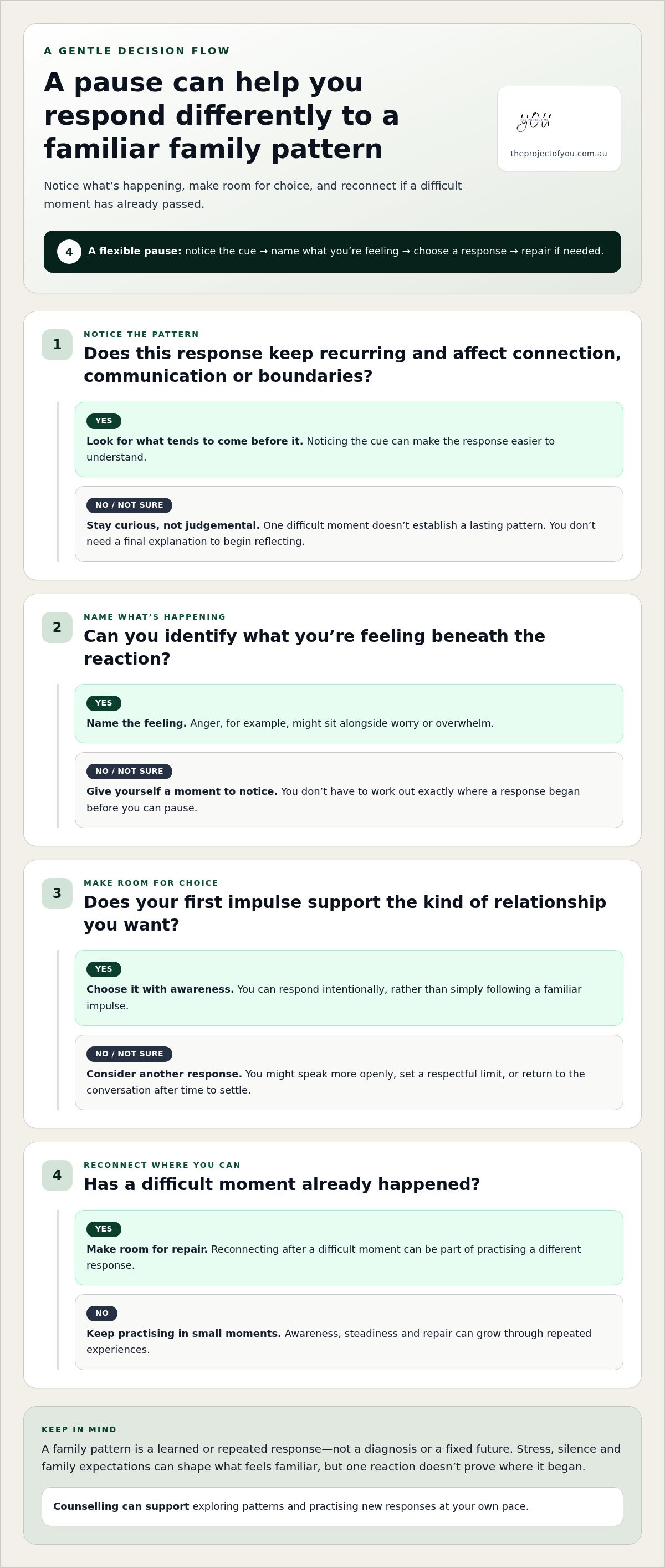
What practical steps can help you respond differently and repair?
Changing a familiar response doesn’t mean you’ll always catch it before it happens. It means building a little more room to notice, choose and reconnect where possible. A flexible sequence can help: notice the cue, pause, name the feeling, choose a response, then repair if needed. Treat it as a guide, not a test you have to pass.
Imagine a family conversation about weekend plans. A relative dismisses your suggestion, and you feel your jaw tighten as you prepare a cutting reply. You might notice the cue, recognise irritation or hurt, and take a moment before deciding whether to ask a question, state what matters to you or step away. The right next move depends on the situation and what feels safe.
How can you pause when an old reaction is taking over?
Start by noticing what’s happening in your body: perhaps your shoulders rise, your hands clench or your thoughts speed up. If it feels useful, quietly name the emotion without criticising yourself: “I’m frustrated,” or “I’m feeling overwhelmed.” Naming what’s present can help you consider what to do next rather than reacting automatically.
A pause might mean taking a sip of water, looking around the room or asking to return to the conversation later. Some people find a slower breath or feeling their feet on the floor grounding; others don’t. You don’t need to force calm. If focusing on your breath or body feels uncomfortable, choose another kind of pause. For more context, read about nervous-system responses to trauma.
What does repair look like after a difficult interaction?
Repair begins with recognising the impact of what happened, listening to the other person and taking responsibility for your part. It doesn’t require you to condemn yourself or explain away the behaviour. If the other person isn’t ready to talk, you can acknowledge the impact and allow them space. Repair is an invitation to reconnect, not a demand for immediate forgiveness.
After the weekend-planning exchange, you might reflect on what made the comment feel so charged while staying curious about how it landed for the other person. A brief, specific apology could sound like: “I snapped at you when we were discussing the plans. That may have hurt, and I’m sorry. I’d like to listen to how it felt for you.” Then listen rather than rushing to defend your intention. This models accountability without asking anyone to be perfect.
As you practise breaking generational trauma cycles, remember that a difficult moment can become an opportunity to notice, learn and try again. Practice may feel uneven. What matters is approaching each moment with honesty and care, not demanding flawless responses from yourself.
When can counselling support breaking generational trauma cycles?
Counselling may be helpful when familiar family or relationship patterns cause distress, feel difficult to shift alone or keep getting in the way of the connections you want. It can offer a thoughtful space to explore what happens in the present, consider how personal and family experiences may inform it, and practise responses that feel more aligned with your values. You don’t need to be certain that trauma explains a pattern before seeking support.
Support is collaborative, not a process of being told what your family means or what you must do next. You and your counsellor can decide together what feels useful to explore and at what pace. Individual counselling may suit someone wanting to understand their own reactions. Parenting counselling may help a parent reflect on moments with their child and consider different ways to respond. Counselling is one possible support, not a requirement for everyone.
What might trauma-informed counselling help you explore?
You might look at what tends to happen before a difficult reaction, what feelings or needs are present, and what you’d prefer to do next time. A counsellor can help you consider these responses alongside your personal and family context without assuming a single cause or assigning blame. Reflection may support greater awareness, self-compassion and clearer boundaries in everyday relationships.
The process is individual. You don’t have to share everything at once, revisit painful memories before you feel ready or arrive with a complete account of your family history. You can begin with a current concern, such as feeling overwhelmed during conflict or finding it hard to say no. For a related reflection, read about support for self-compassion after childhood trauma.
How can you take a supported next step?
Before a first conversation, you might privately consider what you hope to understand or change. Perhaps you want to pause before reacting, feel steadier in a particular relationship or respond to your child with more patience when the day has been demanding. You don’t need polished answers. A question or a recent example is enough to begin exploring what matters to you.
Azita Abdollahian, a qualified social worker and psychotherapist, offers trauma-informed individual, couples and parenting counselling through The Project of You. Counselling can make room for curiosity about your experiences and help you consider new responses, without promising a particular outcome. Starting can be one conversation, and you can take the next step at a pace that feels right for you.
Choose one small step towards a different way forward
You don’t have to understand every part of your family’s past before you begin changing what happens next. You might start by noticing one moment when you want to respond differently, or by considering what safety and connection would look like in a relationship that matters to you. Let that intention guide you gently, rather than turning it into another standard you have to meet perfectly.
Breaking generational trauma cycles isn’t a demand to carry everything alone or make peace with every part of your history. It can be a gradual process of finding more choice in how you relate to yourself and others. Some days may feel easier than others. A setback doesn’t erase the care and attention you bring to the next moment.
If you’d like a supportive space to explore what you want to change, The Project of You offers individual and parenting counselling. You’re welcome to take that step when it feels right.
Book a counselling session There is room to move at your own pace, with curiosity about the past and care for the relationships you’re building now.
Frequently Asked Questions
Is generational trauma a formal diagnosis?
No. “Generational trauma” isn’t a formal diagnosis that can be made from a family story or a recurring behaviour alone. If you’re worried about your wellbeing, a qualified professional can ask about what you’re experiencing, how long it’s been happening and how it affects daily life. That fuller picture helps guide an assessment and consider other possible explanations, rather than relying on a label that may not fit.
Can trauma be passed down through genes?
There’s no established way to predict that a descendant will inherit a specific trauma response through genes. Researchers are investigating possible biological associations, but these findings don’t mean a family’s genetic information can explain an individual’s feelings or forecast their future. For now, it’s more useful to consider a person’s whole context, including relationships, life experiences and current circumstances, rather than treating genetic transmission as a settled explanation.
Do I need to know my family history to change a pattern?
No. If you’re unsure what to make of a reaction, try recording a few details after it happens: what was going on, what you noticed in yourself and what you needed at the time. Over several situations, you may see a theme worth exploring. Keep the notes private and share only what feels useful. You can reflect on your own experiences without investigating relatives or filling in gaps in your family story.
Can I break a family pattern without confronting my parents?
Yes. You can make a change without asking your parents to agree with your understanding of the past. Before a difficult interaction, consider what you’re comfortable discussing and how you’d like to end the conversation if it becomes too much. You can keep your decision simple and private. If you’re weighing different forms of contact or distance, talking through the options with a counsellor may help you clarify what feels manageable.
What if I repeat a pattern I wanted to change with my child?
A difficult moment doesn’t mean you’ve failed as a parent. Once things are calmer, reconnect in a way your child can understand, and let them share how it felt without asking them to comfort you. Avoid promises that you’ll never make a mistake; instead, show through your actions that you’re taking the moment seriously. Parenting counselling can help you explore situations that tend to feel particularly challenging and consider responses to practise.
How long does it take to change generational patterns?
There’s no reliable timetable for changing a family pattern. Instead of expecting a steady upward line, you might notice progress in small signs: recognising a familiar reaction sooner, being able to reflect afterwards or knowing what support you need. These aren’t guarantees that every interaction will go smoothly. If the process feels overwhelming or is affecting daily life, a counsellor can help you review what’s happening and consider a manageable next step.



Comments