.png)

Relationship Workshop Australia: A Compassionate Guide to Choosing the Right Experience

What can a relationship workshop do to help couples communicate more effectively, navigate conflict and rebuild emotional connection? If you and your partner keep having the same arguments or struggle to understand each other, a guided relationship workshop can provide an opportunity to step back from familiar patterns and learn new ways of relating. Choosing the right relationship workshop in Australia means finding an experience that suits your needs, whether you want practical communication tools, deeper relationship work or dedicated time to reconnect.
At The Project Of You, psychotherapist, Clinical Social Worker, relationship expert and couples counsellor Azita Abdollahian facilitates relationship-focused retreats designed to help couples better understand their dynamics, explore recurring conflict and develop practical skills for healthier communication. The Project Of You retreats combine professionally facilitated workshops with dedicated time away from everyday pressures, creating space to focus on your relationship in a supportive environment. Depending on your circumstances, a group couples retreat may also allow you to learn from other couples, gain fresh perspectives and recognise patterns you may not have noticed on your own.
Relationship workshops and retreats are not the same as ongoing couples counselling, and no workshop can guarantee reconciliation or resolve every relationship difficulty. The right experience depends on the challenges you are facing, the level of support you need and whether you and your partner feel ready to participate. In this guide, we explore what relationship workshops can offer, how they differ from couples counselling and intensive retreats, and what to consider when choosing a relationship workshop in Australia. You’ll also learn how The Project Of You retreats may help you and your partner create time for meaningful conversations, develop new relationship skills and take a more intentional approach to your future together.
Table of Contents
What is a relationship workshop, and who might find one useful?
A relationship workshop is a guided learning experience that helps people reflect on how they relate, communicate and respond to one another. In a group setting, the focus is generally on shared learning and common themes, rather than individual clinical care for each couple. This is one form of relationship education, offering ideas that participants can consider and practise beyond the session.
You don’t need to be in crisis to explore one. Perhaps you care deeply about each other but find everyday conversations slipping into familiar loops. Or maybe life is changing, and you’d like to make space for connection before distance grows. Wanting to understand one another better is reason enough to be curious.
What happens in a relationship workshop?
Workshops commonly make space for reflection, communication skills and noticing recurring relationship patterns. The activities and amount of personal sharing depend on the format, so consider whether the experience matches your comfort level. A workshop isn’t a guaranteed fix. If a concern needs sustained, personalised attention, counselling may be a more suitable form of support.
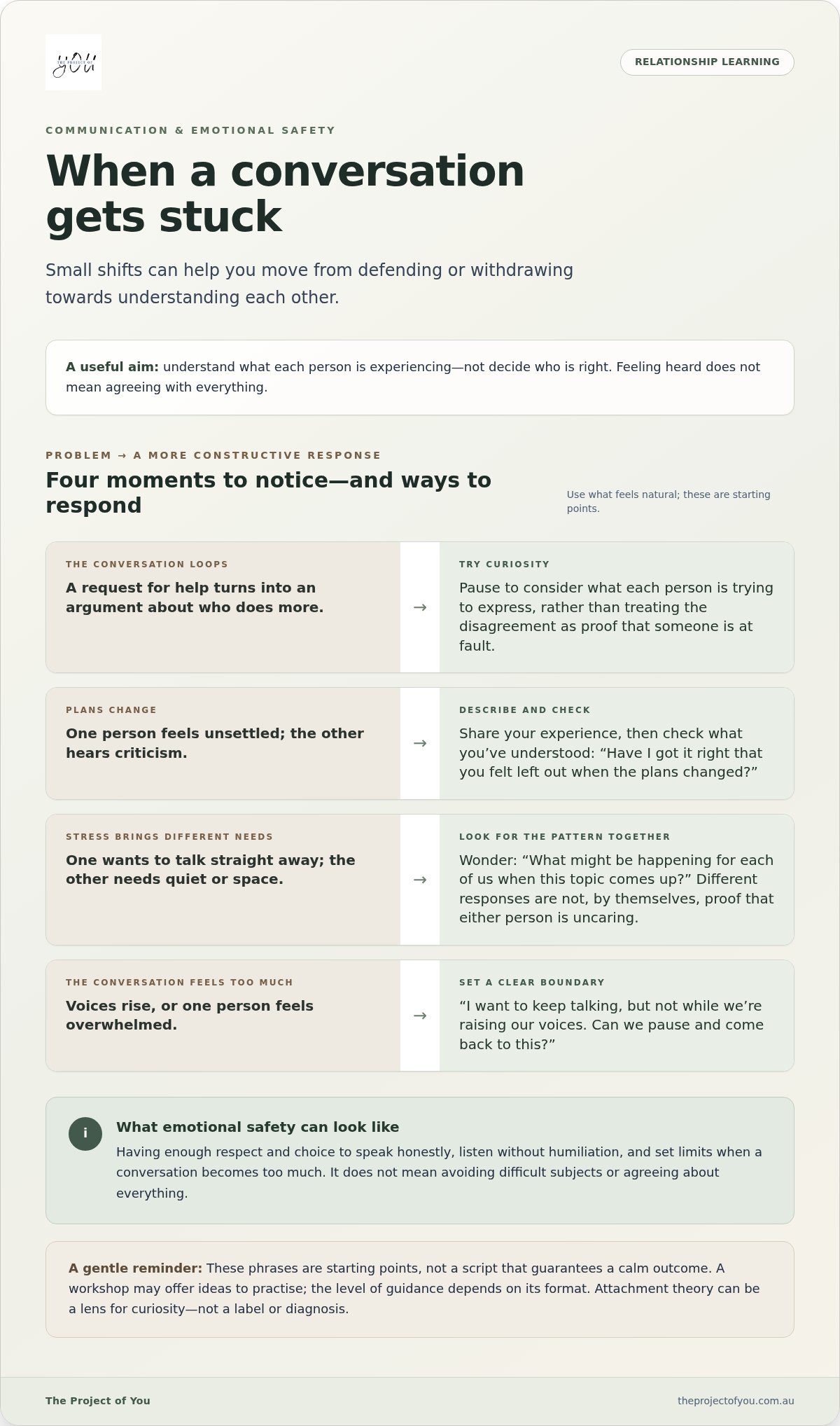
Consider a disagreement about household tasks. One partner asks for help, the other hears criticism, and the conversation turns to who does more. The same argument may return without either person feeling understood. A learning experience can help a couple pause and consider what each person is trying to express, rather than treating the disagreement as proof that one person is at fault. The value is a new perspective to explore, not the expectation that one conversation will resolve everything.
Who might benefit from exploring a workshop?
A workshop may suit couples who want to nurture closeness, practise communicating more openly or reflect on how they handle conflict. It may also appeal to people navigating a transition, such as becoming parents, adjusting to a new stage of life or finding their way back to connection after a difficult period. A relationship doesn’t have to be falling apart for learning to feel worthwhile.
Some workshops are designed for couples, while individuals can also reflect on their own relationship patterns and needs. You might notice that you go quiet when tension rises, or seek reassurance when a partner needs time to think. These responses can have many meanings. Noticing them is an invitation to curiosity, not a diagnosis or a reason for shame.
Before choosing, ask yourself: What would I like to understand or practise in the way I relate? A specific hope, such as listening without preparing a rebuttal or raising a concern more gently, can help you judge whether a learning-focused experience feels relevant. The Project of You offers relationship workshops as one option for supported reflection and relationship learning.
How can a relationship workshop support communication and emotional safety?
A workshop can create a pause in the familiar rush to defend, explain or withdraw. With more room to listen, partners may become curious about what sits beneath a disagreement instead of focusing only on who is right. Feeling heard doesn’t mean agreeing with everything. It can make it easier to stay in a conversation and respond with care.
For example, one person might feel unsettled when plans change at the last minute, while the other experiences questions about the change as criticism. Slowing down can help each describe their experience and check what they’ve understood. A relationship workshop Australia offers can provide a shared setting to learn approaches like this, while the level of guidance depends on the workshop format.
How attachment and stress can shape couple conversations
Under stress, people may seek closeness in different ways. One partner might ask for reassurance or want to talk immediately; the other might need quiet or space before responding. These reactions can be attempts to manage uncertainty or feel safer, rather than proof that either person is uncaring.
Attachment theory offers one way to explore how past and present experiences shape our expectations of closeness. It’s a lens for curiosity, not a label or diagnosis. Instead of deciding, “You always shut down”, try wondering, “What might be happening for each of us when this topic comes up?” That shift can reduce blame and help partners notice the pattern they’re caught in together.
What emotionally safer communication can look like
Emotional safety doesn’t mean avoiding difficult subjects, tolerating hurtful behaviour or agreeing about everything. It means having enough respect and choice to speak honestly, listen without humiliation, and set limits when a conversation becomes too much. A pause can be constructive when it’s communicated clearly, with an intention to return to the discussion rather than leave the other person guessing.
Small phrases can help keep dialogue open:
Listen first: “I want to understand what this has been like for you.”
Name your experience: “I’m feeling overwhelmed, and I’d like a moment to gather my thoughts.”
Check understanding: “Have I got it right that you felt left out when the plans changed?”
Set a boundary: “I want to keep talking, but not while we’re raising our voices. Can we pause and come back to this?”
These words aren’t a script that guarantees a calm outcome. They’re starting points for expressing yourselves without assuming you know the other person’s intentions. A workshop may introduce ideas to practise; couples counselling provides a more individualised form of therapeutic support.
If you’d like to explore support for a conversation that feels difficult to shift, you can view booking options with The Project of You.
Relationship workshop, couples counselling or retreat: how do they differ?
Rather than asking which option is best in general, consider what kind of support your situation calls for. The comparison below highlights practical differences, including how much privacy, flexibility and attention to your circumstances you might value.
These options aren’t mutually exclusive. A couple might use a workshop to explore ideas, then decide whether ongoing counselling would help them work through a specific concern. Another might prefer private support from the beginning. The choice can change as circumstances do; attending one type of experience doesn’t commit you to another.
Comfort and safety matter as much as the topic. If one partner feels unable to speak freely in a group, or if the concern is especially sensitive, a private conversation with a qualified professional may be a more suitable starting point. That isn’t a judgement about either partner or a sign that a workshop has no value. It’s a way to match the setting to what you need now.
Ask yourselves: Would we benefit most from a shared framework, support centred on our own situation, or dedicated time for focused reflection? Your answer can guide the next step without requiring certainty about what will happen or what outcome you’ll reach.
How to decide whether a relationship workshop feels right for you
Choosing a workshop doesn’t require both partners to feel exactly the same level of enthusiasm. It does call for enough willingness to consider the experience honestly, including what each person hopes for and what might feel difficult. Use these reflections to decide whether a relationship workshop Australia offers suits you now, or whether another kind of support feels more appropriate.
Name your hopes. Each of you can complete the sentence, “I’d like to leave with a better understanding of…” One person might hope to understand how they handle conflict; the other might want to make more room for connection. Your hopes can differ without either being wrong.
Check your readiness. Are you both willing to listen and reflect, even if you don’t agree on every point? Readiness doesn’t mean feeling completely comfortable. It does mean being able to participate without one partner feeling pushed into attending.
Consider the group setting. Think about whether you’d feel comfortable learning alongside other people and what you’d prefer to keep private. A workshop may not be a good fit if the group format makes either of you feel unable to engage.
Set boundaries together. Discuss which topics feel manageable to explore in a learning environment and which feel too personal or painful to approach without more tailored support. Agree on how either of you can signal a need for a pause, and how you’ll respect that request.
Choose the support that fits. If your main aim is shared learning, a workshop may feel relevant. If you’re facing concerns that need close attention, more individualised professional support may better meet your needs. You don’t need to settle every question before taking a thoughtful next step.
Questions to discuss before attending together
Make room for each person to answer without debate: “What are you hoping to take away?” “How do you feel about listening or sharing reflections in a group?” “What would help you feel respected if something feels uncomfortable?” The aim isn’t to persuade your partner. It’s to understand each other’s hopes and concerns and decide whether you can approach the experience with mutual care.
How to prepare for a more grounded experience
Go in with curiosity, not a demand to resolve everything straight away. Practical planning can help you arrive with more attention available: allow breathing room around the experience, consider what helps you feel settled, and leave time afterwards to reflect rather than rushing into a difficult discussion. You might each note one insight or question to revisit later. Ask yourselves, “What would a helpful next step look like once we’ve had time to think?”
Explore relationship workshops with The Project of You
Choosing a relationship workshop is a personal decision. It can help to understand who guides the experience and how workshops sit alongside other forms of relationship support. The Project of You offers workshops, couples counselling and couples retreats. These are distinct options with different formats and levels of personal support, so consider what feels aligned with your needs rather than expecting one experience to suit everyone.
A supported space for reflection and relationship growth
Founded by Azita Abdollahian, The Project of You is led by a qualified social worker and psychotherapist. Azita is also a Clinical Social Worker and Couples Therapist. The practice brings a compassionate, trauma-informed perspective to relationship support, with care for the different experiences, histories and boundaries each person brings.
Workshops offer structured space to pause and reflect on how you relate, while counselling provides a more individualised setting and retreats offer an immersive experience. These formats aren’t interchangeable, and none can guarantee a particular outcome. The Project of You’s relationship workshops provide one way to explore supported learning and reflection. Consider whether a group learning environment suits you, or whether a more private form of support would feel easier to engage with.
It may also help to think about the kind of support you’re looking for beyond the immediate question in front of you. Are you hoping to build shared understanding, make room for a focused conversation, or set aside time for a more immersive experience? Naming that preference can make the next step clearer, without turning it into a test of how committed you are to your relationship.
Choose a next step at your own pace
You don’t need to have every concern resolved before exploring support. Notice what you’re hoping to understand, what feels uncertain and what boundaries matter to you. If you and your partner feel differently, take time to hear those differences without using them to pressure one another. A considered decision can begin with an honest conversation, even if you don’t reach the same conclusion straight away.
As you weigh the options, you might ask: “What kind of support would help us feel able to participate?” and “What would we like to reflect on after the experience?” These questions can help you choose a next step that respects both your relationship and each person’s pace. Booking is one practical way to begin exploring support. You remain in control of what feels right for you.
Take your next step with care
Deciding whether a relationship workshop Australia offers feels right doesn’t need to be a verdict on your relationship. It can simply be a choice about what kind of support feels possible and useful at this point in your shared story. You’re allowed to take time, ask questions of yourselves and revisit the decision as your needs become clearer.
You might begin by noticing what stays with you after reading: a question you want to discuss, a boundary you want respected or a wish to approach one another with greater openness. Those points of clarity can help you move forward thoughtfully, without expecting yourselves to have every answer before seeking support.
If you’d like to consider a next step, explore the booking options at The Project of You in your own time.
Whatever you choose, let it be guided by care for both of you. A considered next step is enough for now.
Frequently Asked Questions
Can I attend a relationship workshop if my partner is not ready?
Possibly, depending on whether the workshop is designed for couples or welcomes individuals. Try not to use attendance as a way to persuade your partner indirectly; their hesitation may have its own reasons. You can still reflect on what you want to understand about your relationship and consider individual support for your own questions. If you attend alone, keep the focus on your learning rather than expecting your partner to change.
Is a relationship workshop useful if we are not in crisis?
Yes. A relationship workshop can offer couples a space to learn and reflect before a crisis arises. You might want to understand each other’s needs more clearly, make time for meaningful conversations or strengthen your sense of partnership during a life transition. You don’t need to wait until things feel unmanageable. A useful aim could be modest, such as leaving with one question to keep exploring together.
Can someone attend a relationship workshop on their own?
Some workshops are intended for couples, while others may be open to individuals, so the format matters. If attending alone is possible, use the experience to notice your own needs, expectations and ways of responding in relationships. For instance, you might reflect on what helps you feel heard during disagreement. Attending by yourself can support personal insight, but it can’t provide your partner’s perspective or shared participation.
What should we do if a workshop brings up strong emotions?
If strong feelings arise, you can pause, notice what’s around you and take a moment before deciding whether to continue participating. You’re not required to share more than feels comfortable. If the workshop has a facilitator, let them know you need support or a break. Afterwards, give yourselves time to settle rather than pressing for an immediate discussion. If distress continues, consider speaking with a qualified mental health professional.
How can couples keep using what they learn after a workshop?
Choose one idea you both want to practise, rather than trying to change every conversation at once. For example, agree to take turns speaking about a concern and briefly reflect back what you heard. Set aside a calm moment later in the week to ask what felt helpful and what was difficult. Treat this as shared practice, not a scorecard, and adjust the approach with kindness if it doesn’t suit you.
What if we have different hopes for attending a relationship workshop?
Different hopes don’t automatically mean you can’t attend, but they’re worth discussing before you decide. Each person could name one thing they’d value and one concern, while the other listens without trying to correct it. Then look for a small shared intention, such as understanding each other’s perspectives, rather than requiring agreement on every goal. If one person feels pressured or unable to participate freely, it may be kinder to pause and reconsider the timing or format.


Comments