.png)

Discernment Counselling in Australia: A Guide to Your Next Step

Could discernment counselling in Australia help if one partner is considering separation while the other still hopes to save the relationship? When one person is leaning towards leaving and the other wants to repair things, it can be difficult to know what to do next. Conversations may become repetitive, emotionally charged or filled with pressure to make a decision before either person feels ready. In these circumstances, traditional couples counselling may not feel like the right starting point, particularly when you’re not both sure you want the same outcome.
Discernment counselling is a specialised approach designed for couples where at least one partner is uncertain about continuing the relationship. Rather than beginning with the shared goal of improving the relationship, it focuses on helping each partner gain greater clarity about the relationship, understand their part in the difficulties and consider the available paths forward. As a psychotherapist, Clinical Social Worker and relationship expert, Azita Abdollahian understands the complexity of relationship uncertainty and the importance of approaching major decisions with care, honesty and professional support.
If you’re experiencing grief, guilt, shame, family concerns or fear of making the wrong decision, you don’t have to resolve every feeling before exploring your options. In this guide, Azita explains what discernment counselling involves, how it differs from traditional couples counselling, who it may be suitable for and what to consider when seeking discernment counselling in Australia. The aim is not to pressure you to stay or leave, but to help you approach your relationship’s future with greater understanding, clarity and confidence.
Table of Contents
What is discernment counselling, and when might it help?
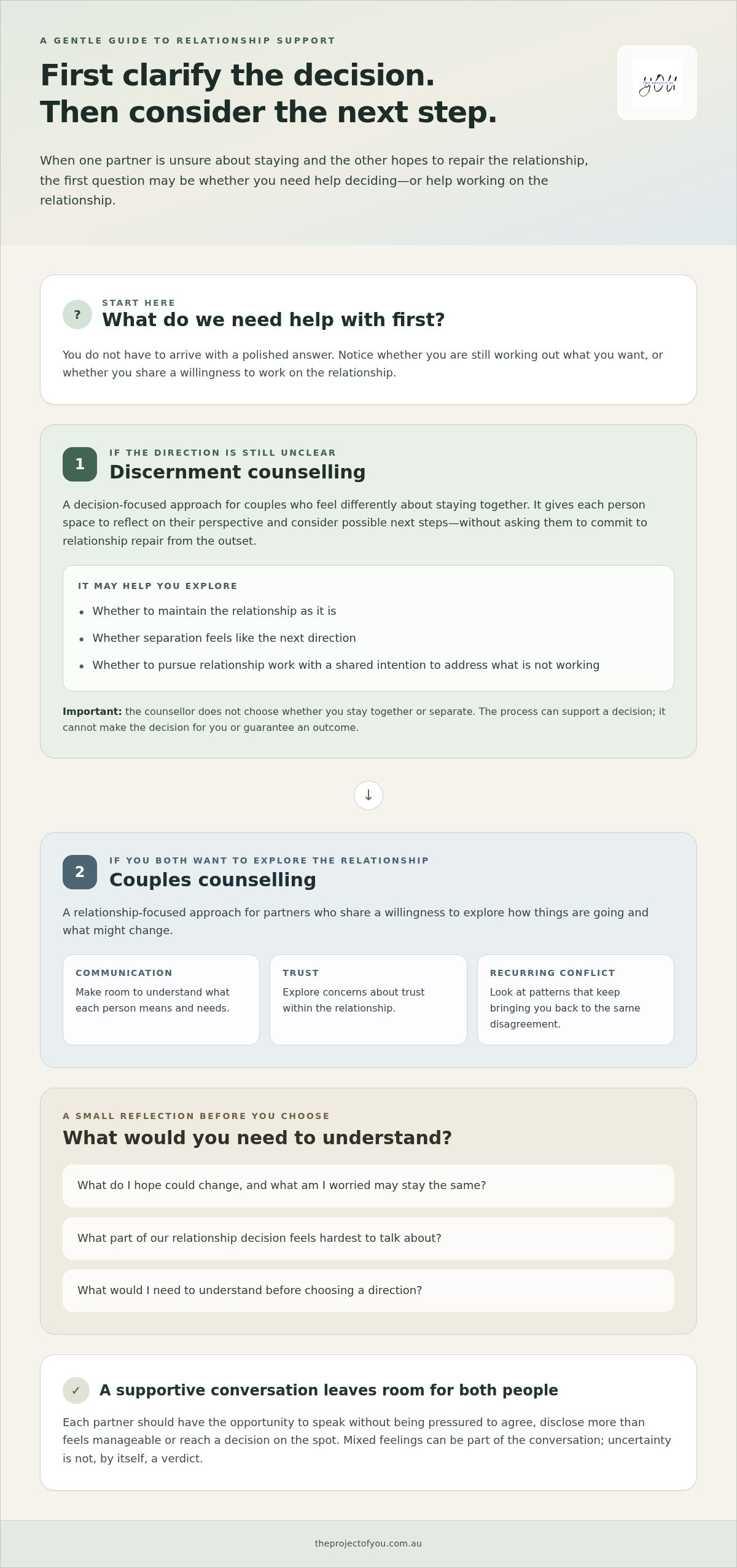
Discernment counselling is a structured way for couples to clarify what they want to do about their relationship when they are not equally sure about staying together. It helps each partner consider their perspective and possible next steps without asking them to commit to relationship repair from the outset. The counsellor does not decide whether the couple should stay together or separate.
This decision-focused approach differs from counselling aimed at changing relationship patterns. In couples counselling, partners may work on communication, trust or recurring conflict because they share a willingness to explore the relationship. In discernment counselling, the first question is whether both partners want to pursue that kind of work, or whether another direction feels more appropriate. This distinction can matter when conversations at home keep returning to the same disagreement without either person feeling heard.
Who may consider discernment counselling?
It may suit a couple where one partner is leaning towards separation while the other wants to work on the relationship. This difference does not make either person the problem. One may be holding onto hope and looking for ways to reconnect; the other may feel worn down, uncertain or unable to imagine change. Both can still care deeply, and both may be carrying grief, fear and competing hopes.
Ambivalence is not a verdict. Feeling unsure does not automatically mean a relationship will end, just as wanting to try does not guarantee that both partners will choose repair. Feelings can be layered: someone may love their partner and also feel hurt, or hope things could improve while fearing another cycle of conflict. A supportive conversation makes room for these mixed feelings rather than demanding a quick answer.
What questions can the process help couples explore?
The conversation can help partners consider whether they want to maintain the relationship as it is, separate, or pursue relationship work with a shared intention to address what is not working. These are possibilities to examine, not outcomes a counsellor selects for them.
Each person’s understanding of the relationship can offer useful context. One partner might experience repeated arguments as a sign that nothing will change, while the other sees them as a painful pattern they still want help changing. Exploring what each person has tried, what they believe would need to be different, and what they feel able to take responsibility for can make the decision less abstract.
You do not need to arrive with a polished answer. You might begin by asking yourself:
What do I hope could change, and what am I worried may stay the same?
What part of our relationship decision feels hardest to talk about?
What would I need to understand before choosing a direction?
These questions can open up reflection, but one conversation does not have to settle a complex decision. For anyone exploring discernment counseling Australia, the central purpose is to create space for thoughtful consideration, not pressure either partner into a particular choice.
How does discernment counselling work when partners feel differently?
A supported conversation can create room to hear what often gets lost at home: the feelings, experiences and needs beneath each person’s words. A counsellor may help partners take turns speaking, slow down when tension rises and notice how they respond to each other. The aim is not to find fault, but to make the conversation more considered and less driven by the pressure to defend a position.
Each person can reflect on their own part in the relationship dynamic without taking responsibility for everything that has happened. For example, one partner might notice they withdraw when a discussion becomes intense, while the other realises they keep pressing for an answer because silence feels frightening. Looking at these responses with curiosity can offer a fuller picture of the interaction.
What might happen in an initial conversation?
A counsellor may invite each partner to describe what led them to seek support and what they most want the other person to understand. Questions might include, “What feels hardest to say at home?” or “What happens for you just before the conversation becomes difficult?” This can help move beyond familiar arguments and make space for experiences that have not yet been heard.
There is no single script that every counsellor follows. You can bring a rough account, a few notes or simply the feeling that something needs attention. You do not need to speak perfectly. A useful conversation can include pauses, requests for clarification and moments when one person needs time to find the words.
For instance, if a partner says, “You never listen”, the counsellor might help explore what being heard would look like in a specific moment. Perhaps it means being able to finish a sentence, or having a concern acknowledged before solutions are offered. Making the request more concrete can help both people understand what those words mean to the person saying them.
How can emotional safety and agency be protected?
Each partner should have the opportunity to speak without being pressured to agree, disclose more than feels manageable or reach a decision on the spot. Boundaries can be spoken aloud: “I need a pause,” “I’m not ready to discuss that detail,” or “Could you ask me one question at a time?” Taking a break can help someone return to the conversation with more capacity to listen.
Supported reflection makes space for a person’s own thinking; it does not require them to reconcile. Strong feelings may arise, particularly when grief, shame or old hurts are close to the surface. A careful pace and respect for consent can help partners notice what is happening without pushing past their limits.
For anyone exploring discernment counseling Australia, the quality of the conversation matters: both people should be able to express themselves and retain agency over what they choose next. If you’d like support with a difficult relationship conversation, you can explore counselling support.
Discernment counselling or couples counselling: which approach fits?
Choosing between these forms of support can feel difficult when emotions are high. Rather than asking which one is “right”, consider what you and your partner can realistically take part in at this point. The comparison below offers a starting point, not a rule. A counsellor can help you discuss your circumstances and what each person feels ready to explore.
When may decision-focused support be a better starting point?
It may be worth considering when one partner cannot yet take part in repair-focused conversations without feeling pushed to promise something they do not know they can offer. Before choosing, each person could privately note what they feel able to engage with, what feels too soon, and what they would need to feel heard. These reflections can make an initial conversation with a counsellor more specific.
Uncertainty is not proof that a relationship must end or continue. The label alone cannot tell you whether a particular approach will suit your circumstances. The important question is whether the support gives both people enough room to speak honestly and consider what they are ready to do.
When might couples counselling better match the goal?
Couples counselling may fit when both partners can agree on something they want to work towards, even if they see the problem differently. That shared starting point might be learning to pause before an argument escalates, making room for each person to finish speaking, or understanding why attempts to reconnect leave one partner feeling rejected and the other overwhelmed. A counsellor can help explore attachment needs and emotional safety without making either person the sole cause of the pattern.
Trauma, coercion or immediate safety concerns call for careful, individualised professional assessment. If someone cannot speak freely or feels unsafe in a joint conversation, their circumstances need to be considered before deciding what support should look like. Partners weighing up relationship work can explore couple counselling with The Project of You | Trauma, Couples & Relationship Therapy Australia, where both perspectives can be held with care. You might start by asking: what kind of conversation can we take part in openly, without pressure?
How can you prepare to choose relationship support in Australia?
You do not need to have made a decision before seeking support. A little preparation can help you describe what you need, whether that is space to weigh up the relationship or help working on patterns together. Each partner can reflect separately first, so the conversation is not shaped only by whoever speaks most confidently or feels ready to decide.
Before a first appointment, write down what you each want help deciding. Keep it simple: “I want to understand whether I’m willing to work on rebuilding trust” or “I need us to talk without the discussion turning into an argument.” Different answers can be useful information, not proof that one person is right and the other is wrong.
What can each partner reflect on beforehand?
Set aside a few quiet minutes to notice what you feel, fear, value and hope might change. You could also consider what you have already tried and what still feels unresolved. For instance, perhaps you have agreed to avoid difficult topics, but the silence now feels lonely. Describe the experience rather than building a case against your partner.
What do I hope support will help me understand?
What am I worried might happen if we begin relationship work?
What matters most to me in deciding our next step?
What have we tried, and what still needs attention?
What boundaries would help me feel able to participate?
Compare notes only if that feels manageable. You might each read one answer aloud and ask, “Have I understood what you mean?” Listening does not require agreement. It can simply help both partners arrive with a clearer sense of what they want the conversation to hold.
What does a trauma-informed conversation make room for?
Past experiences can shape how people respond to conflict, distance or vulnerability, but this does not mean trauma is present in every relationship. A raised voice may feel manageable to one person and overwhelming to another. Context matters, so a thoughtful conversation makes room for different responses without labelling either partner.
Consent, pacing and boundaries matter. You can ask to pause, choose not to discuss a detail yet, or say what would help you feel safer in the conversation. Notice whether both partners can speak freely, disagree and take time to respond. If either person feels unable to participate safely, individual professional assessment may be a more appropriate first step than assuming a joint conversation is the right fit.
This guide offers general education, not an individual assessment or a substitute for professional advice tailored to your circumstances. If there are immediate safety concerns, seek appropriate support for your situation. Preparation can help you explain what you need, but you do not have to resolve everything before asking for help.
Finding a supportive next step with The Project of You | Trauma, Couples & Relationship Therapy Australia
Choosing support does not require you to arrive with a final answer about your relationship. It can begin with a wish to speak more honestly, understand what feels stuck, or work out what question needs attention first. For people researching discernment counseling Australia, The Project Of You offers individual and couple counselling to support relationship conversations and personal reflection.
Led by Azita Abdollahian, a qualified social worker and psychotherapist, the practice offers trauma-informed support that makes room for each person’s perspective. Counselling can help partners explore communication, attachment needs and emotional safety without assigning blame or dictating whether they should stay together or separate. The focus is on understanding what is happening and what each person wants to explore, not securing a particular outcome.
How can counselling support a difficult relationship conversation?
In a non-blaming conversation, partners can describe how they experience conflict and what happens for them when they feel unheard or disconnected. A therapist may help each person slow down, notice their responses and listen for the need beneath the words. This can create room to explore recurring patterns while respecting each partner’s agency and boundaries.
For example, a disagreement about spending time together may hold different meanings: one partner might be seeking closeness, while the other feels pressured or overwhelmed. Exploring those experiences does not make either person’s interpretation the only valid one. It can help clarify what each needs and whether both are willing to work on the pattern. You can learn more about couple counselling support and how it can hold space for both partners’ perspectives.
What might a first step look like?
Begin with the question you most need help exploring. You might write it down before an appointment: “How can we talk about the future without shutting down?” or “What do I need to understand before I choose what comes next?” A clear starting question gives the conversation a focus, even if your feelings remain mixed.
Seeking support does not commit you to staying or leaving. It is a way to bring care and attention to a difficult decision while keeping your choice your own. If you are not sure whether individual or couple counselling feels like the right place to begin, you can name that uncertainty in the conversation. You do not need a perfect plan or to persuade your partner to feel the same way.
Wherever you are in the decision, support can make room for honest reflection without taking the decision out of your hands. You are welcome to take a first step at a pace that feels manageable.
Take the next step at your own pace
You do not need certainty about the whole future to begin a useful conversation. You might start with one honest question: what do I need space to understand before I can decide what comes next? The focus of discernment counselling is to make room for thoughtful reflection, not to find an answer that someone else believes you should reach.
If a shared appointment does not feel right yet, individual counselling can offer space to explore your own feelings and needs. If you are both willing to talk together, couple counselling can help you approach the conversation with care. The Project Of You, led by Azita Abdollahian, provides both individual and couple counselling.
Seeking support does not decide the relationship for you. It can be a considered first step towards facing the question with greater care, whatever direction you eventually choose.
Book an appointment with The Project Of You You’re allowed to take this one conversation at a time.
Frequently Asked Questions
Is discernment counselling the same as couples counselling?
No. Discernment counselling centres on considering a relationship decision, while couples counselling commonly focuses on understanding and working with relationship concerns. The distinction is useful if one partner wants to address recurring arguments and the other is unsure about continuing. Before starting, it may help to tell the counsellor what you each hope the conversations will focus on, so the purpose of support is clear.
Can discernment counselling help if only one partner wants to stay together?
It may offer space to explore that difference without treating either partner’s position as the problem. In discernment counseling Australia, the aim is not to persuade the uncertain partner to stay or the hopeful partner to give up. Each can consider what they want, what concerns them, and what they need to understand before choosing a direction. The process can support reflection, but it cannot guarantee agreement.
Does discernment counselling mean a couple is heading for separation?
No. Considering decision-focused support does not determine whether a couple will separate. It can be a way to examine uncertainty before deciding whether to continue as things are, pursue relationship work, or consider separating. For example, a partner may be unsure because trust has been damaged, while still wanting to understand whether rebuilding feels possible. The conversation is about exploring choices, not predicting the relationship’s future.
What if one partner is not ready to make a decision?
Being unready can be part of the picture, rather than a reason to force an answer. A person may need time to understand their feelings, especially if conversations have felt intense or confusing. It can help to name what feels unresolved, such as concern about repeating old patterns or uncertainty about what change would involve. Support can make space for these questions without requiring an immediate commitment.
Can discernment counselling help after infidelity?
It may help partners explore what the infidelity means for their relationship and whether they want to consider relationship work. Each person may be carrying different questions: the hurt partner might need honesty and time, while the partner who broke trust may be unsure how to begin taking responsibility. Discernment counselling does not replace support focused on infidelity recovery, and it cannot promise trust will be restored. The right focus depends on what each person needs.
Can couples counselling still help if we are unsure about staying together?
It can be worth considering if both partners are willing to explore the relationship, even if neither knows what the eventual decision will be. For instance, you might want help understanding why discussions about parenting or time together keep escalating. If one partner does not feel able to work towards relationship change, it may help to name that uncertainty before agreeing on a counselling goal. The purpose should reflect what both people can genuinely take part in.


Comments