.png)

Attachment Parenting Counselling: Building a More Secure Parent-Child Connection

What is attachment parenting counselling, and how can it help you build a stronger, more secure relationship with your child? If arguments, emotional withdrawal, challenging behaviour or everyday routines repeatedly leave you feeling disconnected, it can be difficult to know how to respond. You may want to stay calm and connected but find yourself reacting in ways you later regret. Attachment-informed parenting support helps you understand the feelings, needs and relationship patterns beneath these difficult moments, so you can respond with greater awareness rather than blame.
As a psychotherapist, Clinical Social Worker and trauma specialist, Azita Abdollahian understands how early attachment experiences, emotional regulation and family dynamics can influence the way parents and children relate to one another. Parenting support informed by attachment theory provides a space to explore recurring challenges, understand what may be contributing to disconnection and develop practical ways to strengthen emotional safety. The goal is not to follow rigid parenting rules or become a perfect parent, but to build your capacity to respond thoughtfully, establish appropriate boundaries and reconnect after conflict.
In this guide, Azita explores what attachment-informed parenting counselling involves, how attachment patterns can influence parent-child relationships, and what you can do when challenging interactions become a recurring source of stress. You’ll also learn practical ways to support emotional regulation, respond to your child’s needs and build a more connected relationship over time. You don’t have to get every moment right to make a meaningful difference. Learning how to find your way back to connection can be one of the most important parts of parenting.
Table of Contents
What is attachment parenting counselling and what is it not?
Attachment parenting counselling explores relationship patterns and supports more emotionally attuned interactions between parents and children. It can help you slow down a recurring moment, consider what may be happening for each of you, and reflect on a response that supports connection. The aim isn’t to find fault with a parent or child, or to get every interaction right.
Attachment-informed parenting counselling is a collaborative approach that draws on children’s needs for comfort, care and connection to help parents understand family patterns and consider practical ways to respond. It’s an approach, not a single prescribed parenting method, and it can’t promise a perfect connection. Families bring different values, histories and pressures to counselling, so the work is shaped around what’s happening in your family.
Your child doesn’t necessarily need to attend for you to seek parenting support. You can explore your own feelings, responses and hopes for the relationship, then consider how everyday interactions might shift. This can be useful if you’re noticing a difficult pattern but aren’t yet sure how to describe it.
How does attachment shape a child’s sense of connection?
Attachment describes a child’s developing expectation of whether comfort and care are available in close relationships. After a hard day at school, for example, a child might seek a hug, become quiet or want to stay close while telling you what happened. Their way of reaching out can vary. A parent’s response, shaped by their own feelings and energy at the time, becomes part of the interaction you can explore in counselling.
Attachment theory offers a way to think about early expectations and patterns of connection. It doesn’t diagnose a particular child or parent. Attachment styles are not fixed labels that explain everything about a person. A child’s behaviour can also reflect their temperament, development, circumstances and what’s happening that day.
Is attachment parenting counselling the same as attachment parenting?
No. Attachment-informed counselling draws on ideas about emotional connection to help you understand your relationship with your child. “Attachment parenting” is often used to describe a parenting philosophy or set of practices, but counselling doesn’t require you to adopt a particular style, follow strict rules or meet an idealised standard. It gives you room to reflect on what feels workable and meaningful for your family.
That might mean looking at how you set a limit, manage a transition or reconnect after tension. You can consider what your child may be communicating, what gets stirred up for you, and which response fits your family’s needs and values. If parenting stress is also affecting your relationship with a co-parent, couple counselling support can help you reflect on that relationship too.
You don’t need to arrive with a complete explanation or a plan to change everything. Counselling can begin with one question: what tends to happen between us in this moment, and what might help us feel safer and more connected?
How attachment-informed counselling explores everyday parent-child patterns
Repeated interactions can offer clues about what a child may need and how a parent is responding. In attachment parenting counselling, the focus is on the sequence between people, not on treating one person’s behaviour as the whole problem. This can help you make sense of a difficult moment without deciding who is at fault.
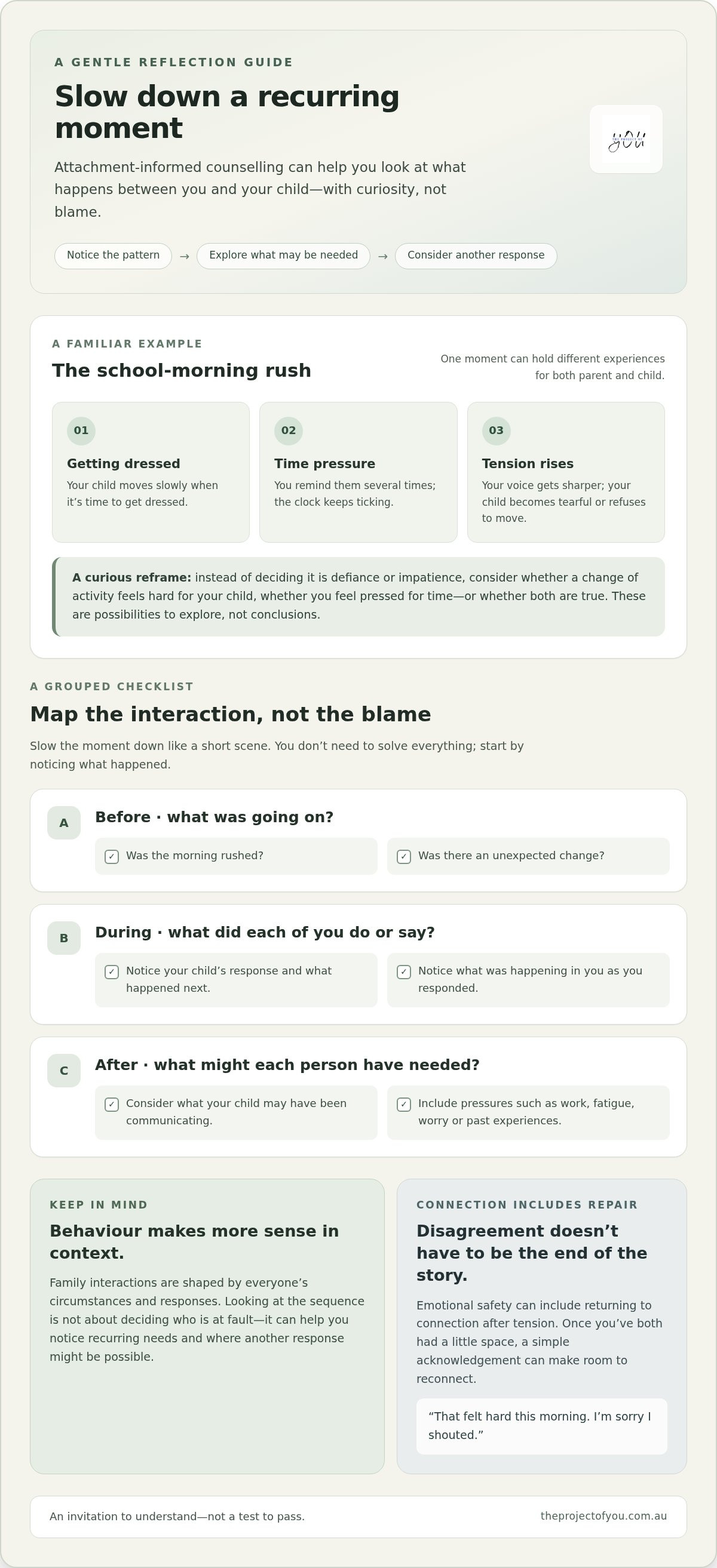
Imagine the school-morning rush: your child moves slowly when it’s time to get dressed, you remind them several times, and your voice gets sharper as the clock ticks on. Your child may then become tearful or refuse to move. It’s easy to see only defiance or impatience. Looking more closely could reveal a child struggling with a change in activity, a parent feeling pressed for time, or both. These are possibilities to explore, not conclusions to impose.
What might a recurring conflict be communicating?
Behaviour makes more sense in context. Rather than assuming a child is trying to provoke or manipulate you, counselling can help you get curious about what happened before, during and after the interaction. Was the morning rushed? Was there an unexpected change or a limit that felt hard to accept? What did your child do next, and what happened in you as you responded?
Your experience matters in this sequence, too. Work pressure, fatigue, worry or memories of how you were parented can affect what feels manageable in the moment. That doesn’t make you the sole cause of a conflict. It recognises that family interactions are shaped by everyone’s circumstances and responses. A counsellor can help you examine the pattern with care, so reflection doesn’t become another reason to criticise yourself.
One practical way to reflect is to slow the moment down like a short scene. Note what was happening beforehand, what each person did or said, and what followed. Then ask what each of you might have needed at each point. This can help you identify recurring needs, notice how you tend to respond, and consider where another response might be possible. It’s an invitation to understand, not a test to pass.
Where do emotional safety and repair fit?
Emotional safety doesn’t mean a family never disagrees or that a parent must stay calm every minute. It includes the possibility of returning to connection after tension. Once you’ve both had a little space, you might say, “That felt hard this morning. I’m sorry I shouted. I still need us to leave on time, and I want to understand what made getting ready difficult.”
This acknowledges the strain, takes responsibility for your part and keeps an appropriate limit in place. Your child may not respond as you hope straight away. Repair isn’t a technique that guarantees a particular outcome; it creates an opening for reconnection and further understanding.
If you’d like help making sense of a repeated interaction in your family, parenting counselling offers space to reflect and consider practical next steps.
When might parenting counselling help, and how is it different from general advice?
Seeking support doesn’t mean you’ve failed as a parent or caused a problem. It can mean you’d value space to understand what’s happening in your family and consider a way forward. You don’t need to wait for a crisis or for your child to show a particular behaviour before reflecting on the relationship.
What concerns might lead a parent to seek support?
You might consider attachment parenting counselling if you’re experiencing recurring disconnection, feel unsure how to respond in certain moments, or find it hard to reconnect after conflict. Support can also help during a family transition or as you make sense of experiences that shape how you parent. These concerns don’t prove that anyone is at fault. They can be a starting point for thoughtful conversation.
Perhaps you and your child keep getting caught in the same argument, or you second-guess a limit after setting it. You may be carrying questions about your reactions or want to feel more confident in how you respond. This article can help you reflect, but it can’t diagnose your family or determine whether counselling is right for every situation. That depends on your needs and circumstances.
How can counselling differ from tips or parenting advice?
General parenting information can introduce useful ideas and strategies. Counselling gives you an individual space to explore how an idea fits your family, including your values, relationship history, current pressures and support needs. Rather than assuming one approach works for everyone, you can reflect collaboratively on what feels realistic and meaningful for you.
General parenting information: Offers broad strategies or explanations that you can consider applying in everyday situations.
Individualised counselling: Makes room to explore your family’s context, recurring interactions and responses that might feel workable for you.
These forms of support can complement one another. You might learn a strategy from a book or parenting resource, then use counselling to think through why it feels difficult to put into practice or how it could be adapted to your circumstances. The point isn’t to rank one kind of support above another, but to find the right kind of reflection for the questions you’re carrying.
Sometimes parenting concerns are connected with tension between co-parents or partners. Exploring how you communicate and make decisions together may be useful alongside reflecting on parent-child interactions. The Project of You’s couple counselling support offers space to consider relationship dynamics without assigning blame.
You might begin by asking yourself: What keeps happening? What feels hardest for me? What would I like to understand better? You don’t need polished answers. Noticing the questions is enough to begin considering what kind of support may fit.
How to prepare for attachment parenting counselling
Preparing for attachment parenting counselling doesn’t mean arriving with a polished account of your family or a plan for what to change. A few gentle reflections can help you begin, but it’s fine to work out what matters as you talk. Think of preparation as gathering a few signposts, not completing an assignment.
What can parents reflect on before a session?
If it feels useful, notice one or two moments that have been on your mind. You might jot down what was happening, how you felt, what you think your child may have needed, and what you hoped would happen. Keep it brief. The purpose isn’t to build a case against yourself or your child, but to give the conversation a starting point.
You could also consider:
What feels difficult or uncertain in your interactions?
What pressures, changes or stressors might be affecting your capacity?
What do you value about the relationship, and when do you feel close or at ease?
What would you like to understand better, even if you’re unsure what might help?
Include what’s working, too. A small moment of humour, a shared routine or a time you felt able to listen can offer important context. If stress sometimes leaves you feeling on edge, shut down or overwhelmed, notice what happens in you and what helps you feel more settled. You don’t need to explain those responses perfectly. Simply noticing them can be useful.
What questions can help make counselling feel collaborative?
Counselling is a conversation, and you can ask questions about how the work will unfold. For example: “How will we decide what to focus on?” “Can we agree on what we’re hoping to understand?” or “How might we notice whether our conversations are helping?” These questions can clarify expectations and make room for your perspective.
You can also name what feels safe, difficult or important to discuss. Perhaps you’d like to take a subject slowly, or you’re concerned about feeling judged. Saying so can help shape a respectful conversation. If you’re unsure where to begin, try: “I don’t have the whole story clear yet, but this is the part I keep thinking about.” That’s enough to open the door.
Your family’s values and history matter. You might want support that respects cultural or personal beliefs, co-parenting arrangements, or experiences that still feel tender. You’re welcome to raise these considerations and discuss how they fit into counselling. The work can begin with what feels most relevant now, rather than trying to cover everything at once.
If you’re ready to explore parenting counselling, you can take the next step at a pace that feels manageable.
How The Project of You approaches parenting counselling
The Project of You provides specialised parenting counselling to help parents reflect on family dynamics and emotional health. Its approach is attachment-focused and trauma-informed. In plain language, this means making space to understand how people seek connection and comfort, while recognising that past and present experiences can shape how family members respond to one another. The focus is on understanding, not blame, and exploring what may be practical for your family.
What can a parent expect from a collaborative approach?
You can bring a concern without needing a complete explanation or deciding who is responsible. Counselling makes room to look at relationship patterns, what feels difficult and what you hope might be different. The conversation can explore each person’s experience with curiosity, including how emotional safety, stress and family history may be relevant.
Practical reflection may involve looking at a situation from more than one angle. For instance, you might describe a moment when you struggled to hold a boundary, then consider what was happening for you and what your child may have been experiencing. The intention isn’t to label either of you or prescribe a single response. It’s to understand the context and consider what could be workable in your family.
There’s room for your strengths and values, too. What helps you feel close to your child? What kind of parent do you hope to be when things are tense? These questions can guide reflection without becoming another standard you must meet. The process is collaborative, and what you choose to explore can be shaped by what feels important to you.
How can a parent take the next step?
You might begin by naming the concern you most want to understand. It could be a recurring disagreement, uncertainty about how to respond, or a sense that you and your child have been missing each other lately. You don’t need perfect words. A simple starting point could be, “I’d like to understand what keeps happening between us.”
Seeking support can be a considered way to care for your family and reflect on your own experience. It isn’t a judgement on your parenting, and you can make the decision at a pace that feels right.
Take one thoughtful step towards connection
In the coming days, you might notice a moment when you can pause before responding. What would it be like to meet that moment with a little more curiosity about yourself and your child? Attachment parenting counselling offers space to explore how you want to show up in your family, while recognising that change unfolds through everyday interactions.
If you’d like a supportive space to consider that next step, book an appointment with The Project of You.
Book an online counselling appointment You don’t need to have everything mapped out. You can begin with a willingness to keep learning about the relationship you’re building together.
Frequently Asked Questions
What is attachment parenting counselling?
Attachment parenting counselling is parenting support that considers how a child’s need for connection and a parent’s experiences can shape family interactions. You can bring a specific question, such as how to respond when your child says “I hate you”, and think through the meaning and impact of different responses. The focus isn’t on finding a perfect phrase, but on making a considered choice that fits your relationship and circumstances.
Can attachment parenting counselling help if my child is not attending?
Yes. A parent can seek support on their own and use the conversation to think through the choices available in a particular situation. You might explore how to explain a family change to your child or respond when they ask a difficult question. The discussion can focus on your perspective and what you want to keep in mind as you parent; your child doesn’t need to join or speak for themselves.
How do I know if I need parenting counselling?
Consider whether you’d value space to think through parenting questions that feel hard to resolve alone. You may notice that decisions weigh on you long after the moment has passed, or that you’re unsure how to balance your values with advice from family, school or friends. You don’t need to prove something is wrong. You can seek support because you want a clearer sense of what matters to you.
What happens in an attachment-informed parenting counselling session?
An attachment-informed session is a chance to talk through what feels relevant and consider your questions with a counsellor. You might explore one decision, such as how to handle a request to stay up later, or discuss how your own upbringing influences your views on discipline. You can say if you’d prefer to take a topic slowly. The discussion can follow what feels most useful to examine.
Can counselling help when parenting disagreements affect my relationship?
Couple counselling can explore parenting disagreements when they’re affecting how partners relate to one another. It may help to identify the concern beneath a difference, such as one parent prioritising consistency while the other is focused on flexibility. You can then consider how to discuss the issue respectfully and what shared principle might guide a decision. The aim isn’t for one person to win, but to understand each other’s perspective.
How can I support my child after a difficult interaction?
Start by noticing what your child seems to need in that moment: quiet, practical help, company or time to themselves. If emotions are still high, a calm presence and a simple choice, such as “Would you like me nearby or some space?”, may feel more manageable than asking for an explanation. Keep any necessary boundary in place. You can return to the conversation later, when you’re both more ready to engage.


Comments