.png)

Avoiding Arguments in a Relationship: How to Disagree Without Losing Connection

How do you avoid arguments in a relationship without suppressing your feelings or creating emotional distance? If you find yourself staying quiet to keep the peace, avoiding difficult conversations or letting concerns go because you fear your partner’s reaction, you’re not alone. While avoiding conflict may bring temporary relief, unresolved hurt and unmet needs can gradually build resentment and make it harder to feel emotionally connected. A healthy relationship isn’t one without disagreements; it’s one where both partners can express themselves, work through differences and find their way back to connection.
As a psychotherapist, Clinical Social Worker and relationship expert, Azita Abdollahian helps couples understand the communication patterns that can keep them stuck in recurring conflict, defensiveness, withdrawal and disconnection. Learning how to navigate disagreements involves more than choosing the right words. It can also mean recognising emotional triggers, understanding each other’s needs, knowing when to pause and developing the skills to return to a difficult conversation without turning it into a battle over who is right.
In this guide, Azita explores practical ways to reduce unnecessary arguments, communicate concerns more constructively and listen to your partner without dismissing your own needs. You’ll learn how to distinguish healthy disagreement from recurring patterns that undermine emotional safety, how to take a productive pause during conflict and when couples counselling may help. The goal isn’t to avoid every difficult conversation or agree on everything. It’s to build a relationship where disagreements don’t have to come at the expense of understanding, trust and connection.
Table of Contents
Why avoiding arguments in a relationship can leave important things unsaid
How stress can turn a small disagreement into a relationship argument
What to say instead of arguing, shutting down or keeping the peace
How to revisit recurring disagreements and repair after an argument
When support can help you stop avoiding arguments and reconnect
Why avoiding arguments in a relationship can leave important things unsaid
Reducing hurtful escalation matters. But avoiding every disagreement can leave needs, preferences and concerns unspoken, making it harder for each partner to understand what matters to the other. Conflict avoidance means steering away from difficult conversations, whether by changing the subject, agreeing to keep the peace or telling yourself an issue doesn’t matter. It describes a response to tension, not a flaw in either person.
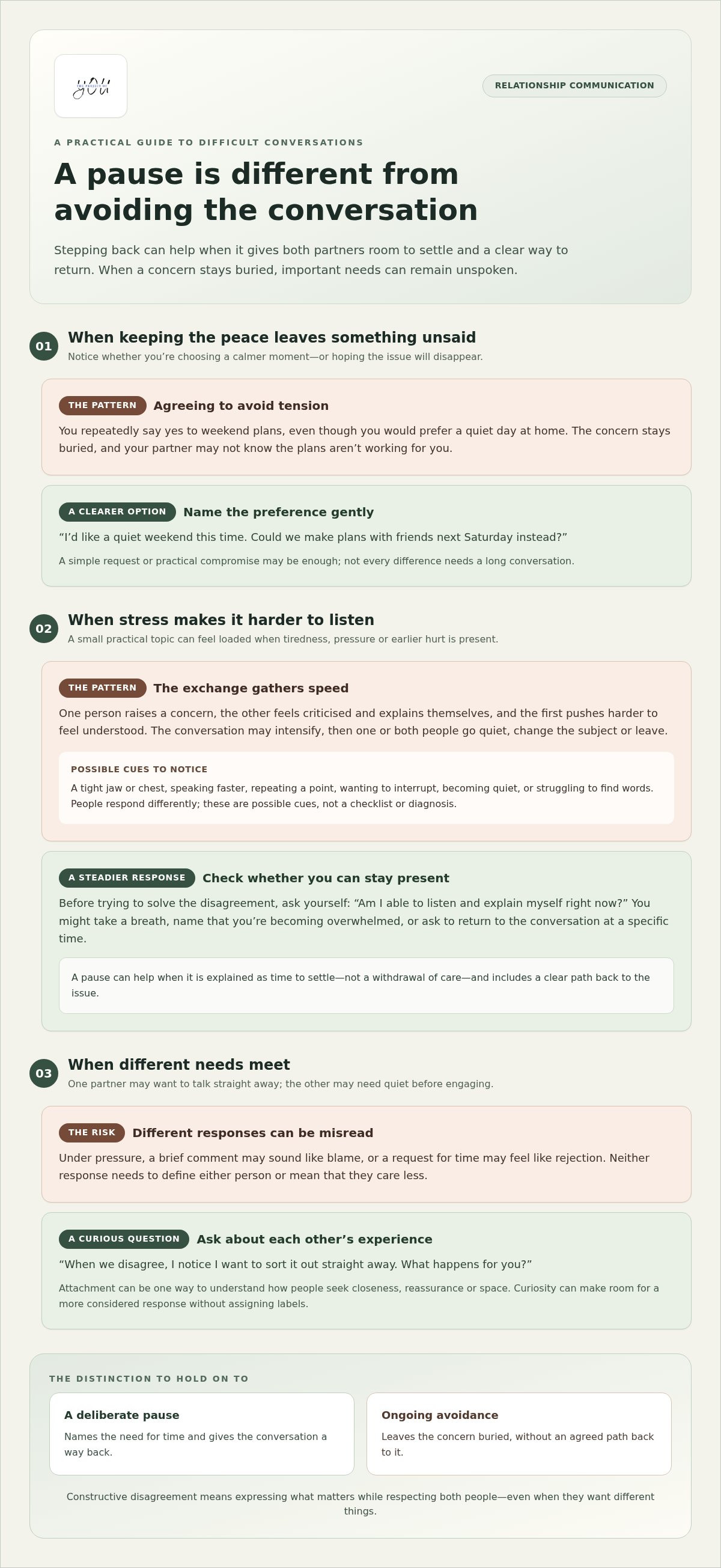
There’s a meaningful difference between choosing a calmer moment and indefinitely shelving a concern. A deliberate pause has a purpose. You might say, “I want to talk about this, but I’m too wound up to listen properly right now. Can we come back to it after dinner?” Ongoing silence or appeasement can look similar on the surface, but the concern stays buried and there’s no agreed path back to the conversation. Conflict avoidance in relationships can take different forms. What matters is whether stepping back helps both people return to the issue or leaves one person carrying it alone.
Think of weekend plans. One partner repeatedly agrees to visit friends, even though they’d prefer a quiet day at home. They may hope that saying yes will prevent tension, but over time they might feel resentful or unseen. Meanwhile, the other partner has no way of knowing the plans aren’t working for them. Naming the preference needn’t become a major discussion: “I’d like a quiet weekend this time. Could we make plans with friends next Saturday instead?” Small, honest adjustments can help partners build a clearer understanding of each other.
Constructive disagreement is honest expression with respect for both people, even when they want different things.
Is it healthy to avoid arguments with your partner?
It can be thoughtful to wait for a better time, especially if either of you is tired, distracted or too upset to speak with care. Not every difference needs a long, intense conversation. Sometimes a simple request or practical compromise is enough.
But if you regularly hide your preferences because you fear upsetting your partner, they have less opportunity to know and respond to you. Ask yourself: am I choosing a calmer time, or hoping the issue will disappear? What might become easier between us if I shared this gently and clearly?
What is the difference between conflict and a disagreement?
An argument becomes less constructive when listening gives way to attack, defensiveness or withdrawal. Notice what happens between you: can both partners speak and listen, and can you return to the topic if you need a break? These patterns offer a more helpful guide than asking whether you argue at all.
How stress can turn a small disagreement into a relationship argument
A conversation about who’ll pick up groceries can quickly become a dispute about who carries more of the household load. The immediate topic may be small, but tiredness, pressure or earlier hurt can make it feel loaded. Under stress, attention can narrow. Each person may focus on defending their point or anticipating criticism, leaving less room to take in what the other is saying.
When stress is high, a partner’s words can be harder to hear accurately, even when neither person intends to cause hurt. A brief comment may sound like blame; a request for time may feel like rejection. That doesn’t mean the impact isn’t real. It means it can help to slow down and check what was meant before responding to what you fear you heard.
A familiar cycle might begin when one person raises a concern, the other feels criticised and explains themselves, and the first person pushes harder to feel understood. As the exchange intensifies, one or both may go quiet, change the subject or leave. Neither response needs to define a person or make them the problem. The useful question is: what happens between us when we’re both under pressure, and how do we find our way back?
What happens when one or both partners feel overwhelmed?
Some people speak faster or repeat their point; others become quiet, lose track of what’s being said or struggle to find words. You might notice tension in your jaw, a tight chest or an urge to interrupt. These are possible cues, not a checklist or diagnosis, and people respond differently. Before trying to solve the disagreement, pause to notice: am I able to listen and explain myself right now?
Nervous system language can be one helpful lens for understanding why a conversation feels harder under pressure, but it isn’t a complete explanation of a relationship or a diagnosis of either partner. Stress, past experiences and what’s happening in the present may all matter. Awareness can offer a choice: take a breath, name that you’re becoming overwhelmed, or ask to return to the conversation at a specific time.
How can attachment experiences shape arguments?
Attachment is a way of understanding how people seek closeness, reassurance or space in important relationships, particularly when they feel uncertain. One partner might reach for more conversation while the other needs quiet before they can engage. These responses can reflect different ways of managing stress. They don’t prove either person has a fixed attachment style or cares less.
Try getting curious rather than assigning labels: “When we disagree, I notice I want to sort it out straight away. What happens for you?” Hearing each other’s experience can make room for a more considered response. If recurring arguments feel difficult to shift, couples counselling support can provide a space to understand the pattern and practise communicating with guidance.
What to say instead of arguing, shutting down or keeping the peace
A useful conversation doesn’t depend on finding perfect words. It can help to follow a simple sequence: settle enough to speak, name one concern, explain its impact and invite your partner’s perspective. This gives each of you a clearer point to respond to, rather than trying to solve several hurts at once.
“I felt unsettled when our plans changed without a conversation; could we talk about how to handle changes next time?” This opening describes an experience and makes a request without assuming your partner’s intentions. It doesn’t guarantee agreement, but it can create a more respectful starting point.
Settle first. Notice whether you can stay present and listen. If you’re too upset to do that, explain that you need a pause and agree when to return to the conversation.
Name one concern. Choose a specific moment or issue, rather than bringing in every frustration at once.
Describe its impact. Use “I” language to share what you felt or needed, without treating your interpretation as proof of what your partner intended.
Invite their perspective. Ask an open question, then leave space for an answer. Listening doesn’t mean you have to agree; it means making room to understand.
Reflective listening can help you check that you’ve heard each other accurately. For example, you might say, “I heard that you changed the plan because you thought it would make the day easier. Have I understood?” Your partner can clarify, and you can then share how the change affected you. That small check can interrupt assumptions before they gather momentum.
How do you raise a concern without blaming your partner?
Describe what happened as specifically as you can: “I felt left out when I found out about the decision afterwards,” rather than “You never include me.” Then name what would help: “Next time, could we discuss it together first?” If you’re unsure what was intended, ask, “What was happening for you in that moment?” This keeps the conversation open without asking you to hide your feelings.
How can you pause an argument without shutting your partner out?
A pause is clearer when it includes reassurance and a plan to reconnect. You might say, “I’m overwhelmed and don’t want to speak harshly. I care about this conversation. Can we take a break and agree on a time to continue?” Choose a return point that feels manageable for both of you. A communicated pause is different from disappearing or using silence to punish. It signals a need to settle, not an intention to abandon the issue.
These phrases are starting points, not a formula that guarantees agreement or resolves every recurring pattern. If avoiding arguments in a relationship has become a way of silencing your needs, practising a different approach may take time. Couple counselling can help you explore what makes conversations difficult and practise new ways of communicating. If you’d like to consider that support, you can book a counselling session.
How to revisit recurring disagreements and repair after an argument
A difficult conversation doesn’t always reach a useful ending in the moment. If one or both of you are overwhelmed, it may be kinder to pause and return to the topic when you can both take part. A pause works best when it isn’t an escape hatch: name the issue you want to revisit and agree on a realistic time or situation to continue.
When you come back, try separating the practical problem from the feelings and assumptions wrapped around it. For example, a disagreement about household jobs may involve a practical question, such as who takes out the rubbish, alongside a feeling of being left with too much to manage. One partner may assume the other doesn’t notice the work; the other may think their contribution is already clear. Exploring these layers can reveal what needs attention beyond the task itself.
What can you do when the same argument keeps happening?
Look at the pattern together, rather than deciding who started it or who is to blame. You might ask: what tends to set this off, what do we each do next, and what need might be going unheard? Then test one manageable change, such as agreeing on who handles a household task and when. After trying it, check how it felt for both of you and adjust if needed.
Repair can begin even if the practical issue is still unresolved. Each person can acknowledge the impact of their words or actions, clarify what they meant without using intent to dismiss the effect, and suggest one next step. For example: “I can see that my comment about the dishes sounded dismissive. I was trying to explain how stretched I felt, but I’m sorry it landed that way. Could we work out a plan together?”
An apology can matter without requiring immediate forgiveness, reassurance or agreement. The person who was hurt may need time, and the original issue may still need further discussion. Repair is less about quickly declaring everything fine and more about showing that the impact has been heard and that both people are willing to consider what happens next. This can be especially important if avoiding arguments in a relationship has meant leaving repeated hurt unaddressed.
When is a pause not enough to make a conversation safe?
If a person feels afraid to speak honestly because of threats, coercion or violence, the priority is safety, not practising communication together. Joint exercises may not be appropriate when someone can’t safely disagree or express a need. Consider individual or specialist support to think through safe next steps. You don’t have to resolve the relationship conflict before seeking help for your safety.
If recurring disagreements are difficult to understand or shift together, couples counselling can offer a supported space to explore the pattern and practise communication. It needn’t mean either partner is at fault. It can make room for both perspectives while you work out what change is possible.
When support can help you stop avoiding arguments and reconnect
It may be helpful to seek support when the same arguments keep returning, important conversations are repeatedly avoided, or unresolved hurt makes it hard to feel close. You don’t need to wait until things feel unmanageable. A neutral, supported space can help you slow down and notice what happens between you when a difficult topic comes up.
Can couples counselling help when partners keep avoiding conflict?
Couple counselling can provide a structured setting to explore concerns and recurring interaction patterns. With support, partners can practise expressing needs, listening to each other and returning to difficult topics with care. Seeking help isn’t an admission that either person is to blame. It can be a way to understand how the pattern affects you both and consider what might change.
Counselling doesn’t guarantee agreement, reconciliation or a particular result. The aim is to make room for each person’s experience and help you consider your options with greater understanding. For some couples, that may include working towards new ways to communicate. For others, the conversations may clarify differences or needs that require further thought.
What can you expect from a supported conversation?
A supported conversation can help you explore not only the subject of a disagreement, but also what each person feels, assumes and needs when it arises. A counsellor may help you notice where communication gets stuck, slow the exchange and practise ways to express concerns without attack or withdrawal. The focus is on understanding and exploring more workable ways to communicate, not forcing a quick resolution.
At The Project of You | Trauma, Couples & Relationship Therapy Australia, Azita Abdollahian brings her background as a qualified social worker and psychotherapist to individual and couple counselling. The work is informed by attachment and trauma-informed care, while recognising that each relationship has its own history and circumstances.
If you’re considering support, it can help to ask yourself: what have we found difficult to say to each other, and what would help us feel more able to talk about it? You might also reflect on what you’d like a supported conversation to make room for, even if you’re not yet sure what the outcome should be.
If you’re avoiding arguments in a relationship because raising a concern feels too difficult, you don’t have to work out the next step all at once. You can take time to consider whether individual or couple counselling feels right. If there’s fear, coercion, threats or violence, prioritise safety and seek appropriate individual or specialist support rather than relying on joint communication exercises.
If you feel ready to explore counselling support, book an appointment.
Make room for a more honest next conversation
A different pattern rarely begins with perfect words. It may begin by noticing when you’re about to say “it’s fine” when it isn’t, or by taking a moment to choose what you most want your partner to understand. The purpose of avoiding arguments in a relationship isn’t to make every difficult feeling disappear. It’s to create more room for honesty, care and connection, even when you see things differently.
Before your next conversation, ask yourself: what matters most to me here, and what would help me stay curious about my partner’s experience? You don’t need to resolve everything in one talk. A small, sincere step can help you approach the next one with greater intention. If these patterns feel hard to shift alone, support can offer a place to explore what’s happening and consider what you’d like to try.
Book an appointment when you feel ready There’s room to learn a new way of meeting each other, one honest conversation at a time.
Frequently Asked Questions
Is avoiding arguments in a relationship healthy?
It can be healthy to choose a calmer moment rather than trying to talk while distracted, exhausted or upset. The key is whether the issue gets a fair hearing later. If you often agree to plans you don’t want, for example, check whether you’re making a genuine choice or trying to prevent a difficult reaction. Notice whether both of you can express preferences, even when they differ.
Can a relationship work without arguments?
Yes, a relationship can be honest and connected without frequent arguments. Partners may handle differences through short conversations, practical compromises or accepting that they prefer different things. What matters is whether both people can raise concerns without feeling they must hide parts of themselves. If you find yourself editing every preference to keep things smooth, consider what makes it difficult to speak openly and what small concern feels safe to raise first.
How do you stop an argument from escalating?
Try to catch the shift from discussing the issue to defending yourselves against each other. Lower your pace, take turns speaking and stay with one topic rather than bringing in past grievances. If you notice you’re repeating yourself or losing track of what your partner said, suggest a pause and name when you’ll return. These choices may help keep the discussion focused, though they can’t ensure you’ll reach the same view.
What should I say when my partner shuts down during an argument?
Speak gently about the change you notice, without deciding what it means. You could say, “I notice we’ve gone quiet. Would it help to pause and talk later?” Then give your partner room to answer rather than asking the same question repeatedly. If they can’t respond just then, agree on a way to revisit the topic. Talk about the pattern at a calmer time, when neither of you is in the middle of it.
Can taking a break during an argument make things worse?
It can feel unsettling if a break is unexplained or leaves you unsure whether the conversation will resume. A pause is more reassuring when you explain that you need space to collect your thoughts, not to dismiss the issue, and work out a return point together. The right amount of time varies. If the agreed moment arrives and one of you still feels unable to talk, acknowledge that and make another clear plan.
What happens if we keep having the same argument?
A repeated disagreement may involve more than the topic on the surface. For instance, a discussion about who organises family visits might also touch on fairness, time or feeling included. Try noting what usually happens just before the conversation turns difficult, then ask what each of you would like to be different next time. Choose one small adjustment to try, such as checking plans together before confirming them.
When should couples seek counselling for arguments?
Consider support if tension or silence is affecting everyday choices, trust or your ability to talk about important matters. A counsellor can help you examine what each person experiences and practise ways to communicate, without promising a particular result. If you’re afraid of your partner, feel controlled or face threats or violence, prioritise your safety and seek appropriate individual or specialist support. Joint communication exercises aren’t a substitute for feeling safe enough to speak freely.


Comments