

Rebuilding Trust After Lying: A Compassionate Guide

How do you rebuild trust after lying, and how can you tell whether your partner’s apology is genuine? An apology can be an important first step, but it doesn't automatically restore trust. If you're questioning what is true, finding yourself asking the same questions repeatedly or pulling away to protect yourself, it's understandable to feel uncertain about what comes next. When trust has been broken, reassurance alone may not be enough to help you feel safe in the relationship again.
Rebuilding trust after lying requires accountability, consistent honesty and time. The person who lied needs to take responsibility for their actions and demonstrate change through their behaviour, not just their words. The person who was hurt needs space to process what happened, express their concerns and decide what they need to feel safe, without pressure to forgive or make an immediate decision about the relationship. There is no universal timeline for rebuilding trust, and genuine repair cannot be forced.
In this guide, psychotherapist and relationship expert Azita Abdollahian explores what rebuilding trust after dishonesty can look like in practice, including how to communicate openly, establish boundaries and develop agreements that support accountability. You'll learn how to navigate difficult emotions, recognise meaningful efforts towards repair and understand how relationship counselling can help you work through the impact of broken trust. Whether you're hoping to repair your relationship or are unsure what you want, the goal is to help you gain clarity and consider your next steps without pressure or promises of a particular outcome.
Table of Contents
Why lying can unsettle trust, and why the impact differs
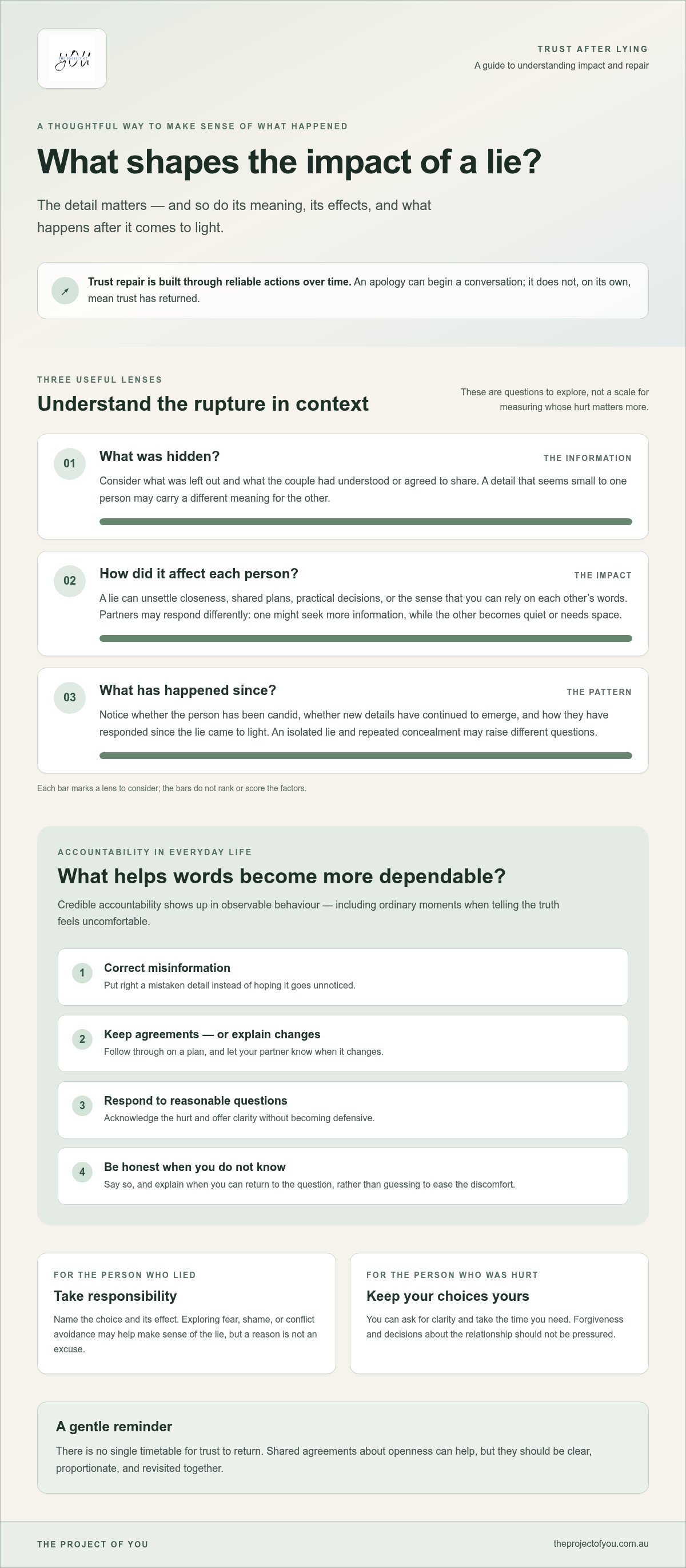
Trust repair means rebuilding reliability through consistent actions over time, rather than simply accepting an apology. Rebuilding trust after lying can feel disorienting because a lie may leave you unsure not only about the detail that was hidden, but also about what else you might not know. Words can start to feel less certain, and ordinary decisions, from making plans to sharing responsibilities, may suddenly raise new questions.
The impact depends on the situation and the people involved. Secrecy, repetition, the consequences of the information and what it means to each partner can all shape the rupture. One person might experience a withheld detail as a breach of closeness; the other might have thought it was unimportant. That difference in understanding doesn’t erase the hurt, but it can help explain why partners respond differently.
Why can one lie affect a relationship so deeply?
Close relationships often rely on a shared sense that you can take each other’s words seriously. When that expectation is shaken, it can be harder to feel settled together or know what to rely on. In attachment terms, the relationship may feel less like a dependable source of comfort. This isn’t a diagnosis, and it doesn’t mean everyone will react alike. One partner might seek more information, while the other becomes quiet or needs space. Both may be trying to manage uncertainty in different ways.
Consider someone who says they’ll be home after work but leaves out that they stopped to see a friend. The detail may seem small to the person who withheld it. Their partner might focus less on the stop itself and more on why it was hidden, especially if the couple had agreed to keep each other informed. The meaning of the lie grows from its context, not from a universal scale of what should hurt.
Does the type or pattern of lying matter?
It can matter, without making one person’s pain more legitimate than another’s. An isolated lie and repeated concealment may create different questions. After one incident, a partner might wonder what prompted the choice and whether it will happen again. If information has emerged bit by bit, they may also be trying to understand what is still missing. Neither pattern tells the whole story on its own.
It can help to consider three things: what was hidden, how it affected each person, and what has happened since it came to light. Has the person been candid, or have new details continued to emerge? Has the information affected shared plans, emotional closeness or practical decisions? These questions keep the focus on the specific rupture, rather than assuming the lie involved infidelity or any other particular behaviour.
Interpersonal Deception Theory offers an overview of how deception can shape communication between people. It may help explain why a lie affects more than the fact itself: people can also question the conversation, the explanation and what they understood at the time. Still, no theory can determine how a particular couple will feel. The details and each person’s experience matter.
What accountability looks like after someone has lied
Accountability is more than admitting that a lie happened. It means telling the truth as clearly as possible, recognising the effect on the other person, and responding to reasonable questions without turning the conversation into a defence of your character. The person who was hurt can ask for clarity; they don’t have to accept an apology before they feel ready.
Credible accountability is shown through consistent, observable behaviour that gradually makes words more dependable. An apology can open the conversation, but repair depends on what follows: whether someone corrects misinformation, keeps agreements and stays honest even when the truth feels uncomfortable.
It may be useful to understand why the lie happened, including fear, shame or conflict avoidance. Exploring those reasons can help someone recognise a pattern and make different choices. But a reason isn’t an excuse, and it doesn’t transfer responsibility to the person who was misled. In rebuilding trust after lying, explanations matter most when they support change rather than deflect attention from the impact.
How can an apology acknowledge harm?
An apology is more likely to feel meaningful when it names the choice and its effect, rather than focusing only on good intentions. For example, “I didn’t mean to upset you” may be honest, but it doesn’t recognise that leaving out information affected the other person’s sense of security or ability to make an informed decision.
Defensiveness, minimising the lie or asking for quick forgiveness can make it harder to speak openly. The person who lied may feel shame or fear of losing the relationship; the hurt partner may need time to put their questions into words. Both experiences can be acknowledged without making the impact disappear. No particular phrase guarantees trust. What matters is whether empathy and responsibility continue after the apology.
What does consistent honesty look like day to day?
Often, it appears in ordinary moments. Someone follows through on a plan, lets their partner know when it changes, and corrects a mistaken detail instead of hoping it goes unnoticed. If they don’t know the answer to a question, they say so and explain when they can return to it, rather than guessing to ease the discomfort.
After a lie, couples may discuss what openness would help them feel safer. They might agree to share changes to a plan or talk about certain topics at an agreed time. These arrangements should be clear, proportionate and reviewed together. Transparency is not the same as unlimited access to devices or constant checking. Monitoring imposed without agreement can leave both people feeling less safe, not more connected.
The Crisis Text Line’s guidance on rebuilding trust also highlights honesty and dependability as practical parts of repair. You might ask: “What action would help demonstrate reliability this week?” or “How can I be honest when I’m uncertain?” Keep the next step specific and realistic. A pattern of follow-through can offer more useful information than repeated promises.
If it’s difficult to have these conversations without getting stuck in blame or shame, booking a Free Consultation - 15 min with The Project of You can be a way to explore relationship counselling and what support might suit you.
How both partners can take part without forcing forgiveness
Both people can have a part in what happens next, but their responsibilities aren’t interchangeable. The person who lied is responsible for their choice and its impact. The person who was hurt is responsible for their own decisions about what they need, what feels acceptable and whether they want to continue the relationship. They aren’t responsible for causing the lie or carrying the work of repair alone.
There may be care and commitment alongside anger, grief, doubt or a wish for space. These feelings can shift or sit side by side. Rebuilding trust after lying doesn’t require either person to settle on a decision before they’re ready. Forgiveness, reconciliation and renewed trust are separate choices. None is a duty, and forgiveness doesn’t necessarily mean staying together or feeling safe again.
What boundaries can support emotional safety?
A boundary describes what you need or what you’ll choose to do to care for your wellbeing. It isn’t a punishment, and it can’t guarantee that another person will act honestly. Some boundaries can be agreed together; others may be personal. The aim is to make the next steps clearer, not to control each other.
For example, a couple might agree to discuss difficult topics at a planned time rather than raising them during the school run or late at night. They could clarify how decisions involving shared plans will be communicated. These agreements work best when they’re specific, mutual where appropriate and open to review as circumstances change. Boundaries should not require surveillance, coercion or disclosure that compromises anyone’s safety or privacy.
If a conversation becomes overwhelming, either person can ask to pause. Try to name what’s happening and, where possible, agree when you’ll return to the topic. A pause is different from using silence to shut the other person out. It can give both people room to settle and take part more thoughtfully.
How can the hurt partner keep agency?
There’s no required timetable for making sense of what happened. You might want answers one day and feel unable to talk the next. You may miss your partner while also feeling unsure whether the relationship is right for you. These mixed responses don’t mean you’re being inconsistent; they can reflect the difficulty of making choices while hurt and uncertain.
Rather than forcing a verdict, consider what would need to change for you to feel safer in the next conversation or in everyday life. You might ask yourself: “What do I need more clarity about?” “Which boundary matters to me now?” “What actions would help me understand whether change is happening?” You can take these questions one at a time.
The decision to stay, leave or take more time belongs to you. Your partner can contribute by respecting your pace and responding honestly, but can’t decide what you should forgive or what outcome you should choose. If both people are willing, small shared agreements can create a more considered path forward, without demanding certainty about the relationship’s future.
Practical ways to practise trust repair in everyday conversations
Trust repair can feel less overwhelming when a conversation has a clear, modest purpose. Rather than trying to resolve everything at once, agree on one topic to discuss and what you hope to understand by the end. The aim isn’t to reach perfect agreement. It’s to listen carefully, clarify what remains unclear and choose a manageable next step.
You could try this sequence:
Agree on one topic. For example, focus on what happened around a particular decision, rather than bringing in every unresolved concern.
Take turns listening. One person speaks while the other tries to understand before responding.
Clarify what you heard. Reflect back the meaning in your own words and invite corrections.
Choose a next step. Decide what information, action or follow-up conversation would be useful, without expecting it to settle everything.
Before talking, each person might ask: “What do I need from this conversation?” “Which value matters here, such as honesty, respect or privacy?” “What would help me feel safer speaking or listening?” These questions can help keep the conversation connected to what matters, rather than turning it into a contest over who remembers every detail correctly.
How can couples talk about the lie without repeating the same argument?
Try asking one clear question at a time, then pause to hear the response. For instance, if you’re discussing a changed family plan, you might ask, “When did you realise the plan had changed?” The other person can reflect back, “You’re trying to understand what I knew at the time,” before answering. This leaves room to correct misunderstandings without interrogating, minimising or assuming you already know the whole story.
If either person feels overwhelmed, take a break and agree when to return to the topic, if that feels safe. A pause can prevent the discussion from becoming harder to follow. If you don’t manage to stick to the plan, acknowledge that and decide together how to make the next conversation more workable.
How can partners notice whether repair is progressing?
Look for patterns, not a pass-or-fail result. Are agreed actions happening? Is it becoming easier to speak openly about the impact, including what remains uncomfortable? Notice both change and uncertainty. One calm conversation doesn’t prove everything is resolved, just as a difficult conversation doesn’t automatically mean progress is impossible.
You might each reflect: “What feels a little different?” “What’s still unresolved?” and “Are our agreements helping us feel respected and safe?” The answers may differ, and that’s useful information to explore, not evidence that one person is wrong. Rebuilding trust after lying is personal to each relationship, so avoid fixed timelines or universal milestones.
If you’d value a more structured space to talk, Choosing Couples Counselling: A Guide for Australians may help you consider what support could look like.
When relationship counselling may help you find a way forward
After a lie, it can be hard to talk without feeling pulled into the same painful exchange. Relationship counselling can offer a supported space to slow the conversation down, understand what happened and make room for each person’s needs. You don’t need to know whether you’ll stay together before seeking support. Uncertainty can be part of what you bring.
Counselling doesn’t decide the future of a relationship, and it can’t promise that trust will return or that you’ll reconcile. It can help you explore what feels unresolved, what each person needs to communicate, and what choices may fit your values. Sometimes gaining clarity about the relationship is a useful outcome in itself, whatever you decide next.
What can couples counselling help partners explore?
With support, partners can look at how conversations unfold: whether one person feels unheard, whether the other becomes defensive, or whether difficult topics are avoided altogether. You can explore the impact of the lie, what boundaries might help, and how to discuss questions without either person feeling pressured to reach a quick conclusion.
For instance, one partner may want to understand how a decision was made, while the other may feel overwhelmed by revisiting it. Counselling can help both express what’s happening for them and consider a manageable way to continue the conversation. It isn’t about deciding who is right or instructing you to remain together. The purpose is to create space for reflection and possible next steps.
Relationship counselling with The Project of You can provide a place to explore the rupture and what each of you needs from the process.
How can you take a first step towards support?
Starting counselling doesn’t require certainty about the relationship’s future or agreement on every detail of what happened. You might begin with questions such as: “What would help us have a more thoughtful conversation?” “What do I want support to help me understand?” or “What would make this feel respectful for both of us?” It’s also okay if your answers differ, or if you’re still working them out.
Azita Abdollahian, Founder of The Project of You, is a Clinical Social Worker and Psychotherapist. Her listed qualifications include MSW, B.Sc Psychology, Adv. Dip Psychotherapy, CMMT and Adv.DCH. If you’d like to explore whether counselling may suit your situation, you can book the Free Consultation - 15 min. There’s no need to arrive with a decision already made. You can take this step at your own pace.
Take your next step at your own pace
There’s no need to have the whole future mapped out before you decide what support might be useful. You might begin by asking yourself what you need to feel heard, what you’re ready to discuss and what you’d like more space to understand. Those answers can change, and you’re allowed to move carefully.
Rebuilding trust after lying isn’t a decision you have to make in a single conversation. Whether you’re considering repair, still weighing your options or simply hoping to communicate with more care, support can help you explore what matters without deciding the outcome for you.
If a supported conversation feels like a helpful next step, you can book a Free Consultation - 15 min with The Project of You.
Book a Free Consultation - 15 min You can take this one step at a time. Whatever you decide, your needs and your pace matter.
Frequently Asked Questions
Can trust be rebuilt after repeated lies?
It may be possible, but repeated concealment can make it harder to know what information is complete. Look for whether the pattern has stopped in the situations where it occurred, rather than relying only on broad promises. For example, if money was hidden, you might agree on a regular, calm time to review shared expenses. Consider whether that arrangement feels respectful and useful to both of you.
How long does it take to rebuild trust after lying?
There isn’t a dependable calendar for this. Instead of asking whether you should be “over it” by a certain date, notice how you respond to specific situations that once felt uncertain. For instance, after a partner follows through on a plan, do you feel more settled, unchanged or newly concerned? You could revisit that question together from time to time, without treating any one answer as a final verdict.
What if my partner keeps denying the lie?
If you can’t agree on what happened, try writing down the points you each understand differently and what information might clarify them. Keep the conversation focused on one specific discrepancy, rather than repeatedly presenting the whole case. If your partner won’t engage, you can decide what you need in order to feel comfortable with shared plans or decisions. You don’t have to resolve every disagreement before setting a personal limit.
Do I have to forgive someone before trust can return?
No. If forgiveness feels like pressure, you can set that question aside and focus on what you need today. For example, you might ask for a conversation about a particular concern, or choose not to discuss the issue until you feel ready. Forgiveness is personal; it isn’t a task you need to complete to make your feelings acceptable or to prove that you’re trying.
Can one person rebuild trust on their own?
You can take steps that support your own clarity, such as talking with someone you trust, writing down what you know and deciding which questions matter most to you. If you were the person who lied, you can examine what made honesty difficult and practise being direct in everyday situations. These actions can help you understand your choices and needs, even though they can’t determine how your partner will respond.
Is it normal to keep asking questions after discovering a lie?
Questions can come back as you remember details or encounter situations connected to what happened. Before raising one, consider whether you’re seeking a fact, reassurance or help understanding the impact. Naming what you hope the answer will clarify can make the conversation more focused. If a question has already been answered, you might note what still feels unresolved and decide whether a new detail has changed what you need to know.
Can relationship counselling help after lying?
It can offer a structured setting to slow down difficult conversations and make room for each person’s perspective. You might use a session to identify a recurring point of conflict, practise listening without interruption or clarify what you want help addressing first. If one partner feels unsure about attending together, individual counselling with The Project of You may provide space to reflect on their own needs and choices before deciding what to do next.



Comments