.png)

PTSD Therapy in Australia: A Compassionate Guide to Healing and Nervous System Restoration

What if feeling constantly on edge isn't a failure to cope, but your nervous system's attempt to keep you safe? PTSD can affect far more than your thoughts, often showing up as hypervigilance, flashbacks, intrusive memories, emotional disconnection and difficulty feeling safe even when the danger has passed.
At The Project Of You, psychotherapist and trauma expert Azita Abdollahian takes a trauma-informed approach to PTSD therapy, helping people understand how trauma affects both the mind and body. By exploring the connection between trauma, nervous system regulation and emotional wellbeing, therapy can provide a structured and compassionate pathway from survival mode toward greater safety, connection and resilience.
In this guide, we explore how trauma-informed PTSD therapy in Australia can support nervous system regulation, emotional healing and healthier relationships, and practical ways to begin moving forward.
Table of Contents
What is PTSD Therapy in Australia? Moving Beyond the Diagnosis
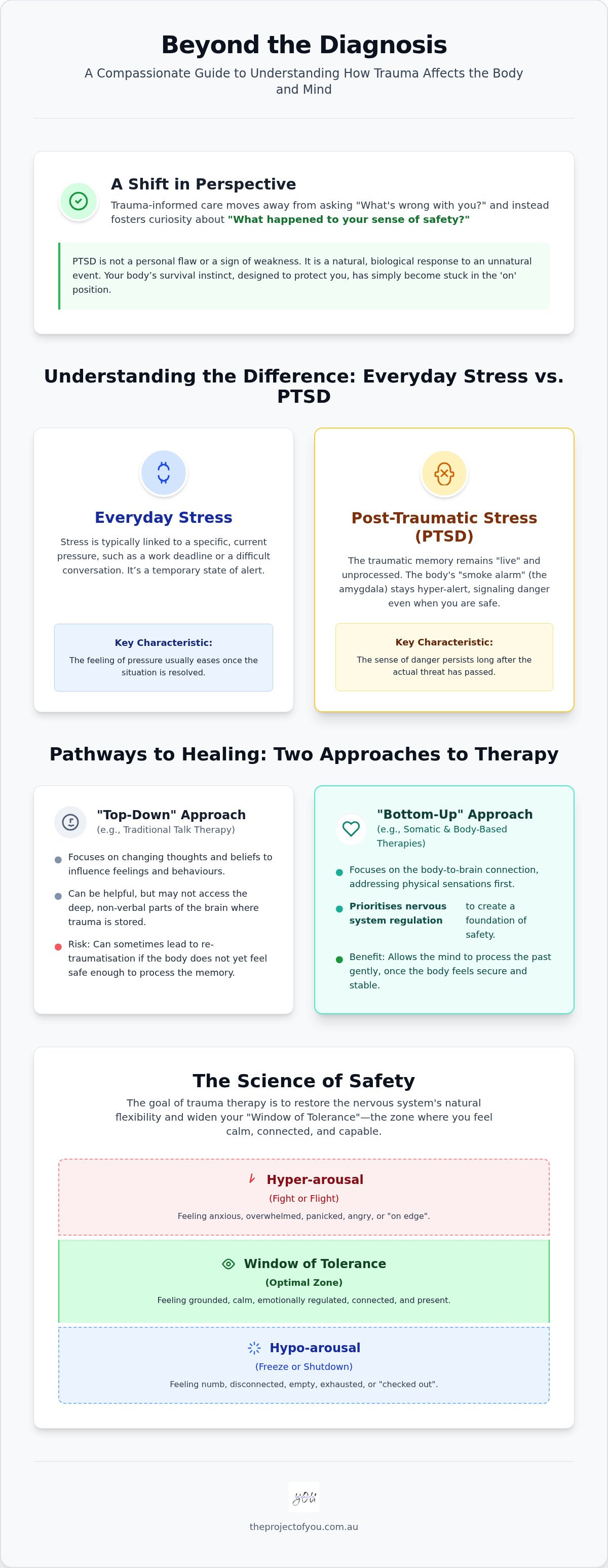
When you first begin exploring PTSD therapy Australia, it is common to feel overwhelmed by clinical definitions and diagnostic checklists. Often, a diagnosis can feel like a heavy label, but we prefer to see it as a map that explains why you have been feeling so lost. Instead of asking "what is wrong with you?", we shift the curiosity toward "what happened to your sense of safety?". This perspective acknowledges that PTSD is not a personality flaw or a sign of weakness; it is a natural response to an unnatural event. It is as if your survival instinct, designed to keep you safe during a crisis, simply got stuck in the "on" position long after the danger passed.
The Australian clinical landscape is guided by Phoenix Australia, our national centre of excellence for post-traumatic mental health. Their guidelines ensure that PTSD therapy Australia remains evidence-based and compassionate, advocating for a model where the therapist and client work as equal partners. As a Clinical Social Worker, Azita Abdollahian understands that healing is a collaborative journey. You are the expert on your own lived experience, and our role is to act as a steady, professional guide, helping you find your way back to a life that feels manageable and bright again.
Understanding What is PTSD involves recognising that trauma is not just a story about the past; it is a physiological reality that lives in the present. When we experience something deeply distressing, the brain can struggle to file that memory away correctly. This is why trauma-informed care is so vital. It creates a container of psychological safety where you can explore these experiences without being overwhelmed by them, ensuring you feel supported at every step of your personal evolution.
The Difference Between Stress and PTSD
Stress is usually tied to a specific pressure, like a work deadline or a difficult conversation, and it typically eases once the situation is resolved. PTSD is different because the traumatic memory remains "live" and unprocessed in the brain. Your amygdala, which acts as a smoke alarm for danger, stays hyper-alert and continues to signal for help even when you are safe in your own home. Because this is a physical change in how your brain functions, telling yourself to "just get over it" is like telling your heart to stop beating. It simply isn't possible without intentional support to help your nervous system return to a state of rest.
Why Traditional Talk Therapy Might Not Be Enough
Many people find that standard "top-down" approaches, such as traditional Cognitive Behavioural Therapy, only go so far. While changing your thoughts is helpful, these methods often don't reach the deep, instinctive parts of the brain where trauma is stored. In some cases, simply recounting a traumatic event can lead to retraumatisation if your body does not yet feel safe enough to handle the memory. This is why we emphasise "bottom-up" healing, which focuses on the body-to-brain connection. By prioritising nervous system regulation first, we create a stable foundation that allows your mind to finally process the past with grace and ease.
The Role of Nervous System Regulation in Trauma Recovery
To understand why PTSD therapy Australia is evolving, we must look at the "science of safety," also known as Polyvagal Theory. Think of your nervous system as a highly sophisticated biological compass. Its primary job is to tell you whether you are safe, in danger, or in a life-threatening situation. For those living with trauma, this compass has become demagnetised. It constantly points toward "danger," even when you are sitting in your living room or sharing a meal with a friend. This persistent state of high alert is not a choice; it is your body's attempt to ensure you are never caught off guard again.
We often speak about the "Window of Tolerance," a term describing the zone where you can manage your emotions and navigate life's challenges with relative ease. When you are within this window, you feel grounded, flexible, and capable of connection. However, PTSD often pushes you outside of this space into states of extreme distress or total numbness. According to the Australian PTSD Guidelines, effective treatment must address these physiological shifts. Nervous System Restoration therapy aims to recalibrate your internal alarm, helping you spend more time within your window and less time in a state of survival.
Understanding Your Body's Survival States
Your body has two main ways of reacting when it feels unsafe. Hyper-arousal is the "fight or flight" mode, where you feel anxious, angry, or unable to sit still. Conversely, hypo-arousal is a state of shutdown or numbness, often manifesting as "freeze" or "fawn." Fawning is a particularly subtle survival strategy where you prioritise the needs of others to avoid conflict or stay safe. Recognising which state you are inhabiting is the first step toward change. We also encourage you to look for "glimmers," which are small, micro-moments of safety or beauty that signal to your body that it is okay to soften, even if just for a second.
Practical Steps for Immediate Regulation
While deep healing takes time, there are simple tools you can use right now to signal safety to your vagus nerve. Grounding techniques that engage your five senses, like noticing the texture of your chair or the scent of your tea, can help pull your focus back to the present moment. Slow, intentional breathing is another powerful way to tell your brain the crisis is over. Perhaps the most vital element of recovery is co-regulation. This is the process of feeling safe in the presence of another person. Working with a compassionate professional can provide the steady anchor you need while you learn to navigate your own system. If you feel ready to explore this partnership, you might consider beginning your journey with a supportive session.
Modern PTSD Treatments: From Somatic Healing to Psychedelic Assisted Therapy
The landscape of PTSD therapy Australia is currently undergoing a profound transformation. We are moving away from a "one size fits all" model toward a more nuanced, multi-dimensional approach that respects the complexity of the human experience. As of 2026, the integration of somatic wisdom and emerging clinical treatments is offering new hope to the 1.4 million Australians living with PTSD. This evolution allows us to create a healing path that doesn't just manage symptoms but addresses the root of the physiological "stuckness" that trauma leaves behind. By weaving together different modalities, we can support your recovery from the inside out.
The Evolution of Trauma Care in Australia
The Therapeutic Goods Administration (TGA) made landmark decisions in 2023 to reclassify MDMA for the treatment of PTSD. By July 2026, these frameworks were further refined to ensure the highest standards of patient safety. Authorised psychiatrists must now demonstrate specific competency through supervised practice or clinical trials to prescribe these medicines. A vital part of this work is the "set and setting," which refers to the intentional, clinical environment and the therapeutic relationship that holds the experience. This isn't a silver bullet, but rather a powerful catalyst used within a structured therapeutic process. You can learn about our approach to Psychedelic Assisted Therapy and how it prioritises your long-term emotional safety and integration.
Somatic Therapy: Listening to the Body's Story
Somatic therapy invites us to listen to the story your body is telling. Trauma isn't just a memory; it is a physical reality stored in your fascia, muscles, and nervous system. If you have ever felt a sudden tightness in your chest or a "gut feeling" of dread without knowing why, you have experienced this body-memory. Through somatic work, we practice "titration." This means we process trauma in tiny, digestible drops rather than trying to tackle everything at once. This careful pacing ensures your system stays regulated, preventing the overwhelm that can sometimes occur when we only use talk-based methods. When your body finally learns that the threat has passed, you can begin to inhabit your physical self with a newfound sense of peace. Feeling safe in your own skin is the ultimate goal of PTSD therapy Australia, allowing you to move through the world with a sense of spaciousness and ease.
Navigating the Path to Recovery: What to Expect in Therapy
Choosing to begin PTSD therapy Australia is a profound act of courage. It marks the moment you decide that surviving is no longer enough and that you deserve to truly live. However, it is helpful to realise that the path to recovery is rarely a straight line. It is more like a spiral, where you might revisit old feelings from a new perspective of strength. This is perfectly normal. Healing involves building a "Therapeutic Alliance," which is a professional way of saying you need a practitioner you can trust with your story. This relationship is the most important tool in your kit, providing the safety required for your nervous system to finally let its guard down.
Finding the Right Trauma-Informed Practitioner
What does "trauma-informed" actually mean in practice? It means your therapist understands that your symptoms are brilliant survival strategies, not character flaws. When vetting a professional, don't be afraid to ask about their specific approach to somatic work or how they integrate nervous system regulation into their sessions. You might find it helpful to read about Azita’s journey and philosophy to see how clinical empathy and lived experience create a different kind of therapeutic space. A good therapist won't just listen; they will partner with you to navigate the complexities of your internal world with curiosity and grace.
The Power of Intensive Healing Environments
Sometimes, the rhythm of weekly sessions can feel a bit like treading water, especially when life's daily demands keep your stress levels high. While individual counselling is vital for long-term growth, there is immense value in stepping away from your regular triggers. Explore our Nervous System Retreats to understand how an intensive healing environment can act as a safe container for deep work. These immersive experiences allow you to focus entirely on restoration, often achieving breakthroughs in a single weekend that might take months in a traditional setting. It is about giving yourself the dedicated space to breathe and heal, far removed from the noise of the everyday world.
Remember, your recovery belongs to you. You are the architect of this process, and your therapist is the steady mentor helping you read the blueprints of your own healing. Whether you choose individual sessions, workshops, or retreats, the goal remains the same: returning to a state of wholeness where you feel safe, connected, and fully alive.
Creating Your Personal Roadmap to Healing
What if you could see yourself not as a patient to be fixed, but as the architect of your own restoration? This shift in perspective is one of the most powerful tools in your recovery. It moves you from being a passive recipient of care to becoming an active participant in your own journey. While the weight of trauma can feel like it defines your entire existence, it is actually just one chapter of your story. By integrating gentle boundaries and radical self-compassion into your daily life, you begin to build a structure that can weather any storm. Healing isn't about erasing the past; it is about building a present where you feel sturdy, capable, and deeply connected to yourself.
In the context of PTSD therapy Australia, creating a roadmap means recognising that your needs will change as you move through different stages of recovery. Some days will require the quiet of internal reflection, while others might call for the active work of nervous system regulation. By viewing your healing as a continuous path rather than a destination, you allow yourself the grace to move at a pace that feels right for your body. This intentional approach ensures that your progress is sustainable, helping you move away from the exhaustion of survival mode toward a life filled with genuine ease and purpose.
Building a Sustainable Support System
Healing does not happen in a vacuum. It requires a community of "safe people" and "safe places" where your nervous system can truly rest. In our often hectic Australian lives, it is easy to neglect the ongoing maintenance our bodies require. Identifying who in your life offers a sense of co-regulation is vital. When talking to partners or family about your journey, try framing your experiences through the lens of your nervous system. Instead of simply saying you are "stressed," you might explain that your system is currently feeling over-stimulated and you need a moment of quiet to recalibrate. This language fosters curiosity and allows your loved ones to become active partners in your "science of safety."
Taking the First Step Toward Restoration
It takes immense courage to even begin searching for PTSD therapy Australia. If you have spent years or even decades in survival mode, the idea of "thriving" might feel like a distant dream. Please remember that you don't have to carry this weight alone. With over 1.4 million Australians currently navigating PTSD, you are part of a community that understands the depth of your struggle. Taking that first step is a profound declaration that your well-being matters and that a different way of living is possible. We are here to walk beside you as you find your way back to your most authentic, regulated self.
Embracing a Future of Emotional Safety
Healing from trauma is not about forcing yourself to be "normal" again; it is about gently returning to the person you were always meant to be before your survival instincts took over. By understanding the science of safety and prioritising nervous system restoration, you can move beyond the constant state of high alert that has felt so exhausting. Whether you explore somatic work or the emerging field of psychedelic assisted therapy, you are taking an active role in your own recovery and transformation.
At The Project of You | Trauma, Couples & Relationship Therapy Australia, Azita Abdollahian provides the compassionate, evidence-informed guidance you need to navigate this transition with grace. We specialise in PTSD therapy Australia that respects the profound connection between your body and mind, offering a steady, professional presence in what can often feel like a chaotic world. You don't have to carry the weight of your past alone; there is a path forward that leads to genuine calm and lasting emotional regulation.
You deserve to feel safe in your own skin and to thrive in your relationships and your life. Your restoration starts with a single, courageous step toward the expert, heart-centred support you deserve.
Frequently Asked Questions
How do I know if I need PTSD therapy or if I'm just stressed?
If your reactions feel "stuck" or you are constantly scanning for danger long after a crisis has ended, you may need PTSD therapy. While stress usually fades once a pressure is removed, PTSD involves persistent intrusive memories and hyper-vigilance that disrupt your daily life. It is like an internal alarm that won't turn off. Seeking a professional assessment can help you understand if your nervous system is stuck in a survival state.
Is PTSD therapy covered by Medicare in Australia?
Medicare provides rebates for up to 10 individual sessions per calendar year through a Mental Health Care Plan. As of July 1, 2026, the rebate for a Mental Health Social Worker is $89.50 per session, making PTSD therapy Australia more accessible. You will need to visit your GP to discuss your eligibility and obtain a referral to a registered practitioner to begin accessing these subsidised sessions.
Can I recover from PTSD without talking about the traumatic event in detail?
Absolutely, as modern trauma care often prioritises "bottom-up" regulation over recounting the story. Somatic therapies and Nervous System Restoration focus on the physical sensations of trauma rather than just the narrative. This approach allows your body to find safety without the risk of being overwhelmed by specific memories. It is a gentle way to process what has happened without needing to find the perfect words for your experience.
How long does PTSD therapy usually take to see results?
The timeline for recovery is deeply personal and depends on your unique history and the type of support you choose. Some people experience significant shifts in their regulation after just a few weeks, especially when using intensive methods like retreats. For others, the journey of PTSD therapy Australia takes several months of steady work to build a lasting foundation of safety. We focus on sustainable progress rather than rushed results.
What is the difference between PTSD and Complex PTSD (C-PTSD)?
PTSD typically arises from a single traumatic event, whereas Complex PTSD (C-PTSD) results from repeated or prolonged trauma, often occurring in childhood or within relationships. C-PTSD often includes additional challenges with emotional regulation and a sense of negative self-perception. Both conditions respond well to trauma-informed care that focuses on rebuilding a sense of safety and secure attachment, acknowledging the deeper layers of interpersonal trauma often found in complex cases.
What should I do if I feel triggered between therapy sessions?
Practising grounding techniques that engage your five senses is the most effective way to manage a trigger in the moment. You might try naming five things you can see or feeling the texture of an object in your hand to signal to your brain that you are safe. It is also helpful to have a "safety plan" discussed with your therapist that includes gentle breathing exercises to help you return to your Window of Tolerance.
Are there specific PTSD treatments for first responders in Australia?
First responders in Australia have access to specialised trauma-informed care that understands the unique pressures of their roles. Whether you are in the police, fire, or ambulance service, your experiences require a therapist who recognises the cultural context of your work. These treatments often focus on the cumulative nature of "on-the-job" trauma and provide practical tools for nervous system maintenance to help you stay resilient in high-pressure environments.
Can couples counselling help if one partner has PTSD?
Couples counselling is an excellent way to navigate the impact of trauma on a relationship. When one partner has PTSD, their nervous system might be in a state of constant high alert, which can lead to misunderstandings or a sense of disconnection. By working together, you can learn to co-regulate and build a shared language that fosters curiosity rather than blame, helping both partners feel more secure and intimate in their connection.



Comments