.png)

Finding a Couples Therapy Therapist: How to Choose the Right Support in Australia

How do you find the right couples therapist when your relationship is already under pressure?
Finding a couples therapist isn’t about choosing someone who will decide who is right or wrong. The right couples therapist can help you and your partner understand the patterns creating conflict, disconnection or resentment and learn new ways of relating to one another.
As a psychotherapist, relationship expert and couples counsellor, Azita Abdollahian works with couples experiencing a range of relationship challenges, including ongoing conflict, communication difficulties, emotional disconnection, intimacy issues and the aftermath of betrayal. Her approach focuses on understanding what is happening beneath the conflict, rather than simply deciding who is at fault.
If one partner is unsure about starting couples therapy, or you’re both carrying significant hurt, it’s completely understandable to wonder what actually happens in a session and whether you will both feel heard and supported.
Choosing a couples therapist is an important decision. Consider their professional qualifications, clinical experience, therapeutic approach and experience working with the issues you and your partner are facing. You can also ask questions before booking to understand whether their approach feels like the right fit for both of you.
In this article, Azita Abdollahian explains how to choose a couples therapist, what qualifications and experience to look for, what questions to ask before your first session, and how to determine whether a therapist’s approach is suitable for your relationship. You don’t need to have everything figured out before reaching out — sometimes the first step is simply having a conversation about what support could look like.
Table of Contents
What does a couples therapy therapist do, and when might support help?
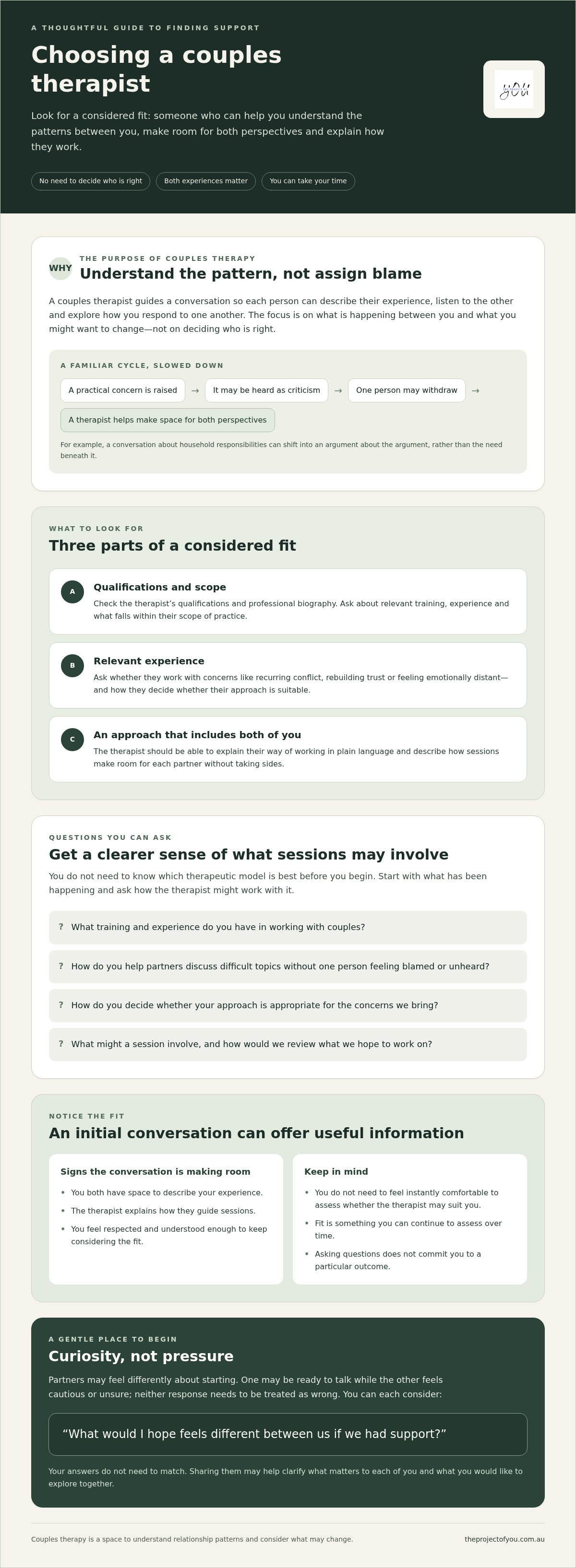
A couples therapy therapist helps partners explore relationship patterns, communication and concerns together. Rather than deciding who is right, the therapist guides a conversation where each person can describe their experience, listen to the other and consider how they respond to one another. The aim is to understand what’s happening between you and what you might want to change, not to assign blame.
For example, one partner might raise a practical issue, such as household responsibilities, while the other hears criticism and withdraws. The conversation can quickly become about the argument itself rather than the need beneath it. A therapist can help slow that cycle down and make room for both perspectives. Couples therapy includes different approaches, and what sessions look like depends on the practitioner’s training and way of working.
This differs from general relationship advice. Advice often suggests what someone should do; therapy makes space to understand the context, feelings and repeated interactions shaping a concern. Some practitioners use a structured approach, while others draw on several methods. Ask how a therapist works, what a session might involve and whether that approach fits what you’re hoping to explore.
What concerns can a couples therapy therapist help you explore?
Partners may seek support when conversations keep ending in the same argument, emotional closeness has faded, or it feels difficult to reconnect after a busy or stressful period. Some therapists also work with concerns involving attachment, trust or infidelity. These experiences don’t, by themselves, prove that a relationship is unhealthy or beyond repair. They can be starting points for a more open conversation about what each person needs and how you relate to one another.
Do you need to wait until the relationship is in crisis?
No. Couples may seek help with ongoing difficulties, after a specific rupture, or because they want to strengthen their relationship. You don’t need to wait until things feel unmanageable to explore support. It’s also common for partners to feel differently about beginning: one may be ready to talk, while the other feels cautious or unsure. That difference can be discussed without treating either response as wrong.
A useful place to begin is with curiosity, not pressure. Each partner might consider: What would I hope feels different between us if we had support? Your answers don’t need to match. Sharing them can clarify what matters to each of you and give a therapist a clearer sense of what you’d like to work on together.
How to assess a couples therapist’s training, experience and approach
Choosing a therapist involves more than finding someone whose title sounds familiar. Look for clear information about their qualifications, relevant experience and the concerns they work with. A couples therapy therapist should be able to explain their approach in plain language and describe how they make room for both partners’ perspectives without taking sides.
Which qualifications and experience should you ask about?
Check the practitioner’s professional biography and ask about training or experience related to what you’d like help with, such as recurring conflict, rebuilding trust or feeling emotionally distant. A professional title alone won’t tell you exactly how someone works, so it’s reasonable to ask what their training involves and what falls within their scope of practice. The American Psychological Association also offers practical guidance on how to choose a therapist, including questions you can use when considering a practitioner.
You might ask:
What training and experience do you have in working with couples?
How do you help partners discuss difficult topics without one person feeling blamed or unheard?
How do you decide whether your approach is appropriate for the concerns we bring?
Clear, thoughtful answers can help you understand what to expect. You don’t need to know which therapeutic model is best before you begin. Start by describing what has been happening and asking how the therapist might work with it. If you’re comparing practitioners, consider the relevance of their experience, how clearly they explain their process and whether both of you can imagine speaking openly with them.
How can a therapist’s approach suit both partners?
Different approaches offer different ways to understand relationship patterns. Cognitive behavioural therapy (CBT), for example, can help people notice links between thoughts, feelings and actions. A partner might interpret a delayed reply as rejection, feel hurt, then respond sharply. Exploring that sequence can create room to consider other meanings and choose a response more deliberately.
An attachment-informed perspective may explore how people seek closeness or space when they feel uncertain. Trauma-informed care means being attentive to personal history, emotional safety and each person’s capacity to discuss difficult experiences. It isn’t a promise of a particular outcome. Ask how the therapist would adapt conversations if either of you felt overwhelmed, and how they balance listening with gently examining each person’s contribution to a shared pattern.
You can also ask whether CBT, attachment or trauma-informed perspectives may be relevant to your goals. The Project of You’s couple counselling information offers another place to consider the service and its approach. Use what you learn to decide whether it aligns with what you both hope to explore.
How to tell whether a couples therapy therapist feels like a workable fit
Fit isn’t about finding a therapist who agrees with both of you all the time, or feeling completely at ease straight away. It’s a shared assessment of whether the conversation feels respectful, the process is clear and each partner has room to speak. A therapist may gently invite you to look at how you each contribute to a recurring pattern. That isn’t the same as saying both people are equally responsible for every concern.
You might worry that the therapist will take sides, particularly if you and your partner remember an argument differently. Ask how they work with differing accounts. A considered response should explain how they’ll listen to both experiences, explore the impact of each person’s actions and avoid reducing the relationship to a verdict about who is right.
What can emotional safety look like in an early conversation?
Notice whether the therapist listens without dismissing either person, explains what they’re doing and makes space for both partners to speak. You don’t have to feel relaxed at every moment. Discussing a tender subject can feel uncomfortable, and being respectfully challenged doesn’t automatically mean the therapist is a poor fit. Pay attention to whether questions are welcomed and your boundaries are treated with care.
After an initial conversation, you could each privately note what felt clear, what felt difficult and whether you felt able to express yourself. Compare observations with curiosity rather than treating them as a scorecard. For instance, if one partner felt interrupted or the pace felt too fast, raise that specific concern and ask how it could be handled in future conversations.
When might you ask for clarification or reconsider fit?
If the approach, goals or boundaries feel uncertain, ask the therapist to explain them in another way. You might say, “Could you help us understand how you’d respond if we disagreed about what happened?” What matters is not whether every interaction feels easy, but whether you can raise concerns without being shamed or pressured.
One awkward moment may not tell you everything. Look for patterns and, where it feels appropriate, discuss what didn’t sit well with you. A couples therapy therapist should be open to hearing that feedback and clarifying how they work. If either of you continues to feel dismissed or unable to speak freely, it’s reasonable to pause and consider whether another practitioner may be a better fit.
What to ask a couples therapist before your first session
You don’t need a perfect script before contacting a therapist. A few considered questions can help you understand how they work and whether their approach suits what you both want to discuss. Each partner could choose one question that feels especially important, then compare notes before you decide what to ask.
Questions about goals, communication and progress
A therapist may help you clarify what you hope will change, while recognising that your priorities could differ. Ask how goals are agreed on and revisited, rather than assuming there’s one fixed pathway. Consider asking:
What experience do you have working with concerns like ours?
How do you usually structure your work with couples, and what approach informs it?
How would you help us set goals if we want different things from counselling?
How do you make sure each person has space to speak and be understood?
How do we review progress, and what happens if our priorities change?
Progress doesn’t have to mean that every disagreement disappears. You might hope to understand each other more clearly, have difficult conversations with less distress, or decide what you want to work towards. Naming a small, meaningful hope can make the first conversation feel more grounded and gives you something specific to revisit later.
Questions about practicalities and boundaries
Practical details can affect whether counselling feels manageable, so confirm them directly with the practice rather than relying on assumptions. A couples therapy therapist should be able to explain the arrangements that apply to their service and answer questions about boundaries. You could ask:
What are the session arrangements, fees and cancellation terms?
How is confidentiality handled in couples work?
What information, if any, is shared between sessions or with either partner separately?
What should we do if one of us needs to pause a conversation or raise a concern about the process?
Confidentiality and information-sharing can work differently in couples work than in individual counselling. Ask the therapist to explain their specific approach, including any limits or relevant policies, so you both understand what to expect before sharing sensitive information. It’s reasonable to take time to consider the answers and discuss them together before deciding what you’re comfortable sharing.
Before you get in touch, each of you might finish this sentence: “I’d feel more prepared to begin if I understood…” It can turn uncertainty into a practical question without requiring either partner to feel completely ready.
Choosing a couples therapy therapist: a gentle next step with The Project of You | Trauma, Couples & Relationship Therapy Australia
Choosing support together doesn’t require certainty about the whole path ahead. Use what you’ve explored so far as a guide: check the therapist’s relevant experience, ask how they work, and consider whether both of you have room to be heard. A couples therapy therapist may be a considered fit even if you still have questions. What matters is being able to discuss those questions openly.
What The Project of You | Trauma, Couples & Relationship Therapy Australia offers couples considering support
The Project of You | Trauma, Couples & Relationship Therapy Australia offers couple counselling informed by CBT and trauma-informed care. CBT can help people notice how thoughts, feelings and actions connect, while trauma-informed care gives attention to personal history, safety and each person’s experience. These approaches may inform the work, but they don’t guarantee a particular outcome or mean the service will suit every couple.
The practice is founded by Azita Abdollahian, a qualified social worker, psychotherapist and neurofeedback trainer. You can read about Azita Abdollahian’s professional background and explore the couple counselling service to consider whether its information speaks to your needs. Counselling is distinct from a retreat; if you’re considering a different format, check the details of that option separately.
How to take a considered next step together
Before making contact, you might each name one hope, concern or question. One partner may want to feel closer, while the other may want to understand how conversations become tense. Different starting points don’t have to be resolved before you enquire. They can help shape what you ask and give you a chance to learn more about the available options.
You could also agree on what you’d need to understand before deciding whether to proceed, such as the therapist’s approach or practical arrangements. An enquiry doesn’t have to be a promise to continue. It can simply be a way to gather information and notice how the conversation feels for you both.
There’s no need to rush a decision. If The Project of You’s approach seems worth exploring, review the available information together and decide whether to take the next step.
Take your next step with care and clarity
Choosing a couples therapy therapist is about finding support that fits your concerns, values and needs as a couple. Look for relevant experience, ask how the therapist works, and notice whether you both feel respected and able to speak. Clear answers about goals, progress and practical arrangements can help you make a considered decision, even if you're not both at the same stage.
The Project of You offers couple counselling informed by CBT and trauma-informed care. The practice's founder, Azita Abdollahian, is a qualified social worker, psychotherapist and neurofeedback trainer. This may be one option to explore, though the right fit is personal and there's no need to promise yourselves a particular outcome before you begin.
If you're considering support, you might each share one hope or question first. An enquiry can be a way to learn more and decide together what feels appropriate, without pressure to have everything figured out.
Book online to explore couples counselling A thoughtful next step, however small, can help you move forward with greater understanding of what you both need.
Frequently Asked Questions
What does a couples therapy therapist do?
A couples therapy therapist supports partners to explore relationship patterns, communication and concerns in a structured setting. They may help each person express their perspective and notice how interactions unfold, such as how a disagreement escalates or gets avoided. The therapist’s approach and areas of experience vary, so ask what informs their work. You can discuss shared goals together, but counselling can’t guarantee reconciliation or any specific outcome.
How do we choose the right couples therapist?
Start by identifying what you’d like support with, then check the therapist’s stated qualifications, relevant experience and approach. Ask how they make room for both partners, agree on goals and respond if someone has concerns about the process. Notice whether their explanations feel clear and respectful. You don’t need to decide based on one detail alone; use your questions to consider whether the work seems suitable for you both.
Can a couples therapist remain neutral when partners disagree?
A therapist can aim to understand each person’s perspective without turning sessions into a contest over who is right. This doesn’t mean avoiding difficult topics or treating every action as equivalent. Ask how they approach disagreement, power and emotional safety. If one of you feels unheard, raise it directly and discuss whether the way the conversation is being guided needs attention. Their response can help you decide how workable the process feels.
When should we see a couples therapy therapist?
You can consider seeing a couples therapy therapist when disagreements keep returning, communication feels difficult, trust has been affected or you want to strengthen your relationship. There’s no single threshold that makes counselling worthwhile. Ask yourselves what feels hard to navigate alone and whether you’re willing to explore it together. A therapist can help you clarify possible goals, without promising that the relationship will follow a particular path.
What should we ask a couples therapist before starting?
Ask about their experience with concerns like yours, the approach they use and how goals are agreed and reviewed. You can also ask how each partner can raise concerns during the work. Confirm practical arrangements, fees and cancellation terms directly with the practice, and ask how confidentiality and information-sharing are handled in couples counselling. Preparing a short list together can help you feel clearer, while leaving room for questions that arise naturally.
Is couples therapy only for relationships in crisis?
No. Couples may seek support for a particular concern, to improve communication or to understand recurring patterns before things feel overwhelming. Each couple’s reasons and goals are different. Enquiring doesn’t mean your relationship has failed or that you’ve decided to separate. It can simply be a way to understand what’s happening between you and consider whether professional support might be useful for both partners.
What if my partner is unsure about seeing a couples therapist?
Ask what feels uncertain, and listen without assuming hesitation means a lack of care. Your partner may have questions about privacy, being blamed, fees or what sessions involve. Share what you hope to understand, then invite them to name their own concerns. You can contact a practice to clarify practical details, but try not to pressure either person into deciding before they feel ready to consider the option.


Comments