.png)

Disorganised Attachment in Relationships: Understanding the Push and Pull

Why can you desperately want closeness in a relationship, yet feel overwhelmed or want to pull away when it actually arrives?
If you find yourself craving reassurance one moment and needing distance the next, you may be experiencing patterns associated with disorganized attachment in relationships. This can create a confusing push-and-pull dynamic where intimacy feels deeply wanted but, at the same time, emotionally unsafe.
As psychotherapist, relationship expert and Clinical Social Worker Azita Abdollahian, explains, these patterns are not necessarily a sign that you are incapable of love or that something is “wrong” with you. They can be protective responses that develop around earlier experiences of relationships, stress and emotional safety.
Disorganized attachment can affect how you respond to conflict, vulnerability, reassurance and intimacy. You might pursue your partner for connection, then withdraw when they get close. Your partner may feel confused about how to respond, while you may feel equally confused by your own reactions.
Understanding disorganized attachment in relationships can provide a different starting point: curiosity instead of blame, and self-awareness instead of shame. Attachment styles are not diagnoses, nor do they determine the future of your relationship.
In this article, Azita Abdollahian explores what disorganized attachment is, why closeness can feel both comforting and threatening, how earlier experiences can influence relationship patterns, and practical ways to build greater emotional safety and connection. We’ll also look at how individual therapy and couples counselling can support you in understanding these patterns and creating a more secure way of relating.
Table of Contents
What does disorganised attachment in relationships mean?
Disorganised attachment describes a push and pull: wanting closeness with someone while also feeling an urge to protect yourself from it. You might long for reassurance, affection or support, yet find that being emotionally close feels unsettling or hard to manage. This can leave you caught between reaching out and stepping back.
Disorganised attachment in relationships is a pattern of conflicting responses to closeness, not a diagnosis, a personal failing or a fixed prediction of how a relationship will unfold. Attachment language can offer a way to reflect on what happens between you and others, but it can’t capture your whole identity or explain every part of your experience. Responses may also shift across relationships and situations. You might feel relatively settled with one person, but more guarded or uncertain when conflict, change or vulnerability enters another relationship.
How might the push and pull show up between partners?
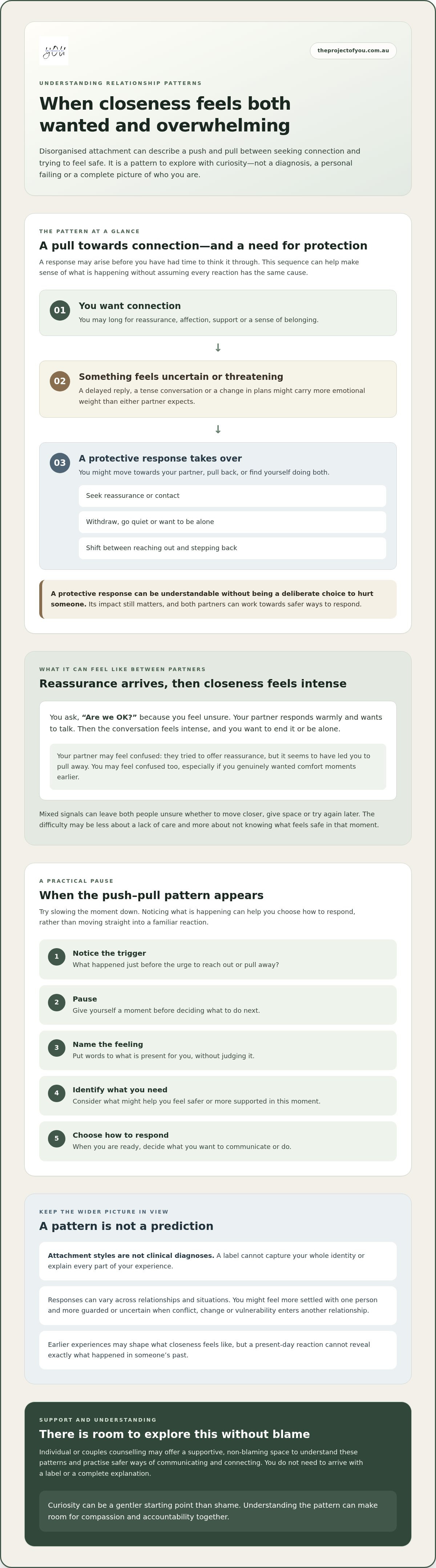
Imagine asking your partner, “Are we OK?” because you’re feeling unsure. They respond warmly and want to talk, but suddenly the conversation feels intense, and you want to end it or be alone. Your partner might feel confused: they tried to offer reassurance, but it seems to have made you pull away. You might feel confused, too, especially if you genuinely wanted comfort moments earlier.
For some people, the pattern may involve seeking reassurance and then feeling overwhelmed, going quiet after reaching out, or finding it difficult to trust comfort. These are possibilities, not a checklist for labelling yourself or your partner. Mixed signals can leave both people unsure whether to move closer, give space or try again later. The difficulty is often less about a lack of care and more about not knowing what feels safe in that moment.
Attachment researchers and clinicians use different terms for adult patterns. For a broad overview of the disorganized attachment style and how it is discussed alongside other adult attachment patterns, see this summary. Treat it as a starting point for reflection, not a tool for diagnosing yourself or someone else.
Is disorganised attachment a diagnosis?
No. Attachment styles are not, by themselves, clinical diagnoses. Noticing that you sometimes want closeness and sometimes need distance can help you become curious about your responses, but it doesn’t establish a mental health condition. A relationship pattern should not be treated as proof of a particular diagnosis.
If your experiences are causing distress, a qualified mental health professional can help you explore them in context. You don’t need to arrive with a label or a complete explanation. The focus can be on understanding what happens for you, what you need, and what may help you feel safer in connection.
Why can closeness feel comforting and overwhelming at the same time?
Connection can meet a real need for comfort and belonging, while also bringing uncertainty: Will I be understood? Can I trust this person to stay? In disorganized attachment in relationships, a protective response may arise before you’ve had time to think it through. You might move towards your partner, pull back, or find yourself doing both.
A possible sequence is: you want connection, something feels threatening, then you react by seeking contact, withdrawing or switching between the two. A delayed reply, a tense conversation or a change in plans might carry more emotional weight than either partner expects. This can help make sense of the push and pull, but it doesn’t mean every reaction has the same cause or that one childhood experience inevitably creates a particular adult pattern.
A protective response can be understandable without being a deliberate choice to hurt someone; its impact still matters, and both partners can work towards safer ways to respond. Understanding the pattern can make room for compassion and accountability without shame or blame.
What role can earlier relationships and experiences play?
Early caregiving may shape what a person expects from closeness, such as whether comfort will be available or whether it feels safe to show a need. But current reactions can’t reveal exactly what happened in someone’s past. In a peer-reviewed review, Fraley and Roisman describe adult attachment as developing over time, with both continuity and change, rather than as a fixed outcome of early experience. Their discussion offers context for understanding research on the development of adult attachment styles. For an accessible overview of signs and management, see Psych Central’s Signs, Causes, and Management.
How can stress affect connection and communication?
During heightened distress, it can be harder to listen, stay present or put a need into clear words. Someone may go quiet, urgently seek reassurance or struggle to take in a partner’s caring response. These reactions aren’t proof of a particular attachment style; they may simply signal that the conversation feels difficult to manage.
Nervous system regulation means finding ways to help yourself return to a more manageable level of distress. A pause, slower breathing or a short break may help some people, but these are optional supports, not substitutes for safety, boundaries or professional care. They connect with the wider conversation about trauma and nervous system dysregulation, while recognising that each person’s experience is different.
If you’d like support exploring how attachment, past experiences and present-day stress interact, you can learn about booking individual counselling with The Project of You.
How is disorganised attachment different from other relationship patterns?
Attachment patterns offer broad ways to describe how people may respond to closeness, uncertainty and support. They’re not fixed categories, and a person’s behaviour can change with the relationship or situation. The table below describes common tendencies. It isn’t a way to assess or label yourself or your partner.
Wanting reassurance doesn’t, by itself, mean someone has an anxious pattern. Nor does needing time alone automatically mean they’re avoidant. A push-pull experience may involve wanting connection but feeling uneasy once it’s offered, or shifting between reaching out and retreating. Focus on what repeats and how it affects each person, rather than whether every moment fits a label.
Could a label help you notice a pattern? Yes, if it opens a conversation. It isn’t a verdict on compatibility or a forecast of what your relationship can become. Understanding disorganized attachment in relationships may help you ask more useful questions: what tends to happen before you pull away, what do you need in that moment, and how might you and your partner reconnect respectfully?
Can someone recognise more than one attachment pattern?
Yes. Responses can be mixed and depend on context: someone may seek reassurance during conflict, yet prefer independence in other situations. Sources and frameworks may also use terms differently; “fearful-avoidant”, for example, isn’t used identically everywhere. Rather than searching for the perfect label, notice what repeats, what feels difficult, and what support or space you need.
What should a partner understand without taking responsibility for everything?
Both partners’ feelings matter. Understanding that a reaction may be protective can invite compassion, but it doesn’t excuse behaviour that causes harm or crosses boundaries. Each person remains responsible for how they act, even when emotions run high. Instead of deciding who is “the problem”, you might ask together: what happens between us when one of us feels uncertain, and what could help us pause or reconnect? This keeps the focus on the shared cycle without asking either partner to carry it alone.
What can you do when the push-pull pattern appears?
When emotions rise, it can be hard to know whether to move closer, take space or do both. A brief pause can help you respond with more intention. Try this sequence: notice what happened, pause, name the feeling, identify what you need, then choose one response.
Notice the trigger: What happened just before the urge to pursue, withdraw or shut down?
Pause: If it feels helpful and safe, take a few slower breaths or step away briefly.
Name the feeling: Is it fear, hurt, anger, shame or uncertainty?
Identify the need: Are you hoping for reassurance, time to think, a boundary or a clearer answer?
Choose a response: Make one direct request rather than testing your partner, disappearing without explanation or assuming you know their intent.
Notice, pause, name, identify, choose. You don’t have to find perfect words; even a small pause can create room for a clearer next step. Regulation practices, such as breathing slowly or noticing your feet on the floor, are optional supports. They don’t replace safety, boundaries or professional care, particularly if a relationship feels unsafe.
How can you communicate a need for closeness or space?
Try naming what’s happening for you and making one specific request: “I’m feeling unsettled and could use reassurance. Could you sit with me for a few minutes?” Or, “I’m overwhelmed and need some space. Can we pause and check in again after dinner?” Agreeing how and when to return to a conversation can make a pause clearer. It shouldn’t become indefinite silence or pressure to resolve everything before either person feels ready.
When might professional support be useful?
Consider support if the pattern keeps causing distress, conflict feels hard to repair, or attempts to talk leave you feeling stuck. Individual counselling can provide space to explore your own experiences and needs. Couples counselling can help partners understand their shared cycle and practise different ways of communicating, without assuming one person is to blame. If you’re looking for a couples counsellor, check their approach and experience, and consider what would help both of you feel heard. The Project of You | Trauma, Couples & Relationship Therapy Australia offers individual and couples counselling informed by attachment, trauma and nervous system care.
How can counselling support safer connection over time?
Counselling can offer a steady space to notice what happens in difficult relationship moments, explore the needs beneath your reactions and practise other ways of responding. The aim isn’t to force closeness or remove every uncomfortable feeling. It’s to understand your own experience and consider what may help you feel safer, communicate more clearly and respect each person’s boundaries.
For disorganized attachment in relationships, this might mean slowing down a familiar sequence: a partner seems distant, worry rises, and you reach out urgently or withdraw. With a counsellor, you could explore what that moment means to you, what you need and what responses feel possible at a manageable pace. Therapy should be responsive to your circumstances; you don’t need to fit a label, and professional support isn’t necessary for every person.
What might attachment-informed counselling explore?
Sessions may look at triggers, emotional safety, boundaries and the meanings you make of everyday interactions. For example, a change in tone might leave you feeling rejected before you’ve had a chance to ask what your partner intended. A therapist can help you approach such moments with curiosity, while taking your present circumstances and individual needs into account. The work should not assume one explanation fits everyone.
How can couples work support both partners?
Couples counselling can focus on the shared interaction rather than deciding which person is at fault. Each partner can describe what they experience, what they need and how the cycle affects them. A counsellor may help you recognise when you’re both getting stuck and practise ways to pause, listen and return to the conversation with care. Understanding a response can build compassion while still making room for accountability and clear boundaries.
The Project of You offers individual and couples counselling informed by attachment, trauma and nervous system care. If you’re considering support, you might first reflect on one recurring moment: What tends to happen, what do you feel, and what would you like to understand better? A suitably qualified professional can help you explore it if it feels distressing or difficult to shift alone.
Change may take time, and progress isn’t always steady. There’s no guaranteed outcome, but small moments of awareness can offer a starting point for trying a different response.
Take a gentler step towards safer connection
Understanding disorganized attachment in relationships can help make sense of the tension between wanting closeness and needing protection. The pattern is a way to reflect on what happens, not a diagnosis or a verdict on your identity or relationship.
When the push and pull appears, noticing what triggered it and naming the need beneath your response can create room for a clearer conversation. You and your partner don’t have to respond perfectly. Small moments of curiosity, honest communication and respect for boundaries can help you find a more considered way through conflict.
If the pattern feels distressing or difficult to shift alone, individual or couples counselling may offer a space to explore it at a manageable pace. The Project of You offers both, with trauma-informed care. Support isn’t a guaranteed fix, but you don’t have to make sense of everything by yourself.
Book a session when you feel ready There’s no need to rush. With time, care and support that fits your circumstances, new ways of relating may become easier to explore, one conversation at a time.
Frequently Asked Questions
Is disorganised attachment a recognised diagnosis?
No. Disorganised attachment is a way of describing a relationship pattern, not a clinical diagnosis in itself. A qualified professional can assess mental health concerns using relevant criteria, but an attachment label alone can’t establish a condition. Reactive Attachment Disorder is a separate childhood diagnosis associated with severe caregiving disruption; it shouldn’t be used as another name for adult relationship difficulties.
Can disorganised attachment affect adult relationships?
It can be a useful way to understand why someone might seek closeness and then feel unsettled by it. In disorganized attachment in relationships, a person may reach out for reassurance, then withdraw when a conversation feels intense. This can leave both partners unsure how to reconnect. These responses vary, though, and don’t define a person or determine how every relationship will unfold.
How do I know if I have disorganised attachment?
You can’t confirm an attachment style from a checklist or one difficult interaction. Instead, reflect on recurring experiences: do you often want support but find it hard to receive, or feel pulled between reaching out and taking distance? Consider what situations bring this up and what you need then. If the pattern causes distress, a suitably qualified professional can help you explore it without assuming a label.
Can someone with disorganised attachment have a healthy relationship?
Yes, an attachment label doesn’t rule out a caring, respectful relationship. What matters is how both people communicate, respond to conflict, respect boundaries and take responsibility for their actions. Greater awareness may help you recognise a familiar pattern and try a different response, though change can take time and isn’t guaranteed. You and your partner can work towards emotional safety without expecting either person to be perfect.
What can trigger a push-pull pattern in a relationship?
There isn’t one universal trigger. Uncertainty, disagreement, a delayed reply, perceived rejection or a change in plans may feel difficult for some people, while others may respond differently. Notice what happened just before you felt an urge to seek reassurance or withdraw. That observation isn’t proof of a particular attachment style; it can help you understand the moment and decide what to ask for.
Can attachment patterns change over time?
People’s ways of relating aren’t necessarily fixed. Self-awareness, supportive relationships and counselling may help someone understand recurring responses and practise other ways to communicate or manage difficult moments. Progress can be gradual and uneven, and no particular outcome is assured. You might begin by noticing one familiar interaction and asking what you felt, what you needed and what response you’d like to try next time.
How can I support a partner without losing my own boundaries?
Listen with curiosity and ask what would feel supportive, but don’t take responsibility for managing your partner’s every feeling or reaction. You can offer reassurance while being clear about what behaviour is and isn’t acceptable to you. For example, agree to pause a heated conversation and return to it at a mutually workable time. Understanding someone’s distress doesn’t mean excusing harm or setting aside your own needs.


Comments