.png)

Deep Emotional Healing Therapy: Finding a Supported Path Forward

What if deep emotional healing therapy didn’t mean revisiting every painful experience before you felt ready? If familiar coping strategies haven’t shifted recurring patterns, it can be discouraging to wonder whether anything will help. It’s also understandable to feel uncertain about therapy, especially when opening up feels vulnerable or unfamiliar. A thoughtful process should make room for your readiness, not rush you.
Deep emotional healing therapy can involve understanding how past experiences, emotions and protective habits shape life now, while building new ways to respond. With trauma expert Azita Abdollahian at The Project Of You, the work can be collaborative and paced, with attention to emotional safety. You don’t have to know exactly what to say or have every memory neatly explained before seeking support.
This article explores what this kind of therapy may involve, how to consider a therapist’s approach and whether the fit feels right, and what a manageable first step could look like. It also explains, in plain English, how trauma-informed care and approaches such as CBT may support reflection, without assuming one approach suits everyone. The aim isn’t to promise a particular outcome, but to help you find a steadier place to begin.
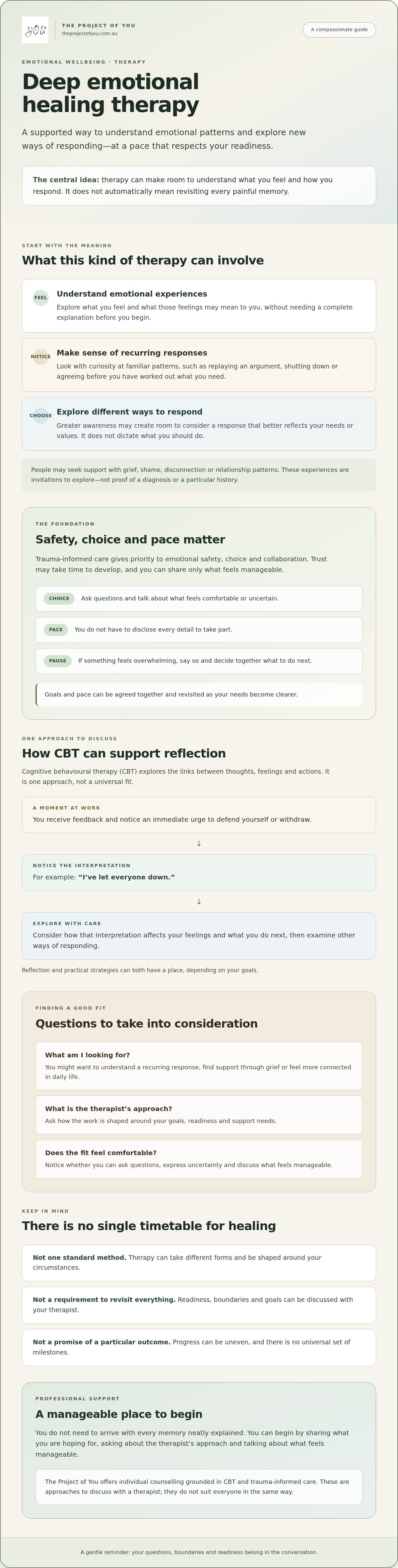
Deep emotional healing therapy isn’t one standard method. It can help you understand emotional patterns and explore different ways of responding.
Therapy doesn’t automatically mean sharing every painful memory. You can discuss your readiness, boundaries and goals with a therapist.
Before choosing support, clarify what you’re looking for, ask about the therapist’s approach and consider whether the fit feels comfortable.
Noticing the emotions and meanings behind recurring responses may help you make choices with greater awareness.
The Project of You | Trauma, Couples & Relationship Therapy Australia offers individual counselling grounded in CBT and trauma-informed care, which you can consider as one option for professional support.
Table of Contents
What does deep emotional healing therapy mean?
Deep emotional healing therapy is supported work to understand your emotional experiences and develop new ways of responding. It isn’t one standard method or a promise to uncover a single cause for everything you feel. The phrase describes a focus: making sense of what’s happening inside, noticing patterns and considering what might help you move forward.
People may seek support while living with grief, shame, disconnection or repeated relationship patterns. Perhaps conflict leaves you unsettled long after a conversation ends, or you notice yourself agreeing to something before you’ve worked out what you need. These responses can be approached with curiosity. On their own, they don’t prove a particular diagnosis or history.
Healing doesn’t mean erasing memories, avoiding difficult feelings or reaching a state where you’re never affected by life. It may mean finding more room to understand feelings, make choices and respond with care, even when old experiences still matter. Therapy can take different forms. For example, Emotionally Focused Therapy is one specific approach. A research review by Wiebe and Johnson, “A Review of the Research in Emotionally Focused Therapy for Couples” (Family Process, 2016), examines research on this model. It’s one approach, not a definition of deep emotional healing therapy.
What might lead someone to seek emotional healing therapy?
You don’t need to be in crisis or arrive with a complete explanation. You might simply be tired of replaying an argument, shutting down when someone asks what’s wrong, or feeling guilty whenever you set a boundary. These moments can be starting points for asking what you feel, what matters to you and what response you’d like to practise. They’re invitations to explore, not evidence that something is wrong with you.
Does deep emotional healing look the same for everyone?
No. People bring different histories, strengths, priorities and support needs. One person may want to understand a recurring response; another may be seeking support through grief or hoping to feel more connected in daily life. Progress can be uneven, and there’s no universal timetable or set of milestones to reach.
Therapy goals and pace are agreed collaboratively and can be revisited as your needs become clearer. You can bring questions, share what feels manageable and say when you need to pause. That shared process helps keep the work grounded in your circumstances rather than an assumed idea of what healing should look like.
How can therapy support deeper emotional change?
Therapy can offer a steady relationship in which you explore what you feel, what those feelings mean to you and how you tend to respond. It isn’t one technique applied in the same way to everyone. Over time, noticing a recurring response may help you pause and consider a choice that better reflects your needs or values.
For example, after receiving feedback at work, you might notice an immediate urge to defend yourself or withdraw. Exploring what you felt in that moment, and what you feared the feedback meant, can make the reaction more understandable. That awareness doesn’t dictate what you should do. It can create room to decide how you want to respond.
Cognitive behavioural therapy (CBT) explores the links between thoughts, feelings and actions. In plain terms, it can help you notice how an interpretation, such as “I’ve let everyone down”, affects your emotions and what you do next. A therapist may work with you to examine that interpretation and consider other ways of responding. CBT is one approach, not a universal fit.
Why do safety, trust and pace matter in therapy?
Trust may take time to develop. You can ask questions, talk about uncertainty and share only what feels manageable. You don’t have to disclose every detail to take part. Trauma-informed care gives priority to choice, collaboration and emotional safety, rather than assuming one pace suits everyone. If a conversation or exercise starts to feel overwhelming, saying so can help you and your therapist decide what to do next.
How can therapy approaches work together?
Reflection and practical strategies can both have a place, depending on your goals. You might spend time understanding a pattern, then consider a small response to practise between sessions. The Project Of You offers individual counselling grounded in CBT and trauma-informed care. These are approaches to discuss with a therapist, not solutions that suit everyone. The American Psychological Association’s guidance on how to choose a therapist may also help you think about fit and what to ask.
An evidence-informed approach can guide the work, but it can’t guarantee a particular result. In deep emotional healing therapy, it’s reasonable to keep checking whether the conversations, pace and strategies make sense for you. If you’d like to explore professional support, you can read about booking individual counselling with The Project Of You.
Does emotional healing therapy mean revisiting every painful memory?
No. Therapy doesn’t automatically require you to share every detail of a painful experience or relive it in the room. You can begin with what’s happening in your life now, such as feeling tense after a disagreement or finding it hard to sleep before a difficult conversation. The focus can be on what you want help with today.
Some emotional discomfort may arise as you explore difficult feelings, but discomfort isn’t proof that therapy is working, and it shouldn’t be used to pressure you into disclosure. In deep emotional healing therapy, you and your therapist can talk about your readiness, boundaries and goals, then consider what feels manageable. You can ask why a topic or exercise is being suggested and discuss other options.
What if talking about the past feels too difficult?
You could say, “I’m not ready to talk about the details,” or explain what you feel comfortable discussing at this point. Present-day concerns and practical goals can still be part of the work. Before beginning, consider asking the therapist how they respond if a conversation feels emotionally intense, and what you might do together to pause or shift focus.
It can help to agree on a simple way to signal that you need a break. You might ask to slow down, talk about what you’re noticing in the moment, or return to a more immediate concern. The right option depends on you and the situation. You don’t have to prove that an experience was painful enough to deserve care.
How can someone recognise whether therapy feels respectful?
Notice whether the therapist listens, takes your concerns seriously and includes you in decisions about the work. You should be able to express uncertainty, ask questions and talk about what doesn’t feel right. If you leave a conversation feeling unsettled, that’s worth reflecting on and raising, rather than assuming you must simply comply.
Fit can take time to assess. You might ask yourself: “Do I feel heard?”, “Can I be honest about my limits?” and “Are we clear about what we’re working towards?” No therapist or process will feel comfortable at every moment, but your perspective should remain part of the conversation. If an approach doesn’t seem helpful, you can discuss adjusting it or, where appropriate, seeking a different practitioner.
Therapy isn’t a cure or a guaranteed path to a particular outcome, and people’s experiences vary. What matters is having space to discuss what feels safe enough to approach, what you hope to work on and how you’ll review whether the support is a good fit.
Choosing and preparing for emotional healing therapy.
Choosing support is a personal decision, and you don’t need to have everything worked out before you start. A few considered steps can help you find a practitioner and approach that feel worth exploring. Begin by naming what you’d like support with: perhaps feeling less overwhelmed after conflict, understanding a recurring pattern or making space for grief. You can also note what you hope might feel different, knowing those goals can change as you learn more about what you need.
Next, review the approaches a practitioner offers and consider whether they connect with your concerns. You might check their relevant qualifications and professional affiliations, and ask about their experience with the issues you want to discuss. In Australia, practitioners can have different professional backgrounds, so it’s reasonable to ask what their training and approach involve rather than assume every title means the same thing.
What questions can you ask a therapist before beginning?
Questions can help you understand how the work might unfold and whether you feel included in it. For example, you could ask:
How do you work with concerns like the ones I’ve described?
How do you make space for my choices and boundaries during sessions?
What might we do if a conversation feels overwhelming?
How do we review progress and decide together whether to adjust the approach?
You don’t need to ask every question at once. Notice whether the answers are clear and whether you feel able to ask follow-up questions. That exchange can offer a useful sense of how communication may feel.
What can you bring to an initial therapy conversation?
A few notes may help if you feel unsure where to begin. You could write down what’s been troubling you, what you’ve already tried and one or two things you’d like to understand. You don’t need a polished account of your past. It’s okay to say, “I’m not sure where to start,” or to focus on a practical concern in your life now.
Before the conversation, ask yourself: What would help this feel more manageable? Perhaps you’d like to take notes, ask how the practitioner will approach a sensitive topic, or begin with what’s happening in the present. With deep emotional healing therapy, a first conversation can be a chance to explore fit and clarify what you’re looking for, not a commitment to a particular approach or outcome.
If you’re considering individual counselling, you can explore this option with The Project Of You.
What could a supported next step with The Project Of You look like?
If you’re considering professional support, individual counselling with The Project Of You is one option to explore. The practice’s work includes CBT and trauma-informed care. These approaches can be discussed in relation to your concerns, without assuming they’ll suit everyone or promising a particular result.
How does The Project Of You describe its counselling support?
The practice is owned and operated by Azita Abdollahian, a qualified social worker, psychotherapist and neurofeedback trainer. You can learn more about Azita Abdollahian’s professional background as you consider what matters to you in a practitioner. It may help to think about what you’d like the counselling conversation to focus on and what questions you want to ask.
You don’t need to arrive with a complete account of your experiences. You could begin with one concern, such as feeling disconnected or wanting to understand a response that keeps repeating, and use the conversation to explore whether the practice’s support seems appropriate for what you’re seeking.
What is one gentle next step if you’re ready to explore support?
If you feel ready to speak with the practice, reviewing the booking information is one possible next step. Booking doesn’t guarantee that a particular approach will be suitable or lead to a specific outcome. It can simply open a conversation about what you’re looking for and whether the support feels like a fit.
There’s no need to rush your decision. You can take the time you need.
Take a considered step towards support
Deep emotional healing therapy is not about forcing yourself to revisit every painful memory or reaching a perfect emotional state. It can be a collaborative way to understand feelings and recurring responses, with goals and pace shaped around your needs. You can ask questions, share what feels manageable and take time to consider whether a practitioner’s approach feels right.
If you’re exploring individual counselling, The Project Of You offers support grounded in CBT and trauma-informed care. The practice is owned and operated by Azita Abdollahian, a qualified social worker, psychotherapist and neurofeedback trainer. These details may help you decide whether you’d like to learn more, while remembering that suitability and outcomes are individual.
You don’t need a complete explanation of what you’re experiencing before reaching out. A question or one concern you’d like to explore can be enough to begin a conversation.
Whatever you choose, you’re allowed to move at a pace that respects your readiness. A small, considered step can help you find your way forward.
Frequently Asked Questions
What is deep emotional healing therapy?
Deep emotional healing therapy is supported work to understand emotional experiences and develop new ways of responding. It isn’t one standard method. A therapist may help you notice how feelings, interpretations and familiar reactions connect, then explore what choices fit your needs and values. The focus can include present-day concerns as well as past experiences, without assuming that every person needs the same approach or goals.
Can therapy help with emotional pain from past experiences?
Therapy can provide space to explore how past experiences affect you now, though what feels helpful varies between people. You might look at why a disagreement leaves you unsettled or why it’s hard to express a need. Exploring these responses can support greater understanding and new ways of approaching them, but therapy can’t promise a particular result. You can discuss what you hope to work towards with a practitioner.
Do I have to talk about everything that has happened to me?
No. You don’t have to share every detail or recount painful events before you feel ready. You can tell a therapist what feels manageable, what you’d prefer not to discuss and what support you’re seeking in the present. Questions about pacing, boundaries and options belong in the conversation. If a topic feels too intense, you can say so and discuss pausing or changing focus.
How do I know if a therapist is right for me?
Notice whether you feel listened to, taken seriously and included in decisions about the work. You can ask about their qualifications, professional affiliations, experience with your concerns and approach to boundaries and goals. It may take time to reflect on fit. If you feel uncertain or something doesn’t seem helpful, raise it with the therapist. Adjusting the approach or seeking another practitioner may be appropriate.
How long does emotional healing therapy take?
There’s no set timeline for emotional healing therapy. The time involved can depend on your concerns, goals, preferences and the kind of support you’re seeking. Rather than expect fixed milestones, discuss what you’d like to work towards and how you and your therapist might review whether the approach is useful. Goals can change as your understanding develops, and progress may not feel even from one stage to another.
What is the difference between CBT and trauma-informed therapy?
CBT, or cognitive behavioural therapy, explores links between thoughts, feelings and actions, and may help you examine patterns and practise different responses. Trauma-informed therapy is an approach that prioritises choice, collaboration and attention to emotional safety when discussing difficult experiences. They describe different things and may be used together, depending on the practitioner and your needs. Neither approach is a universal fit or guarantee of a particular outcome.


Comments