.png)

How to Deal with a Partner’s Affair: A Compassionate, Practical Guide

An affair can be one of the most traumatic experiences in a relationship. But what if the first step after discovering an affair isn’t deciding whether to stay or leave, but finding enough steadiness to hear what you need? If you’re searching for how to deal with a partner's affair, you may be carrying shock, anger, grief and doubt all at once, while feeling pressure to make a decision before you’re ready. It makes sense to want answers and to feel unsure where to begin.
As trauma and relationship expert Azita Abdollahian tells her clients, you don’t have to settle the future of your relationship today. Staying doesn’t mean excusing what happened, and leaving doesn’t mean you gave up too soon. For now, focus on what may help you feel safer, clearer and more supported in the immediate aftermath.
This guide offers practical ways to care for yourself, set boundaries and prepare for grounded conversations, including what information you may want to ask for. It also explores individual and couples support, so you can consider your options without being pushed towards a particular outcome. One step at a time is enough.
Table of Contents
How to deal with a partner's affair when everything feels overwhelming
If you’ve just discovered an affair, you don’t have to decide today whether to stay or leave. To begin thinking about how to deal with a partner's affair, focus on what can help you through the next few hours: attend to immediate needs, pause major decisions where circumstances allow and reach out to someone you trust.
You might feel furious one moment, numb the next, then deeply sad or uncertain. These feelings can coexist, and there’s no single correct way to respond. Even familiar tasks, like making dinner or replying to a message, may feel unusually difficult when your thoughts keep returning to what happened.
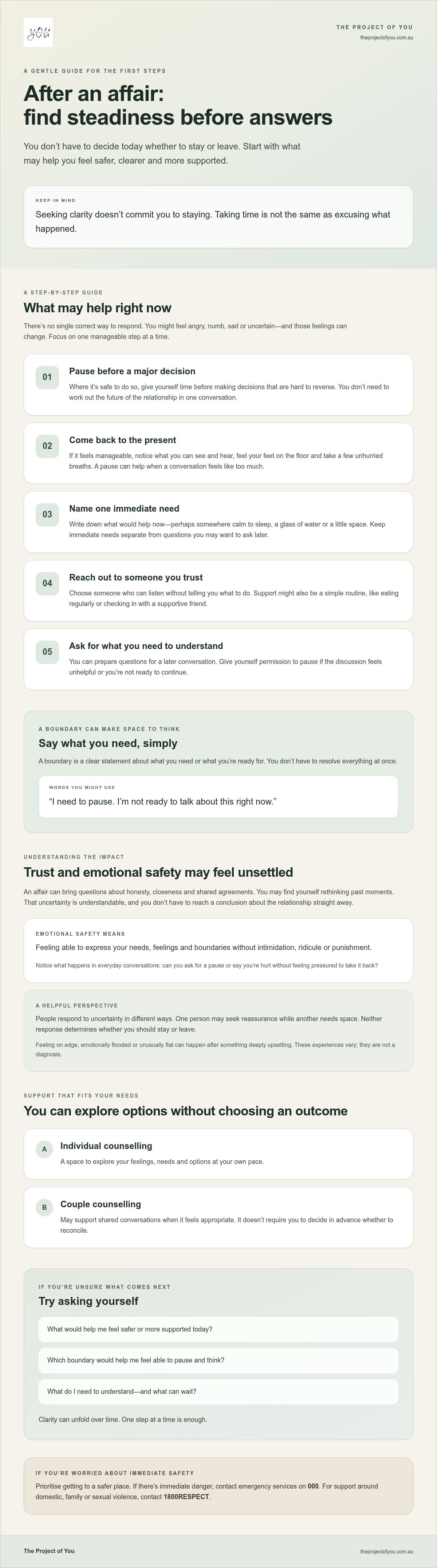
Try a brief grounding pause before continuing a difficult conversation. Notice what you can see and hear around you, feel your feet on the floor and take a few unhurried breaths. You could say, “I need to pause. I’m not ready to talk about this right now.” Then choose one manageable next step, such as drinking water, calling a trusted person or writing down a question.
What should I do first after discovering an affair?
Where it’s safe to do so, give yourself time before making decisions that are hard to reverse. Choose one person who can listen without telling you what to do. Write down immediate needs, such as somewhere calm to sleep, separately from questions you may want to ask later. You don’t need to solve everything in one conversation.
If you’re unsure how to name what happened, this broad overview of understanding what constitutes infidelity may offer context. Your own relationship boundaries and agreements still matter.
Why can the first days feel so disorienting?
When something deeply upsetting happens, the body and mind can shift into a state of high alert or feel shut down. This can make it harder to concentrate, sleep, take in information or find words during a conversation. It’s a stress response, not a diagnosis. Slowing things down and returning to basic needs may help before you try to make sense of every detail.
People respond to betrayal in different ways. Some seek answers straight away, while others need quiet or time before they can talk.
If you’re concerned about your immediate safety, prioritise getting to a safer place and contacting emergency services on 000 if there’s immediate danger. For support around domestic, family or sexual violence, you can contact 1800RESPECT. You deserve help that takes your safety seriously.
How an affair can affect trust, attachment and emotional safety
An affair can unsettle more than confidence in a partner’s honesty. It may prompt questions about closeness, shared agreements and the meaning of past moments. You might find yourself rethinking what you believed about the relationship. That uncertainty is understandable, but you don’t have to reach a conclusion about the relationship straight away.
Emotional safety means feeling able to express your needs, feelings and boundaries without intimidation, ridicule or punishment. After trust has been disrupted, you may need time to feel safe enough to speak openly. Notice what happens in everyday conversations: can you ask for a pause or say you’re hurt without feeling pressured to take it back?
Attachment is a way of understanding how people seek closeness and respond to uncertainty in important relationships. In their foundational study of romantic love and attachment, Hazan and Shaver explored how attachment ideas could apply to adult romantic relationships. This can be a lens for reflection, not a fixed label or proof of what you should do. One person may seek reassurance while another needs space, but neither response determines whether you should stay or leave.
Why might my emotions change from hour to hour?
After a deeply upsetting event, you might feel on edge, emotionally flooded or unusually flat. People’s experiences vary, and these reactions aren’t a diagnosis. “Nervous system regulation” describes how the body shifts in response to stress and settles again. You may feel composed while focused on work, then find difficult feelings surface when you get home and have more space to think.
How can I begin to feel more emotionally grounded?
Try a gentle practice only if it feels manageable. Press your feet into the floor, notice a few things around you or step outside for fresh air. A simple routine, such as eating regularly or checking in with a supportive friend, may offer some structure. These actions won’t resolve relationship questions, but they can help you attend to yourself as you consider them.
You can read more about trauma and nervous system dysregulation in The Project of You’s articles. If you’d like a private space to explore what you’re feeling and need, individual counselling may be one option. You don’t need to make a decision about the relationship first.
How to talk about the affair without rushing forgiveness or reconciliation
Talking about what happened can help you understand your options, but it doesn’t mean you have to forgive, reconcile or decide the future of the relationship straight away. When considering how to deal with a partner's affair, give yourself permission to ask for clarity at a pace you can manage. Forgiveness is personal. It can’t be demanded as proof of love or used to skip over the impact of the affair.
It may help to distinguish between information that answers a question you need to make sense of events and details that leave you more distressed without adding clarity. There’s no required checklist. Consider what you most need to understand now and what can wait. Writing down questions beforehand can give the conversation a clearer focus.
What questions can help create clarity?
Choose questions that fit your situation. For example: “What do I need to know to understand what happened?”, “Are you willing to answer my questions honestly?” or “What boundaries are you prepared to respect now?” You don’t have to ask everything at once, and you can decide that some details aren’t useful for you. If either of you is too overwhelmed to listen or speak respectfully, pause and agree to return to the conversation later, if that feels appropriate.
Accountability means engaging honestly with the impact of the affair, responding to reasonable questions and respecting agreed boundaries. It can create conditions for more considered conversations, but it doesn’t guarantee that trust will return. Notice whether actions over time align with what’s being said, without feeling you must reach a verdict immediately.
How can I set boundaries while I decide what comes next?
A boundary is a clear statement about what you need and what you’ll do to care for yourself. It isn’t a way to control another person. You could ask to discuss the affair at an agreed time rather than during work, request personal space for a few days or say you’ll end a conversation if it becomes disrespectful. These are starting points, not rules you must adopt.
Try using direct, specific language: “I’m not ready to talk tonight. I’ll let you know when I can continue,” or “I need some space, so I’ll sleep separately for now.” You can revisit a boundary as your needs or circumstances change. Setting one doesn’t require a promise to stay or leave. It gives you room to notice what feels manageable and what you need in order to continue talking.
How to choose support after a partner’s affair
Support after an affair can help you feel less alone and make sense of what you need, without steering you towards staying or leaving. The right starting point depends on what would be most useful now: a private space to sort through your feelings, help having conversations together or someone trustworthy who can listen.
Individual counselling can centre your wellbeing, questions and boundaries. You can attend without your partner and explore your options at your own pace. Couple counselling may offer structure for shared conversations and relationship questions when both people freely choose to attend. It isn’t a requirement for reconciliation or a way to decide that separation is right for you.
Trusted personal support can provide companionship and practical help, such as checking in or giving you space to talk. Choose someone who can listen without taking over your decisions. Self-guided books, articles and other educational resources may support reflection between conversations, but they aren’t a substitute for personalised support if you need it.
Should I seek individual counselling or couples counselling?
Ask yourself what you need most right now. If you want room to understand your feelings, clarify boundaries or consider choices privately, individual counselling may fit. If you both want support to communicate and explore questions about the relationship, couple counselling may be worth considering. Neither format guarantees reconciliation or determines whether you should stay or separate. You can begin with individual support and reassess later.
A couples counselling guide may help you prepare questions. The Project of You | Trauma, Couples & Relationship Therapy Australia also shares information about its couple counselling.
To explore counselling options, visit The Project of You’s booking page.
What should I look for in a counsellor?
Ask whether a counsellor has experience supporting people affected by infidelity, and how they work with attachment and trauma-informed care. You might ask, “How will you help us discuss the impact without taking sides?” or “How do you support each person’s choices?” A counsellor should be willing to explain their approach and help you consider whether the pace feels manageable.
As you explore options, reflect: Do I feel listened to? Can I ask for a pause? What would I like to gain from support, even if I’m unsure about the relationship? Your answers can help you choose a next step that feels appropriate, not final.
Practical next steps for dealing with a partner’s affair
You don’t need a complete plan for the relationship today. For the next few days, focus on one practical need, one emotional need and one source of support. A small, flexible plan can offer structure while you work out how to deal with a partner's affair at your own pace.
What can I focus on over the next few days?
Choose one action in each area. For example:
Practical: arrange a quieter place to rest or ask someone to help with an everyday task.
Emotional: make time for a walk, a meal or a check-in with someone who listens without directing your decision.
Relational: ask to pause discussions until you feel ready, or agree on when you’ll revisit them.
Keep a note of unanswered questions and return to them when you feel steadier. After a conversation, check in with yourself: Do I feel able to speak honestly? Are my boundaries being respected? Does this arrangement feel emotionally safe enough for now? Your answers may help you decide what support or space would be useful next.
You can review your choices over time. Consider what would need to change for you to continue the relationship, or what support you’d want if you chose to leave. Neither possibility needs to be settled before you care for yourself today.
When might professional support be helpful?
Individual counselling may give you a private space to explore your feelings, boundaries and options. Couple counselling may help structure shared conversations if both people freely choose to participate and it feels appropriate. If you feel intimidated or unsafe, prioritise your safety and seek individual, specialist support rather than feeling obliged to attend counselling together.
The Project of You offers individual and couple counselling focused on infidelity, attachment and trauma-informed care. Counselling can be a place to explore what you need without promising reconciliation or directing you to separate. You can also read a guide to choosing couples counselling as you consider what may suit you.
For booking information, visit The Project of You’s booking page.
Take your next step at a pace that feels right
There’s no single right way to respond to an affair, and you don’t have to decide the future of your relationship all at once. As you consider how to deal with a partner's affair, remember that attending to your wellbeing, naming the boundaries you need and seeking support can help you approach each next step with care.
Forgiveness isn’t a deadline, and getting support doesn’t commit you to staying or leaving. Take time to notice what feels emotionally safe, what questions remain and what you need from the people around you. Your choices can become clearer as you give yourself space to reflect.
The Project of You provides individual and couple counselling, with a focus on infidelity, attachment and trauma-informed care. You can explore your needs and options without being directed towards a particular outcome.
You don’t need to have everything worked out before taking one small step towards support. Move at a pace that honours what you need now.
Frequently Asked Questions
What should I do immediately after finding out my partner had an affair?
If you can, pause before making major decisions and focus on what you need in the next few hours. Find someone you trust who can listen without telling you what to do, and write down questions you may want to ask later. You don’t have to resolve everything in one conversation. If you feel unsafe, prioritise getting to safety and seeking appropriate specialist support.
Can a relationship recover after an affair?
Some couples choose to work towards rebuilding their relationship, while others decide that separation is right for them. There’s no guaranteed outcome or single timeline. What happens depends on each person’s needs, choices, circumstances and willingness to engage. Support may help you explore your options without requiring you to promise reconciliation or make a final decision straight away.
Should I forgive my partner after an affair?
You don’t have to decide whether to forgive now, and forgiveness doesn’t have to mean staying together or excusing what happened. People understand forgiveness in different ways. Give yourself room to consider what you need, what feels safe and what forgiveness means to you. A counsellor can help you explore these questions without directing your decision or setting a deadline.
How do I talk to my partner about the affair?
Choose a time and setting that feel manageable, then begin with what you need to understand or communicate. Ask clear questions and take a break if the conversation becomes overwhelming. You can state a boundary by explaining what you need, such as pausing the discussion until you feel ready. You don’t have to cover everything at once. If conversations repeatedly feel unsafe or unproductive, consider professional support.
Is couples counselling helpful after an affair?
Couple counselling may provide a structured space to discuss the impact of the affair, each person’s needs and questions about the relationship, if both people freely choose to attend. It doesn’t guarantee reconciliation or require either partner to stay. You may prefer to begin with individual counselling. When considering a counsellor, ask about their experience with infidelity and how they support each person’s choices.
Can I get support if my partner will not attend counselling?
Yes. Individual counselling can give you space to explore your feelings, boundaries and options without your partner attending. You can seek support for your own wellbeing even if your partner is unwilling, undecided or unavailable. Counselling shouldn’t tell you what decision to make. Consider asking a prospective counsellor about their experience supporting people affected by infidelity and how they help clients retain agency over their choices.
How long does it take to decide what to do after an affair?
There’s no set timeframe for deciding whether to work on the relationship or separate. Your circumstances, emotional needs and sense of safety may shape the pace. Where possible, give yourself time to gather clarity and support rather than deciding to meet someone else’s expectations. A counsellor can help you explore possible next steps without pushing you towards a particular choice or promising a specific outcome.


Comments