.png)

Somatic Healing Australia: A Guide to Body-Led Nervous System Recovery

What if you cannot think your way out of a survival pattern that your body created to protect you? If you have spent years in traditional talk therapy understanding your history, yet still live with tight shoulders, shallow breathing, or unexplainable exhaustion, you aren't failing at recovery. When chronic stress becomes trapped beneath conscious thought, exploring somatic healing Australia offers a supportive pathway back to balance by meeting your distress where it actually lives: inside your autonomic nervous system.
Somatic healing is a gentle, body-centred approach that works from the bottom up. Instead of attempting to reason with an overwhelmed mind, it uses bodily sensations, physical awareness, and gentle movement to release unresolved fight, flight, or shutdown responses. And yes, it works! Trauma expert Azita Abdollahian hosts dozens of somatic trauma healing workshops a year at her retreat space Carnelian House. Discover how body-centred somatic healing restores your nervous system when traditional talk therapy reaches its limits, helping you feel safe within your own skin and more connected in your relationships.
Ahead, we explore the clinical science behind how the body stores stress, outline safe trauma-informed modalities suited to your needs, and share practical somatic exercises you can begin gently exploring today.
Table of Contents
What Is Somatic Healing and How Does It Work?
The word soma originates from the Greek term for the living, breathing body. While conventional psychology predominantly addresses psychological distress through cognitive reflections and spoken narratives, somatic healing approaches recovery through physical sensation. The broad field of somatic psychology demonstrates that emotional memories, protective survival reflexes, and relational wounds exist as biological events recorded directly into our muscles, connective tissues, and autonomic physiology.
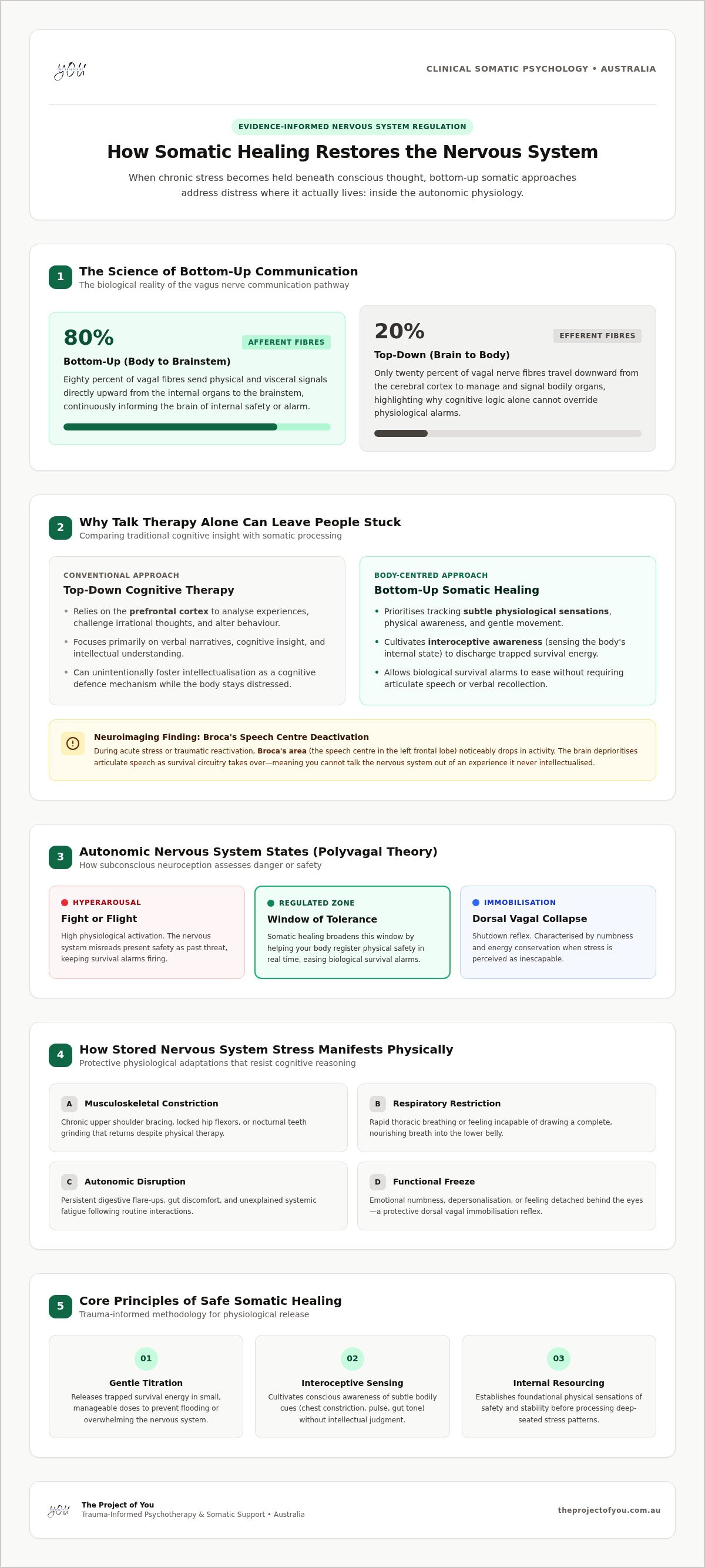
Traditional cognitive therapy works "top-down," relying on the prefrontal cortex to analyse experiences, challenge irrational thoughts, and alter behaviour. In contrast, somatic healing works "bottom-up." It prioritises tracking subtle physiological sensations, such as tight constriction in the chest, gut knots, or changes in heart rate. By cultivating interoceptive awareness (the ability to sense the body's internal state), you learn to safely discharge unresolved survival energy that conscious thoughts simply cannot access.
The Science of Bottom-Up Nervous System Regulation
Your physiology is structured for physical dialogue. Approximately eighty percent of the vagus nerve's fibres are afferent, meaning they send physiological information upwards from your visceral organs directly into the brainstem. Only twenty percent travel downward from the cortex. Dr Stephen Porges' Polyvagal Theory explains how our subconscious neuroception continuously assesses subtle relational and physical environments for signs of danger or safety without asking conscious permission.
When overwhelming stress or developmental relational wounds remain unprocessed, our neuroception misreads present safety as past threat. The biological system remains trapped in hyperarousal (fight or flight) or dorsal vagal collapse (shutdown). Practising evidence-informed somatic healing Australia broadens your window of tolerance by helping your body register physical safety in real time, easing biological survival alarms from the ground up.
Recognising When Stress Becomes Stored in the Body
Stored nervous system activation does not always announce itself as intense anxiety. It frequently manifests as quiet, everyday physical limitations that resist conventional medical explanation:
Musculoskeletal constriction: Chronic upper shoulder bracing, locked hip flexors, or nocturnal teeth grinding that returns despite physical therapy.
Respiratory restriction: Rapid thoracic breathing or feeling incapable of drawing a complete, nourishing breath into the lower belly.
Autonomic disruption: Persistent digestive flare-ups, gut discomfort, and unexplained systemic fatigue after standard interactions.
Functional freeze: Emotional numbness, depersonalisation, or feeling detached behind your eyes, reflecting a dorsal vagal immobilisation reflex designed to protect against perceived harm.
These responses are not personal shortcomings. They are intelligent, protective adaptations that kept you safe during earlier times of distress, waiting for the right somatic invitation to safely let go.
Why Talk Therapy Alone Leaves Many Australians Feeling Stuck
It is remarkably common to meet clients who can recount their life histories with fluent, precise psychological insight, yet their hands still tremble, their breathing remains shallow, or their stomachs clench. Knowing why you feel anxious does not inherently soothe an autonomic alarm. Neuroimaging studies demonstrate that during moments of acute stress or traumatic reactivation, Broca's area, the speech centre within the left frontal lobe, noticeably drops in activity. Under threat, the brain deprioritises articulate speech. Your survival circuitry takes over, proving that you cannot talk your body out of an experience it never intellectualised in the first place.
The Limits of Intellectualising Emotional Pain
Insight is valuable, yet insight alone cannot persuade your physiology that danger has passed. For many conscientious people, intellectualisation becomes an involuntary cognitive defence mechanism. We dissect our past from the neck up to protect ourselves from feeling vulnerable, uncomfortable visceral states. When an entire therapy session focuses strictly on narrative dialogue, the mind works tirelessly while the body stays trapped in fight, flight, or collapse. True emotional resolution asks for physiological settling within a supported window of tolerance. Through clinical somatic healing Australia, we gently invite the physical self to complete the biological survival loops that talk alone leaves open.
How Unresolved Somatic Stress Impacts Relationships
Living from a dysregulated nervous system quietly alters relational life. Subconscious defensiveness narrows your social engagement system, making vulnerability feel inherently unsafe. In close relationships, our partners rarely react solely to our words. Their nervous systems continuously read our autonomic cues: a stiffened neck, a tight vocal cadence, or a withdrawn posture. These non-verbal biological signals can inadvertently ignite defensive conflict, leading couples into repetitive cycles of misunderstanding.
Nervous system restoration bridges this gap, moving couples away from personal blame and towards mutual curiosity. Learning to track your own bodily states creates the foundation for genuine co-regulation. If you notice persistent physical tension spilling into your relationship despite your best verbal intentions, you may choose to book an individual or couples therapy session to gently restore physical safety and relational warmth from the bottom up.
Core Evidence-Informed Somatic Modalities in Australia
When seeking somatic healing Australia offers a rich variety of clinical approaches designed to meet the body with deep respect. Rather than asking you to relive distressing events, reputable body-led modalities rely on titration. This clinical principle involves touching into physical sensations in very small, manageable drops before returning to a grounded state of safety, ensuring your physiological system is never overwhelmed. By working in partnership with an accredited clinician, you learn to track involuntary physical impulses, map your autonomic responses, and restore natural biological flow.
Somatic Experiencing and Sensorimotor Psychotherapy
Developed by Dr Peter Levine, Somatic Experiencing® focuses on releasing biological survival energy that became thwarted during perceived threat. A practitioner gently tracks subtle autonomic shifts such as pupil dilation, micro-tremors, or breathing rhythms to help your system discharge shock. Alongside this, Dr Pat Ogden's Sensorimotor Psychotherapy combines body-based awareness with attachment theory. Clinicians observe habitual movement patterns and posture to help clients uncover subconscious somatic beliefs, gently transforming defensive physical habits into open, resilient postures.
Neurofeedback and Neuro-Somatic Interventions
For individuals whose nervous systems exist in severe dysregulation, verbal reflection can sometimes feel counterproductive. Direct neuro-somatic training, including neurofeedback, monitors real-time brainwave activity to gently encourage self-regulation. By rewarding balanced neural oscillations, the brain steadily re-learns how to transition out of rigid fight-or-flight states. This non-invasive approach widens your physiological window of tolerance, creating the internal calm necessary to engage in deeper personal and relational growth without requiring extensive trauma narration.
Somatic Group Workshops and Immersive Retreats
Healing does not have to occur in isolated contemplation. Group settings harness intentional co-regulation, where the steady, settled presence of others helps dismantle deep-seated shame and biological isolation. Step outside daily routines and chronic stressors to allow your body to decompress entirely.
Immersive experiences provide structured, restorative containers for this work:
Targeted group spaces: Offerings like The Healing Feminine Workshops support women to safely soften physical guarding, release held grief, and reclaim intuitive vitality.
Restorative retreats: Immersive programs, such as an Executive Nervous System Retreat or couples intensive, provide sustained relational safety, guiding your autonomic system back into equilibrium.
The Stages of a Clinical Somatic Healing Journey
Stepping into body-centred therapy can evoke natural apprehension, especially if past attempts at recovery left you feeling overwhelmed. Safe practice never demands plunging straight into traumatic memory or forceful physical catharsis. True somatic healing Australia adheres to a structured, trauma-informed sequence designed to protect your biological equilibrium. By pacing each intervention carefully, clinicians support your physiology to process distress without flooding your nervous system.
Phase 1: Establishing Safety and Somatic Resourcing
Before examining distress, we intentionally cultivate internal and external stability. Somatic resourcing involves discovering physical anchors that signal security to your autonomic pathways. Your clinician may guide you to notice the steady support of the chair beneath your legs, explore calming sensory touch, or bring attention to a neutral, easy area of the body. These practices stimulate the ventral vagal brake, teaching your physiology how to access baseline safety before approaching difficult emotional material.
Phase 2: Tracking Sensations and Titrated Processing
Once stability is established, therapy turns toward mindful interoception. Instead of dissecting narrative details, you track subtle physiological sensations such as temperature fluctuations, tight constriction, or heavy pulses. Clinicians apply two essential techniques here:
Titration: Breaking dense survival responses into micro-doses, allowing your system to metabolise stress drop by drop.
Pendulation: Gently swinging attention between an uncomfortable physical sensation and an established bodily resource, preventing emotional overwhelm.
Phase 3: Somatic Completion, Discharge, and Integration
As old defensive energy finishes its interrupted path, your autonomic system naturally releases stored arousal. This biological completion often emerges quietly through spontaneous deep sighs, gentle muscular tremors, or ripples of warmth flowing down the spine. Following this discharge, sessions focus on integration. You develop greater resilience for handling everyday conflict, set compassionate relational boundaries, and navigate daily life with a renewed, embodied sense of ease.
Choosing Safe, Trauma-Informed Somatic Support Across Australia
Because body-led therapy has grown rapidly in popularity, knowing how to choose a qualified practitioner is vital. The title "somatic therapist" is not legally protected under a single national registration board in Australia. While many well-intentioned practitioners offer bodywork, working with trauma touches deep biological survival circuitry. Exploring somatic healing Australia safely means ensuring your practitioner possesses a solid clinical foundation alongside specialised somatic training.
Key Qualifications and Questions to Ask a Practitioner
Prioritise therapists whose primary qualifications are in clinical social work, psychotherapy, psychology, or counselling. These practitioners are held accountable to strict ethical codes and ongoing clinical supervision through governing bodies such as the Australian Association of Social Workers (AASW), the Psychotherapy and Counselling Federation of Australia (PACFA), or AHPRA. When speaking with a prospective therapist, consider asking:
Foundational credentials: What primary clinical qualifications do you hold, and which professional registration body oversees your practice?
Somatic training: Have you completed multi-year, accredited post-graduate training in modalities like Somatic Experiencing or Sensorimotor Psychotherapy?
Trauma protocols: How do you identify and support freeze states, dissociation, or sudden nervous system overwhelm during a session?
A trustworthy practitioner welcomes these questions openly. They will never pressure you into forced emotional catharsis or overwhelm your system to chase quick breakthroughs.
Immersive Experiences: Retreats and Specialised Support
Different seasons of life call for different therapeutic containers. Ongoing weekly sessions offer steady, incremental support as you navigate everyday routines. However, chronic personal exhaustion, complex grief, or relational disconnection can sometimes make meaningful progress feel slow when limited to standard 50-minute hours.
Immersive environments offer an uninterrupted pause from work deadlines, parenting demands, and daily domestic pressures. Stepping into a structured multi-day workshop or an intimate private couples retreat allows the autonomic nervous system to decompress over several consecutive days. In these grounded settings, the body finally receives the prolonged relational safety and stillness it needs to release persistent vigilance and rediscover genuine vitality.
Stepping into Embodied Calm and Relational Vitality
Recalibrating an overwhelmed nervous system isn't about working harder; it's about learning to listen gently beneath the level of thought. When you shift from cognitive analysis to body-led awareness, interrupted survival responses can finally complete their natural cycles. Real recovery honours your physiology, cultivating the biological safety needed for authentic intimacy and emotional resilience.
At The Project of You, founder Azita Abdollahian, Clinical Social Worker and Psychotherapist, combines relational psychotherapy with advanced nervous system restoration. Whether through individual sessions, immersive couples intensives, or restorative retreats across the country, our trauma-informed framework meets you at your own pace. Supported somatic healing Australia provides a compassionate space where your body can finally soften its guard and rediscover profound peace.
Explore our private retreats and somatic counselling Your body has carried you through every challenge. With patient, grounded support, moving from chronic survival into lasting ease is entirely possible.
Frequently Asked Questions
What happens during a typical somatic healing session?
A typical session begins with conversational grounding before gently shifting attention toward physical sensations rather than intellectual storytelling. You remain fully clothed, seated comfortably. Your therapist invites you to notice subtle cues such as breathing rhythms, muscle bracing, or postural shifts. Together, you track these internal sensations, allowing interrupted survival reflexes to release safely through small movements, sighs, or resting pauses, always moving at your biological pace.
How is somatic healing different from regular talk therapy?
Traditional talk therapy operates top-down by analysing thoughts and behaviours to influence emotional states, whereas somatic therapy works bottom-up by addressing autonomic physiology directly. Spoken narratives rely on the brain's prefrontal cortex, which often decreases activity during traumatic stress. Body-centred practices engage the subcortical brain and vagal pathways, resolving physical holding patterns and chronic alarm states that conversation alone cannot reach.
Can somatic healing work if I find it hard to feel my body?
Yes, feeling disconnected from bodily sensations is actually an intelligent survival response known as functional freeze or dissociation. When past distress felt overwhelming, your nervous system protected you by dampening physical awareness. Within somatic healing Australia, therapists never force immediate sensation. Instead, you begin externally by noticing physical touch against a chair or ambient sounds, slowly rebuilding interoceptive safety without pressure.
Is somatic therapy safe for people with complex PTSD or severe trauma?
Yes, somatic therapy is exceptionally safe and effective for complex PTSD when guided by an accredited, trauma-informed clinician. Conventional methods can sometimes trigger overwhelming distress by revisiting painful memories prematurely. Somatic clinicians utilise titration to touch into held stress in minute, manageable fractions, paired with constant pendulation back to physiological safety, preventing retraumatisation while building lasting autonomic capacity.
How many somatic healing sessions does someone usually need?
The duration of somatic therapy depends on whether you are navigating acute situational stress or untangling layered developmental trauma. Some clients experience noticeable nervous system relief within several sessions or an immersive retreat, while long-held relational survival patterns often unfold over several months of steady work. Lasting neural rewiring respects the body's natural pace rather than following rigid, predetermined deadlines.
Can you practice somatic healing exercises on your own at home?
Yes, gentle nervous system exercises can be practised independently to cultivate everyday emotional resilience. Techniques such as prolonged exhalations, mindful sensory orienting to your environment, and gentle self-touch offer accessible grounding during stressful moments. However, untangling deep traumatic stress or persistent dorsal collapse requires the skilled co-regulation of a trained therapist to ensure your nervous system feels completely safe.
Is somatic healing covered by Medicare or private health funds in Australia?
While somatic therapy does not exist as a standalone Medicare item code, sessions may qualify for rebates if your practitioner is an accredited mental health social worker, psychologist, or occupational therapist operating under a GP Mental Health Treatment Plan. In addition, many Australian private health funds provide extras rebates for registered counsellors or psychotherapists. We recommend confirming specific coverage directly with your private insurer.


Comments