.png)

Couples Communication Workshop: How to Choose the Right Support

Are couples communication workshops worth it, and can they actually help a relationship? For couples who keep having the same unresolved arguments, struggle to feel heard, or find conversations quickly becoming defensive or disconnected, a couples communication workshop can provide practical tools and a structured space to practise communicating differently. The most effective workshops, however, are not simply about learning the “right” words — they help couples understand the relationship patterns underneath the conversation and create safer ways to listen, respond and repair.
As a psychotherapist, clinical social worker and relationship specialist, Azita Abdollahian of The Project Of You works with couples experiencing conflict, disconnection, communication difficulties and recurring relationship patterns. She understands that communication problems rarely exist in isolation. How couples communicate is often connected to attachment, emotional safety, unresolved hurt, nervous-system responses and the patterns each partner brings into the relationship.
A couples communication workshop may be helpful when both partners are willing to participate, reflect on their patterns and practise new skills together. However, a workshop is not necessarily the right fit for every couple. If there is significant relationship distress, trauma, infidelity, ongoing emotional disconnection or difficulty feeling safe enough to communicate openly, couples counselling or more individualised therapeutic support may be more appropriate.
In this guide, Azita explains what to look for when choosing a couples communication workshop, including the facilitator’s qualifications, therapeutic approach, group size, format and whether the workshop is online or in person. You’ll also learn what couples can realistically expect from a communication workshop, when counselling may be a better option, and how to choose support that matches your relationship’s needs — rather than looking for a quick fix or a perfect communication formula.
Table of Contents
What can a couples communication workshop help you practise?
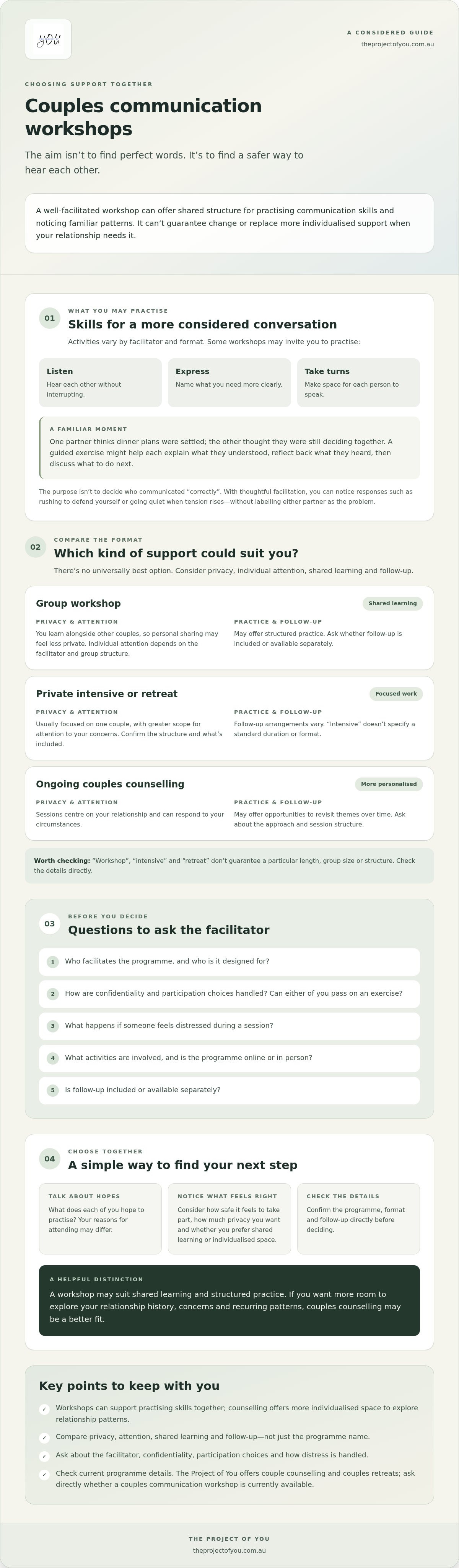
A couples communication workshop offers structured opportunities to learn and practise communication skills together. Depending on the facilitator and format, you might work on listening without interrupting, expressing a need clearly or taking turns discussing a difficult topic. It’s a learning space, not a promise that every disagreement will be resolved.
This kind of learning sits within Relationship education, which focuses on knowledge and skills that can support relationships. A couples communication workshop may introduce ideas and guided exercises, while therapy can make more room to understand personal histories and recurring relationship patterns. What’s included varies, so check the programme details rather than assuming every workshop follows the same approach.
What might couples practise during a workshop?
Some workshops invite partners to practise listening, naming what they need and making space for each person to speak. For example, after a tiring day, one partner may assume a plan to pick up dinner was settled, while the other thought they were deciding together. A guided exercise could help each person explain what they understood, reflect back what they heard and then discuss what to do next.
The aim isn’t to decide who communicated “correctly”. With thoughtful facilitation, practice can help you notice familiar responses, such as rushing to defend yourself or going quiet when tension rises. You can get curious about what happens between you without labelling either partner as the problem. Activities differ, so ask in advance what participation involves and whether you can pass on an exercise.
How is a workshop different from couples counselling?
A workshop is generally organised around shared learning and structured practice. Depending on the format, it may involve other couples or guided exercises focused on a particular skill. Couples counselling is usually more personalised, giving partners and a counsellor space to explore their own concerns, experiences and patterns. The exact structure varies between providers.
A workshop may not have time to understand your full relationship history or respond in depth to complex experiences. That doesn’t make it less useful; it means the format may suit a different need. If you want a clearer picture of individualised support, read the guide to couples counselling and what to expect. The Project of You | Trauma, Couples & Relationship Therapy Australia offers couple counselling. Check directly for current details about any specific workshop.
Which couples communication workshop format could suit you?
The right format depends on what you want to practise, how much privacy you need and whether you’d value ongoing support. A group setting can offer shared learning; private support may allow more attention to your relationship; ongoing counselling can provide space to return to concerns over time. None is universally best. To compare options, consider how much personal discussion you’re comfortable with, whether you want a one-off learning experience or continuing sessions, and what follow-up is available.
Terms such as “workshop”, “intensive” and “retreat” don’t guarantee a particular length, group size or structure. Check the details directly, including what happens during a session and whether follow-up is offered. Ask whether the programme is mainly educational or includes time to discuss your relationship. Clear answers make it easier to judge whether the format matches what you’re looking for and what feels comfortable for both of you.
When might a group workshop feel like a good fit?
A group may suit you if you’re comfortable learning alongside others and want a structured chance to practise communication skills together. Before signing up, ask how many couples may attend, what confidentiality expectations apply and how the facilitator supports participants if a topic feels difficult. Check whether sharing personal details is optional and whether there are activities you can choose not to take part in.
When might private support be more appropriate?
If your concerns feel highly personal or connected to a complex shared history, you may prefer a setting with more individual attention. The Project of You | Trauma, Couples & Relationship Therapy Australia offers couple counselling and private couples retreats. These are distinct support options, not interchangeable services. You can read about its private couples retreat options and ask what format may suit your needs.
Before choosing a couples communication workshop, compare the actual programme with what you both hope to gain rather than relying on its label. If personalised support feels like a better fit, you can explore online booking options as a possible next step.
How do you assess a workshop’s approach, safety and facilitator?
A clear description should tell you who the workshop is for, what you’ll be invited to do and how the facilitator will support participants. Emotional safety doesn’t mean avoiding every uncomfortable feeling. It means being treated with respect, understanding your choices and being able to participate at a pace that feels manageable.
What should you ask the facilitator before booking?
You’re entitled to ask practical questions before deciding. Clear answers can help you work out whether the format feels appropriate for both of you. Consider asking:
Who will facilitate the workshop? What relevant qualifications, training or experience do they have in relationship education or couples work?
What will participants do? Ask about the topics, exercises and balance between teaching, discussion and practice.
How is personal sharing handled? Is sharing optional, and what are the group’s confidentiality expectations?
What support is available if a topic feels distressing? Can participants pause or step away, and how does the facilitator respond if someone becomes upset?
Who is the workshop intended for? Ask whether it’s designed for couples seeking general skills or people managing particular relationship concerns.
Look for straightforward answers rather than assumptions that every couple will feel comfortable with the same activities. If you’re unsure, take time to talk it over together before booking. You can write down your questions beforehand and compare the answers with what each of you needs from the experience.
How can you tell whether the approach feels right?
Notice the language used to describe the work. A balanced approach invites both partners to reflect without casting one as the problem or suggesting a quick fix. The facilitator should be able to explain psychological ideas in everyday language and distinguish established evidence from opinion. For context, Child Trends’ overview of relationship education curricula describes common areas such as communication and managing conflict.
It may also help to read about Azita Abdollahian’s professional background. She is identified as a Clinical Social Worker, Psychotherapist and Couples Therapist, and The Project of You describes its approach as trauma-informed. This information can help you understand the practice, but check who will facilitate a particular couples communication workshop and ask about its format and suitability directly.
A workshop may not be the right setting for every situation. If either of you has concerns about personal safety, feels pressured to attend or worries that speaking openly together could lead to harm, consider seeking individual professional guidance before choosing a joint group activity. You deserve support that takes your circumstances seriously.
How can you decide if a couples communication workshop is right for you?
You don’t need to feel perfectly ready or agree on every reason for attending. Start by naming the concern you’d like to work on, talk about whether you’re both open to learning together, then compare the format with your needs. From there, ask any remaining questions and choose a next step that feels considered rather than pressured.
What if one partner is unsure about attending?
Uncertainty can have different roots. One partner may worry about sharing private details in a group, being blamed or not knowing what will happen. Ask what feels uncomfortable before trying to persuade them. Could you agree to gather information together first, without committing to a booking?
Each person might name one thing they hope to practise and one boundary that would help them feel more comfortable. For example, one partner may want to learn how to pause during conflict, while the other hopes to feel listened to without being expected to disclose personal history in front of others. Your motivations don’t have to match. Curiosity can make room for both perspectives; pressure may make an already uncertain conversation harder.
When might a workshop not be the best first step?
A general skills-based setting may not offer enough individual attention if you’re carrying complex distress, grief, betrayal or longstanding patterns that need careful exploration. In that case, tailored professional support may be a more suitable place to begin. Choosing counselling instead is a valid decision, not a sign that you’ve failed to make a workshop work.
If either of you feels unsafe, fears repercussions for speaking honestly or feels unable to choose freely, don’t assume joint attendance is suitable. Prioritise appropriate individual support and seek guidance about what would be safe for your circumstances.
Before deciding, consider these questions together:
What would we each like to understand or practise?
Are we comfortable with the format and level of personal sharing?
What would help each of us feel respected and able to participate?
Would we prefer shared learning, or more individualised support?
If counselling feels like a better match, The Project of You offers couple counselling. Read more about choosing couples counselling. The aim is to find support that fits your needs and readiness, whether that’s a couples communication workshop, counselling or another considered next step.
What next steps can help you find couples communication support?
A useful next step is to get clear about what you’d like help with, check the details of any programme and choose a format both of you can consider. You don’t need to have every part of the conversation figured out before making an enquiry. A short list of questions can help you find out whether a couples communication workshop is currently available and whether its approach suits your needs.
What information should you have before enquiring?
Think of one communication pattern you’d like to understand or practise differently. You can describe it in broad terms at first; you don’t have to share your full relationship history in an initial enquiry. Then note what you’d like to clarify about the facilitator, format, privacy, suitability and current availability. It may also help for each partner to name what would help them feel respected and able to take part.
For example, ask whether sessions are group-based or private, what participation involves and whether there’s a chance to discuss suitability before deciding. If you’re considering a workshop, confirm its details directly rather than relying on its name or a general description. That way, you can make a choice based on what’s actually offered.
How can The Project of You support your next step?
The Project of You offers couple counselling and couples retreats, including private and group options. These are distinct forms of support, and the right fit depends on what you’re looking for. Couples counselling may be worth exploring if you’re seeking a more individualised setting. Check directly whether a couples communication workshop is currently available, and ask about its format and suitability.
Azita Abdollahian, Clinical Social Worker, Psychotherapist and Couples Therapist, is the founder of The Project of You. You can use the booking page to explore options and ask about suitable support. An enquiry or booking doesn’t guarantee access to a particular workshop, a specific outcome or a format that hasn’t been confirmed. It’s one way to begin a conversation about what may fit.
Choose a next step that feels right for both of you
A couples communication workshop can offer a structured place to practise new ways of listening and speaking, but its format, facilitator and suitability matter. Before deciding, clarify what you hope to learn, ask how participation and privacy are handled, and consider whether you’d feel more supported in a group, a retreat or counselling.
There’s no need to expect an instant change or choose the same path as another couple. If a workshop doesn’t feel like the right fit, couples counselling or another form of support can be a thoughtful next step. The Project of You offers couple counselling and private and group couples retreats. Azita Abdollahian is identified as a Clinical Social Worker, Psychotherapist and Couples Therapist. Check directly whether a specific workshop is currently available and what it involves.
You can take this one step at a time. A considered conversation about what each of you needs can help you find support that feels respectful and appropriate for your relationship.
Frequently Asked Questions
What happens at a couples communication workshop?
A couples communication workshop usually offers guided learning and practice, though activities vary by facilitator and format. You might explore ways to listen, express needs clearly or take turns discussing a topic. Some sessions involve group learning; others may be private. Before attending, ask what you’ll be invited to do, whether sharing personal details is optional and what support is available if a discussion brings up strong feelings.
Can a couples communication workshop help if we argue about the same things?
It may help you practise approaching familiar disagreements differently, but it can’t guarantee that the arguments will stop. A facilitator might guide you to slow down, hear each other’s perspectives and notice habitual responses, such as defending yourself or withdrawing. If repeated conflict is connected to complex distress or a painful relationship history, general skills practice may not provide enough individual attention. Counselling could be another option to consider.
How do we choose a couples communication workshop?
Choose by matching the programme to what you hope to learn and the setting in which you feel comfortable taking part. Check who facilitates it, their relevant experience, the intended participants, the activities, privacy arrangements and whether follow-up is available. Ask how the facilitator responds if someone becomes distressed. Clear, balanced explanations are more useful than promises of a quick fix or language that blames one partner.
Is a couples communication workshop the same as couples counselling?
No. A workshop generally focuses on shared learning and structured practice, while couples counselling can offer more individualised space to explore your relationship concerns and patterns. The exact format varies between providers, so ask what sessions involve. A workshop may not have room to understand each couple’s full history. The Project Of You offers couple counselling; confirm the details of any workshop separately before assuming it’s available.
What if one partner does not want to attend a couples workshop?
Start by asking what’s behind the hesitation, without treating it as a refusal to care about the relationship. A partner may be concerned about privacy, feeling blamed or not knowing what will happen. You could agree to gather information together before making any decision. Each person can name one hoped-for benefit and one boundary that would help them feel respected. Avoid pressuring either partner to commit before they’re ready.
Can a couples workshop help after infidelity or relationship trauma?
A general workshop may offer communication skills, but it may not be designed to address the distress or complexity that can follow infidelity or trauma. Ask the facilitator whether the programme is suitable for your circumstances and what support is available. If either partner needs more tailored care, professional support such as couple counselling may be a better starting point. The right next step depends on your needs and sense of safety.
How do we know whether a workshop is emotionally safe?
You can’t know every detail in advance, but you can ask how confidentiality works, whether activities and personal sharing are optional, and how participants can pause or seek support if distressed. Emotional safety means being treated respectfully and having choices, not avoiding every difficult feeling. If either partner feels unsafe speaking together or fears repercussions, don’t assume a joint workshop is suitable; seek appropriate individual professional guidance first.


Comments