.png)

Creating Emotional Safety in a Relationship: Practical Ways to Build Trust

What does emotional safety in a relationship actually look like, and how can you create it with your partner?
Emotional safety in a relationship means feeling able to express your feelings, needs, boundaries and concerns without fearing rejection, punishment, humiliation or losing your partner’s connection. It doesn’t mean you never disagree. In a healthy relationship, emotional safety allows couples to have difficult conversations, navigate differences and repair after conflict while maintaining a sense of connection.
As a psychotherapist, relationship expert and couples counsellor, Azita Abdollahian helps couples understand the patterns that can make emotional safety difficult to maintain. When conversations repeatedly lead to defensiveness, criticism, withdrawal or silence, it can become increasingly difficult for partners to feel heard and understood.
Creating emotional safety isn’t about finding the perfect words or avoiding conflict altogether. It involves learning how to listen without immediately becoming defensive, communicate needs clearly, respect boundaries, stay emotionally present during difficult conversations and reconnect after moments of disconnection.
In this article, Azita Abdollahian explores how to build emotional safety in a relationship, the everyday behaviours that strengthen trust and connection, and what couples can do when communication repeatedly breaks down. We’ll also look at when couples counselling may provide a supportive space to understand these patterns and develop healthier ways of relating.
Because emotional safety isn’t created through one perfect conversation. It is built through repeated moments of trust, responsiveness, honesty and repair.
Table of Contents
What does creating emotional safety in a relationship mean?
Creating emotional safety in a relationship means both partners can express feelings, needs and boundaries with respect and care, without expecting ridicule, intimidation or immediate dismissal. It isn’t a clinical diagnosis or a promise that every conversation will feel comfortable. It describes the trust that can grow when people are able to be honest and stay engaged with one another.
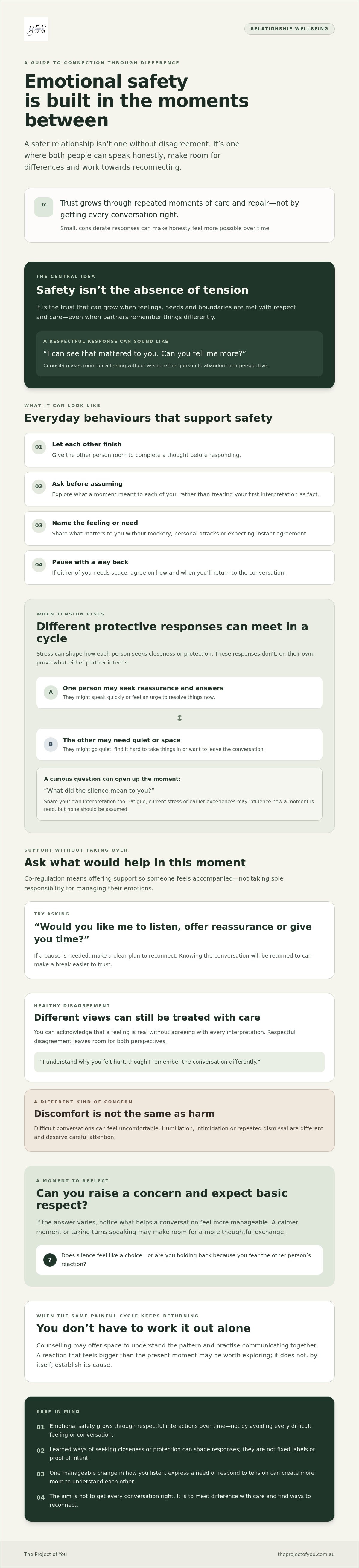
That trust develops through repeated interactions, not through a constant absence of discomfort. For example, one partner might say they felt disappointed when plans changed. The other doesn’t have to agree with every part of their account to respond with curiosity: “I can see that mattered to you. Can you tell me more?” This response makes room for the feeling without requiring either person to abandon their perspective. Emotional safety is also discussed in relation to trust and attachment, offering a starting point for thinking about how secure connection develops.
What does emotional safety look like in everyday conversations?
It can look like letting each other finish a thought, asking questions before making assumptions, and discussing a disagreement without mockery or personal attacks. Respect doesn’t mean you have to see things the same way. You might say, “I understand why you felt hurt, though I remember the conversation differently.” You can acknowledge that a feeling is real without agreeing with every interpretation of what happened.
How is emotional safety different from avoiding conflict?
Keeping quiet can preserve a calm surface, but if difficult topics are repeatedly avoided, one or both partners may have less room to express what matters. Respectful disagreement allows different needs to be named and explored. The aim isn’t to force a conversation before either person is ready. Instead, notice what the silence means. Does it feel like a choice, or are you holding back because you fear the other person’s reaction?
Ask yourself: “Can I raise a concern and expect to be treated with basic respect, even if we don’t agree?” If the answer varies, notice what makes the conversation more manageable. It might help to choose a calmer moment or take turns speaking. Small, considerate responses can gradually make honesty feel more possible. Emotional safety doesn’t remove tension; it helps both people meet it with care.
How attachment and nervous-system responses shape relationship safety
Attachment describes learned ways of seeking closeness or protection in relationships. These patterns can be shaped by early experiences and later relationships, but they aren’t fixed labels or a measure of how much someone cares. Under stress, one partner might seek reassurance and answers, while the other needs quiet or space to gather their thoughts. Neither response, on its own, proves what the other person intends.
When tension rises, the body can shift into a protective response. Someone might speak quickly, feel an urge to leave, go quiet or find it hard to take in what’s being said. These reactions can make a conversation feel more urgent or distant, even when both partners want to reconnect. Creating emotional safety in a relationship includes noticing these responses with curiosity, rather than treating them as evidence that one partner is uncaring or unreasonable.
Why can a small disagreement feel so intense?
A delayed reply might mean “They’re busy” to one partner and “They’re pulling away” to the other. Fatigue, current stress or earlier experiences could influence how each person reads the moment, though none should be assumed. Try asking, “What did the silence mean to you?” and sharing your own interpretation too. Curiosity can help you separate what happened from the story each of you made of it.
How can partners support regulation without taking over?
Co-regulation means offering support that helps another person feel accompanied, rather than taking sole responsibility for managing their emotions. You might ask, “Would you like me to listen, offer reassurance or give you time?” If either of you needs a break, agree on how and when you’ll return to the conversation. A pause is easier to trust when it includes a clear intention to reconnect, rather than leaving the other person uncertain.
These patterns may be worth exploring if a reaction feels stronger than the present moment seems to explain. Trauma can affect how people respond to stress, but a reaction alone doesn’t establish its cause. You can explore related writing on The Project of You | Trauma, Couples & Relationship Therapy Australia, including themes of trauma and nervous-system responses.
If you’d like support understanding a recurring pattern, booking a counselling appointment is one possible next step. Counselling can provide a supported space to explore what each of you needs, without assuming there’s one simple explanation for the cycle.
Does creating emotional safety mean never upsetting each other?
No. Creating emotional safety in a relationship doesn’t mean constant agreement, perfect calm or making sure neither person ever feels hurt. Honest conversations can bring discomfort, especially when partners have different needs or one has to hear that their actions had an impact. Safety shows in how you treat each other through that discomfort, and whether there’s room to listen, take responsibility and set limits.
A disagreement is different from an interaction that humiliates, intimidates or repeatedly dismisses someone. Conflict is about opposing views or needs; harmful behaviour undermines a person’s dignity or ability to speak freely. One difficult exchange alone doesn’t define an entire relationship, but repeated patterns deserve attention. Accountability and respectful boundaries can help partners stay connected without asking either person to ignore their own experience.
Can you set boundaries and still be emotionally close?
A boundary describes what you need or what you’ll do to care for yourself. It isn’t a way to control your partner. For example: “I want to keep talking, but I need a pause. Can we come back to this after dinner?” Your partner may feel disappointed or unsettled, and the boundary can still be valid. Naming when you intend to return helps distinguish a pause from shutting the other person out.
What does repair look like after a hurtful moment?
Repair starts with noticing that something has caused hurt or disconnection. Before explaining what you intended, make space for the impact: “I can hear that my comment felt dismissive.” Then listen, take responsibility for your part and discuss what might help next time.
Notice: Name that the conversation or moment went off course.
Listen: Ask what affected your partner and hear them without interrupting.
Take responsibility: Acknowledge your action and its impact without turning straight to defence.
Plan: Agree on a practical next step, such as speaking more gently or revisiting the topic when you’re both ready.
An apology can matter, but it may not be enough if the same hurtful pattern keeps returning. Consistent change takes attention from both partners, and skilled support may help you understand the cycle and practise a different way forward. The aim isn’t to avoid every rupture. It’s to make room for honest conversations, respectful limits and meaningful repair.
How can you create emotional safety in a relationship, step by step?
Creating emotional safety in a relationship is a practice, not a test you pass by saying everything perfectly. Try these steps, and choose one manageable change to practise first. Small, repeatable shifts are easier to carry into everyday conversations.
Pause and choose a focus. Before raising a concern, notice whether you’re ready to talk and agree on one topic. For example: “Can we talk about how we’re sharing the school pick-ups, rather than trying to solve everything tonight?”
Speak from your own experience. Describe what happened and how it affected you, without assigning motives or making character judgements. Try: “I felt left out when the weekend plans were made before we checked in with each other,” instead of “You never consider me.”
Listen and reflect before fixing. Summarise the feeling or concern you’ve heard, then check that you’ve understood. “It sounds like you felt under pressure when I asked about the plans. Have I got that right?” Advice can wait until both of you feel heard.
Make one clear request. Ask for a specific action rather than hoping your partner will guess what you need. For instance: “Could we check in about weekend plans on Thursday?” Your partner can respond honestly, and you can discuss what might work for both of you.
Agree how to pause and reconnect. If the conversation feels overwhelming, decide together when you’ll return to it. “Let’s take a break and come back to this after dinner” offers breathing room while keeping the discussion open.
How can you make listening and repair more consistent?
A brief weekly check-in can help you notice what’s working and what needs attention. Each partner might share one thing they appreciated, one unmet need and one practical next step. Keep the conversation curious. Ask: What helps each of us feel heard, and what makes it harder?
If you lose your way, return to listening, acknowledge the impact of what was said and agree on what you’ll try differently. You don’t need to change every interaction at once. Consistency matters more than getting it right every time.
If you’d like more structured support, couple counselling can offer a space to practise communication and understand recurring patterns.
When can counselling help you build emotional safety together?
Counselling may be worth considering when the same painful cycle keeps returning, even though both partners want things to improve. Perhaps a question about plans repeatedly turns into defensiveness, or one person stops raising concerns because they expect the conversation to go nowhere. These patterns don’t mean either partner is to blame. They can be difficult to shift without a supported space to slow down, understand what’s happening and practise a different response.
Creating emotional safety in a relationship can involve learning how each person experiences a recurring pattern: what they need, what feels hard to say and what helps them stay engaged. Couple counselling can offer a place to practise communication and explore those needs with care. It isn’t a guarantee of relationship repair, and seeking support doesn’t mean you’ve failed. It’s one possible way to get help finding a next step.
What might couples counselling help you work through?
Sessions may provide space to explore recurring misunderstandings, concerns about trust or difficulty discussing boundaries. Trauma-informed care aims to approach each person’s experiences with sensitivity and respect, without assuming there’s one simple explanation for a reaction or conflict. The Project of You | Trauma, Couples & Relationship Therapy Australia offers individual and couple counselling informed by CBT and trauma-informed therapy. You can read more about couple counselling and consider whether that kind of support may suit you.
What is a gentle next step if you are ready for support?
Before looking for support together, you could each consider: “What would I hope feels different in our conversations?” One person might want to raise concerns without shutting down; the other might hope to listen without becoming defensive. You don’t need to agree on every detail before beginning. Naming what matters to each of you can offer a helpful starting point.
If your partner isn’t ready, individual counselling may still give you room to reflect on your own experience, needs and choices. You’re allowed to begin with what feels manageable. There’s no need to have everything worked out before asking about support.
If you’d like to explore counselling, you can book a supportive conversation with The Project of You | Trauma, Couples & Relationship Therapy Australia. It’s a gentle first step, not a promise about what comes next.
Keep building trust through small, respectful steps
Creating emotional safety in a relationship isn’t about getting every conversation right or agreeing to keep the peace. It grows through repeated moments of respect: listening before responding, expressing needs clearly, allowing boundaries and making space to repair after hurt.
Attachment patterns and stress responses can shape how each partner approaches tension, but they don’t tell the whole story or define what either person intends. Staying curious about the pattern, rather than casting one partner as the problem, can make it easier to choose a small change to practise together. You might reflect what you heard, make a specific request or agree how to reconnect after a pause.
If the same painful cycle keeps returning, counselling can offer a supported space to understand it and explore what each person needs. The Project of You | Trauma, Couples & Relationship Therapy Australia offers individual and couple counselling informed by CBT and trauma-informed care.
You don’t need to have every answer before you begin. A thoughtful next step can help you find a way forward together.
Frequently Asked Questions
Is emotional safety important in a relationship?
Yes. Emotional safety can make it easier for partners to share concerns, ask for support and be honest about their needs. It doesn’t mean every conversation feels comfortable or that you always agree. Both people make an ongoing effort to respond respectfully, take each other seriously and address hurt without ridicule or intimidation. What helps someone feel safe can vary, so it’s useful to ask rather than assume.
Can a relationship have emotional safety and still have conflict?
Yes. Partners can disagree and still feel emotionally safe. The focus is how differences are handled: can each person speak without contempt, listen to understand and return to repair when hurt occurs? Conflict doesn’t automatically mean a relationship is unsafe. If disagreements repeatedly involve fear, threats or humiliation, consider seeking appropriate professional support and prioritising personal safety. Emotional safety allows room for honesty, not a requirement for constant harmony.
How do you create emotional safety with your partner?
Creating emotional safety in a relationship starts with small, repeatable actions. Listen before offering advice, describe your feelings and needs clearly, respect boundaries and make time to reconnect after a difficult conversation. Ask your partner what helps them feel heard instead of guessing. For example, check whether they’d prefer reassurance, practical help or simply someone to listen. These steps aren’t a quick fix, but they can help build trust over time.
What does emotional safety feel like in a relationship?
It may feel like being able to raise a concern without expecting ridicule, punishment or immediate dismissal. You can still feel nervous, disagree or need time to think. Look at the pattern rather than expecting one perfect conversation: do both people try to listen, respect limits, acknowledge impact and return to difficult topics with care? Experiences differ, so an open conversation about what helps each of you feel respected can offer a useful starting point.
How can I make my partner feel safe enough to open up?
You can’t control whether or when your partner shares, but you can make room for honesty. Listen without interrupting, ask what kind of response would help and avoid using vulnerable information against them later. Respect a request for time or privacy, and don’t demand disclosure as proof of love. Trust develops through consistent behaviour and patience. Your partner may need a different pace or approach, and that’s worth discussing with care.
What should I do if my partner dismisses my feelings?
Try naming the specific moment and its impact in calm, direct language, then say what response would help. For example: “When you changed the subject, I felt brushed aside. Could you hear me out before we move on?” You might also ask how your partner understood the exchange. If dismissal keeps happening, consider whether a boundary or outside support could help. You deserve to have your experience taken seriously, even when you see things differently.
Can couples counselling help create emotional safety?
Couples counselling may offer a supported space to slow down recurring conversations, understand each person’s perspective and practise different ways of communicating. It can also help partners explore what support feels appropriate for their circumstances. The Project of You | Trauma, Couples & Relationship Therapy Australia offers individual and couple counselling informed by CBT and trauma-informed care. Counselling can’t guarantee a particular outcome, but it may help you consider your needs and possible next steps together or individually.


Comments