.png)

Codependency Recovery Steps: A Gentle Guide to Rebuilding Self-Trust

How do you stop losing yourself in a relationship and start building healthier, more balanced connections?
If you regularly feel responsible for your partner’s emotions, struggle to say no, put their needs ahead of your own or worry that setting a boundary will cause conflict or distance, you may recognise patterns often described as codependency. Codependency recovery begins with learning to recognise these patterns without shame and developing a stronger connection to your own needs, feelings and values.
As a psychotherapist, Clinical Social Worker and relationship expert, Azita Abdollahian helps people understand relationship patterns that can lead to self-abandonment, difficulty with boundaries and an unhealthy sense of responsibility for another person’s wellbeing. Caring deeply about someone does not mean you have to lose yourself in the relationship.
It’s also important to understand that codependency is not a formal mental health diagnosis. The term is commonly used to describe certain patterns of relating, and recognising yourself in these patterns does not mean something is wrong with you. In many cases, these behaviours may have developed as ways of maintaining connection, avoiding conflict or feeling safe.
In this guide, Azita explores practical codependency recovery steps, including how to recognise self-abandonment, identify your own needs, practise healthier boundaries, tolerate the discomfort that can come with saying no and rebuild trust in yourself. We’ll also explore how developing greater emotional independence can support relationships based on mutual care, respect and emotional safety.
You don’t have to care less about someone else to care more about yourself. Recovery is about learning that both can exist at the same time.
Table of Contents
What does codependency recovery mean, and where can you begin?
Codependency recovery is a gradual practice of reconnecting with your needs and choices while building relationships where care can move in both directions. It isn’t about becoming less loving. It’s about making room to care for someone without losing your own sense of agency, wellbeing or safety.
“Codependency” is commonly used to describe relationship patterns, rather than a formal mental health diagnosis. It isn’t listed as a diagnosis in the DSM-5-TR or ICD-11, so noticing these experiences isn’t the same as diagnosing yourself. Mental Health America offers a helpful overview of codependency, including how the term is used. A label doesn’t define you or explain every difficulty in a relationship.
Supportive care means offering help while respecting another adult’s choices. Taking responsibility for them means feeling you must manage those choices or emotions. For example, listening when your partner has had a hard day can be an act of care. Feeling you must fix their mood before you’re allowed to enjoy your own evening may be a pattern worth exploring.
What patterns might someone recognise without self-diagnosing?
You might notice people-pleasing, taking on more than your share of practical or emotional tasks, or struggling to express what you need. Perhaps your partner seems upset, so you cancel plans with a friend and spend the evening monitoring their mood. These experiences aren’t proof of a condition. They’re an invitation to get curious about what is happening for you.
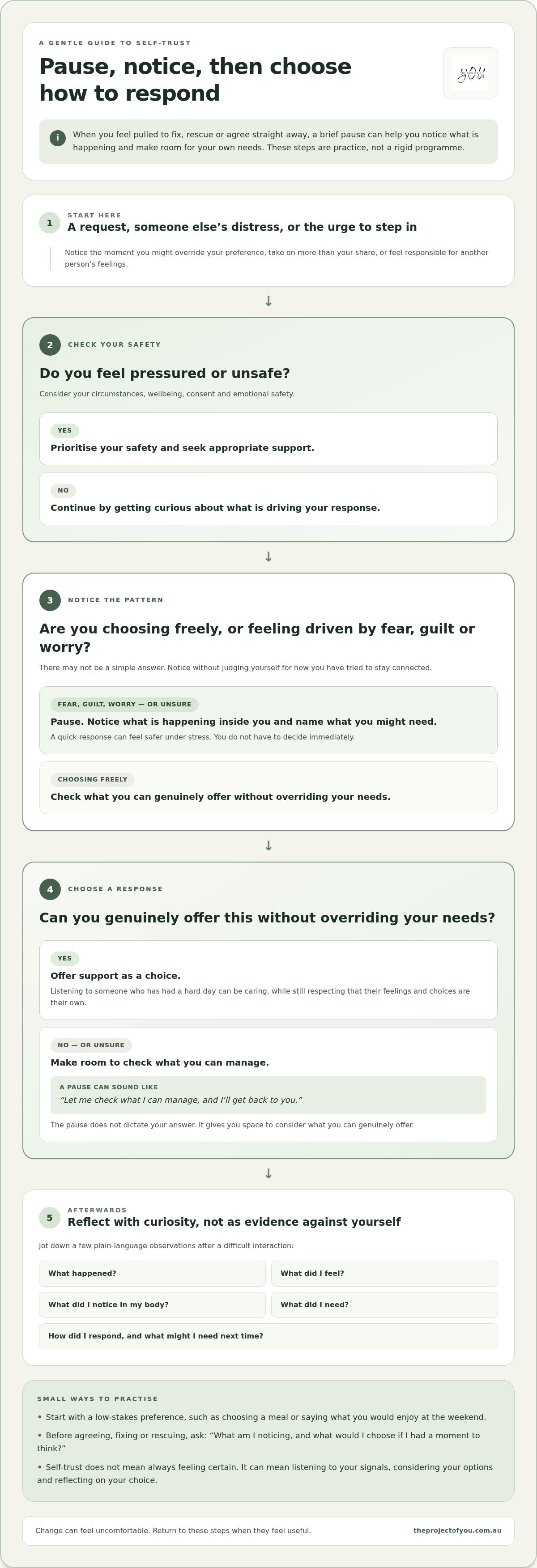
Ask yourself: which actions feel freely chosen, and which seem driven by fear, guilt or worry about what might happen if you don’t step in? There may be no simple answer. The aim is to notice without judging yourself for how you’ve tried to stay connected.
Does recovery mean leaving the relationship?
No. Recovery doesn’t automatically require a breakup, and it can’t guarantee a relationship will continue. It means becoming more aware of your needs and decisions, rather than trying to control your partner’s response. They may welcome a change, feel uncertain about it or respond differently. You can’t decide that part for them.
Relationship decisions depend on the circumstances, each person’s wellbeing, consent and emotional safety. If you feel pressured or unsafe, prioritise your safety and seek appropriate support. Otherwise, you might begin by noticing one moment when you override your preference, then asking yourself what you need before choosing how to respond. These early codependency recovery steps are opportunities for understanding, not a test you have to pass.
Codependency recovery steps: build awareness and self-trust first
Self-trust often grows through small moments of noticing what’s happening inside you before responding automatically. A flexible sequence can help: notice a pattern, pause, name a need, choose one response, then reflect afterwards. These codependency recovery steps are practice, not a rigid programme or a promise of a particular outcome. Return to them whenever they feel useful.
For instance, a friend asks you to help with a task on your only free evening. You feel the familiar urge to agree immediately, so you take a breath and say, “Let me check what I can manage, and I’ll get back to you.” The pause doesn’t dictate your answer. It creates space to work out what you can genuinely offer.
That pause can be difficult. Stress may make a quick response feel safer, while fears of rejection or conflict can pull you towards pleasing or fixing. Attachment experiences may help explain some reactions, but they’re not a complete account of anyone’s behaviour. Mental Health America’s overview of codependency offers further context on the pattern and recovery.
How can journalling reveal the pattern beneath the reaction?
After a difficult interaction, write a few plain-language notes: what happened, what you felt, what you noticed in your body, what you needed and how you responded. You might notice a tight chest before agreeing, or guilt when you consider asking for time. Keep the notes as observations, not evidence against yourself.
Over time, gently ask: What felt like my responsibility here? What did I choose, and what did I feel pressured to do? What might I need next time? You don’t have to reach a firm conclusion. The aim is to see more clearly what tends to happen and what options you may have.
How can you practise self-trust in small, everyday choices?
Begin with low-stakes preferences. Say which meal you’d like, or share what you’d enjoy doing at the weekend. Before fixing, rescuing or agreeing, pause briefly and ask yourself, “What am I noticing, and what would I choose if I had a moment to think?”
Self-trust doesn’t mean always feeling certain. It means listening to your signals, considering your options and making a choice you can reflect on afterwards. If it feels hard to practise alone, individual counselling support can provide a collaborative space to explore patterns and consider manageable changes at your own pace.
How do boundaries and communication change codependent patterns?
A boundary is a statement about your own limits and what you’ll do to respect them. It can help make care more sustainable by separating offering support from taking responsibility for another person’s feelings or choices. These codependency recovery steps aren’t about becoming cold or distant. They’re about expressing what you can genuinely offer.
Imagine your partner wants to talk through a stressful day late at night, but you’re exhausted. You might stay up and listen, even though you need rest. A controlling demand might be, “You’re not allowed to talk about your problems after dinner.” A clear boundary could be, “I want to hear about your day, but I’m too tired to talk well tonight. I’m going to bed, and we can make time to talk tomorrow.” It names your limit and the action you’ll take without dictating what your partner must feel or do.
Saying no can bring discomfort, especially if you’re used to keeping the peace. Feeling guilty or worried doesn’t automatically mean you’ve done something wrong. You can acknowledge that unease and still consider whether your response is honest, respectful and realistic.
What is the difference between a boundary and an ultimatum?
A boundary describes a choice you can make for yourself. An ultimatum generally tries to compel someone else’s behaviour through pressure or threat. For example, “If I’m too tired to talk, I’ll pause the conversation and return to it when I can be present” is about your own action. “You must stop bringing up difficult things at night or else” aims to control the other person.
Language is only part of the picture. A script that feels manageable in one relationship may not feel safe in another, so adapt it to your circumstances rather than treating it as a rule.
How can you communicate a need without blame?
Try a simple structure: describe what’s happening, name your feeling or need, then make a clear request. For example: “We’ve been talking late, and I’m feeling worn out. I need more rest. Could we set aside time tomorrow to talk?” This is more specific than “You never care that I’m tired,” while still being honest about the impact on you.
A request invites a response; it doesn’t guarantee agreement. The other person may have a different need or suggest another time. You can listen and discuss options without abandoning your limit. Communication works best when both people can speak and respond freely.
If intimidation, coercion or violence is present, prioritise safety rather than practising a boundary conversation. A direct discussion may not be safe in every situation, and you don’t have to use a particular script to prove you’re making progress.
What practical steps help you maintain progress when old patterns return?
Progress doesn’t mean responding perfectly every time. It can mean noticing sooner that you’ve taken on too much, recognising what was happening for you and making a different choice next time. To keep things manageable, choose one small boundary, one activity that belongs to you and one trusted person you can talk with. These codependency recovery steps are a gentle structure, not a measure of your worth.
You might protect an hour for a walk, keep a personal plan instead of cancelling automatically, or tell someone you trust that you’re practising saying what you need. Review how things are going by considering agency, honesty, mutual care and emotional safety, rather than asking whether you’ve done it flawlessly.
What can you do after people-pleasing or over-functioning returns?
Pause for a kind review. What happened? What were you feeling or needing? What might you try next time? Perhaps you agreed to organise everything for a family gathering, then felt resentful and exhausted. You could consider whether a conversation would help, such as explaining what you can manage differently next time.
If you want to repair a conversation, you might acknowledge your part and share what you’d like to change, without demanding immediate agreement or punishing yourself for getting it wrong. Familiar responses can take repetition and support to shift. A return to an old pattern is information, not proof you’ve failed.
How can you keep the plan safe and realistic?
Reflection should never become pressure to confront someone. If you’re concerned that raising a limit could lead to intimidation, coercion or violence, prioritise your safety rather than initiating a boundary conversation. What feels possible and safe depends on your circumstances.
If you’d like more context for how stress can shape reactions, explore the article on trauma and nervous system responses. It may help you think about what happens in your body during difficult moments, without treating one explanation as the whole story.
When might professional support be helpful?
Consider counselling if these patterns cause distress, affect daily life or feel difficult to shift alone. Individual counselling can offer a collaborative space to explore attachment, boundaries and emotional safety at a pace that feels considered. If you’re thinking about shared work, it’s important that both people participate voluntarily and that the relationship feels emotionally safe. You can read more about couple counselling where joint conversations feel appropriate.
How can counselling support codependency recovery steps?
Counselling can offer a collaborative space to understand relationship patterns and consider new responses at a pace that feels manageable. It isn’t a diagnosis, and it can’t guarantee that a relationship will change. The focus is on exploring what’s happening for you, what matters to you and what choices feel possible.
Individual counselling may help you look at how personal history, attachment experiences or shame influence present-day choices. You can explore the needs you find difficult to express, the boundaries you want to practise and how stress affects your responses. You remain an active participant: you can decide what feels useful to discuss and when.
What might an individual counselling conversation explore?
You might bring a recurring moment, such as agreeing to something and later feeling overwhelmed, and explore what was happening around it. Together, you can consider the feelings, needs and relationship history that may be relevant, without reducing your experience to one explanation. Azita Abdollahian is a Clinical Social Worker, Psychotherapist, Couples Therapist and founder of The Project of You. Learn more about Azita Abdollahian’s approach.
When might you seek support?
You might consider counselling if a pattern feels distressing, leaves you isolated, affects daily life or remains difficult to shift on your own. Therapy isn’t the only valid kind of support. A trusted friend or community connection may also help you feel less alone. You can choose what fits your circumstances.
Couples counselling may support shared communication work when both people choose to participate and the relationship feels emotionally safe. If you feel pressured, intimidated or unsafe, joint conversations may not be appropriate. Prioritise your safety and consider individual support instead.
You don’t need a complete plan before beginning. You can bring questions, uncertainty or one situation you’d like to understand better. Counselling can help you explore options without promising a particular outcome for you or your relationship.
Begin rebuilding trust in yourself, one choice at a time
Rebuilding self-trust doesn’t require you to stop caring or have every answer. It can begin with noticing when you’re acting from fear or guilt, pausing to recognise what you need, and choosing one response that respects your limits. The codependency recovery steps in this guide are practices to return to, not a test of whether you’re changing “well enough”.
Boundaries help you express what you can offer without trying to control another person. When an old people-pleasing pattern returns, you can treat it as a chance to understand what was happening and consider what you might try next, rather than as proof of failure.
If you’d like support, The Project of You offers individual and couples counselling. Azita Abdollahian is a Clinical Social Worker, Psychotherapist and Couples Therapist. Counselling can provide space to explore your relationship patterns and choices collaboratively, without promising a particular outcome. You can begin with questions, not a complete plan.
Book a counselling appointment Each small, considered choice can help you make more room for your own needs and for relationships grounded in mutual care. Take the next step at a pace that feels right for you.
Frequently Asked Questions
What are the first steps in codependency recovery?
Begin by noticing one moment when you automatically agree, fix or take responsibility for someone else. Pause, name what you’re feeling or needing, choose one response, then reflect on how it felt. These codependency recovery steps are flexible practices, not a test or a promise of a particular outcome. Start with a manageable situation, such as taking a moment before replying to a request, and build awareness gradually.
Can you recover from codependency while staying in a relationship?
Yes, you can work on your own patterns while remaining in a relationship. Recovery doesn’t automatically mean leaving, and it can’t guarantee that the relationship will continue. You can practise expressing needs and making choices that feel more aligned with your values, while recognising that you can’t control how your partner responds. Decisions about staying together depend on the circumstances, each person’s wellbeing, consent and emotional safety.
How do I set boundaries without feeling guilty?
Start with a clear, respectful statement about your limit and what you’ll do, such as, “I can’t talk tonight because I need rest. I’ll check in tomorrow.” Guilt or discomfort may arise, particularly if you’re used to putting others first, but those feelings don’t automatically mean your boundary is wrong. Consider whether your words are honest and considerate. You can care about someone and still make choices that respect your own needs.
Is codependency a mental health diagnosis?
No. Codependency is commonly used to describe relationship behaviours and dynamics, but it isn’t a formal mental health diagnosis. Recognising a pattern doesn’t mean you can diagnose yourself or that the label captures your whole experience. You might find it more helpful to look at specific behaviours, such as difficulty expressing needs or taking on too much responsibility, and explore how they affect your wellbeing and relationships.
What if the other person does not change when I set boundaries?
A boundary is about your own limits and actions, so it doesn’t depend on the other person agreeing or changing. You can decide what you’ll do if a conversation becomes overwhelming, for example, by pausing and returning to it later. Notice whether the relationship allows room for mutual care and emotional safety. If setting a limit could lead to intimidation, coercion or violence, prioritise safety rather than initiating a direct conversation.
When should I seek counselling for codependency patterns?
Consider counselling if these patterns feel distressing, affect daily life, leave you isolated or seem difficult to shift alone. A trusted friend or community connection may also be supportive; counselling isn’t the only valid path. Individual counselling can help you explore relationship dynamics, needs and boundaries at a considered pace. The Project of You offers individual and couples counselling with Azita Abdollahian, a Clinical Social Worker, Psychotherapist and Couples Therapist.


Comments