.png)

Chronic Stress and the Nervous System: What Is Happening, and What Can Help?

How does chronic stress affect the nervous system, and why can your body continue to feel stressed even after the pressure has passed?
Chronic stress can keep the body’s stress response activated for longer than is helpful, leaving you feeling constantly on edge, tense, restless or unable to fully switch off. You may notice changes in your sleep, mood, concentration, energy or ability to relax and wonder why your body doesn’t seem to return to a sense of calm.
As a psychotherapist, Clinical Social Worker and trauma specialist, Azita Abdollahian helps people understand how prolonged stress, trauma and emotional overwhelm can influence the nervous system and shape the way we respond to everyday experiences. Feeling stuck in a state of high alert is not necessarily a sign that you are failing to cope or that you lack resilience. It can be a protective response to ongoing or overwhelming stress.
Understanding the relationship between chronic stress and the nervous system can help you recognise what may be happening in your body without immediately assuming that every symptom has the same cause. Stress-related experiences can vary significantly from person to person, and persistent symptoms may also have other physical or psychological causes.
In this article, Azita explains how the nervous system responds to chronic stress, what prolonged stress can feel like, why it can become difficult to switch from high alert into rest and recovery, and practical ways to support nervous system regulation. We’ll also explore when speaking with a qualified mental health professional may be helpful in finding a steadier way forward.
Table of Contents
What does chronic stress mean for your nervous system?
Chronic stress describes prolonged pressure and an ongoing stress response, not a diagnosis. Work demands, caring responsibilities, conflict, uncertainty and the accumulation of everyday demands can all play a part. Sometimes there’s one clear source of pressure; sometimes it’s the feeling that there’s little room to pause or recover between challenges.
The stress response is protective. It helps you respond to demands, but when strain continues or keeps returning, you may find it harder to feel settled. That doesn’t mean you’re weak or failing. People respond differently, and no single experience or symptom proves stress is the cause. Sleep changes, tension or difficulty concentrating can have many explanations.
What is the difference between short-term and chronic stress?
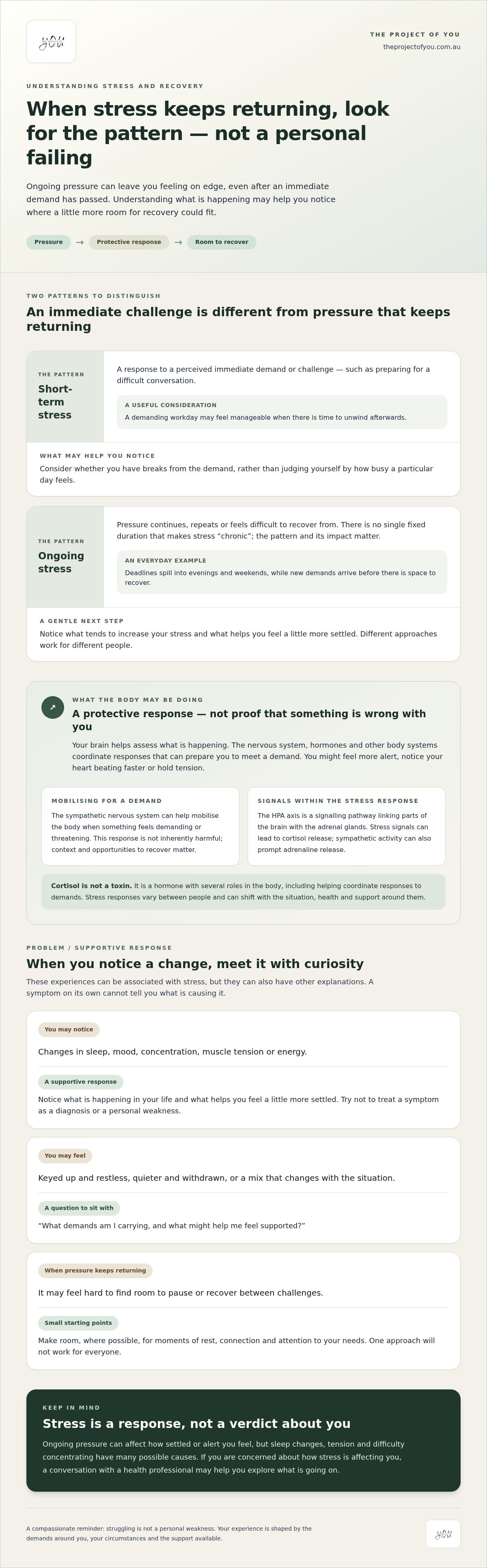
Short-term stress is a response to a perceived immediate demand or challenge, such as preparing for a difficult conversation. Chronic stress refers to pressure that continues, repeats or feels difficult to recover from. There isn’t one fixed duration that makes stress “chronic”; the pattern and its impact matter.
For example, a demanding workday may feel manageable when there’s time to unwind afterwards. If deadlines spill into evenings and weekends, and new demands arrive before you’ve had space to recover, the pressure may start to feel ongoing. You could notice this pattern by considering whether you’re getting breaks from the demand, rather than focusing only on how busy a particular day feels.
In brief: short-term stress is linked to an immediate demand; ongoing stress is pressure that keeps returning or leaves little sense of recovery.
What does the nervous system do during stress?
Your nervous system helps your body notice what’s happening and organise a response. If a situation feels demanding or uncertain, that response can involve changes in alertness, heart rate and readiness to act. These shifts help prepare you to meet a challenge; they aren’t evidence that something is wrong with you.
The response isn’t a neat switch that works identically for everyone. You might feel restless and keyed up, become quieter and withdrawn, or notice a mix that changes with the situation. Past experiences, current circumstances and available support can all shape how stress feels. A broad overview of chronic stress describes its links with the brain, nervous system and physical health, though it can’t explain what any one person’s symptoms mean.
So, the phrase chronic stress and nervous system describes a possible relationship between prolonged pressure and the body’s responses, not a diagnosis or a complete explanation of your health. A useful question may be less “What’s wrong with me?” and more “What demands am I carrying, and what might help me feel supported?”
How can ongoing stress affect the nervous system and body?
Stress isn’t produced by one body part acting alone. The brain helps assess what’s happening, while the nervous system, hormones and other body systems coordinate responses that may prepare you to meet a demand. This can change how alert you feel, how your heart beats and where you hold tension. It’s an adaptive process, not a sign that your body is working against you.
Over time, ongoing pressure may coincide with disrupted sleep, difficulty concentrating, shifts in mood, muscle tension or changes in energy. These experiences can be associated with stress, but they can also have other explanations. The relationship between chronic stress and nervous system activity is complex, so a symptom on its own can’t reveal its cause.
What are the sympathetic nervous system and the stress response?
The autonomic nervous system helps manage body functions that usually happen without conscious effort. One part, the sympathetic nervous system, can help mobilise the body when something is perceived as demanding or threatening. Before a difficult conversation, for instance, you might notice your heart beating faster or feel more alert.
This response isn’t inherently harmful. It can help you respond to a challenge; what matters is the situation, how often the response is called on and whether you have opportunities to recover. The autonomic nervous system also includes processes that support rest and other functions, but these aren’t simply opposing switches. Different responses can overlap and shift with context.
What role do cortisol and the HPA axis play?
The hypothalamic-pituitary-adrenal (HPA) axis is a signalling pathway linking parts of the brain with the adrenal glands. During a stress response, signals along this pathway can lead to the release of cortisol. Sympathetic activity can also prompt the release of adrenaline, which is involved in preparing the body for action. These are parts of a wider response, not a complete explanation for every change someone experiences.
Cortisol isn’t a toxin; it’s a hormone with several roles in the body, including helping coordinate responses to demands. A simple explanation of how the stress response works is available from Harvard Medical School. Popular accounts sometimes make stress sound like one hormone being switched permanently on. In reality, the response involves multiple systems, and its patterns differ from person to person.
Stress-response patterns vary between people, and the same person may respond differently depending on the situation, their health and the support around them. If you’re concerned about how stress is affecting you, an individual counselling conversation may help you explore your experience. You can book an individual counselling session to consider that support.
What can chronic stress feel like, and what can’t symptoms tell you?
Ongoing stress can show up in different parts of life, and it doesn’t look the same for everyone. You might notice changes in your body, emotions, thoughts or habits. These experiences can be useful clues about how you’re doing, but they aren’t a checklist for diagnosing yourself. Similar signs can have different causes, so it’s worth meeting them with curiosity rather than assuming you know what they mean.
Physical: muscle tension, headaches, stomach discomfort, restless sleep or feeling tired.
Emotional: irritability, worry, feeling overwhelmed or finding it harder to experience pleasure.
Cognitive: difficulty concentrating, forgetfulness or thoughts that keep circling around a concern.
Behavioural: withdrawing from people, putting off tasks, working longer or leaning on habits that offer short-term relief.
These are possibilities, not predictions. You may recognise some, none or a different pattern altogether. Your health, relationships, circumstances and available support can all influence what you experience. A change in sleep or concentration, for instance, might be connected with stress, but that alone can’t establish its cause.
Can chronic stress affect sleep, mood and concentration?
It can be associated with restless sleep, irritability, worry or difficulty focusing. Perhaps you lie awake thinking through tomorrow’s responsibilities, or find it harder to follow a conversation after a demanding week. These examples may help you describe what’s happening, but they don’t prove stress is the explanation or indicate a particular diagnosis. If a change concerns you, consider discussing it with a health professional.
Does feeling on edge mean your nervous system is damaged?
No. Feeling on edge doesn’t, by itself, mean your nervous system is damaged or that you’re permanently dysregulated. Stress responses are protective patterns, shaped by what your body and mind perceive as demanding. If pressures continue, feeling more alert or guarded may make sense in context. That doesn’t make the experience easy, and it doesn’t mean it has to define you.
Trauma can also shape how a person responds to reminders of danger or uncertainty, but stress and trauma aren’t interchangeable, and symptoms alone can’t tell you which may be relevant. Trauma-informed therapeutic support can offer space to explore your experience with care.
Rather than asking whether you’re broken, you might gently notice: When do I feel more settled, and when do I feel more activated? Perhaps there are small differences between being alone and with someone you trust, or between a quiet evening and a day filled with competing demands. Noticing patterns isn’t a test. It’s a starting point for understanding what you may need.
What may help when stress keeps returning?
There may not be one action that makes ongoing stress disappear, especially if the pressures around you remain. Instead, try a step-by-step approach: notice patterns, name what’s weighing on you, consider what support is available, then review what feels manageable. The aim isn’t to stay calm all the time. It’s to understand your needs and find options that fit your circumstances.
Notice: Is there a time, situation or interaction when tension tends to rise?
Identify: Which pressures are within your influence, and which aren’t currently changeable?
Consider support: Is there someone safe to talk with, or practical help that could ease one demand?
Review: What feels possible to try now, without turning it into another task you must get right?
Small moments can matter without being a cure: stepping outside for fresh air, pausing between tasks, sharing a meal with someone you trust or making room for a need you’ve been setting aside. A boundary might mean asking for clearer expectations at work, or being honest with someone close about what you can manage. These aren’t universal solutions, and some pressures can’t be removed on your own. Self-compassion can help you recognise that limitation without blaming yourself.
How can you notice your stress patterns without judging yourself?
Try noticing, gently, when tension rises and what’s happening around you. You might ask, “What would help me feel supported in this moment?” Consider whether emotional safety, a relationship, workload, grief or an unmet need could be part of the picture. This isn’t about monitoring yourself all day or making calmness a goal. It’s simply a way to gather clues at a pace that feels respectful.
For some people, exploring nervous system regulation support may be one option for learning more about support and restoration. What’s useful will depend on your circumstances and what feels right for you.
When might professional support be useful?
Consider speaking with a professional if distress persists, affects daily life or feels difficult to manage alone. Counselling can provide space to make sense of patterns, explore emotional safety and relationships, and think through next steps together. If concerns about trauma are part of your experience, trauma-informed support can help you explore them with care, without assuming a particular diagnosis.
Reaching out doesn’t mean you’ve failed to cope. It can be a way to share the load and understand what kind of support may be helpful.
How can counselling support chronic stress and nervous-system restoration?
Counselling can offer a thoughtful space to understand how stress is showing up in your life, rather than treating your experience as a problem to solve quickly. You and your counsellor might explore current pressures, relationships, emotional safety, coping patterns and needs that have been hard to make room for. The aim is to build understanding and consider possible next steps, not to promise a particular result.
At The Project of You, Nervous System Regulation & Restoration and individual counselling support people who want to explore their experience of stress. Azita Abdollahian is a qualified social worker, psychotherapist and neurofeedback trainer. Support can be shaped around your circumstances and proceed at a pace that respects your experiences and sense of safety.
What might you explore in nervous-system-focused support?
You might look at what is creating pressure now, and whether earlier experiences influence how certain situations feel. That exploration doesn’t assume you’ve experienced trauma. It can include noticing what helps you feel emotionally safe, how stress affects your relationships, and which coping approaches feel supportive or no longer fit.
There may also be room to consider practical ways of responding to demands and making space for personal needs. This is collaborative work: your perspective matters, and the focus can shift as you make sense of what’s happening. Exploring the relationship between chronic stress and nervous system responses does not guarantee that specific symptoms will change, but it may help you develop a clearer understanding of your own patterns.
To learn more about this approach, explore nervous system regulation support.
How can you take a first step towards support?
You don’t need to arrive with a polished explanation. It may help to reflect on what feels most difficult at the moment, or what you hope having support might make space for. Perhaps you’re carrying work pressure, navigating conflict or unsure why it’s hard to switch off. “I’m not sure where to begin” is a perfectly valid place to start.
Counselling is a conversation, not a test you have to pass. You can take time to share what feels comfortable and work together to understand what support might be useful. If you feel ready, booking a session can be one gentle next step.
Take a gentle next step towards feeling supported
Ongoing stress can affect how alert you feel and show up in sleep, mood, concentration or energy. These experiences may offer clues, but they don’t prove what’s causing them. The relationship between chronic stress and nervous system responses is personal, and struggling doesn’t mean you’re weak or broken.
Small moments of rest, connection and attention to your needs may help you notice what feels manageable. If stress continues to weigh on you, counselling can offer space to explore your pressures, relationships and coping patterns without needing to have everything figured out first.
At The Project of You, Azita Abdollahian, a qualified social worker, psychotherapist and neurofeedback trainer, offers individual counselling and Nervous System Regulation & Restoration. The work is collaborative and respects your circumstances and pace, rather than promising a particular outcome.
You deserve care and understanding as you find your next step, one moment at a time.
Frequently Asked Questions
What is the connection between chronic stress and the nervous system?
Chronic stress involves prolonged or recurring pressure, while the nervous system helps your body respond to demands it perceives. When pressure continues, you may find it harder to feel settled between challenges. The connection between chronic stress and nervous system activity varies from person to person. Feeling unsettled doesn’t, by itself, establish a diagnosis or mean your nervous system is damaged.
Can chronic stress change how your body responds to everyday situations?
Ongoing stress may influence how alert, tense or reactive you feel in everyday situations. You might notice feeling more on edge during a conversation or finding it harder to unwind after work. Responses differ, and sleep, mood, concentration or physical sensations can also be affected by other factors. If changes persist or interfere with daily life, a health professional can help you explore possible explanations.
What are common signs of chronic stress?
Possible signs include changes in sleep, energy, mood, concentration, muscle tension or everyday habits. You might feel irritable, struggle to focus or withdraw from activities you usually enjoy. These examples aren’t a diagnostic checklist, and they can have causes other than stress. Rather than trying to label yourself from a list, consider how the experience is affecting your wellbeing and whether you’d like support.
Does chronic stress mean your nervous system is stuck in fight or flight?
No. “Fight or flight” is a familiar way to describe aspects of the body’s response to perceived threat, but people’s stress experiences are more varied than one fixed state. Feeling unsettled doesn’t prove your nervous system is permanently stuck. If distress continues, an individual assessment can help explore what may be contributing, while making room for your health, circumstances and personal history.
How can you calm your nervous system when stress feels constant?
There’s no single technique that works for everyone, and you don’t need to make feeling calm another task to get right. Start by noticing what tends to increase pressure, then consider a manageable moment of rest, connection or attention to your needs. If stress is affecting daily life, counselling or another suitable form of professional support may help you explore options that fit your circumstances.
When should you seek professional help for chronic stress?
Consider seeking support if distress continues, feels difficult to manage alone or affects sleep, relationships, work or daily activities. You don’t need to wait until things feel unbearable or arrive with a clear explanation. A qualified professional can listen, explore your circumstances and discuss possible next steps with you. Asking for support can be a way to understand what you’re carrying, not a sign of weakness.


Comments