.png)

Trauma-Informed Guide to Better Relationship Communication

What if the recurring friction in your partnership isn't a sign of failure, but a signal from a nervous system trying its best to keep you safe? It is exhausting to feel like you are walking on eggshells, or to wake up to the cold weight of the silent treatment after yet another unresolved argument. You likely already know that communication is the heartbeat of intimacy, yet you might still struggle with how to improve relationship communication when your body feels primed for a fight. You are not alone in this search. It's a common path to tread, but there is a way to find a smoother trail toward genuine understanding and peace.
We often believe that if we just find the perfect words, the conflict will dissolve; however at The Project Of You, relationship expert Azita Abdollahian tells her clients that true connection requires more than a clever script. This guide promises to help you move beyond temporary fixes by recognising the profound role your attachment style and physiological responses play in your daily interactions. You will learn how to cultivate a sense of deep emotional safety, allowing you to resolve conflict without lasting hurt and restore the physical intimacy you both deserve. We will look at the "why" behind the "what," offering you a structured map to guide your relationship back to a place of warmth and mutual respect.
Table of Contents
Beyond the Words: Why Relationship Communication Often Breaks Down
It is a heavy, isolating feeling to sit across from the person you love most and feel completely unheard. Perhaps you've spent years repeating the same grievances, only to be met with a wall of silence or a sharp retort. When you are searching for how to improve relationship communication, it's easy to focus solely on the words being said. But what if the words are just the surface? Often, these communication blocks aren't just "bad habits" or a lack of effort. They are deeply ingrained protective mechanisms designed to shield us from perceived threats.
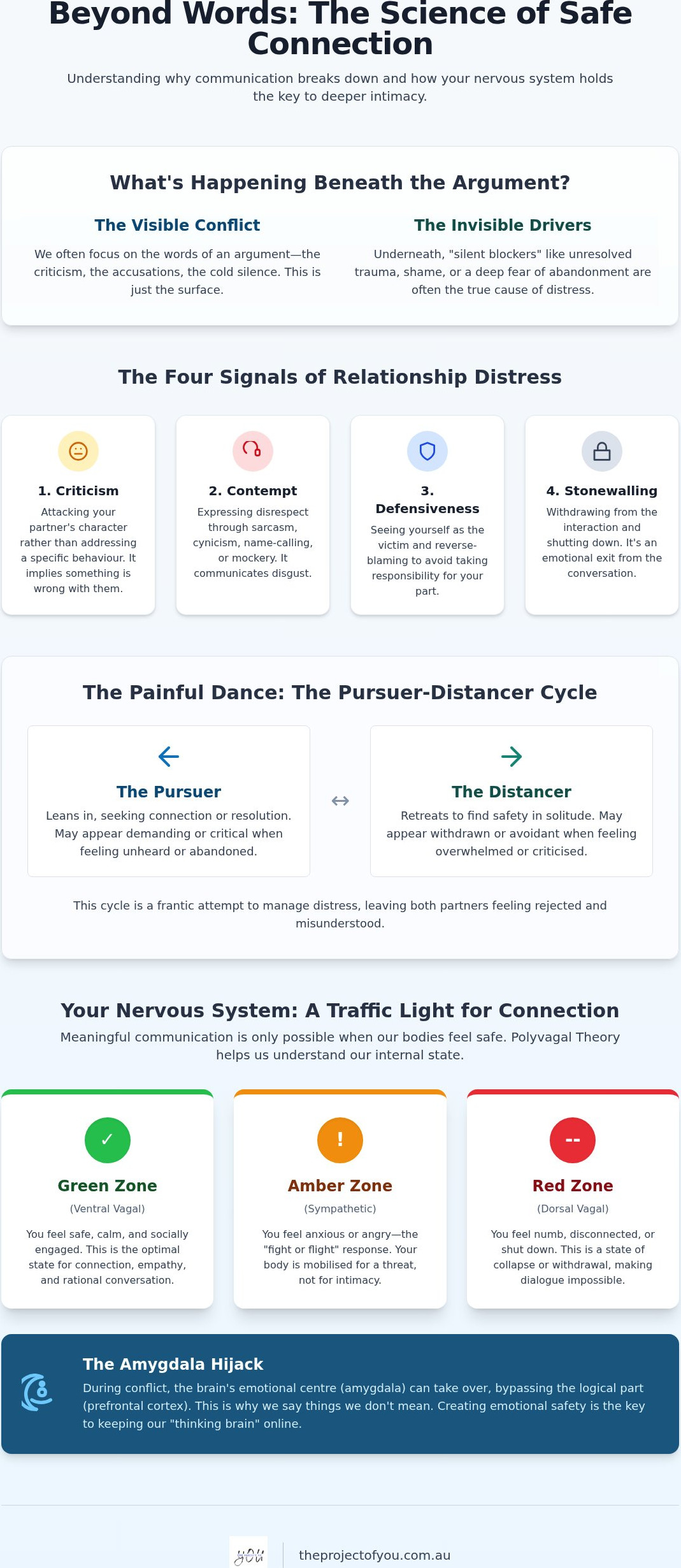
Beneath the surface of a heated argument often lie "silent blockers" like unexpressed grief, deep-seated shame, or a primal fear of abandonment. These emotions act like static on a radio line, distorting every message sent and received. Dr John Gottman’s research identifies "The Four Horsemen": criticism, contempt, defensiveness, and stonewalling. These behaviours signal a profound lack of safety within the relationship. They aren't just personality flaws; they are frantic signals that the emotional foundation is under stress.
The Role of Unresolved Trauma and Attachment
Our early years create a blueprint for how we navigate intimacy. If those early foundations involved instability, we might carry attachment issues in relationships into adulthood without even realising it. Recognising Your Attachment Style is a vital step in understanding why logic seems to vanish the moment an emotional trigger is pulled. When our "survival brain" takes over, the part of us responsible for rational thought effectively goes offline. We aren't just arguing about the present; we are reacting from a place of ancient self-preservation.
Recognising the 'Cycle' in Your Relationship
Many couples find themselves trapped in a "Pursuer-Distancer" dynamic. One partner leans in, demanding answers or connection, while the other retreats to find safety in solitude. It is a painful dance where both people end up feeling rejected and misunderstood. To break this loop, we must move toward curiosity. What is actually happening beneath the surface of this argument? Instead of reacting to the anger, try to see the vulnerability underneath. When I feel unheard, what part of me is trying to be protected? Understanding this cycle is a core part of learning how to improve relationship communication and finding your way back to a place of mutual warmth.
The Science of Connection: Nervous System Regulation as a Foundation
Communication is not just an exchange of words; it's a physiological event. To understand how to improve relationship communication, we must first look at nervous system regulation. This is your body's ability to stay grounded and present, even when emotional waves start to swell. Think of your internal state through the lens of Polyvagal Theory, which acts like a traffic light system for your emotions. When you are in the "Green" (Ventral Vagal) zone, you feel safe, open, and capable of connection. The "Amber" (Sympathetic) zone is the realm of fight or flight, where your body prepares for a perceived threat. Finally, the "Red" (Dorsal Vagal) zone is where we experience shutdown, numbness, or withdrawal.
You cannot solve a complex emotional problem or reach a compromise when your nervous system is stuck in Amber or Red. In these states, your body prioritises survival over intimacy. Emotional safety is the biological prerequisite for vulnerable dialogue. Without this foundation, even the most well-intentioned conversation can quickly spiral into a defensive battle.
What Happens to Your Brain During a Conflict?
When a discussion feels like a threat, your brain may undergo an "Amygdala Hijack." This occurs when the emotional centre of the brain takes over, effectively bypassing the prefrontal cortex, the area responsible for logic, empathy, and social engagement. This is why we say things we don't mean when we are stressed. For many, how trauma dysregulates your nervous system can narrow what therapists call the "Window of Tolerance." Inside this window, you can handle life's ups and downs. Outside of it, you might experience a racing heart, shallow breath, or a clenched jaw. These physical signals are your body's way of saying it no longer feels safe to talk.
The Concept of Co-regulation
Relationships provide a powerful space for co-regulation, where one partner's calm state helps to soothe the other's distress. It is a beautiful, silent dance of biology. By maintaining soft eye contact, using a nurturing tone of voice, and staying physically present, you can help your partner's nervous system return to a state of safety. A simple, practical tool for this is the "20-second hug." Holding each other for this length of time encourages the release of oxytocin and helps to reset the oxytocin system, lowering stress hormones for both of you. If you find that your physiological responses are frequently overwhelming your attempts at connection, you might consider how professional couples support can help you both find your way back to a regulated, loving centre.
Recognising Your Attachment Style in Difficult Conversations
If your nervous system is the engine of your communication, your attachment style is the map you follow. Understanding these internal blueprints is essential when learning how to improve relationship communication. Most of us fall into one of four categories: Secure, Anxious, Avoidant, or Disorganised. While Secure individuals feel comfortable with both intimacy and boundaries, those with Anxious styles often crave closeness to feel safe. In contrast, Avoidant individuals may view intimacy as a threat to their independence. Disorganised attachment often involves a confusing mix of both seeking and fearing connection.
It is a common paradox that Anxious and Avoidant partners often find each other. This creates what is known as the "Anxious-Avoidant Trap." When the Anxious partner feels a shift in connection, they may engage in "protest behaviours" like frequent texting or clinging. This pressure often triggers the Avoidant partner's "deactivation" strategies, such as withdrawing or focusing on their partner's flaws to create distance. It's a painful cycle, but recognising the pattern is the first step toward breaking it. Many couples find that couple counselling provides the neutral ground needed to navigate these deep-seated dynamics.
The Anxious Partner's Communication Style
For the Anxious partner, silence often feels like an approaching storm. The need for constant reassurance isn't a desire to be difficult; it's a primal fear of losing the connection. To communicate effectively without overwhelming your partner, try to name the feeling rather than the demand. Instead of saying "You never talk to me," try "I'm feeling a bit disconnected and would love ten minutes of your time." Take a moment to reflect: "Am I asking for connection, or am I demanding relief from my anxiety?"
The Avoidant Partner's Communication Style
For the Avoidant partner, closeness can sometimes feel like being engulfed. The fear isn't necessarily of the partner, but of losing one's sense of self. You can express your need for space without causing abandonment pain by being specific and reliable. A "Scheduled Check-in" is a powerful strategy here. By agreeing to talk at a set time, you provide your partner with certainty while giving yourself the autonomy you need. This structure is a practical way to explore how to improve relationship communication while respecting the biological needs of both partners.
Practical Strategies for Healthier Dialogue and Repair
Once you understand the biological and emotional maps of your relationship, you can begin to implement specific tools for how to improve relationship communication. The way a conversation begins usually determines how it ends. A 'Soft Start-up' involves raising a concern without triggering your partner's internal alarm system. Instead of leading with blame, start by describing your own experience. Using 'I' statements, such as "I feel overwhelmed when the kitchen is messy because I need a calm space to relax," invites your partner into a partnership rather than a confrontation.
Active listening is another cornerstone of healthy dialogue. It requires a shift from simply waiting for your turn to speak to truly seeking to understand your partner's perspective. When the temperature of a conversation starts to rise, the art of the repair attempt becomes vital. These are small, often subtle gestures, like a shared joke, a gentle touch, or a simple "I'm sorry, I didn't mean to snap," that de-escalate tension before it turns into a full-scale argument. Research shows that the ability to make and receive these repairs is a primary predictor of long-term relationship stability.
Somatic Grounding Exercises for Couples
Communication is more than just a mental exercise; it's a physical one. When you feel the heat of a conflict rising, follow these three steps to stay within your window of tolerance:
Step 1: Recognise the early physical signs, such as the 'flush' of anger in your chest or the 'chill' of emotional shutdown.
Step 2: Declare a 'Compassionate Time-out.' This is not an escape, but a promise to return to the conversation once you have both calmed down.
Step 3: Engage in intentional self-regulation. This might include deep breathwork, gentle movement, or exploring more intensive nervous system restoration to help you find your centre.
The Weekly 'State of the Union' Meeting
Consistency creates safety. Setting aside just 20 minutes each week for a structured check-in can prevent small resentments from growing into larger barriers. During this time, focus on what went well during the week, what needs a little more attention, and ask, "How can I make you feel particularly loved this week?" This practice helps build your 'Emotional Bank Account' through daily appreciations, making it easier to navigate how to improve relationship communication during more challenging times.
Moving Forward: When to Seek Professional Support
What if the next step toward a deeper connection isn't about trying harder on your own, but about allowing yourself to be supported? It is a courageous act to admit when you have reached the end of your own current resources. Every couple, no matter how committed, eventually encounters a plateau where self-help books and independent effort aren't enough to bridge the gap. Recognising this moment isn't a sign of failure; rather, it's a signal that your relationship is ready for a more structured level of care and a new way of being together.
There are clear indicators that you may need the guidance of a neutral third party. If you find yourselves trapped in circular arguments that lead nowhere, or if you are navigating the heavy aftermath of infidelity, professional support provides the framework needed for repair. Perhaps the most telling sign is a state of total silence, where the fear of conflict has led to a complete emotional withdrawal. In these moments, couples counselling offers a safe container. An expert can 'hold the space' for difficult conversations, ensuring that both partners feel heard and valued without the dialogue spiralling into further hurt. Taking a proactive approach to your relationship health is always more effective than waiting for a reactive crisis.
Intensive Healing: The Power of Couples Retreats
Sometimes, the daily environment is so full of triggers that it is nearly impossible to find a calm, regulated centre. This is why getting away from the routine of the household and the demands of work can accelerate the healing process so significantly. During a Private Couples Retreat at The Project Of You, you are given the time and professional guidance to focus entirely on your bond. This immersive experience helps you move out of 'survival mode'—where you are simply trying to avoid another fight—and into a space of thriving connection. It's an opportunity to reset your communication patterns in a sanctuary designed for restoration.
Your Journey Starts with Self-Awareness
Your relationship is a living system that requires two healthy individuals to flourish. Focusing on your own growth is one of the most profound gifts you can offer your partnership. When you understand how to improve relationship communication from the inside out, you become a more resilient and compassionate partner. You might choose to explore individual therapy or engage with resources like our Self Love e-Books to strengthen your own nervous system. Final takeaway: communication is a practice, not a destination. Be gentle with yourselves as you navigate this path, and remember that every small step toward understanding is a victory for your love.
Finding Your Way Back to Connection
What if the path to a more vibrant partnership starts with a single, regulated breath? By recognising that your nervous system’s need for safety is the cornerstone of every dialogue, you’ve begun to master how to improve relationship communication. You now understand that intimacy is built through the steady work of co-regulation and the courageous act of repair. These shifts from reactive protection to conscious connection are what allow a relationship to truly flourish over time.
Ready to transform your connection? Book a session or retreat with The Project of You today. At The Project of You, our team of qualified psychotherapists, led by Azita Abdollahian, offers an evidence-informed and trauma-sensitive approach to healing. We specialise in complex relationship dynamics and betrayal recovery, providing a steady presence as you navigate your unique journey. Growth is a continuous process, not a final destination. Be gentle with yourselves as you create a new, safer way of being together.
Frequently Asked Questions
How do I talk to my partner when they won't listen?
Start by checking the physiological state of the room. If your partner is "flooded" or in a state of nervous system shutdown, they physically cannot process your words. Try approaching them during a "green zone" moment and lead with your own feelings rather than their behaviour. Asking "Is now a good time to chat about something on my mind?" gives them the agency to engage when they are ready to listen.
What are some communication exercises for couples to try at home?
One effective exercise is the "Appreciation Jar," where you each write down one specific thing you valued about the other that day. Another is the "Speaker-Listener Technique," where one person speaks for two minutes while the other listens without interrupting, then reflects back what they heard. These simple rituals help build the emotional safety needed when you are learning how to improve relationship communication in your daily life.
Is it possible to improve communication if only one person is trying?
Yes, because a relationship is a system, and when one person changes their input, the output of the system must shift. By regulating your own nervous system and responding with calm instead of reactivity, you stop feeding the cycle of conflict. While long-term success usually requires both partners to engage, your individual growth can often act as a catalyst for your partner to begin their own journey toward better dialogue.
How do I stop being defensive during arguments?
Defensiveness is usually a sign that your "inner protector" feels threatened. To soften this, try to find a "kernel of truth" in what your partner is saying, even if you don't agree with the way they said it. Taking a slow, deep breath can help keep your prefrontal cortex online. Acknowledging their perspective with a simple "I can see why you'd feel that way" can instantly lower the tension for both of you.
What should I do if my partner uses the silent treatment?
Recognise that the silent treatment is often a "freeze" response from a person who feels emotionally overwhelmed. Instead of pushing for an immediate answer, which can deepen their withdrawal, offer a gentle bridge. You might say, "I can see you need some space right now. I'm going to give you some room, but I'd love to check back in an hour." This maintains the connection while respecting their need for physiological safety.
When is the best time to bring up a difficult topic?
The best time is during a "low stakes" moment when you are both well-rested and fed. Avoid bringing up heavy issues late at night, right after work, or when you are already in the middle of a separate disagreement. Ideally, you should schedule a time to talk, which prevents the other person from feeling blindsided. This "pre-planned" approach ensures both nervous systems are prepared for a vulnerable conversation.
Can couples counselling really save a relationship where communication has died?
Yes, it certainly can. Often, what looks like "dead" communication is actually just a state of chronic shutdown or "Dorsal Vagal" collapse. A therapist acts as a neutral guide to help you find your way back to each other. Through structured support, such as Gottman Couples Therapy or a Private Couples Retreat, you can learn how to improve relationship communication by rebuilding the foundational safety that has been lost over time.
How does trauma affect the way we communicate with our spouse?
Trauma can leave the nervous system on high alert, making neutral comments feel like personal attacks. If you grew up in an environment where conflict was dangerous, you might instinctively use "fight" or "flight" responses during minor marital disagreements. This is why trauma-informed therapy is so vital. It helps you understand that your reactions are often based on past blueprints rather than the reality of your current partnership.


Comments