.png)

Couples Therapy After Infidelity: A Compassionate Guide to Healing Betrayal Trauma

What if the crushing weight in your chest and the constant "scanning" for lies aren't just signs of a broken heart, but your nervous system's way of trying to keep you safe? Trauma expert Azita Abdollahian explains that betrayal can often be experienced as actual trauma.
When you discover there has been a betrayal in your relationship, your shared sense of reality shatters, often leaving you in a state of chronic hypervigilance or emotional "flooding" that makes even simple conversations feel like a minefield. Seeking couples therapy after infidelity is a courageous step, yet it's common to feel that the path back to each other is blocked by walls of hurt and defensiveness. It's an exhausting way to live, feeling like you're constantly bracing for the next blow.
You've likely spent many nights wondering if you'll ever feel secure again. While infidelity is a factor in 40% of Australian divorces, research suggests that 60% to 75% of couples who seek professional support are able to reconcile and rebuild. This guide offers a way through the wreckage. You'll discover how to find a sense of safety within your own body and follow a clear framework for rebuilding trust. We'll explore why the betrayal happened without excusing the behaviour, providing you with the tools to move from shock toward a future of supported growth.
Table of Contents
Understanding Betrayal Trauma: Why Infidelity Feels Like a Physical Shock
When you experience betrayal, it feels as though the ground has vanished beneath your feet. This isn't just emotional distress. It's a rupture of your primary attachment bond, the very foundation of your sense of security. In my practice, I often see how this shock manifests as a profound physical experience. Your body enters a state of high alert, where every text message or late arrival home feels like a direct threat to your survival. It's common to experience intrusive thoughts, sleep disturbances, and a sense of emotional volatility that feels entirely out of character.
This state of chronic hyper-vigilance often leads to "flooding", a physiological event where your nervous system becomes overwhelmed. When flooding occurs, your heart rate increases and your logical brain effectively goes offline. It becomes impossible to have a productive conversation about the future when your body is screaming at you to run or fight. This is why couples therapy after infidelity must begin with stabilisation rather than just "talking it out". We need to calm the alarm system before we can rebuild the bridge.
The Biological Reality of Betrayal
The amygdala, the part of your brain responsible for processing fear, doesn't distinguish between a physical threat and the psychological damage of infidelity. It treats the betrayal as a survival crisis. You might find yourself struggling with a loss of a shared sense of reality, wondering what was true and what was a lie. These symptoms are your body's way of trying to protect you from further harm. Simply "moving on" is biologically impossible because your nervous system requires evidence of safety before it can de-escalate. You cannot think your way out of a physiological trauma; you have to feel your way through it with support.
Reflective question: Have you noticed your body reacting with a racing heart or shallow breath before your mind even processes what triggered you?
Validation as the First Step to Healing
Healing cannot begin until we acknowledge the depth of the rupture. For the partner who was unfaithful, the primary emotion is often a heavy sense of guilt or shame. For the betrayed partner, however, the experience is one of trauma. Both are painful, but they require different types of support to resolve. Betrayal trauma is a systemic shock to the relationship foundation. By validating this trauma together, you stop fighting the symptoms and start addressing the wound. Engaging in couples therapy after infidelity allows you to create a shared language for this pain, ensuring neither partner feels isolated in their experience as you begin the slow process of repair.
The Role of Nervous System Regulation in Affair Recovery
At The Project of You | Trauma, Couples & Relationship Therapy Australia, we consider Nervous System Restoration a fundamental pillar of the healing process. When betrayal occurs, the "fight or flight" response often becomes a permanent, exhausting resident in the relationship. One partner might be hyper-aroused, constantly scanning for signs of further deceit, while the other feels paralysed by a heavy sense of shame or defensiveness. This persistent dysregulation makes productive couples therapy after infidelity difficult because the human brain simply cannot process complex emotional repair while it's trapped in survival mode.
Before we can safely explore the nuances of the affair, we must first establish "somatic safety". This is a felt sense of security within your own body. It involves learning the art of co-regulation, where partners learn how to settle each other's nervous systems through presence, eye contact, and a softened tone. Research highlights that a structured therapeutic approach to healing is most effective when it prioritises this physiological grounding, ensuring that discussions lead to connection rather than further trauma.
Polyvagal Theory and Relationship Safety
Polyvagal Theory introduces us to the "Window of Tolerance", which is the emotional space where we can handle stress without becoming overwhelmed. Betrayal often causes this window to shrink significantly, making even minor disagreements feel like major threats. You might notice your partner moving into a "shutdown" state, where they appear cold or emotionally distant, or an "attacking" state, characterised by sharp anger. Recognising these as involuntary nervous system responses, rather than intentional acts of malice, is a vital step in de-escalating conflict. You can explore more about these biological shifts in our blog resources on trauma and the nervous system.
Healing the Attachment Rupture
Infidelity often acts as a powerful spotlight on our oldest childhood wounds. If you grew up with an anxious attachment style, a betrayal might trigger an intense, primal fear of abandonment. Conversely, those with avoidant tendencies might withdraw further into a shell to protect themselves from the pain. Through couples therapy after infidelity, we work to move toward "earned secure" attachment. This process involves identifying "protest behaviours", such as excessive checking or stony silence, and replacing them with clear, vulnerable communication. By understanding these patterns, you can begin to rebuild a relationship that feels more resilient than the one that came before. If you're finding it difficult to stay grounded during these conversations, beginning professional support can provide the steady guidance needed to find your way back to each other.
What if the reason you feel stuck isn't a lack of love, but the way your therapy is structured? When couples seek support, they often expect a space to simply air their grievances. However, standard talk therapy can sometimes do more harm than good in the wake of a betrayal. If a therapist encourages a "venting" session without first establishing safety, the betrayed partner can easily become re-traumatised by hearing details they aren't ready to process. Effective
**couples therapy after infidelity
**requires a more nuanced, structured approach that goes beyond just talking about what happened.
While Cognitive Behavioural Therapy (CBT) is excellent for challenging unhelpful thoughts, it often misses the somatic, or body-based, nature of betrayal trauma. This is where the Gottman Method becomes invaluable. It provides a framework for rebuilding the relationship by focusing on friendship, conflict management, and the creation of shared meaning. By blending these evidence-based strategies with somatic awareness, we can move past circular arguments and start the genuine work of repair.
Many couples also find that standard 50-minute weekly sessions feel like opening a wound only to have it bandaged before any real work is done. This is why intensive formats are gaining traction. They allow for deep, focused healing without the interruption of daily life, providing the space needed to move through months of progress in just a few days.
Traditional vs. Trauma-Informed Care
Many Australians find that generic marriage counselling fails because it treats infidelity as a simple communication breakdown. It isn't. It's a traumatic rupture. Without a therapist who understands the specific mechanics of betrayal trauma, the sessions can feel invalidating or even dangerous for the betrayed partner. Choosing the right path is essential for long-term recovery, and you can find more guidance on this in our blog on choosing couples counselling.
The Project of You | Trauma, Couples & Relationship Therapy Australia Approach
At The Project of You | Trauma, Couples & Relationship Therapy Australia, we believe in a holistic path to restoration. Azita Abdollahian acts as a compassionate guide, integrating CBT with Nervous System Restoration and attachment-based work to ensure both partners feel heard and supported. For those dealing with deep-seated trauma that feels stuck in the body, we also offer Psychedelic Assisted Therapy. This innovative approach can help bypass the logical mind to reach the emotional core of the trauma, facilitating a level of breakthrough that traditional methods may struggle to achieve. By combining these diverse tools, we help you navigate the complexities of couples therapy after infidelity with grace and professional authority.
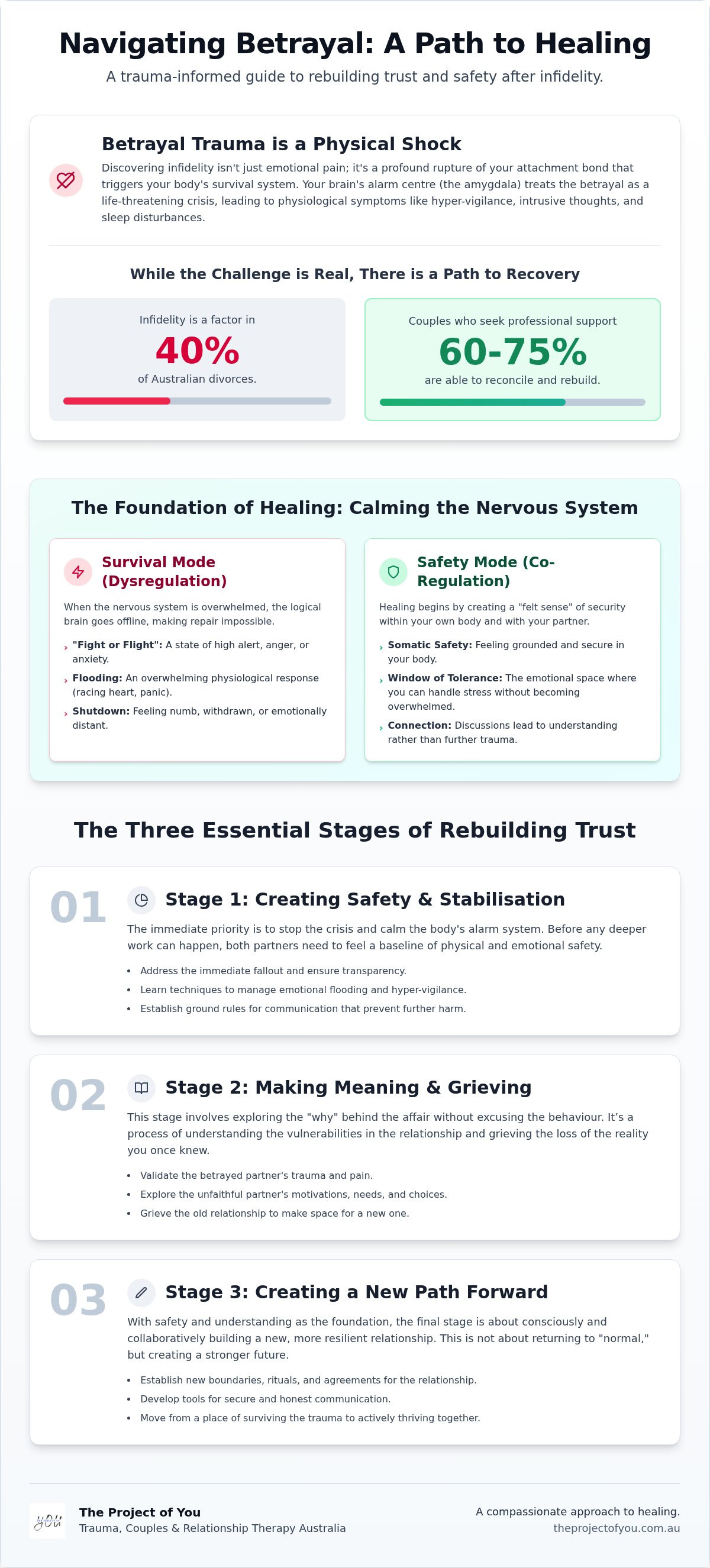
The Three Essential Stages of Rebuilding Trust
Rebuilding trust after a betrayal is rarely a straight line. It's more like a spiral, where you might revisit old hurts even as you move toward a new understanding. In my work with couples, I've found that the most resilient recoveries follow three essential stages. These phases often overlap, and it's perfectly normal to feel like you've looped back to the beginning when a new trigger arises. Recognising where you are in this process can provide a sense of direction when everything else feels chaotic.
Stabilising the Crisis
The first stage is all about establishing immediate safety. This is the "Crisis Phase", where the shock is most acute and the nervous system is most reactive. During this time, we focus on setting non-negotiables. This might include full transparency with devices or a commitment to ending all contact with a third party. To manage the moments of "flooding" at home, practical grounding techniques like the 5-4-3-2-1 sensory method or using cold water to reset the vagus nerve can be life-saving. The primary goal of the stabilisation phase is reducing physiological reactivity. Without this calm foundation, the deeper work of couples therapy after infidelity cannot truly begin.
The Hard Work of Meaning-Making
Once the immediate fire is under control, we move into the "Why Phase". This is where we transition from "detective work", which is obsessing over the minute details of the betrayal, to "discovery", which is understanding the gaps in the relationship that allowed the rupture to occur. It requires radical honesty from one partner and an immense capacity for grieving from the other. For the partner who was unfaithful, this stage is about demonstrating deep attunement. This means sitting with your partner’s pain, listening without defensiveness, and validating their experience. It's about showing that you're safe enough to hold their hurt.
Reconnecting and Reimagining the Future
The final stage isn't about "going back to how things were". That relationship no longer exists. Instead, this is the "New Us Phase", where you take the lessons learned from the fire and use them to build something stronger. You begin to reimagine a future based on shared values, emotional intimacy, and a deeper level of self-awareness. While the scar of the betrayal remains, it eventually becomes a part of a larger, more complex story of resilience and transformation. Professional couples therapy after infidelity facilitates this shift, helping you move from a place of mere survival to a relationship that feels intentional and profoundly connected.
Creating a New Path Together: How Professional Support Facilitates Transformation
The journey through betrayal is often described as a walk through fire; yet many couples find that the process of rebuilding actually creates a foundation far more resilient than the one that existed before. This isn't because the betrayal was "good" for the relationship, but because the recovery process forced a level of radical honesty and self-awareness that was previously absent. Specialized couples therapy after infidelity provides the scaffolding for this transformation, helping you move from a state of mere survival to a relationship based on conscious choice and deep emotional intimacy.
It's vital to recognise that professional support isn't just about resolving conflict. It's about finding your way back to yourself and each other with grace. When you're stuck in the cycle of hyper-vigilance and flooding, the kindest path forward is often to invite a steady, compassionate guide into the space. This allows you to step out of the "detective" role and begin the work of becoming partners again. Through couples therapy after infidelity, you gain the tools to communicate without escalating, ensuring that your shared sense of reality is restored piece by piece.
The Value of Intensive Healing
For many Australians, weekly sessions can feel like they're barely scratching the surface of a deep wound. This is where Private Couples Retreats offer a profound advantage. These intensives provide the "containment" necessary for deep emotional work, allowing you to stay in the process without the interruptions of domestic life or work stress. There is a fundamental difference between "saving a marriage" and "building a new one". One looks backward at a broken structure; the other looks forward, using the lessons of the past to create something entirely different. I invite you to explore The Project Of You retreats as a dedicated space for this focused restoration and nervous system healing.
Taking the Next Step
Healing is possible, even if it feels like a distant shore right now. The pain you're feeling today won't always be this sharp. With the right tools and a trauma-informed approach, you can learn to regulate your nervous system and find a sense of safety within your own body and your relationship. What would it feel like to breathe easily in your relationship again? The path is there, and you don't have to walk it alone.
Moving Forward with Compassion and Clarity
Navigating the aftermath of betrayal is one of the most significant challenges a couple can face. We've explored how infidelity acts as a physiological trauma, requiring more than just communication skills to repair. By focusing on nervous system restoration and moving through structured stages of trust-building, you can begin to find your way back to a sense of safety. Engaging in couples therapy after infidelity provides the evidence-informed trauma care needed to bridge the gap between a painful present and a reimagined future. In our practice, we provide a compassionate, non-judgemental environment where both partners can feel heard and supported as they explore the "why" behind the rupture without excusing the behaviour.
Begin your path to healing by booking a session today The weight you're carrying today doesn't have to be your permanent reality. While the journey of repair requires patience and courage, it also holds the potential for a deeper, more intentional connection than you've ever experienced. You've already taken the first step by seeking understanding. When you're ready, we're here to help you create a path forward built on genuine emotional intimacy and earned security.
Frequently Asked Questions
How long does it typically take to heal from infidelity in couples therapy?
Healing is a journey rather than a race, and most couples find it takes between 18 and 24 months to reach a new state of stability. In the early stages of couples therapy after infidelity, we focus on crisis management and calming the nervous system. As the initial shock subsides, the work shifts toward meaning-making and rebuilding emotional intimacy. The timeline depends heavily on both partners' commitment to radical honesty and consistent effort.
Is it possible to truly forgive and trust again after an affair?
It is entirely possible to rebuild trust, though it requires a complete transformation of the relationship's foundation. Forgiveness isn't about forgetting what happened; it's a conscious choice to release the grip of the past to create space for a different future. Trust is rebuilt through small, consistent moments of transparency and emotional attunement. Many couples find that their post-infidelity relationship becomes more resilient and honest than the one they had before.
What should we look for in an infidelity recovery therapist in Australia?
Look for a practitioner who is trauma-informed and specifically trained in evidence-based models like the Gottman Method or somatic therapy. In Australia, ensure your therapist is a registered professional, such as a Clinical Social Worker or Psychotherapist. It's essential that they understand Polyvagal Theory and nervous system regulation. You need a guide who can hold a non-judgemental space for both partners while providing a structured framework for navigating the complex stages of recovery.
My partner refuses to go to therapy; can I still work on the relationship alone?
You can certainly begin your own healing process through individual counselling, even if your partner isn't ready to join you yet. While you cannot "fix" the relationship single-handedly, focusing on your own nervous system regulation and boundaries can shift the dynamic between you. Often, when one partner begins to show up with more clarity and self-awareness, it creates a safer environment that may eventually encourage the other to engage in professional support.
What is the difference between marriage counselling and affair recovery?
Standard marriage counselling often focuses on communication skills and conflict resolution, which can be insufficient for the trauma of betrayal. Affair recovery is a specialised form of couples therapy after infidelity that prioritises stabilisation and the repair of a shattered attachment bond. It addresses the physiological shock first. While traditional counselling might treat infidelity as a symptom of relationship problems, affair recovery recognises it as a traumatic rupture that requires specific intervention.
How do we handle triggers and intrusive thoughts while we are in therapy?
Handling triggers requires a combination of immediate grounding techniques and long-term somatic processing. When an intrusive thought strikes, focus on calming your body through deep, rhythmic breathing or sensory awareness. In therapy, we develop "safety plans" for these moments, helping the unfaithful partner learn how to respond with empathy rather than defensiveness. Over time, as your nervous system begins to feel more secure, these triggers usually become less frequent and less intense.
Can an intensive couples retreat work better than weekly sessions for infidelity?
Intensive formats, such as a Private Couples Retreat, can be highly effective because they provide the containment needed for deep emotional work. Weekly 50-minute sessions can sometimes feel too short to process the complexity of betrayal trauma. An intensive allows you to bypass months of slow progress by staying in the therapeutic process for several days. This immersion helps in regulating the nervous system and reaching breakthroughs that are often difficult to achieve in standard appointments.


Comments