.png)

Healing in High Definition: Australian Couples Retreats

What if the reason you keep having the same argument isn't a lack of love, but a nervous system that doesn't feel safe enough to let go? It's incredibly draining to feel stuck on the therapy treadmill, where you might spend forty minutes of every hour simply recapping the week's fights. You may find yourself in a state of constant exhaustion, your body perpetually braced for the next misunderstanding at home. Choosing a couples intensive retreat like the ones hosted by couples counsellor and relationship expert Azita Abdollahian, allows you to step off that cycle and into a sanctuary designed for deep, focused restoration.
We recognise that real change requires more than just better communication skills; it requires a biological sense of security. By prioritising a concentrated, nervous system-led experience, you can break through years of relationship gridlock in just a few days. This article explores how a dedicated intensive provides a clear roadmap for recovery, offering practical tools to regulate your emotions and help you feel truly seen by your partner again. We will look at the evidence behind this immersive approach and how it creates a safe harbour for lasting intimacy.
Table of Contents
Beyond the Weekly Hour: Why Relationships Need an Intensive Reset
Have you ever felt like you're just getting to the heart of the matter when your therapist says, "We'll have to stop there for today"? This is the reality for many engaging in standard couples therapy. While weekly sessions have their place, they often lack the momentum required for significant shifts. A couples intensive retreat is a concentrated therapeutic experience, typically spanning two to three days, designed to bypass the surface-level noise and reach the core of your connection.
By stepping away from the daily demands of life, you create a "safe container." This isn't just about a change of scenery; it's about removing the biological stressors that keep your nervous system on high alert. When you aren't worried about school pick-ups or work emails, you can finally afford to be vulnerable. This intentional pause allows you to move from simply surviving to truly thriving, making it a strategic investment in the very foundation of your life together.
The Limitations of the 50-Minute Session
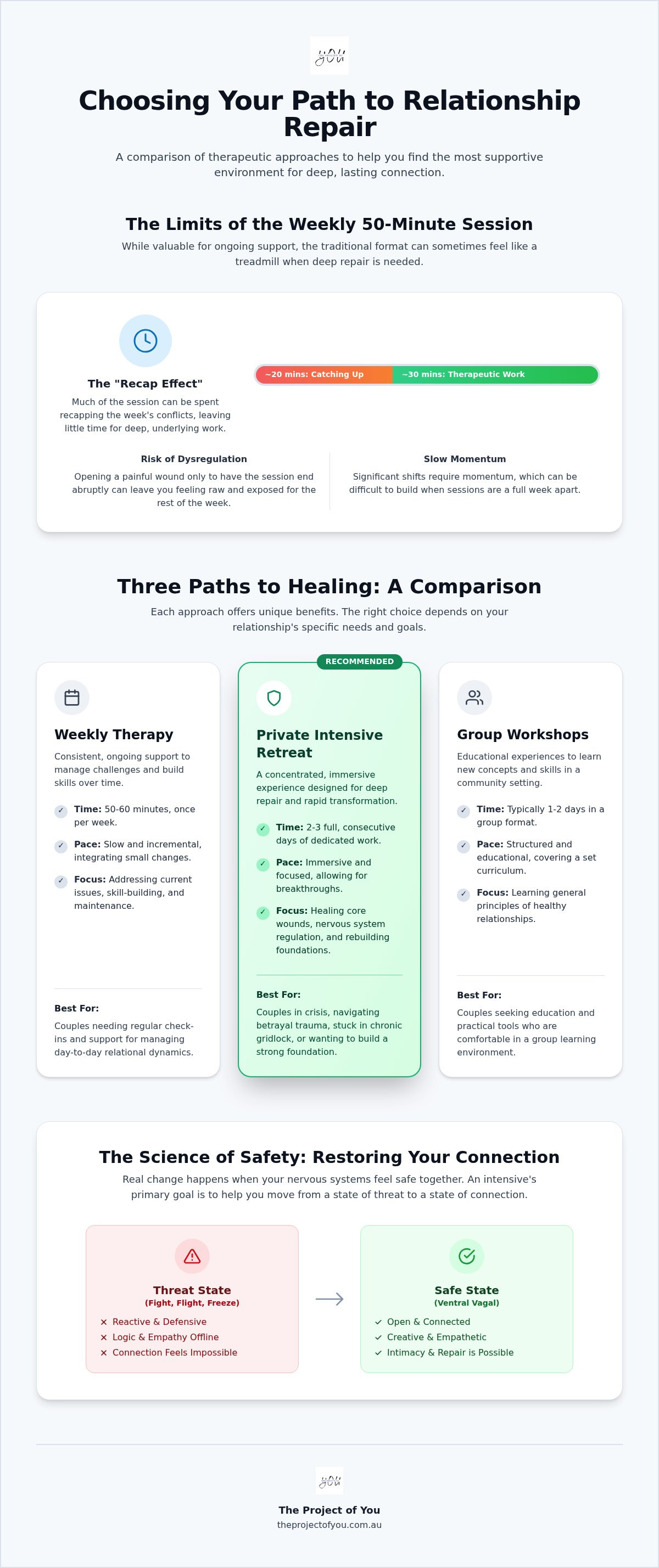
Standard sessions often fall victim to the "recap effect." You spend the first twenty minutes catching the therapist up on the latest argument, leaving very little time for actual healing work. For couples facing deep-seated trauma, opening a painful wound only to be told the session is over forty minutes later can be incredibly dysregulating. It can leave you feeling raw and exposed as you head back into your week, often leading to more conflict rather than less. A couples intensive retreat provides the dedicated space to open these doors and, more importantly, the time to safely walk through them together.
When is an Intensive the Right Choice?
An intensive is often the most effective path for those who feel they've reached a plateau or a crisis point. It's particularly effective for:
Betrayal Trauma: Navigating the aftermath of infidelity requires more than an hour a week to process the intense waves of grief, shame, and broken trust.
Chronic Gridlock: If you've been stuck in the same cycle for years, a private couples retreat provides the time needed to unpick the underlying attachment needs that keep you stuck.
Building Foundations: Couples preparing for marriage can use this time to align their values and map out a shared vision before the pressures of life settle in.
What if you could accomplish in one weekend what usually takes six months of weekly appointments? By dedicating this time to each other, you aren't just talking about your problems; you're actively building the biological safety required for a lifetime of connection.
The Science of Safety: How Nervous System Restoration Repairs Connection
Have you ever noticed how a simple question about the dishes can suddenly feel like a personal attack? This isn't necessarily because of the words used, but because of how your body interprets the tone, the posture, and the energy in the room. This biological radar is explained by Polyvagal Theory, which suggests our nervous systems are constantly scanning for cues of safety or danger. When we feel safe, we enter a "ventral vagal" state. This is the only physiological space where true emotional intimacy, repair, and play can occur.
When a relationship is under chronic stress, the ability to access this state becomes "fried". You might find yourselves stuck in a loop of reactivity where every interaction feels like a threat. The primary goal of a couples intensive retreat is to move beyond mere talking and focus on co-regulation. This is the process where two people help settle each other's nervous systems, creating a shared sense of calm that allows for genuine conversation. By learning to co-regulate, you stop being each other's source of stress and start becoming each other's safe harbour.
From "Fight or Flight" to "Safe Harbour"
In many struggling relationships, couples get caught in "the dance". This is a repetitive cycle where one partner's trigger, perhaps a sigh or a look, immediately sets off the other's defensive response. When you are in survival mode, the part of your brain responsible for logic and empathy essentially goes offline. You cannot solve a relationship problem when your body thinks it's fighting for its life. At The Project of You, we prioritise Nervous System Restoration to help you exit this "fight or flight" loop. This provides the biological foundation needed to address conflict with curiosity rather than combativeness.
Attachment Styles and Biological Wiring
It's helpful to view attachment styles, such as anxious or avoidant patterns, as nervous system "settings" rather than personality flaws. An anxious style often manifests as a biological need for proximity and reassurance, while an avoidant style is a protective wiring that seeks safety through distance. During an intensive, we have the time to map these styles without blame, helping you understand how your partner's behaviour is often an attempt to find safety. Our aim is to help you move toward "earned secure attachment," which is the realistic goal of developing a sense of relational safety through consistent, supportive experiences over time.
If you're ready to move from survival to connection, you can book a session online to begin your journey toward a more regulated and resilient partnership.
Choosing Your Path: Comparing Intensives, Workshops, and Weekly Therapy
Deciding how to move forward requires an honest look at your current level of distress. Are you in a season of maintenance, or does it feel like your foundation is crumbling? Weekly therapy is excellent for gradual growth and ongoing support, but if you're stuck in a cycle of constant reactivity, a couples intensive retreat offers a necessary circuit breaker. It’s helpful to think of the therapist as an expert guide whose own nervous system regulation acts as an anchor for yours. While the initial investment in an intensive might seem higher, it often equates to six to nine months of weekly sessions condensed into a single weekend, saving you months of ongoing emotional exhaustion and "recap" time.
Private Retreats vs. Group Workshops
Choosing between a group setting and a private intensive depends largely on your need for containment. For couples navigating betrayal or deep-seated trauma, total privacy is often essential to feel safe enough to speak the unspoken. Group environments are wonderful for learning skills and finding community. Many find that The Healing Feminine Workshops provide a beautiful way for women to do their own individual work, which naturally complements the couple's journey. However, if your conflict levels are high or the issues are sensitive, a private format ensures the clinical focus remains entirely on your specific dynamic and history.
The 'Luxury' Trap: Therapy vs. Vacation
It's easy to be swayed by beautiful locations, but a true healing experience requires more than just a nice view. While a serene setting supports the nervous system's ability to down-regulate, it isn't the work itself. When researching options, you should look for a retreat that prioritises clinical repair and trauma-informed care over simple relaxation. A holiday might provide a temporary reprieve from stress, but a clinical couples intensive retreat equips you with the biological tools to handle that stress once you return home. Without a structured, evidence-informed approach, a retreat is just a vacation with a few difficult conversations. With the right clinical guidance, it becomes a genuine path to personal and relational transformation.
Preparing for the Journey: What to Expect During a Couples Intensive
Stepping into a couples intensive retreat can feel like standing on the edge of a significant transition. It's entirely natural to feel a flutter of apprehension or wonder if you're "ready" for such deep work. We demystify this journey by starting with a thorough assessment phase. Before we even meet in person, we look at your shared history, individual attachment styles, and core values. This ensures that every hour of our time together is tailored to your specific needs, rather than following a rigid, one-size-fits-all schedule. By the time you arrive, we already have the beginnings of your roadmap.
The middle of the experience is where we lean into the "unsolvable" problems. These are the gridlocked issues that have felt too heavy or volatile to carry alone. By doing this work within a safe clinical container, you can process deep hurts without the conversation spiralling into familiar patterns of blame. Finally, we focus on integration. We don't want the insights you gain to vanish the moment you pull into your driveway. We provide practical tools to ensure the shifts you make are sustainable in the messy, beautiful reality of daily life.
The Arc of the Experience
Day 1: Establishing Safety. We begin by mapping your "cycle" and identifying the biological triggers that keep you stuck. This is about building the foundation of safety required for the work ahead.
Day 2: Processing and Repair. This is often the deepest part of the journey. We process past hurts or betrayal trauma with professional support, allowing for a level of repair that weekly sessions rarely permit.
Day 3: Future-Proofing. We focus on building your "Love Map" and aligning your values. You leave with a clear plan for how to maintain your connection and handle future challenges with resilience.
Practical Logistics and Emotional Preparation
To get the most out of this experience, we recommend a total digital detox. Organising childcare and work commitments in advance allows your nervous system to fully settle into the process. Come with curiosity rather than a list of complaints. It's helpful to view the retreat as a collaborative project where you are both on the same team. If you want to start the mental preparation early, listening to the Project of You Podcast can help you begin to shift your perspective and understand the somatic approach we take.
A Sanctuary for Repair: The Project of You Approach
Azita Abdollahian, founder of The Project of You, believes that every relationship is a living, breathing project worthy of dedicated care. As a Clinical Social Worker and Neurofeedback trainer, she brings a sophisticated blend of scientific rigour and somatic warmth to every couples intensive retreat. This isn't a one-size-fits-all programme. Instead, our Private Couples Retreats are meticulously tailored to the specific "project" that is your partnership. We look past the immediate conflict to see the inherent potential within you both, providing a steady, non-judgmental presence during the most difficult parts of your journey.
For some couples, traditional talk therapy only reaches a certain depth. To support more profound shifts, we may integrate advanced modalities such as Neurofeedback to help quiet a hyper-vigilant brain. In specific clinical contexts, Psychedelic Assisted Therapy can also be a powerful tool for softening long-standing defensive structures. These evidence-informed approaches are always applied within a trauma-informed framework, ensuring that safety remains the absolute priority. Repair is a skill that can be learnt; no matter how disconnected you feel right now, there is always a path back to each other.
The 'Tea with a Therapist' Philosophy
We prioritise psychological safety above all else. This philosophy means our sessions feel less like a clinical interrogation and more like a supported, deeply human conversation. We work to move past the heavy weight of shame, which often acts as a barrier to intimacy, to find the "essence" of why you chose each other in the first place. During the intensive, Azita acts as a co-regulator. Her calm, steady nervous system provides an anchor, helping you both stay present and grounded even when discussing the most challenging topics.
Your Path Forward
The journey doesn't end when the retreat concludes. We recognise that the transition back to daily life requires ongoing support to ensure lasting change. We help you understand the vital connection between your individual healing and your thriving as a couple. By addressing your own attachment needs and nervous system health, you become better equipped to show up for your partner. If you feel that your relationship needs a more intentional, focused space for repair, we invite you to book a discovery call. It's a chance to explore your needs and see if an intensive is the right path for your unique story.
The Path Back to Each Other
Choosing to step off the therapy treadmill and into a dedicated sanctuary for repair is a courageous act of love. We have explored how a couples intensive retreat bypasses the limitations of weekly sessions by prioritising nervous system regulation and the creation of biological safety. By understanding co-regulation and mapping your unique attachment styles, you move from defensive survival into a space of genuine connection. This approach, led by Azita Abdollahian, Clinical Social Worker and Psychotherapist, helps you unpick years of gridlock in just a few days.
Through evidence-informed and trauma-informed care, we specialise in nervous system restoration to help you navigate even the most complex relational challenges. What if the distance you feel right now is simply a sign that your bodies need a moment to rest and recalibrate together? Repair is not a matter of chance; it is a skill that can be nurtured with the right guidance and intentional space.
Explore our Private Couples Retreats and begin your journey to repair. No matter how long you have felt stuck, there is always the possibility of finding your way back to a relationship that feels like home.
Frequently Asked Questions
Is a couples intensive retreat more effective than weekly therapy?
A couples intensive retreat is often more effective for breaking through long-standing gridlock because it prevents the "recap effect" common in weekly therapy. Instead of spending half your hour catching up on the week's fights, you have two to three full days to stay with the deep work. This concentrated time allows your nervous system to settle into a state of safety that is difficult to achieve in just fifty minutes.
What happens if we realise we want to separate during the retreat?
While the goal is often repair, the retreat is fundamentally about finding clarity. If you realise that separation is the healthiest path forward, the process shifts toward "Conscious Uncoupling" or "Pre Divorce Counselling". We provide a safe, compassionate container to explore this transition. The focus remains on respect, emotional safety, and unpicking the relationship with grace rather than reactive conflict. We support you in whatever path leads to your long-term wellbeing.
Do we have to share our 'dirty laundry' in front of other couples?
You don't have to share your private history with anyone else if you choose a "Private Couples Retreat". At The Project of You, these sessions are strictly one-on-one between you, your partner, and Azita. While we do offer group workshops, they are educational in nature. A private intensive is a bespoke experience where your sensitive information stays within a confidential, clinical setting designed entirely for your specific needs and history.
How much does a couples intensive retreat cost in Australia?
Pricing for a couples intensive retreat in Australia varies significantly based on the duration, the setting, and the practitioner's level of expertise. It's helpful to view the cost as a strategic investment that condenses several months of weekly therapy into a single weekend. Because every retreat is tailored to the couple's unique "project", we recommend booking a discovery call to discuss your needs and receive accurate information regarding our current offerings and availability.
Can an intensive retreat help with infidelity and betrayal trauma?
Yes, an intensive is specifically designed to handle the high-intensity emotions of infidelity and betrayal trauma. Standard weekly sessions can often feel inadequate when you're navigating the intense waves of grief and shame that follow a breach of trust. We use trauma-informed methods to help you unpick the betrayal and explore whether "Affair Recovery" is possible. This focused time allows for deep repair that isn't rushed or interrupted by the clock.
What should we bring to a relationship intensive?
Beyond comfortable clothing and personal items, the most important thing to bring is a sense of curiosity. We recommend a full digital detox, so please plan to leave work laptops and constant phone notifications behind. You don't need to bring a "list of complaints". Instead, bring a willingness to look at your own nervous system responses and a commitment to being present with your partner in a new, more vulnerable way.
How do we maintain the progress we make after we go home?
We prioritise an integration phase to ensure the progress you make is sustainable. This often includes a roadmap for the weeks following your return and suggested follow-up sessions. We provide practical somatic tools and regulation strategies you can use at home. By focusing on "Nervous System Regulation & Restoration" during the retreat, you leave with a biological blueprint for staying connected when the stressors of daily life inevitably return.
Is Azita Abdollahian's approach suitable for neurodivergent couples?
Azita's approach is highly suitable for neurodivergent couples because it prioritises biological safety over social performance. Our focus on nervous system health and somatic therapy respects the different sensory and processing needs of neurodivergent individuals. We avoid a one-size-fits-all communication model, instead helping each partner understand their own unique wiring. This creates a more inclusive environment where both people can feel truly seen and supported without the pressure to mask their needs.


Comments