.png)

Beyond the Weekend Away: A Guide to Therapeutic Couples Retreats in Australia

What if the distance between you and your partner isn't a lack of love, but a nervous system that has forgotten how to feel safe? You might find yourselves exhausted by the same circular arguments during weekly therapy, or perhaps there is a quiet, heavy flatness where intimacy used to live. While a simple holiday offers a temporary escape from the daily grind, a structured couples retreat provides a dedicated, trauma-informed space for deep restoration and genuine attachment repair.
It's understandable to feel overwhelmed by the weight of past betrayals or the slow erosion of your connection. You've likely tried to talk it through, yet the same painful patterns remain. At many of her couple's retreats in Kurrajong, NSW, Relationship Expert and Couples Counsellor Azita Abdollahian has seen it time and time again with the hundreds of couples that have experienced her workshops. The results speak for themselves, with over a hundred incredible reviews and testimonials for The Project Of You retreats.
This guide explores how moving beyond traditional talk therapy into intentional nervous system regulation can create a clear path toward emotional safety. We will look at how these therapeutic intensives offer practical tools to help you move through transitions, quiet the noise of conflict, and build a hopeful, resilient future together. It is about finding a way back to each other with curiosity and grace.
Table of Contents
What is a Therapeutic Couples Retreat?
A therapeutic couples retreat is more than a change of scenery. It's an intentional, structured container designed to hold the weight of your relationship's history while creating a path forward. Unlike a standard holiday, which often just pauses the conflict, a therapeutic intensive focuses on the underlying relational dynamics that keep you stuck. While couples therapy is the foundation of this work, the retreat format amplifies the process by removing the interruptions of home life.
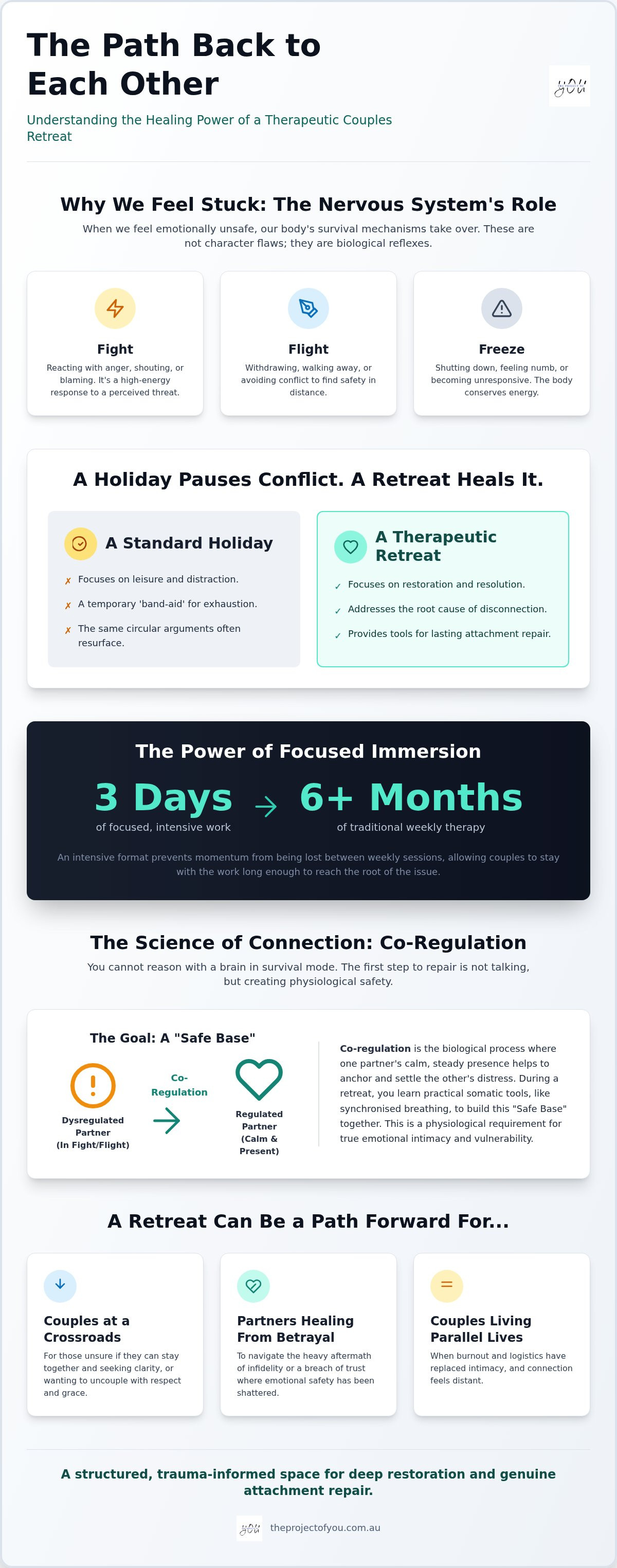
Think of a holiday as a band-aid for exhaustion. You might have a cuppa and a chat overlooking a beautiful view, but the circular arguments usually follow you into the hotel room. A therapeutic intensive is different. It provides the space and time to bypass the distractions of daily Australian life, allowing for deep nervous system restoration that isn't possible in a 50-minute weekly session. Clinical experience suggests that three days of focused work can often achieve more than six months of traditional weekly appointments. This is because the momentum isn't lost between sessions, allowing you to stay in the "work" long enough to reach the root of the issue.
The Difference Between Leisure and Healing
Leisure retreats focus on relaxation. They are about the outside experience: the spa, the food, and the scenery. A therapeutic intensive focuses on restoration and resolution. It's about the inside work. You might need a clinical intervention rather than just a break if you feel a sense of dread when you think about your future together. Having a trauma-informed facilitator is vital here. They provide the psychological safety needed to navigate complex emotional territory without causing further harm or re-triggering old wounds.
Who is a Relationship Intensive For?
These retreats are specifically designed for partners who feel they have reached their limit with standard approaches. It's a space for those who need more than a weekly check-in can provide.
Couples at a crossroads who are unsure if they can stay together or are considering "conscious uncoupling" with respect.
Partners navigating the heavy aftermath of infidelity or a significant breach of trust where emotional safety has been shattered.
High-achieving couples who find themselves living "parallel lives", where chronic burnout and domestic logistics have replaced intimacy.
Whether you are seeking a private couples retreat for total confidentiality or a group setting to find community, the goal remains the same: moving from survival into a state of shared growth. It's about creating a path toward a different way of living together.
The Science of Connection: Nervous System Co-regulation
Have you ever noticed how a simple disagreement can suddenly feel like a life-or-death battle? This happens because your body's survival mechanisms have taken over. In the context of a couples retreat, we explore Polyvagal Theory, which explains how our nervous systems constantly scan for safety or threat. When we feel emotionally unsafe, we don't just "feel" angry; our bodies physically enter a state of high alert. We might "fight" by shouting, "fly" by walking away, or "freeze" by shutting down and becoming unresponsive. This isn't a choice your mind makes; it's a reflex your body uses to protect you.
Traditional talk therapy often hits a wall because you cannot reason with a brain that is in survival mode. If your heart is racing and your breath is shallow, the logical part of your brain is effectively offline. This is where the science of co-regulation becomes transformative. It is the biological process where one partner's steady, calm presence helps to anchor and settle the other's distress. Building this "Safe Base" is a biological requirement for genuine emotional intimacy and vulnerability.
Moving Out of Survival Mode
In the heat of a circular argument, your nervous system isn't interested in "active listening" or "I-statements". It's trying to survive. Recognising these moments as biological events rather than character flaws is the first step toward repair. Understanding how trauma dysregulates your nervous system allows us to see that restoration is a physiological requirement, not just a psychological goal. During a retreat, we use somatic grounding techniques to bring you back to the present. These might include synchronised breathing to slow the heart rate or mindful awareness of physical sensations to interrupt the "freeze" response. These practical tools help you expand your capacity for difficult conversations without becoming overwhelmed.
Attachment Styles and Emotional Safety
Our early experiences create "blueprints" for how we give and receive love. If your early environment was unpredictable or distant, you might develop anxious or avoidant attachment patterns. These patterns act as "tripwires" in adult relationships, causing us to over-react or withdraw when we feel disconnected. A therapeutic intensive helps you move toward a "Secure" attachment, where you view your partner as a safe harbour from which to explore the world. If you feel ready to explore these patterns in a supportive environment, you might consider how to begin your journey toward repair today.
To help you understand your current dynamic, ask yourself this reflective question: "In moments of stress, does my partner feel like a safe harbour I can return to, or a source of threat I must defend myself against?"
Choosing Your Path: Private Intensives vs. Group Retreats
Choosing the right format for your relationship repair involves looking inward at your current capacity for connection. Every couples retreat we offer is designed with psychological safety at its core, yet the format you choose will change the rhythm of your healing. It's about deciding whether you need the quiet, focused intensity of a private room or the collective strength of a shared workshop. Both paths offer a map toward restoration, but they serve different emotional landscapes.
One of the most profound benefits of a group environment is its ability to dissolve the isolation of shame. When a relationship is struggling, it's common to feel like you're the only couple failing to find your way. Realising that others share your fears and frustrations can be a powerful catalyst for change. This sense of belonging reminds you that your struggles are part of the human condition, not a sign of a broken partnership. However, assessing your level of distress is vital. If you are in the midst of an active crisis or high-conflict period, a group setting may feel too exposed. In those moments, the priority is creating a small, secure container where you can feel heard without the presence of others.
The Private Couples Retreat Experience
The private model offers total confidentiality and a 1:1 focus with a psychotherapist. This path allows for a tailored curriculum that focuses exclusively on your specific relationship history, triggers, and goals. It's often the preferred choice for high-profile individuals or those navigating the delicate, complex stages of betrayal recovery. In this space, we can move at a pace that respects your nervous system's capacity for deep work. Explore our Private Couples Retreat options to see how a dedicated intensive can support your unique journey.
The Group Workshop Dynamics
Group workshops are designed around skill-building, communication, and the power of shared humanity. You learn through the experiences of others in a professionally held space that prioritises emotional safety for everyone involved. These workshops are less about unpicking every detail of your past and more about equipping you with practical tools for a different future. You'll find that witnessing another couple's breakthrough often provides the clarity you need for your own. View upcoming Healing Feminine and Couples Workshops to find a supportive community of partners committed to growth.
What to Expect: Navigating the Journey of a Relationship Intensive
The journey begins long before you arrive at your couples retreat. A comprehensive pre-retreat assessment ensures your therapist understands your unique history, attachment patterns, and specific goals. This initial step allows us to begin the work with clarity, creating a secure "container" where both partners feel held and respected. Within this space, we establish clear boundaries that prevent the time together from becoming another arena for conflict. Instead, it becomes a laboratory for connection.
The arc of a couples retreat typically moves from identifying the "tripwires" that trigger your defensive responses to practising new, softer ways of relating. It is a methodical process of unlearning old habits and building a shared language for your needs. Integration is the final, vital piece of the journey. We focus on how to maintain the "retreat version" of your relationship once you return to the pressures of work, family, and daily chores in the real world.
A Typical Day of Healing
Morning sessions often begin with somatic grounding exercises to settle the nervous system, preparing you for the emotional work ahead. We then move into guided conversations using evidence-informed frameworks like the Gottman Method. These sessions help you navigate complex feelings with a structure that ensures you are both heard. Restorative breaks are intentionally woven into the schedule. Doing nothing is not a waste of time; it is a vital part of the therapeutic process that allows your brain and body to process the deep shifts occurring throughout the day.
Addressing the "Elephant in the Room"
Many couples fear that bringing up "hot topics" like infidelity, finances, or intimacy will lead to a spiral they cannot control. A skilled therapist acts as a steady anchor, helping you navigate these issues without falling into old patterns of blame or withdrawal. We shift the focus from "Who is to blame?" to "What is happening between us?" This curiosity opens the door to understanding.
Take a moment to consider this: What would happen if we both felt truly understood for five minutes?
Restoring Your Bond with The Project Of You
Choosing a path toward healing is a courageous step. At The Project Of You, we don't just offer a service; we offer a partnership in your growth. Azita Abdollahian, our founder and a Clinical Social Worker and Psychotherapist, brings a unique blend of clinical expertise and deep empathy to every couples retreat. Her approach is grounded in the belief that every partnership has the potential for transformation when given the right environment. By blending clinical social work with advanced modalities like neurofeedback, we provide a space where your body can finally relax enough to let your heart speak.
Our commitment to evidence-informed, trauma-sensitive relationship care ensures that even the most painful histories are handled with the utmost respect. The work we do together is designed to be a beginning, not an end. To support your long-term journey, we offer ongoing couples counselling and a range of digital resources to keep your momentum alive. Whether you are navigating a specific crisis or simply want to deepen your intimacy, we invite you to reach out for a confidential chat. We can help you determine whether a private intensive or a group workshop is the right next step for your partnership.
A Compassionate Partnership in Growth
Psychological safety is the foundation of everything we do. We understand that for real change to occur, both partners must feel equally seen and supported. This is why we prioritise the integration of advanced modalities like Nervous System Restoration. This approach addresses the physiological roots of your conflict, helping you move out of defensive patterns and into a space of genuine co-regulation. When your body feels safe, your relationship has the capacity to thrive. If you're ready to explore how this approach could work for you, book a consultation to discuss your needs with us.
The Journey Back to Each Other
Transformation is possible when we stop fighting the symptoms of our distress and start healing the underlying system. The circular arguments, the flatness, and the silence are often just signs that the connection needs repair. Your relationship is a project worthy of your deepest attention and care. It is the soil in which your family and your future grow. Learn more about Azita and our philosophy to see if our way of working resonates with your vision for a more connected life together.
Creating a Future of Shared Safety
Choosing a therapeutic couples retreat is an investment in the very foundation of your life. We've explored how moving beyond traditional methods into deep nervous system restoration allows you to break free from circular arguments and rediscover emotional intimacy. By prioritising evidence-informed trauma and attachment care, you aren't just taking a break from your problems; you're building the physiological capacity to solve them together. It's about creating a path toward a different way of living and loving.
Led by Azita Abdollahian, Clinical Social Worker and Psychotherapist, The Project of You provides a compassionate, national service dedicated to helping you navigate the complexities of your bond. Transformation doesn't require a miracle, just the right structure and a steady guide to help you find your way back to each other. Your relationship is a project worthy of your deepest attention, and it's possible to move from a place of distress into one of shared hope.
Begin your journey toward repair; enquire about our Private Couples Retreats today You don't have to navigate this transition alone. There is a path forward, and it begins with the courageous decision to look closer at what is possible for your future together.
Frequently Asked Questions
How is a therapeutic couples retreat different from a marriage counselling session?
A therapeutic couples retreat differs from weekly counselling by providing an immersive environment that maintains momentum. In standard sessions, you often spend half the time checking in on the week's events. An intensive format allows you to stay in the "work" for several days. This depth helps us bypass defensive patterns and reach core attachment issues that are often missed in the stop-start nature of hourly appointments.
Will we be forced to share our private issues with other couples in a group setting?
You are never forced to share private details with other participants in a group workshop. These sessions are structured so that the deep emotional work happens privately between you and your partner. While we gather as a group to learn communication skills and nervous system theory, your specific history remains confidential. The group setting is designed to provide a sense of belonging and shared humanity rather than public disclosure.
Can a retreat really help if there has been infidelity or a major breach of trust?
A relationship intensive is specifically designed to handle the heavy weight of infidelity or betrayal trauma. These situations require a trauma-informed approach that prioritises emotional safety and nervous system regulation before attempting repair. By dedicating several days to the process, we can move through the initial stages of grief and anger with the constant support of a psychotherapist, creating a structured path toward rebuilding trust.
What happens if we start arguing during the retreat?
Conflict during a retreat is actually a valuable opportunity for real-time intervention. If you start to argue, we use it as a moment to practice somatic grounding and co-regulation techniques. Instead of letting the argument spiral, we pause to look at the biological triggers occurring in the body. This helps you learn how to navigate "hot topics" without becoming overwhelmed or shut down when you return home.
How do we know if we are ready for an intensive retreat or if we should start with weekly counselling?
Determining your readiness for a couples retreat usually involves an initial intake assessment. If you feel "stuck" in circular arguments that weekly therapy isn't shifting, or if there is a sense of urgent crisis, an intensive format may be more effective. However, if there is active violence or unmanaged substance abuse, we may recommend different support. We always help you choose the path that ensures the most psychological safety.
What is the cost of a couples retreat in Australia, and is it worth the investment?
While the cost of a retreat reflects the intensive time with a specialist, many couples find it a vital investment in their shared future. It's helpful to view the expense in the context of the emotional and financial toll of separation or chronic relationship distress. By addressing the root causes of your disconnect in a focused way, you are building the resilience needed for a healthier, more sustainable partnership.
Do we need to prepare anything before attending a relationship intensive?
Preparation primarily involves completing a thorough pre-retreat assessment to help us understand your relationship's unique story. We ask you to come with an open mind and a willingness to be curious about yourself and each other. It's also helpful to clear your schedule of work and family obligations so you can fully commit to the process of nervous system restoration without external distractions or pressures.
What kind of follow-up support is available after the retreat ends?
Follow-up support is a core part of the healing process once the retreat ends. We offer ongoing individual and couple counselling to help you integrate the tools you've learned into your daily life. Additionally, digital resources such as our Self Love e-books and regular check-ins ensure that the progress you made during the intensive isn't lost. We view the retreat as the beginning of a continuous journey of growth.


Comments