.png)

Somatic Exercises for Burnout: Nervous System Recovery

What if the heavy, leaden feeling in your limbs and that persistent mental fog aren't signs that you need more "mindset" shifts, but signals that your body is stuck in a survival loop? When we experience chronic workplace stress, our physiology can become trapped in a state of high alert or total shutdown, making traditional rest feel almost impossible. If you've been searching for a way back to yourself, somatic exercises for burnout offer a path that doesn't require more intellectual effort from an already exhausted mind. As a nervous system expert, Azita Abdollahian has hundreds of clients going through the same thing.
It's incredibly draining to feel emotionally flat or to carry physical tension that simply won't release, no matter how many holidays you take. I understand how isolating it feels when simple decisions become overwhelming mountains to climb. In this article, we'll explore how to use gentle, body-based movements to communicate safety directly to your nervous system, allowing you to reclaim your vitality and move through your day with a newfound sense of lightness.
We will look at the science of why your body holds onto stress and provide actionable tools you can use even during a busy afternoon to find your centre again. By shifting our focus from "fixing" the mind to supporting the body, we can begin the gentle process of nervous system restoration together.
Table of Contents
Understanding Burnout as a Nervous System Event (Not Just Mental Fatigue)
The Science of Somatics: Why Your Body Stays 'On' When You Try to Rest
Somatic Exercises vs. Traditional Workouts: Choosing What Your System Needs
5 Gentle Somatic Exercises to Release Chronic Stress and Restore Energy
Beyond the Exercises: Creating a Sustainable Path to Restoration
Understanding Burnout as a Nervous System Event (Not Just Mental Fatigue)
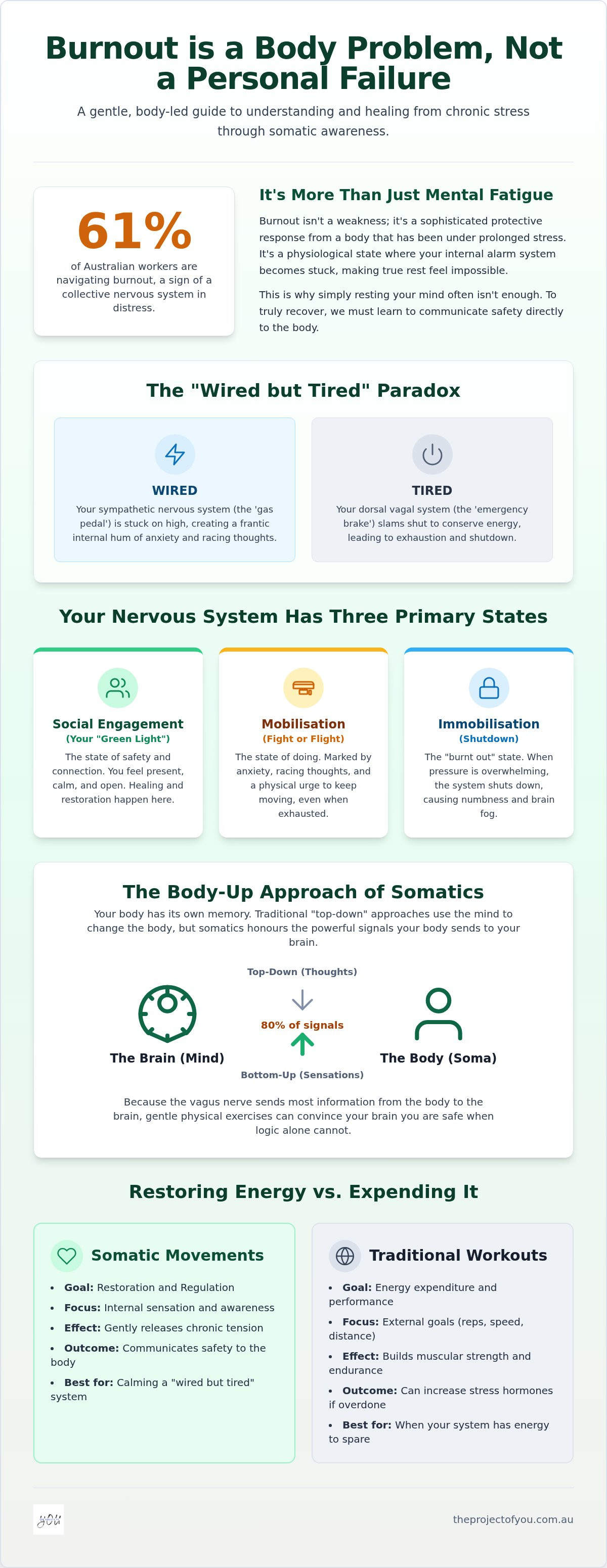
What if your exhaustion isn't a sign of weakness, but a sophisticated protective response from your body? In Australia, where recent data shows that 61% of workers are navigating burnout, it is easy to view this state as a personal failure of resilience. We often treat it as a mental hurdle that can be cleared with a better mindset or a long weekend. However, true burnout is a state of chronic nervous system dysregulation. It is the physiological result of your internal alarm system being triggered so frequently that it no longer knows how to return to a state of rest.
Many people describe feeling "wired but tired." This confusing sensation occurs when your sympathetic nervous system, your internal gas pedal, is stuck on high, while your dorsal vagal system, the emergency brake, has simultaneously slammed shut to prevent total collapse. You feel a frantic internal hum of anxiety even as your limbs feel like lead. This is why resting your mind through Netflix or meditation often isn't enough; if your body still perceives a threat, it will stay in survival mode. To move forward, we must look toward the field of somatics to learn how to communicate safety to the body first.
The Three States of Your Nervous System
To understand how somatic exercises for burnout work, we can look at the three primary states of our physiology:
Social Engagement: This is your "green light" state. You feel safe, present, and connected to others. This is where healing and restoration happen naturally.
Mobilisation (Fight/Flight): This is the state of constant doing. It is marked by chronic anxiety, racing thoughts, and a physical urge to keep moving, even when you are exhausted.
Immobilisation (Shutdown): This is the "burnt out" state. When the pressure becomes too much, the system shuts down to protect itself, leading to feelings of numbness, flatness, and profound brain fog.
Why Burnout Feels Like a 'Body Problem'
Chronic stress doesn't just stay in your head; it lives in your tissues. When you are under constant pressure, your body prepares to defend itself through muscle bracing. You might notice your shoulders perpetually hovering near your ears or a tight, clenching sensation in your stomach. The psoas muscle, which connects your spine to your legs, is a primary player in the fight or flight response. In burnout, this muscle can stay perpetually contracted, sending a continuous loop of "danger" signals back to your brain.
Your window of tolerance is the physiological space where you can manage life's stressors with ease rather than reactive exhaustion. When we are burnt out, this window shrinks, making even small decisions feel like insurmountable tasks. If you feel you have been living outside this window for too long, our Executive Nervous System Retreat provides a structured, gentle space to begin expanding that capacity once again through intentional restoration.
The Science of Somatics: Why Your Body Stays 'On' When You Try to Rest
Have you ever noticed that even when you finally have a moment to sit down, your heart is still racing or your jaw remains tightly clenched? This happens because your body has its own memory, separate from your conscious thoughts. The word "somatic" comes from the Greek word soma, which refers to the living body as experienced from within. When we use somatic exercises for burnout, we aren't just stretching muscles; we are learning to listen to the internal language of our nervous system. It's a shift from treating your body like a machine to be fixed, to honouring it as a wise, living system that is currently trying to keep you safe.
Traditional therapy often focuses on a "top-down" approach, using the mind to change the body. However, about 80% of the fibres in our vagus nerve—the main highway of our nervous system—send signals from the body up to the brain. This "bottom-up" reality means that if your body feels under threat, no amount of logical thinking will fully convince your brain that you are safe. By engaging in a gentle somatic workout, you can begin to communicate safety directly to the brain through physical feedback, effectively completing the stress response cycles that have been left hanging.
Breaking the Cycle of Chronic Bracing
When we live in a state of high pressure, our bodies develop what is known as "armouring." This is an unconscious pattern of physical bracing where we hold ourselves together against perceived emotional or professional blows. Over time, your nervous system actually memorises these stress patterns, making them your new "normal" baseline. This persistent tension is a key reason why trauma dysregulates your nervous system, as the body remains stuck in a defensive posture long after the initial stressor has faded. Recognising this bracing is the first step toward gently inviting your system to soften.
Neuroplasticity and Body-Based Healing
The beauty of the nervous system is its neuroplasticity—its ability to re-pattern and learn new ways of being. Through somatic exercises for burnout, we teach the brain that the "danger" has passed by finding small "glimmers" of safety or ease in the body. Perhaps it is the feeling of your feet on the floor or the softness in your palms. Approaching these practices with gentle curiosity rather than a goal-oriented "need to relax" allows your system to open up at its own pace. If you find yourself needing a supportive partner to navigate these physical patterns, booking a session can provide a safe space to explore this deeper restoration together.
Somatic Exercises vs. Traditional Workouts: Choosing What Your System Needs
We often hear that exercise is the ultimate antidote to stress. When you feel flat or overwhelmed, the common advice is to "push through" a spin class or hit the gym for a heavy lifting session to clear your head. However, when you are navigating burnout, these high-intensity activities can often act as additional stressors rather than solutions. If your nervous system is already frayed, adding the physiological demand of a HIIT workout can spike your cortisol levels even further, pushing an exhausted system deeper into a state of depletion.
The fundamental difference lies in the intention of the movement. Traditional workouts are typically about output; they focus on expending energy, burning calories, or achieving a specific external performance goal. In contrast, somatic exercises for burnout are about input. They are designed to restore the system by focusing on internal sensation rather than how the movement looks from the outside. Instead of asking your body to do more, you are inviting it to feel more, which allows your physiology to finally shift out of a survival loop and into a state of genuine recovery.
It is helpful to pay attention to how you feel after you move. If you finish a workout and feel "crashed" the next day, or if you notice your brain fog and irritability increasing after a session, your body is likely telling you that the intensity was too much for your current capacity. Somatic movement encourages us to listen to these subtle signals, honouring the body's need for softness when it is already carrying a heavy load.
When to Choose Somatic Movement Over Cardio
Assessing your current physiological state is the first step in choosing the right support. Are you in "high-revs," feeling anxious and unable to sit still, or have you reached "total shutdown," where even simple tasks feel impossible? If you are in a state of shutdown, your body needs to feel a sense of safety before it can mobilise. Pushing into intense cardio during these times can be counterproductive, as it reinforces the body's belief that it is under threat. Somatic movements prioritise the parasympathetic nervous system, which is the branch responsible for muscle repair, digestion, and deep restoration.
Creating a 'Safety-First' Movement Practice
Shifting your goal from "burning" to "building" can be a profound part of your healing journey. A safety-first practice focuses on building your internal capacity to handle stress without becoming overwhelmed. This includes prioritising a slow, intentional "cool down" for the nervous system, ensuring you don't leave your practice in a state of high arousal. For those looking for a structured way to begin this journey, our guide to nervous system restoration therapy offers deeper insights into how these body-based patterns are formed and how they can be gently transformed over time.
5 Gentle Somatic Exercises to Release Chronic Stress and Restore Energy
When you are deeply depleted, even the thought of "doing" something can feel heavy. These somatic exercises for burnout are designed as a menu of micro-movements that require very little energy. You can even practice them from your desk or while lying in bed. One core concept here is "pendulation," which is the gentle process of shifting your attention between a place of tension and a place of ease in the body. This rhythmic shifting helps your system learn that it doesn't have to stay stuck in a state of survival forever.
Exercise 1: The Basic Exercise (Vagus Nerve Reset)
This practice is a powerful quick win for immediate calming. To begin, interlock your fingers and place them behind your head, supporting the base of your skull. Keeping your head still, simply shift your eye gaze as far to the right as is comfortable. Hold this position until you notice a physiological release, such as a spontaneous sigh, a deep breath, or a swallow. Repeat the process on the left side. This simple movement helps reset the vagus nerve, signalling to your brain that it is safe to downshift from high alert.
Exercise 2: Body Orienting and Grounding
Orienting helps bring your nervous system back to the here and now. Begin by slowly looking around your room, noticing three things you can see, two you can hear, and one you can touch. Pay particular attention to the "weighted" sensation of your body against your chair or the floor. Feeling the solid support beneath you helps ground your physiology. This process of orienting to a safe environment sends a direct signal to your brainstem that the immediate threat has passed, allowing your system to soften and expand.
Exercise 3: Gentle Tremoring and Shaking
In the wild, animals naturally shake their bodies after a stressful event to discharge excess energy. You can mimic this "biological shake" to release trapped sympathetic energy from your own system. Try a low-intensity micro-shake by gently fluttering your hands or jiggling your feet while seated. This rhythmic movement helps discharge the "fight or flight" energy that often becomes stuck in our muscles during chronic burnout. By allowing this physical release, you are helping your body complete its natural stress cycle and return to a state of equilibrium.
Remember that there is no right way to feel during these practices. Whether you feel a significant shift or just a tiny flicker of ease, your body is listening and responding to your care. Approach these movements without judgment, allowing your system to lead the way at its own pace.
Beyond the Exercises: Creating a Sustainable Path to Restoration
While somatic exercises for burnout provide immediate relief, sustainable restoration is often about more than just a set of movements. It's about shifting your relationship with your body from one of control to one of compassionate partnership. As you move through your day, remember that your nervous system is constantly scanning for cues of safety or danger. Integrating small moments of awareness, like a "3pm check-in" where you pause to notice the tension in your jaw or the depth of your breath, helps prevent the slow creep of dysregulation that leads back to exhaustion.
We often think of healing as a solo endeavour, but human beings are biologically wired for connection. This brings us to the concept of co-regulation. Simply put, co-regulation is the way our nervous systems settle and find safety through the presence of another calm, supportive person. When you've been "on" for too long, your internal thermostat for safety might be broken. Sitting with someone who can hold a steady, compassionate space for you is often the missing piece in moving from surviving to thriving.
The Power of Co-Regulation and Professional Support
Sometimes the most courageous thing you can do is admit that you can't regulate your system in total isolation. If your body has been stuck in a survival loop for months or years, it needs more than a quick fix. Azita Abdollahian and the team at The Project of You facilitate deep restoration by providing the expert guidance and emotional safety required for true physiological change. Whether through individual somatic therapy or an immersive experience, we help you re-pattern your system for long-term resilience. Learn more about our Nervous System Retreats to discover how dedicated space can transform your recovery.
Reflective Questions for Your Journey
As you continue to explore this path, I invite you to sit with these questions over a cup of tea. There are no right or wrong answers; they are simply invitations for deeper self-understanding:
Where in my body do I feel the most "armoured" or tight right now?
What would it feel like to give myself permission to do "nothing" for five minutes today?
How can I honour my body's need for safety in this very moment?
Moving beyond burnout isn't about returning to the same pace that broke you. It's about building a system that is resilient enough to feel the world without being overwhelmed by it. By combining somatic exercises for burnout with professional support and consistent self-compassion, you are creating a sustainable path toward a life that feels lighter and more vibrant.
Reclaiming Your Vitality Through Body-Led Safety
Burnout is not a sign that you need to try harder; it's a signal that your system needs a different kind of support. We've explored how shifting from mental effort to body-based awareness allows your nervous system to finally release chronic tension. By choosing restorative movement over high-intensity output, you begin the gentle process of expanding your window of tolerance once more.
Integrating somatic exercises for burnout into your daily rhythm isn't just about physical relief. It's about building a foundation of emotional safety that allows you to navigate life's challenges with more grace. Whether you start with a simple vagus nerve reset or a moment of grounding, each small step communicates to your brain that the immediate pressure has passed.
Explore our Nervous System Restoration services and retreats You don't have to navigate this path alone. Under the trauma-informed guidance of Azita Abdollahian, we use evidence-based Polyvagal theory to help you move from a state of survival back to a life of connection. There is hope for restoration, and your body already knows the way home.
Frequently Asked Questions
What exactly are somatic exercises and how do they differ from yoga?
Somatic exercises focus primarily on your internal sensation, known as interoception, rather than achieving a specific pose or external alignment. While yoga often involves stretching and holding positions to improve flexibility, somatic movement uses gentle micro-movements to recalibrate the nervous system. It isn't about how the movement looks from the outside. Instead, it's about communicating safety to your brainstem by noticing how the movement feels from within your own body.
How long does it take for somatic exercises to help with burnout?
Many people experience a subtle shift in their physiology, such as a spontaneous sigh or softened shoulders, within the first few minutes of practice. However, sustainable recovery from chronic exhaustion typically requires consistent application over several weeks to re-pattern the nervous system. Using somatic exercises for burnout daily helps build long-term resilience by gradually expanding your window of tolerance and teaching your body that it is truly safe to rest.
Can I do somatic exercises if I'm feeling completely exhausted and have no energy?
Yes, these practices are specifically designed for low-energy states and can be performed while lying in bed or sitting at a desk. Unlike traditional workouts that demand physical output, somatic exercises are about restoration and input. They don't require cardiovascular effort or muscle strength. Instead, they use gentle, rhythmic movements to settle your system, making them an ideal tool for those who feel physically drained or emotionally flat.
Do I need a professional therapist to start using somatic techniques?
You can certainly begin with simple self-led techniques at home to find immediate moments of ease. However, professional support is often the missing piece for deeper, long-term restoration. A qualified practitioner can provide co-regulation, helping you navigate complex patterns of physical "armouring" that are difficult to release alone. At The Project of You, we offer specialised somatic therapy to support you in creating a sustainable and supported path to vitality.
Are somatic exercises safe for people with a history of trauma?
These exercises are generally safe because they are gentle and non-invasive, but it's vital to move at a pace that feels comfortable for you. For those with a history of trauma, the body can sometimes feel like an unsafe place to inhabit. Working with a trauma-informed professional ensures that you don't accidentally overwhelm your system. We focus on evidence-based Polyvagal theory to ensure every movement fosters a genuine sense of emotional and physical safety.
How often should I practice somatic exercises for the best results?
Consistency is far more important than duration when it comes to nervous system healing. Practicing for just five to ten minutes once or twice a day is often more effective than a single long session once a week. Frequent "micro-breaks" throughout your workday help prevent stress from accumulating in your tissues. This regular feedback teaches your brain that safety is a consistent state rather than a temporary escape from daily pressure.
What should I do if I feel more emotional after doing a somatic exercise?
It is quite common for suppressed emotions to surface as the body begins to release chronic physical tension. If this happens, try to meet the feeling with gentle curiosity rather than judgment. You might choose to pause the exercise and focus on grounding, such as feeling the weight of your feet on the floor. If the emotions feel overwhelming, it may be a sign that your system would benefit from the partnership of professional counselling.
Can somatic exercises help with physical symptoms like IBS or headaches?
Yes, because many physical ailments are exacerbated by a nervous system stuck in a survival loop. When we use somatic exercises for burnout to lower our overall physiological arousal, we often see a reduction in stress-related symptoms like tension headaches or digestive distress. By calming the "gas pedal" of the sympathetic nervous system, we allow the body to finally prioritise essential internal functions like cellular repair and healthy digestion.


Comments