.png)

Somatic Healing in Australia: A Compassionate Guide to Body-Based Recovery
- Azita Abdollahian

- 6 hours ago
- 13 min read
What if the reason you feel stuck in your head isn't because you haven't talked about your experiences enough, but because your body is still responding as though it needs to protect you?
You may understand your trauma or stress intellectually. You may know where your patterns come from and have spent years talking through your experiences. Yet your body may still feel constantly on edge, exhausted, tense or disconnected. Your heart may race without warning, your mind may struggle to switch off, or you may experience the opposite response—feeling numb, shut down or disconnected from yourself and the people around you.
This is where nervous system regulation therapy in Australia can offer a different approach to emotional healing.
As a psychotherapist, trauma expert and founder of The Project Of You, Azita Abdollahian takes a trauma-informed approach that recognises the connection between the mind, body and nervous system. While insight and traditional talk therapy can be valuable, understanding why you respond the way you do is sometimes only one part of the healing process. Learning how to recognise and respond to your body's stress and protective responses can also play an important role.
Through approaches informed by somatic healing, nervous system regulation and trauma-informed psychotherapy, the focus is on helping you develop greater awareness of how stress and past experiences may influence your physical and emotional responses.
In this guide, Azita explores what nervous system regulation therapy involves, how somatic approaches can complement traditional psychotherapy, and practical ways to manage stress, emotional activation and feelings of shutdown.
You'll discover how developing a greater sense of safety and connection within your body can support emotional wellbeing, healthier relationships and a greater capacity to respond to life's challenges without feeling constantly overwhelmed.
Healing isn't always about analysing your story more deeply. Sometimes, it begins with learning to listen to what your body has been trying to communicate—and giving it the tools and support it needs to feel safe again.
Table of Contents
What is Somatic Healing? Why the Body Holds What the Mind Cannot
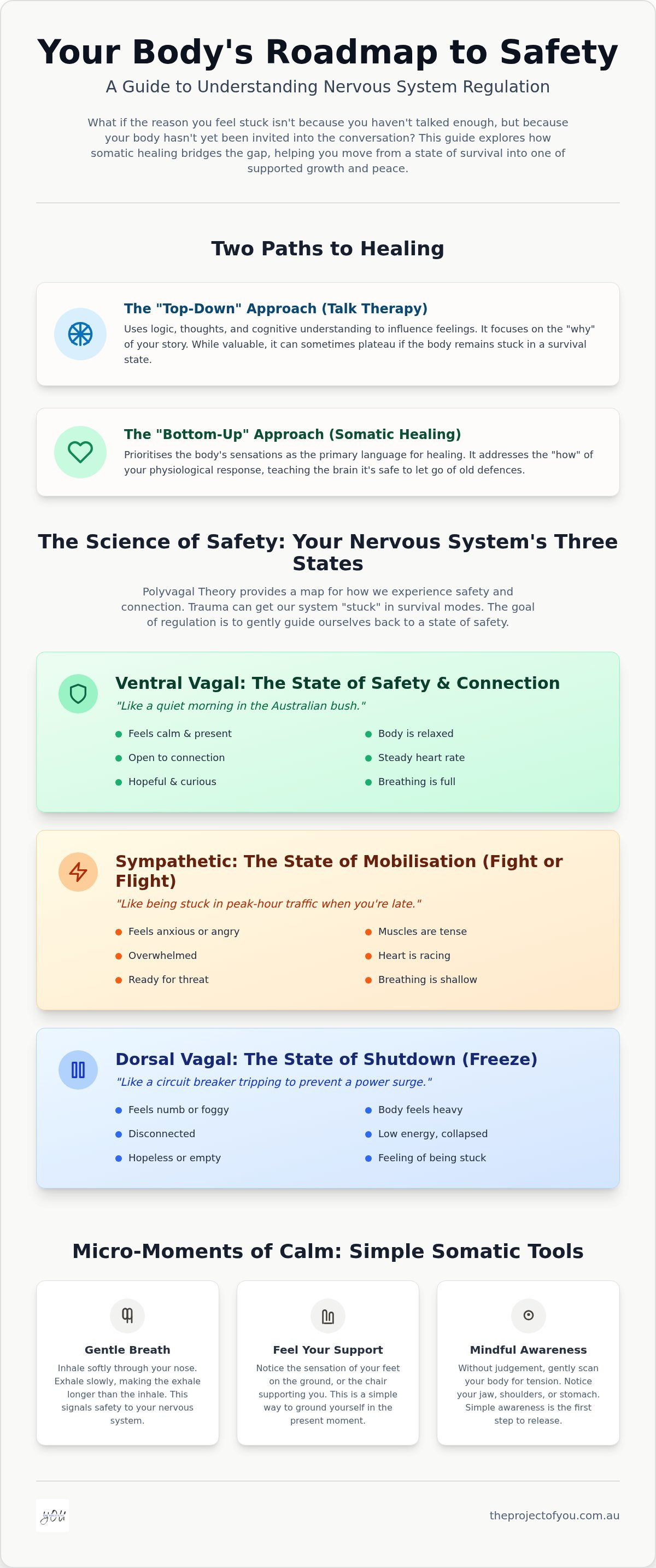
You may have noticed that even after years of talking through your past, the tightness in your chest or the knot in your stomach remains. It's a common experience for many Australians seeking recovery. Traditional talk therapy often focuses on the "top-down" approach, where we use our logic and thoughts to influence our feelings. While this is valuable, it can sometimes reach a plateau if your body is still stuck in a survival state. To understand What is Somatic Healing?, we must look at the "bottom-up" process. This approach prioritises the body's sensations as the primary language of healing, teaching the brain that it's finally safe to let go of old defences.
Somatic healing is a body-centred path to emotional wellness. It acknowledges that trauma and chronic stress aren't just stories we tell; they're physical events that leave an imprint on our biology. When you engage with nervous system regulation therapy Australia, you're learning to listen to your body's subtle signals. As you read this, I invite you to take a gentle breath. Notice the support of the chair beneath you. Can you feel any tension in your shoulders or a slight bracing in your jaw? This awareness is the first step toward moving beyond the limitations of the mind.
The Connection Between Mind, Soul, and Body
Your body is a living record of every experience you've ever had. When the mind suppresses a memory or an emotion because it feels too heavy to carry, the body often stores that energy instead. This "unfinished business" frequently manifests as chronic fatigue, digestive issues, or persistent physical tension that no amount of massage seems to fix. What if you could wake up tomorrow without that heavy cloak of physiological bracing? Imagine moving through your day with a sense of lightness, where your body feels like a sanctuary rather than a site of constant struggle. Somatic work helps you process these stored imprints, clearing the path for your soul to feel at home in your skin once more.
Somatic Healing in the Australian Context
Across Australia, there's a growing recognition that clinical social work and psychotherapy must include the body to be truly effective. Many people are moving away from purely clinical models in search of more holistic, trauma-informed care. Within this framework, Nervous System Restoration has emerged as a vital tool for those who feel their internal "alarm system" is permanently switched on. By integrating evidence-based psychological concepts with somatic awareness, nervous system regulation therapy Australia provides a structured and compassionate way to navigate back to a state of genuine peace. It's a journey of returning to yourself, supported by professional expertise and deep, intuitive empathy.
The Science of Safety: Polyvagal Theory and Nervous System Restoration
Polyvagal Theory isn't just a clinical concept; it's the biological map of how we connect with others and feel secure within ourselves. Think of it as your body's internal compass, guiding you through life's challenges. This theory, developed by Dr Stephen Porges, explains how our nervous system organises our experiences into three primary states. When we understand these states, we can begin to see why we react the way we do, moving from self-criticism toward self-compassion.
To make sense of these states, imagine two very different Australian scenes:
Ventral Vagal (Safe and Social): This is like a quiet morning in the bush. The air is still, you feel deeply present, and your heart rate is steady. You're open to connection and can think clearly.
Sympathetic (Fight or Flight): Imagine being stuck in peak-hour traffic when you're already late. Your hands grip the wheel, your chest feels tight, and you're ready to react to every perceived threat.
Dorsal Vagal (Freeze or Shut Down): This is the feeling of being completely overwhelmed, like a circuit breaker has tripped to protect a house from a power surge. You might feel numb, foggy, or physically heavy.
Trauma often jams the switch, leaving your system trapped in that peak-hour traffic or a total blackout, even when you're safely at home. This is why nervous system regulation therapy Australia focuses on gently nudging the system back toward that sense of bushland calm, helping you feel present in your everyday life again.
Understanding Your Window of Tolerance
Imagine your capacity for managing stress as a riverbank. When the water stays within its banks, you can navigate the ripples of life with ease. This is your Window of Tolerance. Somatic work helps widen these banks, so a sudden splash doesn't lead to an emotional flood. Within this process, we address neuroception, which is the nervous system’s subconscious surveillance system that constantly scans our environment for cues of safety or danger without our conscious awareness. By expanding your window, you gain the resilience to stay grounded even when life feels turbulent.
The Role of Attachment Styles in Physiological Regulation
Our early relationships act as the first blueprint for our physiological regulation. If our caregivers were a steady, nurturing presence, we likely learned how to self-soothe effectively. However, if those early bonds were unpredictable, our baseline state might feel perpetually on edge. This is why Attachment Based Therapy is such a vital component of somatic recovery. We aren't meant to heal in isolation. Co-regulation, the process of finding safety through the presence of a trusted therapist or partner, allows us to rewrite these internal scripts. If you're ready to explore this path, you can book an initial session online to begin your journey toward restoration.
Somatic Therapy vs. Traditional Counselling: Which Path Is Right for You?
Many people start their healing journey with Cognitive Behavioural Therapy (CBT). It's an effective tool for identifying thought patterns, yet you might find that while your mind understands the logic, your body still feels on edge. This is where nervous system regulation therapy Australia becomes an essential partner to clinical psychological support. Rather than choosing one over the other, think of somatic work as the missing piece that addresses the physiological "how" behind your emotional "why." It's about acknowledging that your thoughts and your biology are two sides of the same coin, both requiring gentle, intentional care to find lasting balance.
Traditional approaches often focus on a "fixing" mindset, where we attempt to solve a problem with logic. Somatic work invites a shift toward curiosity. What happens if we stop trying to fix the anxiety and instead become curious about the sensation in our chest? This exploration isn't a vague or unstructured process. Under the guidance of clinical social work oversight, it's a methodical way to build internal safety while remaining evidence-informed. It provides a structured path for those who feel they've reached a plateau in traditional talk therapy.
Healing Relationships Through a Somatic Lens
When we're dysregulated, our capacity for empathy shrinks. This is why many couples find themselves stuck in the same repetitive arguments. By looking through a somatic lens in Couples Counselling, we move beyond who said what. We begin to notice the shallow breath or the tensed jaw that precedes the conflict. Learning to co-regulate with your partner allows you to de-escalate tension before it becomes a shouting match, creating a shared sense of safety that words alone can't build. It fosters a deeper intimacy rooted in physiological connection rather than just verbal agreement.
Breaking the Cycle of Chronic Burnout
High-achieving Australians often pride themselves on their resilience, frequently ignoring their body's signals until they reach a point of total exhaustion. We push through the fatigue, not realising that our nervous system is screaming for a reset. Somatic awareness acts as a preventative measure, helping you recognise the early signs of burnout before they manifest as illness. For those who are already feeling the weight of the world, immersive Nervous System Retreats offer a profound opportunity to step away and recalibrate. It's about moving from a state of constant "doing" into a restorative way of "being," ensuring your long-term resilience is built on a foundation of true physiological health.
Practical Somatic Tools for Everyday Regulation
Healing doesn't always require hour-long blocks of time. Often, the most profound shifts occur in the quiet micro-moments of your day. Nervous system regulation therapy Australia teaches us that our biology is constantly listening for cues of safety or danger. By offering these cues through simple physical actions, we can gently guide ourselves back to a state of balance without needing to over-analyse our thoughts. I invite you to try one of these exercises right now. Notice if your shoulders drop even a fraction or if your breath becomes just a little deeper. These small shifts are the building blocks of long-term resilience.
Grounding Techniques for High-Stress Moments
When your system feels on edge, these five exercises can help stimulate the Vagus nerve, which acts as the essential brake pedal for your stress response. Each one is designed to be discreet and effective:
Orienting: Gently scan your environment and name three things you see that feel neutral or pleasant. This signals to your brain that there's no immediate physical threat in your current space.
The Voo Sound: Take a deep breath and, on the exhale, make a low, vibrating "Voo" sound. The vibration in your chest and throat directly massages the Vagus nerve, encouraging a state of calm.
The Physiological Sigh: Take a full inhale through your nose, followed by a tiny second inhale to fully expand the lungs, then release a long, slow sigh through your mouth. This helps offload carbon dioxide and signals the heart to slow down.
Self-Soothing Touch: Place one hand on your heart and the other on your belly. This simple act of containment can lower your heart rate and provide a sense of internal boundaries and warmth.
The Butterfly Hug: Cross your arms over your chest and slowly alternate tapping your shoulders. This rhythmic, bilateral stimulation helps the brain process overwhelming emotions and return to the present.
Integrating Mindfulness into the Australian Lifestyle
You don't need to change your entire schedule to find peace. It can be as simple as turning your morning cuppa into a deliberate somatic check-in. As you hold the warm mug, feel the heat against your palms and notice the scent of the tea. If you're out for a walk, take a moment to look up at the trees or feel the breeze on your skin. These are what we call "glimmers", which are small, everyday moments of safety and beauty that act as the biological opposite of triggers. They remind your system that even in a chaotic world, safety is accessible. For those looking for more independent guidance, our Self Love E-books offer gentle pathways for self-paced growth and deeper self-understanding.
Navigating Your Somatic Journey with The Project of You
Azita Abdollahian founded The Project of You with a clear vision: to create a space where clinical expertise meets the deep wisdom of the body. As a Clinical Social Worker and experienced psychotherapist, Azita understands that true recovery requires more than just understanding your past; it requires a physiological shift. This integrated approach to nervous system regulation therapy Australia ensures that you aren't just managing symptoms, but actively restoring your system's capacity for joy and connection. When you choose a practitioner, it's vital to look for this blend of trauma-informed care and clinical credentials, as it provides the necessary safety net for deep emotional work.
What if you could step away from the noise of daily life to focus entirely on your own evolution? The Project of You offers a range of pathways tailored to your unique needs, whether you're seeking individual counselling or a more immersive group experience. This isn't about a quick fix; it's about a structured, intentional journey toward becoming the most regulated version of yourself. You aren't just a passive observer in this process. You're an active participant in a partnership designed to foster hope and agency.
Immersive Experiences: Retreats and Workshops
Sometimes, the most significant breakthroughs happen when we give ourselves the gift of time and space. The Healing Feminine Workshops help women reconnect with their bodies and their innate wisdom in a supportive, communal environment. If your relationship needs a deeper level of care, a Private Couples Retreat offers a level of focus that a standard holiday simply cannot provide. Unlike a vacation, which often only offers a temporary distraction, these retreats provide professional guidance and a clear structure to address the underlying physiological patterns that keep you stuck. It's a profound reset that allows you to return to your life with new tools and a deeper connection.
Modern Modalities: Psychedelic Assisted Therapy
As the landscape of mental health evolves, we remain committed to offering evidence-informed options that push the boundaries of traditional care. Psychedelic Assisted Therapy is one such tool, providing a unique opportunity for deep emotional recovery under strict clinical supervision. This modality is never a standalone experience; it's a carefully managed process that includes thorough preparation and an essential integration phase. Our commitment to your safety means that every session is grounded in professional protocols, ensuring you feel supported at every step of your transformation. You don't have to navigate this path alone; we're here to act as your compassionate guide through every transition.
Your Path Toward Lasting Physiological Peace
You've explored how somatic healing bridges the gap between understanding your history and actually feeling safe within your own skin. By moving beyond traditional talk therapy and embracing the science of Polyvagal Theory, you've seen that peace isn't just a mental state; it's a physiological one. Whether you're integrating micro-moments of regulation into your morning cuppa or seeking deeper restoration through immersive retreats, you're building a foundation of resilience that lasts. Engaging with nervous system regulation therapy Australia offers a structured path to release chronic tension and find genuine ease.
Book your initial consultation with The Project of You today With an expert clinical social work background and a specialised focus on nervous system restoration, Azita Abdollahian provides the trauma-informed, evidence-based care you deserve. You don't have to carry the weight of the past alone. There is a path forward, and it begins with a single, compassionate step toward your own healing.
Frequently Asked Questions About Somatic Healing
What exactly happens in a somatic healing session?
A somatic session involves a gentle exploration of your bodily sensations alongside traditional conversation. Instead of only talking about your week, we might notice how your chest tightens when discussing a specific stressor. Your practitioner guides you to track these internal signals, using breath or small movements to help your system process stored tension. It is a collaborative, slow-paced environment designed to help you feel safe while exploring the language of your body.
Is somatic therapy effective for treating PTSD and complex trauma?
Somatic approaches are highly effective for trauma because they address the physiological "stuckness" that talk therapy can sometimes miss. Trauma often leaves the body in a state of perpetual survival, either through hyper-arousal or numbing shut-down. By using nervous system regulation therapy Australia, we can gently renegotiate these frozen responses. This evidence-informed process helps your biology learn that the danger has passed, allowing for a genuine sense of internal safety and recovery.
How many somatic sessions will I need before I feel a difference?
Many people notice subtle shifts, such as improved grounding or better sleep, within the first three to five sessions. However, deeper restoration of long-standing patterns typically requires a longer commitment. Healing is a non-linear journey of personal evolution rather than a quick fix. Your practitioner will work with you to establish a rhythm that respects your system's pace, ensuring you feel supported and empowered as you move toward lasting physiological peace.
Can I do somatic healing online, or does it have to be in person?
Somatic work is remarkably effective via telehealth, as it allows you to engage in the process from the comfort of your own home. Many Australians find that being in a familiar, safe environment makes it easier to connect with their internal sensations. While in-person sessions offer the benefit of physical co-regulation, online sessions provide a powerful space for developing self-regulation skills. Both formats offer a structured and compassionate path toward healing.
What is the difference between somatic experiencing and somatic psychotherapy?
Somatic experiencing is a specific modality developed by Dr Peter Levine that focuses on releasing trapped survival energy. Somatic psychotherapy is a broader umbrella term that integrates body awareness with clinical psychological theories like attachment and neurobiology. At The Project of You, we utilise an integrated approach. We combine clinical social work expertise with various somatic tools to ensure your nervous system regulation therapy Australia is tailored to your specific emotional and physiological needs.
Is somatic healing covered by Medicare or private health insurance in Australia?
Medicare rebates are available if your practitioner is an Accredited Mental Health Social Worker or Psychologist. Under a valid Mental Health Treatment Plan, you can access rebates for up to 10 sessions per calendar year. As of July 2026, the rebate for an Accredited Mental Health Social Worker is A$89.50. Many private health funds also offer rebates for counselling and psychotherapy services; however, it is always best to check your specific level of cover with your provider.
Do I need to have a specific trauma to benefit from somatic work?
You don't need a diagnosed trauma to find immense value in somatic healing. This work is deeply beneficial for anyone experiencing chronic stress, burnout, anxiety, or a general feeling of being "stuck" in their head. Modern life often keeps our nervous systems on high alert, leading to fatigue and disconnection. Somatic tools provide a practical way to recalibrate your system, helping you find more ease, presence, and joy in your daily life and relationships.
How do I know if a somatic practitioner is properly qualified?
It is essential to choose a practitioner with recognized clinical credentials and specialised somatic training. In Australia, look for professionals registered with AHPRA, such as Clinical Social Workers or Psychologists, or those with membership in peak bodies like PACFA or the ACA. A qualified practitioner should have a transparent background in trauma-informed care and be able to explain their evidence-based approach clearly. Trusting your intuition during an initial consultation is also a vital part of the selection process.


Comments