.png)

Best Couples Therapy Retreats Australia 2026: A Compassionate Guide to Reconnection
- Azita Abdollahian

- 7 hours ago
- 13 min read
What if the reason you and your partner keep finding yourselves trapped in the same exhausting cycle of arguments isn't a lack of love, but a pattern neither of you has yet been able to understand or interrupt?
Many couples reach a point where they feel emotionally drained by constant friction, disconnection or the same unresolved issues repeating over and over again. You may love each other deeply and still struggle to communicate, feel unheard, or wonder why even small disagreements can escalate so quickly.
For some couples, traditional weekly therapy provides valuable ongoing support. For others, stepping away from everyday life for a more immersive experience can create the time and space needed to focus more deeply on the relationship.
When searching for the best couples therapy retreats in Australia in 2026, it's important to look beyond a beautiful location or a weekend away. A meaningful couples retreat should offer more than communication scripts and surface-level relationship advice. The quality of the therapeutic approach, the experience of the facilitators and the level of emotional support available can all play an important role.
As a psychotherapist, trauma expert and relationship specialist, Azita Abdollahian, founder of The Project Of You, takes a trauma-informed approach to helping couples understand the deeper patterns influencing conflict, communication, intimacy and emotional connection. Her work explores the role of attachment, nervous system responses and learned relationship patterns, alongside practical tools that couples can take back into everyday life.
In this guide, we'll explore what to look for when choosing a couples therapy retreat in Australia, including the difference between a wellness retreat and a therapeutically guided relationship intensive. You'll discover the questions to ask before booking, the potential benefits of an immersive format, and how trauma-informed relationship support can help couples move beyond repetitive conflict toward greater emotional safety, understanding and connection.
The goal isn't to decide who is right or who is to blame. It's to understand the pattern you have created together—and learn how to change it.
Table of Contents
Why Couples are Choosing Intensive Retreats in 2026
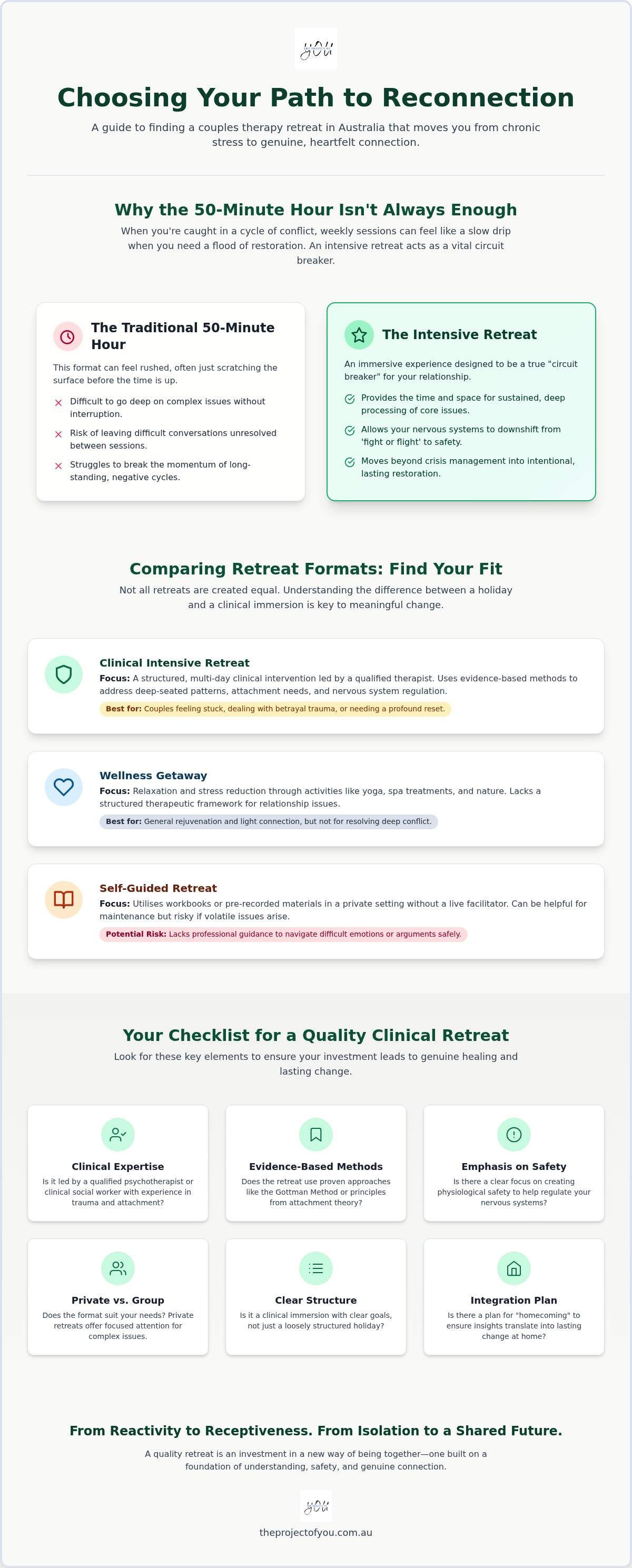
In 2026, the pace of Australian life has reached a point where many of us feel chronically "on". Between the relentless stream of digital notifications and the pressures of modern living, our relationships often receive only the leftovers of our energy. When a couple is struggling, the traditional 50-minute therapy hour can feel like trying to perform surgery in a revolving door. You might spend the first twenty minutes simply "landing" in the room, ten minutes touching on a sensitive topic, and the final twenty minutes bracing yourselves to return to the car park. It's a frustrating cycle that often leaves partners feeling more disconnected than when they arrived.
This is why the best couples therapy retreats Australia 2026 focus on providing a genuine circuit breaker for these exhausted patterns. By physically removing yourselves from the environment where your conflicts live, you allow your nervous systems to downshift from "fight or flight" into a state of receptiveness. This shift from crisis management to intentional restoration is where the real work begins. It's about moving away from the surface-level arguments and moving toward a deeper, shared understanding of your internal worlds.
The Science of the Therapeutic Intensive
Intensive Therapy is a focused, multi-day clinical intervention that allows for the sustained processing of relationship patterns. When we work in a condensed format, we can follow a thread of emotion all the way to its root without the interruption of a ringing phone or a work deadline. This approach significantly reduces the risk of "re-traumatisation", which can happen when difficult topics are opened in weekly therapy but cannot be safely resolved before the session ends. To gain a broader perspective on the history of these interventions, you might explore what is couples therapy and how it has evolved into the trauma-informed models we use today. At The Project of You, Azita Abdollahian draws on her background as a Clinical Social Worker to ensure these intensives provide the physiological safety needed for true neurobiological change.
Is a Relationship Retreat Right for You?
How do you know when it's time to step away? Relationship burnout is a common sign, often manifesting as a sense of emotional numbness or the feeling that you're simply co-existing rather than connecting. If you find that standard couples counselling isn't providing the momentum you need, a retreat offers a more immersive path to reconnection. Success depends heavily on mutual readiness and a willingness to look at the "dance" between you with curiosity rather than blame. If you're both committed to the process, choosing one of the best couples therapy retreats Australia 2026 can be a powerful catalyst for long-term growth and healing.
Comparing the Best Couples Retreat Formats in Australia
Choosing the right environment for your relationship's healing is as vital as the therapy itself. Are you looking for a shared experience with others, or does your relationship require a private sanctuary? In the search for the best couples therapy retreats Australia 2026, you'll encounter a wide spectrum of offerings. Understanding the difference between a wellness getaway and a clinical intervention is the first step toward finding your way back to each other. While a spa weekend or a yoga retreat can provide much-needed relaxation, they often lack the structured, evidence-based frameworks required to shift deep-seated relational patterns. Clinical retreats are designed to navigate the complex barriers to successful couples' therapy that often arise from unresolved conflict or defensive habits.
You might also see self-guided retreat options, which provide workbooks and beautiful locations but lack a professional guide. While these can be lovely for a "maintenance" weekend, they can be risky if deep-seated trauma or volatile arguments surface without a therapist present to help you navigate the storm. A facilitated experience ensures that a trained clinical professional is there to hold the space. This trauma-informed approach is particularly important in the Australian landscape, where many couples are dealing with the intersection of personal relationship stress and broader societal pressures. Having a guide who understands nervous system regulation ensures that the experience remains restorative rather than overwhelming.
Group Relationship Workshops
Group settings offer a sense of community that can be incredibly validating. Realising that other couples face similar struggles often dissolves the shame that keeps us isolated. These workshops are typically more affordable and follow a structured curriculum, making them an excellent choice for relationship enrichment or proactive growth. However, they may feel a little performative for those who aren't comfortable sharing in a group. They are best suited for couples who want to learn new skills alongside others in a supportive, low-pressure environment.
Private Therapeutic Immersions
For couples moving through significant transitions or seeking infidelity recovery, a private immersion is often the gold standard. These retreats provide 100% focus on your unique dynamic, creating a high level of psychological safety. While the emotional intensity is higher, the progress made in a few days can equal months of traditional sessions. This format allows a practitioner to tailor every moment to your specific needs, ensuring you feel heard and supported at every step. If you feel ready to explore a deeper level of connection, you can check availability for our upcoming sessions to see which format feels right for your journey.
How to Identify a Quality Couples Retreat in 2026
What if the most important part of your retreat isn't the view from the balcony, but the clinical expertise of the person guiding you? When you're researching the best couples therapy retreats Australia 2026, it's essential to look past the aesthetics and focus on the professional foundation. In an industry that remains largely unregulated, checking the qualifications of your lead therapist is your first step toward safety. Azita Abdollahian, for instance, brings her experience as a Clinical Social Worker and neurofeedback trainer to every session, ensuring that the process is grounded in science rather than just good intentions. A clinical background means your guide understands the complexities of mental health, trauma, and the delicate dance of human attachment.
The methodology used during your time away acts as your roadmap. You should look for programs that utilise research-backed couples therapy, such as the Gottman Method or Emotion-Focused Therapy. These frameworks aren't just academic theories; they are proven tools that help couples de-escalate conflict and rebuild trust. It's also vital to ensure the retreat is inclusive and affirming of all relationship structures and identities. Whether you are in a long-term marriage, a de facto relationship, or a diverse family unit, you deserve a space where your specific dynamic is respected and understood without judgement.
The Importance of Nervous System Regulation
Have you ever noticed how your mind goes blank or your chest tightens during a heated argument? This is your survival brain taking over, and you simply cannot "talk your way out" of a physiologically dysregulated state. When your body feels under threat, the parts of your brain responsible for logic and empathy effectively go offline. This is why Nervous System Restoration is a core pillar of a high-quality retreat. A regulated system is the foundation of healthy communication. By prioritising physiological safety, you create the internal space needed to be truly vulnerable with your partner again.
Trauma-Informed Care in a Retreat Setting
Trauma-informed care means your therapist recognises that your current patterns are often protective responses to past wounds. It's about moving away from "what's wrong with you?" and toward "what happened to you?". Red flags to watch for when booking include retreats that promise "guaranteed" outcomes or those that use shame-based language to highlight your failings. True healing requires a steady, non-judgmental presence. Emotional safety is the quiet engine of the therapeutic process; it's what allows you to lower your guard and begin the work of genuine reconnection.
Maximising Your Investment: Preparation and Integration
A transformative retreat is a significant investment in your future, both emotionally and practically. While the best couples therapy retreats Australia 2026 provide the environment and expertise for a breakthrough, the true measure of success lies in how those insights take root in your daily life. Choosing one of the best couples therapy retreats Australia 2026 is only the beginning of a larger journey of reconnection. Think of the retreat as a deep renovation of your relationship's foundation. Once you return home, you're the ones who will live in that house, and it's natural to feel a little protective of the new peace you've found. The transition from a quiet, supported sanctuary back to the busyness of the real world requires a gentle, intentional approach.
Preparing Your Heart and Mind
What if you approached your preparation with as much care as the retreat itself? Before you arrive, take a moment with your partner to ask: "What is the one thing I most want to feel when we leave?" or "How can we support each other when the work feels heavy?" Clearing the decks at work and home is essential for your success. If you're answering emails or worrying about the school run during your sessions, your nervous system remains in a state of high alert, making it harder to access the vulnerability needed for healing. Managing the anxiety of doing the work is a normal part of the process. It's okay to feel nervous; it simply means the relationship matters to you and you're ready for change.
Integration: The Key to Long-Term Change
The week you return is often referred to as the "Homecoming" phase, and it's the most critical window for integration. You might experience a "retreat glow" for a few days, but old triggers can easily resurface as you navigate the familiar stressors of laundry, bills, and work schedules. This is where a structured plan becomes your anchor. Scheduling regular, fifteen-minute relationship check-ins allows you to practice the communication tools you've learned in a low-stakes environment. Sometimes, focusing on your own individual growth helps the partnership too. Exploring resources like a self love ebook can help you maintain your own regulation so you can show up more fully for your partner.
If flare-ups occur, don't see them as a failure or a sign that the retreat didn't work. They're simply moments where your old patterns are testing your new boundaries. When things feel tense, remember to use the somatic techniques you practiced to soothe your nervous system before continuing the conversation. Over time, you might choose to transition back into regular counselling to keep the momentum going and refine your connection as you move through different seasons of life.
Restoring Your Bond with The Project of You
At The Project of You, we believe that every relationship has the inherent capacity for healing, even when the path forward feels obscured by years of conflict or the sharp pain of betrayal. Our approach is intentionally different. We don't just look at the arguments on the surface; we look at the neurobiology underneath. By merging the rigour of clinical social work with advanced modalities like somatic healing, we create an environment where your nervous system can finally feel safe enough to let go of its defensive armour. This is what sets us apart when you are looking for the best couples therapy retreats Australia 2026. It isn't just about learning new communication scripts; it's about a fundamental shift in how you experience one another.
The Private Couples Retreat experience is designed to be a sanctuary for your relationship. Led by Azita Abdollahian, a qualified psychotherapist and neurofeedback trainer, these immersions offer a level of individualised attention that group settings simply cannot match. We support couples from every corner of Australia, providing a space where you can step out of your daily roles and into a process of deep, immersive restoration. Whether you're navigating the aftermath of an affair or simply feel like you've become strangers living under the same roof, we offer a steady hand to help you find your way back.
A Compassionate, Evidence-Led Path
Our work is firmly rooted in the Gottman Method and Attachment Theory, ensuring that every strategy we share is backed by decades of research into what makes relationships last. We also recognise that a healthy partnership begins with a regulated self. This is why we facilitate "The Healing Feminine" workshops alongside our couple-focused work, helping individuals explore their own internal landscapes and attachment wounds. Our commitment is to provide a non-judgemental, safe space for all couples, regardless of their history or relationship structure. We look past the immediate obstacles to see the potential for growth that exists within you both. Our goal is to help you move from a place of uncertainty toward a sense of clarity and purpose.
Taking the Next Step Toward Healing
Choosing to attend a retreat is a courageous act of hope. If you feel that our approach resonates with your needs, we invite you to enquire about our upcoming retreat dates for 2026. The process begins with an initial consultation, which is a vital step in ensuring we are the right fit for your specific journey. This isn't a high-pressure meeting; it's a quiet conversation to understand your needs and see how we can best support you. We encourage you to book a discovery call to discuss your situation and explore how a restorative retreat can help you build the lasting, secure bond you deserve. You don't have to navigate this transition alone.
Choosing Your Path Toward Lasting Reconnection
What if the distance you feel today is simply a sign that your relationship is ready for a new way of being? Reconnecting isn't about fixing what's broken; it's about rediscovering the safety and warmth you once shared. By moving beyond simple conversation and focusing on nervous system regulation, you give your partnership the space it needs to breathe and grow. Finding the best couples therapy retreats Australia 2026 involves choosing a path that respects your history while providing evidence-based tools for a more secure future.
As a qualified psychotherapist and neurofeedback trainer, Azita Abdollahian offers a trauma-informed approach specialised in infidelity and attachment healing. Whether you choose a private immersion or a structured workshop, the goal remains the same: to provide a steady, compassionate environment where you can both feel heard and understood. You've already taken the first step by exploring what's possible. Now, it's about following that curiosity toward a place of genuine restoration and hope.
Explore our Private Couples Retreats and start your journey to restoration Your relationship deserves the time and expertise required to heal. We look forward to supporting you as you navigate this transition and build a bond that feels truly resilient and safe.
Frequently Asked Questions
How much does a couples therapy retreat in Australia typically cost in 2026?
Costs for these experiences vary depending on the format and the level of clinical expertise provided. A private two-day intensive typically ranges from $3,500 to $5,500, while group-based weekend programs might start around $1,100. These figures usually cover the therapeutic sessions and sometimes include accommodation and meals. When researching the best couples therapy retreats Australia 2026, it's important to consider that the investment reflects the specialised training of the lead practitioner.
Can a retreat really save a marriage on the brink of divorce?
While no professional can guarantee a specific result, a retreat serves as a vital circuit breaker for couples in crisis. By stepping away from daily triggers, you create the psychological safety needed to explore your options with clarity. Many couples find that the intensive format allows them to process years of accumulated hurt in a few days. This process helps you decide whether to recommit to the relationship or move toward a conscious uncoupling.
What is the difference between a marriage retreat and a relationship intensive?
A relationship intensive is a clinical intervention focused on deep therapeutic work, often utilising evidence-based frameworks like the Gottman Method. Marriage retreats are sometimes more general, focusing on romance, wellness, or religious guidance. Intensives are specifically designed to address complex issues such as betrayal trauma or chronic disconnection. They prioritise nervous system regulation and attachment healing over simple relaxation, making them a more rigorous choice for those seeking profound relational change.
Do we have to share our private issues in front of other couples?
You don't have to disclose your private struggles to others if you choose a private immersion format. At The Project of You, our private retreats are entirely confidential, focusing solely on your unique dynamic. Even in our group workshops, we prioritise your privacy. Most of the exercises are conducted privately between you and your partner, ensuring you never feel forced to perform or share sensitive information in a way that feels unsafe.
How do I convince my partner to attend a therapy retreat with me?
Try framing the invitation around your desire for reconnection rather than listing your partner's faults. You might say, "I've been feeling lonely, and I'd love for us to have a dedicated space to find our way back to each other." Focus on the "reset" aspect of the experience. Inviting your partner to look at the best couples therapy retreats Australia 2026 with you can foster curiosity and help them feel like an active participant.
Are couples retreats in Australia covered by Medicare or private health insurance?
Medicare does not currently provide rebates for couples therapy or retreats, as its focus is on individual mental health care. However, some private health insurance funds may offer partial cover if the retreat is led by a registered Clinical Social Worker or Psychologist. You should contact your provider to discuss your specific policy. While the initial investment is higher, the concentrated nature of a retreat often leads to more efficient progress than months of weekly sessions.
What happens if we start arguing during the retreat?
Arguing during a retreat is actually a valuable opportunity for the therapist to see your dynamic in real-time. Instead of letting the conflict spiral, the practitioner will guide you through de-escalation techniques. You'll learn how to recognise when your nervous system is becoming dysregulated and practice somatic tools to stay calm. These moments allow you to build new, healthier habits in a safe environment, ensuring you feel supported even when things get difficult.
How long do the effects of a relationship retreat typically last?
The longevity of your results depends on your commitment to the integration process once you return home. A retreat provides a powerful new foundation, but maintaining that "retreat glow" requires practicing the tools you've learned in your daily life. Most couples experience a significant shift in their baseline of safety and connection. By scheduling regular check-ins and using your new communication skills, the insights gained during the retreat can lead to a lifetime of growth.


Comments