.png)

The Transformative Benefits of a Therapeutic Retreat: A Path to Restoration
- Azita Abdollahian

- 17 hours ago
- 12 min read
Have you ever taken time away from work or everyday life, only to return feeling as though the exhaustion, stress and mental fog never truly left?
For many people experiencing chronic stress or burnout, a standard holiday provides temporary relief but doesn't necessarily address the underlying patterns keeping the nervous system in a constant state of activation. You may return home rested physically, yet still feel emotionally depleted, disconnected from yourself or struggling to reconnect with your partner and the people around you.
This is where the benefits of a therapeutic retreat can extend beyond simply taking a break.
As a psychotherapist, trauma expert and founder of The Project Of You, Azita Abdollahian understands that meaningful recovery from chronic stress and burnout often requires more than stepping away from your responsibilities. It can involve creating the time, environment and therapeutic support needed to understand what has contributed to your exhaustion and develop practical tools for lasting change.
A trauma-informed therapeutic retreat offers an opportunity to step outside your usual environment and focus intentionally on your emotional wellbeing. Through guided therapeutic workshops, nervous system regulation, reflection and meaningful connection, participants can begin to move beyond simply coping with stress and explore what it takes to restore their emotional and physical capacity.
In this guide, Azita explores the benefits of therapeutic retreats for burnout, chronic stress, nervous system regulation and relationship connection. You'll discover how an immersive, structured experience can act as a circuit-breaker from everyday patterns while providing practical tools that can be integrated into life long after the retreat ends.
Whether you are feeling emotionally exhausted, disconnected from yourself, struggling with chronic stress or longing to reconnect with your relationship, healing doesn't always require running away from your life.
Sometimes, you need to step outside of it long enough to understand what needs to change—and give yourself the space, support and tools to begin creating that change.
Table of Contents
Beyond the Holiday: What Defines a Truly Therapeutic Retreat?
The Physiological Shift: How Retreats Regulate Your Nervous System
Deepening Connection: Relational Benefits for Couples and Families
Creating Psychological Safety: The Role of the Therapeutic Environment
Sustaining the Shift: The Importance of Post-Retreat Integration
Beyond the Holiday: What Defines a Truly Therapeutic Retreat?
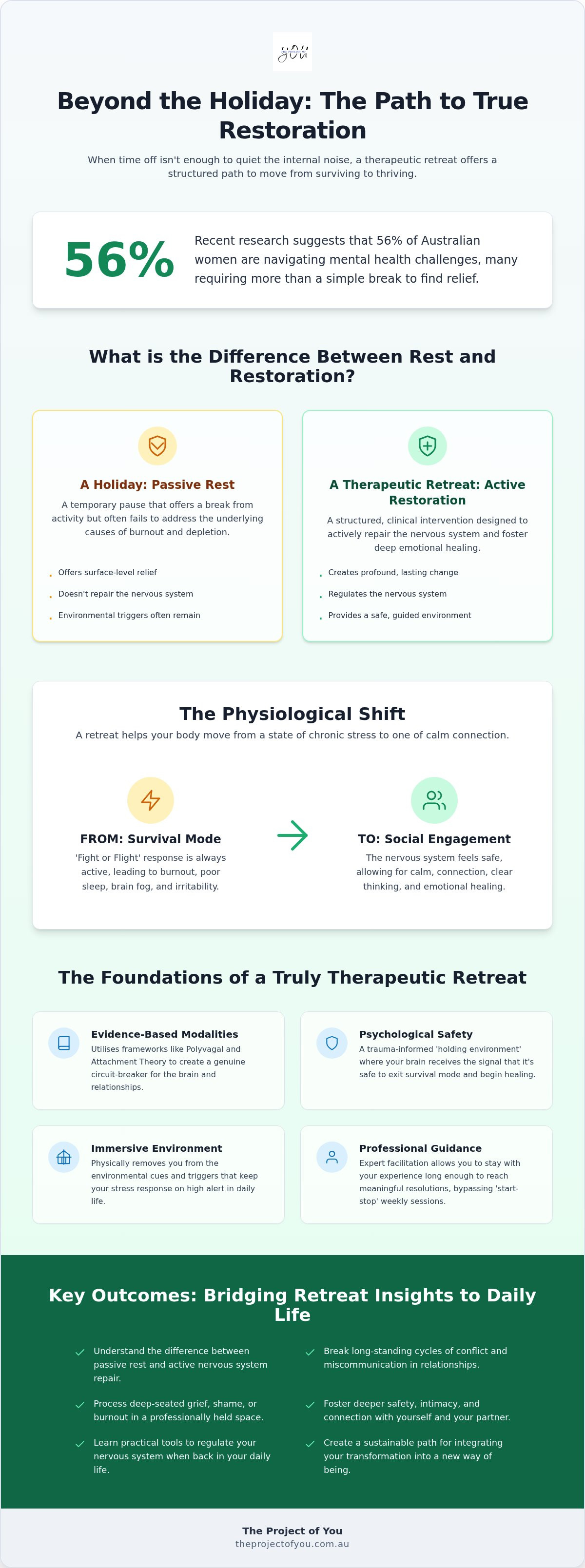
It's a common mistake to confuse a holiday with a therapeutic retreat. While a trip to the coast might offer a temporary pause, it often fails to address the underlying physiological depletion caused by chronic stress. One of the primary benefits of a therapeutic retreat is that it moves beyond passive leisure into the territory of a structured, clinical intervention. Think of it as the difference between turning off a flickering light and actually repairing the faulty wiring. Resting is simply the cessation of activity. Restoring, however, is an active process of repairing the nervous system. This requires a level of focus and safety that daily life rarely permits.
Many people find that weekly 50-minute counselling sessions, while valuable, can feel like a 'start-stop' process. Just as you begin to touch on a deep emotional truth, the clock runs out. The immersive nature of a retreat bypasses this friction, allowing you to stay with your experience long enough to reach a meaningful resolution. Under the guidance of a qualified facilitator like Azita Abdollahian, you enter a 'contained' emotional space where the usual distractions of the world are silenced, making room for profound self-reflection.
The Core Elements of a Clinical Retreat
A truly restorative experience isn't built on generic wellness activities. It relies on evidence-based modalities, such as Polyvagal Theory and Attachment Theory, to create a genuine circuit-breaker for the brain. At The Project of You, our Nervous System Restoration retreats prioritise trauma-informed care and psychological safety above all else. This isn't just about feeling relaxed; it's about providing the emotional scaffolding needed to process grief, shame, or burnout. When the environment is curated for safety, your brain finally receives the signal that it's okay to exit survival mode and begin the work of healing.
Why 'Time Away' is a Biological Necessity
Our homes and workplaces are often filled with 'environmental cues' that keep our stress response on high alert. Even the sight of a laptop or a particular chair can trigger a subtle cortisol spike. By physically removing these triggers, we create the necessary conditions for neuroplasticity, which is the brain's ability to reorganise and heal itself. What if you could look at your life with curiosity rather than judgement? Stepping outside your routine allows you to observe your patterns without the immediate pressure to perform or fix. This distance is a biological requirement for those seeking the long-term benefits of a therapeutic retreat, providing the space needed for the body to remember how to feel grounded and present once more.
The Physiological Shift: How Retreats Regulate Your Nervous System
Have you ever wondered why your body refuses to relax even when you are physically still? For many of us, chronic stress keeps our system locked in a state of 'fight or flight', where the world feels perpetually unsafe. To understand how to shift this, we look to Polyvagal Theory. This framework helps us move from survival states into 'Social Engagement', where we feel connected, calm, and grounded. One of the primary benefits of a therapeutic retreat is that it provides the immersive environment necessary to signal this safety to your brain.
When you are constantly flooded with cortisol and adrenaline, your body prioritises survival over maintenance. This is why chronic stress often leads to poor sleep, sluggish digestion, and persistent brain fog. By reducing this physiological load, a retreat allows your system to catch its breath. We integrate Somatic Therapy because we know the body must feel safe before the mind can begin to heal. It's not enough to talk about peace; your nervous system needs to experience it through felt sensations of security.
Breaking the Cycle of Chronic Burnout
In your daily life, a dysregulated nervous system might show up as sudden irritability, a lack of focus, or a bone-deep fatigue that sleep won't touch. These aren't personal failings; they are biological responses to an overloaded system. A retreat acts as a 'manual override' for this stress response, pulling you out of the repetitive loops of your home and work environment. You can read more about how trauma dysregulates your nervous system to understand how these patterns develop and how they can be gently unlearned.
The Science of Deep Rest
True healing happens when the parasympathetic nervous system is dominant, as this is the state required for cellular repair and emotional processing. In our fast-paced Australian culture, we often view 'doing nothing' as a waste of time. On a retreat, however, this stillness is a productive therapeutic act. By experiencing the benefits of a therapeutic retreat, you give your body the chance to recalibrate its natural rhythms. We use somatic tools and neurofeedback to facilitate this shift, helping you access a level of rest that feels both deep and sustainable. If you're ready to move from exhaustion to restoration, you might consider booking a session to discuss which intensive format best suits your path forward.
Deepening Connection: Relational Benefits for Couples and Families
When a relationship is in crisis, or simply feeling stagnant, the usual 50-minute therapy hour can feel like trying to empty the ocean with a teaspoon. One of the most significant benefits of a therapeutic retreat is the ability to engage in a 'Relationship Intensive'. This format allows couples to move past surface-level bickering and address the core dynamics that keep them stuck. By using Attachment Theory, we can begin to identify the 'pursue-withdraw' cycle. This is a common pattern where one partner seeks connection through protest or criticism, while the other retreats into silence to protect themselves. In the safe, mediated space of a retreat, both partners can finally lower their guard and begin to build a 'Secure Base' together.
We incorporate Gottman Method principles to provide a structured way of communicating that prioritises respect and emotional safety. Instead of assigning blame, we foster curiosity about why these patterns exist. This concentrated time together creates a container for shared vulnerability that is often impossible to achieve amidst the noise of domestic life. By working through these layers in a condensed timeframe, many couples find they can resolve months of conflict in just a few days, creating a path toward genuine reconciliation and deeper intimacy.
Healing from Betrayal and Infidelity
Recovering from a breach of trust requires an immense amount of emotional containment. A retreat provides a dedicated space where the 'crisis' phase can be safely managed, allowing the couple to transition into the 'rebuilding' phase of intimacy. It's about more than just moving past the pain; it's about understanding the 'why' behind the betrayal and creating a new foundation. If you're navigating this difficult path, our guide on Choosing Couples Counselling offers more insight into finding the right support for your relationship.
The 'Healing Feminine' Perspective
For many women, exhaustion isn't just about physical labour; it's the weight of the 'mental load' and the constant pressure to hold everything together. This is a key focus in our Healing Feminine workshops and retreats. By stepping away from domestic expectations, women can reconnect with their intuition and essence. We explore why so many high-achieving women feel disconnected in our article on Healing the Wounded Feminine. One of the benefits of a therapeutic retreat is this rare opportunity to put down the roles of mother, partner, or professional, and simply be. This restoration of self is often the first step in improving how we show up in all our other relationships.
Creating Psychological Safety: The Role of the Therapeutic Environment
When we discuss the benefits of a therapeutic retreat, we often focus on the activities, but the most vital component is actually the environment itself. Safety is not a luxury; it's a clinical requirement for healing. In a trauma-informed setting, we create what is known as a 'holding environment'. This is a curated space where the facilitator provides the emotional scaffolding you need to explore painful memories or difficult emotions without becoming overwhelmed. It's about more than just a quiet room. It's about a non-judgemental presence that allows your system to finally drop its guard.
There is also a profound power in the group dynamic of a retreat. So much of our suffering is compounded by the belief that we are alone in our struggle. When you sit with others who are also navigating burnout, grief, or relationship challenges, the weight of shame begins to lift. This shared vulnerability fosters a unique type of self-reflection. You are given the space to balance this social connection with moments of deep solitude, ensuring you have the time to process your insights at your own pace.
The Importance of Professional Facilitation
Attempting a 'DIY' retreat can sometimes do more harm than good. Without clinical oversight, you risk 'flooding', which is when your emotional intensity exceeds your capacity to cope. An experienced therapist knows how to monitor your regulation in real-time, providing the necessary support if you begin to feel unsafe. This is why Nervous System Retreats led by qualified professionals are so effective. We ensure that the depth of the work never exceeds the safety of the container.
Integrating Advanced Modalities
The structured nature of a retreat allows for the integration of advanced modalities that aren't always possible in a standard office setting. We may incorporate elements of Psychedelic Assisted Therapy for those seeking to move past long-standing emotional blocks. Every activity, from somatic experiencing to mindfulness exercises, serves a specific therapeutic purpose. By weaving these tools into a cohesive schedule, we ensure that your time away is not just a break from life, but a genuine path toward restoration.
Sustaining the Shift: The Importance of Post-Retreat Integration
Many people worry that the profound peace they found will vanish the moment they land back at the airport or step through their front door. This is a common and valid concern. While one of the primary benefits of a therapeutic retreat is the immediate relief it provides, the true value lies in how those insights are woven into your daily life. We call this integration. It is the bridge between a 'peak experience' and a sustainable way of living. Without an intentional plan for re-entry, the demands of a busy Australian lifestyle can quickly erode the progress you've made.
Integration isn't about maintaining the 'retreat glow' forever; it's about honouring the shifts in your nervous system and protecting your newly established boundaries. This might mean saying 'no' to social commitments that used to drain you or being more curious about your emotional triggers rather than reacting to them. To anchor these gains, ongoing individual or couple counselling can be incredibly helpful. These sessions provide a space to process the 'homecoming' experience and ensure the tools you learned remain sharp and accessible.
A Step-by-Step Integration Plan
To help you navigate the transition, we suggest a methodical approach to your first week back. This isn't about perfection; it's about creating a soft landing for your system.
Step 1: The 'Buffer Day'. If possible, avoid going straight back to work or high-stress environments. Give yourself 24 hours to simply exist in your home space without an agenda.
Step 2: Identifying 'High-Value' Habits. Choose one or two small practices from the retreat, such as a five-minute somatic grounding exercise, and prioritise them above all other tasks.
Step 3: Scheduling Follow-up. Book a session to discuss how the integration is going. Having a witness to your journey helps solidify the changes you are making.
Avoiding the 'Quick Fix' Trap
It's important to remember that healing is a continuous journey, not a single event. There will be days when you feel yourself slipping back into old patterns of 'fight or flight', and that's okay. What if you viewed those moments with compassion rather than frustration? You can use resources like our Self Love E-books to provide ongoing digital support when you need a gentle reminder of your worth and your capacity for growth. One month after your experience, take a moment to ask yourself: "How has my relationship with my stress changed, and where am I finding more ease?" Recognising these subtle shifts is how you truly realise the long-term benefits of a therapeutic retreat.
Your Path to Lasting Restoration
Choosing to step away from the weight of daily expectations is the first act of reclaiming your sense of self. We've seen how the benefits of a therapeutic retreat go far beyond a temporary pause, offering a clinical circuit-breaker that repairs the nervous system and rebuilds the foundations of intimacy. By moving through these structured layers of safety and somatic healing, you give your body the opportunity to finally transition from chronic stress into a state of deep, lasting restoration.
This journey is supported by an evidence-based, trauma-informed approach that prioritises your long-term wellbeing over quick fixes. With the guidance of a qualified clinical social worker, you can navigate the complexities of your internal world with curiosity and compassion. You deserve a life that feels connected and grounded, where you can show up fully for yourself and those you love.
Explore our upcoming transformative retreats and intensives at The Project of You The path toward healing is a continuous journey, but you don't have to walk it alone. We are here to provide the expertise and the holding environment you need to find your way back to a life of ease. Your restoration is not just a possibility; it is a path that is open to you right now.
Common Questions About Therapeutic Retreats
Are the benefits of a therapeutic retreat permanent?
The longevity of your results depends heavily on post-retreat integration. While the initial physiological shift is often profound, lasting change requires weaving new habits into your daily life. Think of a retreat as a solid foundation rather than a finished building. By continuing with follow-up counselling and using practical tools for nervous system regulation, you can sustain the sense of ease you discovered. It is about creating a new way of being, not just a temporary escape.
How do I know if I need a retreat or just a standard holiday?
A standard holiday offers a break from tasks, but a therapeutic retreat offers a break from your stress response. If you return from holidays still feeling exhausted or find that your internal 'switch' never turns off, you likely need a clinical intervention. One of the primary benefits of a therapeutic retreat is the structured support from a qualified professional. This allows your body to move from survival mode into genuine restoration, which a beach trip alone cannot achieve.
Is a therapeutic retreat suitable for people with severe trauma or PTSD?
Yes, provided the retreat is led by a qualified clinical professional and is specifically trauma-informed. For individuals navigating PTSD, psychological safety is the first priority. A clinical social worker can provide the 'holding environment' needed to process deep emotions without causing re-traumatisation. It's essential to have a pre-retreat consultation to ensure the format is safe for your current window of tolerance. This ensures that the depth of the work matches your emotional capacity.
What is the difference between a group retreat and a private couples intensive?
Group retreats offer the healing power of community, helping you realise you aren't alone in your struggles. In contrast, a private couples intensive provides a tailored, one-on-one environment focused entirely on your relationship's unique attachment patterns. While group settings are wonderful for individual growth and workshops, the private format is often better for navigating crisis points like affair recovery or deep-seated conflict that requires total confidentiality and focused clinical attention.
Do I need to be 'good' at meditation or yoga to attend a retreat?
Not at all. You don't need any prior experience or specific skills to attend. Our focus is on nervous system regulation and somatic awareness, which are natural human processes rather than performance-based activities. Whether you've never meditated before or you're a seasoned practitioner, the retreat is designed to meet you exactly where you are. We use gentle, accessible tools that help you reconnect with your body's innate wisdom without any pressure to 'perform' wellness.
How can I justify the cost of a therapeutic retreat to myself or my partner?
Think of a retreat as an investment in your long-term health and the longevity of your relationship. Chronic burnout and relational distress carry a significant emotional and financial cost over time. By addressing these issues in a concentrated intensive, you often achieve breakthroughs that might take months or years in traditional therapy. It's a strategic 'circuit-breaker' that prevents further depletion and helps you regain the clarity and energy needed to thrive in your daily life.
What should I look for when choosing a retreat facilitator in Australia?
Look for clinical qualifications and a background in trauma-informed care. In Australia, a qualified clinical social worker or psychologist with experience in Polyvagal and Attachment theories is ideal. You want someone who balances professional authority with deep empathy. Ensure they offer a structured approach rather than just general wellness. A good facilitator will always prioritise your psychological safety and provide a clear plan for both the experience and the integration phase that follows.
Can a retreat replace regular weekly therapy sessions?
A retreat doesn't replace regular therapy; it accelerates it. Think of it as a deep-dive that clears the path for your ongoing work. While an intensive can resolve acute crisis points and provide a massive shift in perspective, weekly sessions are where you anchor those changes into your long-term habits. Many clients find that the benefits of a therapeutic retreat provide the 'aha' moments that make their regular counselling far more effective and focused.


Comments