.png)

Nervous System Regulation for Couples: How to Stop Arguing and Start Connecting
- Azita Abdollahian

- 17 hours ago
- 13 min read
What if the reason you keep having the same circular argument isn't because you and your partner are incompatible, but because your nervous systems no longer feel safe?
When conflict becomes repetitive, exhausting or difficult to resolve, it can leave both people feeling as though they are constantly walking on eggshells. A disagreement may escalate quickly, small issues can trigger disproportionately intense reactions, and the emotional impact of an argument can linger for hours or even days.
You may begin to wonder whether the relationship itself is the problem.
But often, repeated conflict is influenced by more than the issue you're arguing about. When we feel criticised, rejected, ignored or emotionally threatened, our nervous system can move into a protective response. We may fight, withdraw, shut down, become defensive or desperately try to make the other person understand us.
As a psychotherapist, trauma expert and relationship specialist, Azita Abdollahian helps individuals and couples understand the deeper psychological and physiological patterns influencing relationship conflict. Her trauma-informed approach explores the connection between attachment, emotional triggers, nervous system regulation and the ways couples communicate when under stress.
This is where nervous system regulation for couples can become an important part of relationship healing. When both partners understand what happens to them during moments of activation, they can begin to interrupt destructive patterns before conflict escalates.
In this guide, Azita explores the neurobiology of emotional safety, the role of co-regulation in relationships, and practical strategies couples can use to de-escalate tension, recover after conflict and create healthier patterns of communication and connection.
You'll learn why regulating yourself isn't about suppressing your emotions or avoiding difficult conversations. It's about developing the awareness and tools to remain present enough to respond rather than simply react.
A healthy relationship isn't one where conflict never happens. It's one where both people can learn how to move through difficult moments without losing themselves—or each other—in the process.
Table of Contents
Why We Fight: The Science of Survival in Relationships
Have you ever noticed how a simple chat about the household chores can suddenly feel like a life or death struggle? It's not because you've stopped loving each other or because you are fundamentally incompatible. Instead, your "survival brain," or the limbic system, has hijacked your "thinking brain," known as the prefrontal cortex. When this happens, logic and perspective fly out the window. You aren't just reacting to the dishes; you're reacting to a perceived threat to your emotional bond. This is why nervous system regulation for couples is so vital. It helps us understand that these heated moments are often a "protest against disconnection." We aren't trying to be difficult; we're desperately trying to find our way back to safety through the only biological tools we have available in that moment.
Our bodies are constantly scanning our partner for cues of belonging or rejection, a process known as neuroception. A partner's slightly sharp tone of voice or a fleeting facial expression of disapproval can act as a biological tripwire. Before you've even consciously processed the words being said, your nervous system may have already decided you are in danger, triggering a cascade of stress hormones that prepare you for battle or retreat.
The Polyvagal Perspective on Love
Polyvagal Theory is the science of feeling safe enough to fall in love. It describes three main states our bodies inhabit. The "Safe and Social" state, or ventral vagal, is the foundation of a healthy relationship. This is the energy that allows for intimacy, deep listening, and soft communication. However, when neuroception detects a threat, we shift into "Fight or Flight" (Hyperarousal) or "Shutdown" (Hypoarousal). Recognising these shifts is a core part of couple counselling, as it moves the conversation from "who is right" to "how can we help each other feel safe again."
When the Window of Tolerance Closes
Think of your "Window of Tolerance" as the zone where you can handle life's ups and downs without flipping your lid. Inside this window, you can stay curious, present, and compassionate. When the window closes, common relational triggers like perceived criticism, neglect, or feeling controlled push you outside your capacity. You might feel your heart racing, your breath becoming shallow, or a sudden heat rising in your chest. If you move into a shutdown state, you might literally "lose your words." It isn't a conscious choice to be silent; your brain has simply prioritised survival over speech, making nervous system regulation for couples the essential first step in any resolution.
Recognising the Stress Loop: Are You Hyperaroused or Shutting Down?
Understanding the biology of your conflict loop transforms how you see your partner. Instead of seeing them as "difficult" or "uncaring," you begin to see a nervous system that is simply overwhelmed. This shift in perspective is the foundation of nervous system regulation for couples. Most couples find themselves caught in a predictable "Pursuer-Withdrawer" dynamic, which is essentially a biological mismatch of survival states. One person is trying to bridge the gap with high energy, while the other is trying to find safety by pulling away or going quiet. Neither is wrong; both are simply trying to survive a moment of perceived danger.
The Hyperaroused Partner (Fight/Flight)
When you're in a state of hyperarousal, your system is flooded with "fight or flight" energy. This often manifests as shouting, pacing, or a frantic need to ask questions until you get a response. You might feel an urgent, almost painful pressure to resolve the issue right this second. It's helpful to realise that this isn't about being pushy; it's a biological response to the anxiety of feeling disconnected. For the hyperaroused partner, silence feels like a threat, so they "pursue" even harder to find reassurance. Over time, living in this high-stress state takes a significant toll on your physical health and emotional well-being. Take a breath and wonder: "What does my body need to feel safe enough to pause?"
The Hypoaroused Partner (Freeze/Shutdown)
On the other side of the loop is hypoarousal, which often looks like stonewalling, "zoning out," or feeling completely numb. While it may feel like your partner is using the "silent treatment" as a weapon, it's frequently an involuntary nervous system collapse. This is the "freeze" or "shutdown" response. They might describe feeling "trapped" or "foggy," as if they've lost access to their thoughts and words. It's crucial to distinguish between active avoidance and a genuine biological shutdown. In a shutdown state, the brain has effectively pulled the fire alarm and turned off non-essential systems, including the ability to communicate. They aren't choosing to be cold; they're simply out of capacity.
By shifting from blame to curiosity, you can start to see these moments as signals that the "relational tank" is empty. If you're finding it hard to navigate these loops on your own, you can book a session online to begin the journey of restoration together. Recognising these states is the first step toward creating a home that feels like a sanctuary once more.
Why Talking It Out Often Fails (And What to Do Instead)
We have all been told to use "I-statements" or practice active listening when things get heated. But have you noticed how these tools feel nearly impossible to use when you're actually upset? There is a biological reason for this. When you move outside your Window of Tolerance, the prefrontal cortex; the part of your brain responsible for logic, empathy, and complex language; effectively goes offline. You can't "talk it out" because the hardware required for a calm conversation isn't currently powered up. This is where nervous system regulation for couples shifts from a mental exercise to a physical one. We must settle the body before we can ever hope to reach the mind.
The Trap of Traditional Communication Skills
Traditional advice often focuses on "top-down" processing, assuming we can think or talk our way into a better mood. However, when you're in a survival state, your body is in charge. Arguing about "the facts" or who said what usually just adds fuel to the fire because your system is looking for safety, not a logical debate. We need "bottom-up" strategies that address the body's sense of alarm first. Practising these somatic shifts is a core part of Couple Counselling, where the focus moves from the script of the argument to the safety of the connection itself.
The Power of Co-Regulation
While self-regulation is a valuable skill, humans are biologically wired to heal through connection. This is known as the "Co-Regulation Effect." It's the beautiful reality that one calm nervous system can help settle another. A soft gaze, a gentle touch, or a lower, slower vocal pitch can signal safety to your partner's system more effectively than any well-crafted sentence. Research from the Gottman Institute highlights "physiological soothing" as a hallmark of successful couples. These partners don't just solve problems; they actively settle each other's heart rates through their presence.
Sometimes, the most loving thing you can do is take a breather. However, for this to be effective, it must be done with a clear promise to return. Without that reassurance, a pause can feel like abandonment to an anxious system. Co-regulation in this context looks like saying, "I'm too overwhelmed to be kind right now, so I'm going to step away for twenty minutes to settle my system, and then I'll come back to you." This maintains attachment security while allowing both of you the space to return to a state of "Safe and Social."
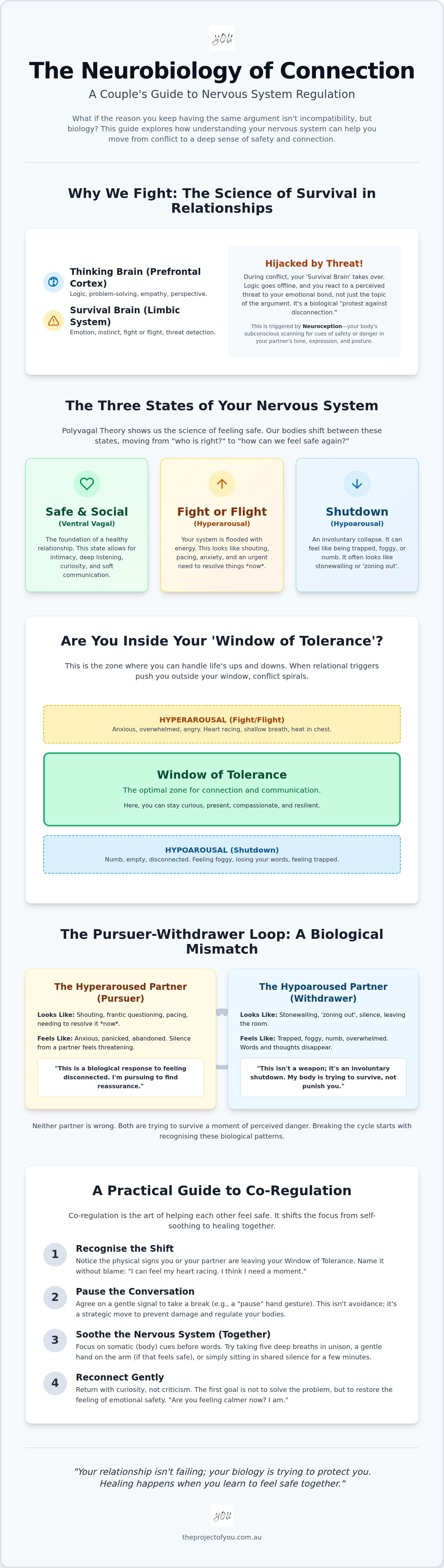
A Step-by-Step Guide to Co-Regulation: De-escalating in the Moment
When you are in the thick of a disagreement, the theory of Polyvagal states can feel a world away. This is why having a practical, step-by-step framework for nervous system regulation for couples is essential. It moves you from a place of reactive survival to intentional connection, allowing you to navigate the storm together rather than being swept away by it.
Step 1: Name the State. Instead of pointing fingers, point inward. Try saying, "I can feel my heart racing, I’m getting overwhelmed," or "My chest feels tight, I think I’m losing my ability to listen." This simple act of naming the physical sensation helps your prefrontal cortex begin to come back online, shifting the focus from the argument to the biological reality of your body.
Step 2: Propose a "Nervous System Reset." Unlike a traditional "time out," which often feels like a punishment or a withdrawal of love, a reset is a mutual agreement to pause for the sake of the relationship. You aren't leaving your partner; you are leaving the conflict to preserve the bond. It’s a way of saying, "I value us too much to keep going while we are both this upset."
Step 3: Utilise Somatic Anchors. Shift the focus from words to bodies. This might look like back-to-back breathing for a few minutes or a 20-second hug, which is the time required for the body to release oxytocin and lower cortisol. These physical actions provide the "bottom-up" safety your system is craving when it feels under threat.
Step 4: Re-engage with Intention. Only return to the conversation once both systems are clearly back within the Window of Tolerance. If one person still feels "on edge," the reset isn't over yet. Patience in this stage prevents the "post-fight hangover" and ensures the subsequent conversation is productive rather than destructive.
The Same-Team Protocol
Using "we" language is a powerful way to signal safety to an overwhelmed system. Phrases like, "We are both dysregulated right now, let’s settle together," remind you that the problem is the loop, not the person beside you. In Australia, we have the beautiful, mundane ritual of the "Cuppa Tea" reset. Putting the kettle on, hearing the water boil, and sitting in silence while the tea brews provides a predictable, grounding rhythm that helps the system land. Repair is the most important skill in a relationship, serving as the bridge that restores connection after a moment of discord. This shared practice of nervous system regulation for couples ensures that the body feels safe enough to allow the heart to open again.
Somatic Exercises for Two
If eye contact feels too intense while you are hyperaroused, try back-to-back breathing. Feeling the rhythmic rise and fall of your partner’s breath against your own back can be deeply soothing without the pressure of being "seen" when you feel vulnerable. You might also try an "Orienting Scan" together. Look around the room and name five things you see, such as a picture on the wall or a plant in the corner. This confirms to your primitive brain that there is no actual physical threat in your immediate environment. Always use consent-based touch. Ask, "Would a hug help, or do you need some space?" This simple inquiry respects boundaries while offering a gentle path back to intimacy.
Beyond the Argument: Building Long-Term Relational Resilience
While learning to de-escalate in the moment is a vital skill, true transformation happens when you move from reactive "firefighting" to proactive restoration. Think of your relationship as having a collective "emotional tank." When the tank is full of safety and connection, you can navigate small bumps without spiralling. However, when you are both running on empty due to work stress, lack of sleep, or individual burnout, even a minor misunderstanding can feel like a catastrophe. Proactive nervous system regulation for couples involves intentionally "filling the tank" during the quiet times, not just trying to fix things when they're broken.
One of the most effective ways to widen your collective Window of Tolerance is through shared joy and play. When we play, we are in a high-energy "Safe and Social" state. This builds a biological buffer against future stress. If you do find yourselves sliding into a conflict, remember to handle the "relational hangover" with deep self-compassion. Instead of judging yourself for the argument, get curious about what pushed you both out of your window. Was it hunger? Exhaustion? A lingering sense of being unheard? Treating these moments as data rather than failures is the key to resilience.
Nervous System Restoration as a Lifestyle
Resilience is built in the small, seemingly mundane moments of your day. Establishing rituals that signal safety to one another can significantly lower the baseline of tension in your home. These might include:
Morning check-ins: Five minutes of uninterrupted connection before the day’s demands take over.
No-phone zones: Creating "sanctuary times" during dinner or before bed where screens are put away to allow for genuine eye contact.
Shared meals: The simple act of eating together provides a predictable, grounding rhythm for the system.
It's also important to recognise the link between your individual well-being and your relational health. If you are perpetually burnt out, you simply won't have the capacity for co-regulation. For those who feel their systems are chronically stuck in a state of alarm, a dedicated period of Nervous System Restoration can provide the deep reset necessary to return to your partner with a full heart.
The Path to Deep Healing
Sometimes, despite our best efforts, the patterns of conflict are too deeply etched to shift through daily rituals alone. In these cases, moving from "coping" to "thriving" often requires a more intensive, focused approach. A Private Couples Retreat offers a container for this deep healing, away from the triggers and stressors of daily life. Azita Abdollahian’s approach combines the evidence-based structure of CBT with the somatic wisdom of Polyvagal Theory and the emotional depth of Attachment Theory. This holistic framework addresses the roots of your disconnection, helping you rebuild your foundation on a bedrock of safety. There is a path forward, and your relationship truly can feel like a sanctuary again.
Restoring the Sanctuary of Your Partnership
What if the path back to each other isn't found in a better argument, but in a more settled body? We've explored how understanding the neurobiology of safety can transform your home from a place of tension into a true sanctuary. By prioritising nervous system regulation for couples, you move beyond the exhaustion of repetitive loops and into the ease of genuine connection. You begin to see that your partner isn't your adversary; they're simply a person whose system is seeking safety, just like yours.
Azita Abdollahian brings her deep expertise in Nervous System Restoration to every session, offering a trauma-informed, evidence-based approach grounded in Polyvagal and Attachment theories. Whether you are navigating a difficult season or simply want to deepen your intimacy, this work provides the practical tools to move from surviving to thriving together. You don't have to stay stuck in the stress loop. There is a way to feel like a team again, and it starts with the body.
Begin your journey toward a calmer, more connected relationship with Azita Abdollahian Your relationship has the inherent potential for deep healing and joy. We look forward to supporting you as you create a future filled with calm, curiosity, and lasting love.
Frequently Asked Questions
Can one person regulate the nervous system of both partners?
Yes, one partner can influence the regulation of both through the process of co-regulation. When you consciously maintain a state of safety, your calm heart rate and soft facial expressions signal to your partner’s brain that the "danger" has passed. This isn't about "fixing" them; it’s about being a steady anchor. By staying regulated yourself, you provide the biological cue that allows their system to settle alongside yours.
How long does it take for the nervous system to calm down after a fight?
It typically takes 20 to 30 minutes for the body to metabolise the stress hormones released during a fight. However, the emotional residue can linger much longer if the "threat" wasn't clearly resolved. This is why we recommend a minimum 20-minute reset before trying to talk again. Rushing back into the conversation too soon often triggers a secondary spike in adrenaline, leading to a circular argument that feels impossible to escape.
Is it normal to feel physically exhausted after an argument with my partner?
It is completely normal to feel drained after an argument. Your "fight or flight" response consumes a massive amount of glucose and oxygen as your body prepares for a perceived survival struggle. Once the adrenaline wears off, you experience a physiological "crash." This exhaustion is a signal that your system needs restoration; such as a nap, a glass of water, or a quiet space; to return to its natural baseline.
What if my partner refuses to believe our fights are about the "nervous system"?
Focus on your own experience rather than trying to "teach" them the science. You might say, "I've noticed my heart races and I can't think straight when we shout, so I need to settle my body." As you use nervous system regulation for couples to stay calm, they will likely notice the shift in the dynamic. Seeing the positive results of a regulated partner is often more convincing than any clinical explanation.
How do I know if we are in a "Stress Loop" or if we are just incompatible?
Compatibility is difficult to assess when you are stuck in a chronic stress loop. If you can't access curiosity or playfulness, your "thinking brain" is simply offline. You'll only know your true potential as a couple once both systems feel safe. If you can find moments of "Safe and Social" connection outside of your specific triggers, your struggle is likely a matter of biological survival responses rather than a fundamental mismatch.
Can nervous system regulation help with infidelity or betrayal trauma?
Regulation is an essential foundation for healing from betrayal trauma, as infidelity shatters the sense of biological safety. The betrayed partner's system often stays in a state of hyper-vigilance, scanning for new threats. Nervous system regulation for couples helps lower this baseline of alarm. This allows the slow work of rebuilding trust to happen in a space that doesn't constantly feel like an active, terrifying war zone.
What is the best way to ask for a "pause" without making my partner feel rejected?
The key is to make a "promise to return" to ensure their attachment system feels secure. Instead of walking away abruptly, try saying, "I'm starting to feel overwhelmed and I want to be able to listen to you properly. I'm going to take twenty minutes to settle my system, and then I'll come back." This reassures your partner that you are stepping away from the conflict, not abandoning them or the relationship.
Are there specific exercises for long-distance couples to co-regulate?
Long-distance couples can co-regulate through vocal tone and rhythmic breathing over a video call. Try "Synchronised Breathing" where you both watch each other's breath and slowly align the rhythm. Simply hearing a partner's low, soothing voice or seeing a soft gaze through a screen can signal safety to the primitive brain. These cues tell the nervous system that connection is still present, even when you aren't in the same physical room.


Comments