.png)

Attachment Wound Healing Exercises: A Compassionate Guide to Restoring Your Nervous System
- Azita Abdollahian

- 6 hours ago
- 14 min read
What if the repetitive patterns in your relationships aren't a personal failure, but your nervous system's learned attempt to keep you safe?
You may feel a surge of anxiety when a partner pulls away, constantly seek reassurance, or experience the opposite response—the sudden urge to withdraw or flee when someone gets too close. These patterns can feel frustrating, especially when you recognise that they are affecting your relationships but don't seem able to simply “think” your way out of them.
Often, these responses are connected to attachment wounds and early relationship experiences that have shaped how you experience closeness, conflict, trust and emotional safety.
As a psychotherapist, trauma expert and relationship specialist, Azita Abdollahian helps individuals understand the deeper patterns behind relationship anxiety, avoidance and attachment difficulties. Her trauma-informed approach combines psychological insight with an understanding of nervous system regulation, emotional triggers and the connection between past experiences and present relationship patterns.
Attachment wound healing isn't about fixing who you are or blaming your past for everything happening in your life today. It is about understanding why your mind and body respond the way they do—and developing new tools that help create greater emotional safety, self-awareness and capacity for connection.
In this guide, Azita explores practical attachment wound healing exercises, nervous system regulation techniques and reflective tools designed to help you understand your attachment patterns and emotional triggers. You'll discover how to respond differently when emotions escalate, interrupt old relationship cycles and begin moving toward healthier, more secure connections.
Whether you're struggling with relationship anxiety, fear of abandonment, emotional withdrawal, betrayal or repeating the same patterns in relationships, healing begins with understanding that these responses developed for a reason.
The goal isn't to become someone else. It's to create enough internal safety that intimacy no longer has to feel like something you need to chase, control or run away from.
Table of Contents
Understanding Attachment Wounds and Why They Hurt
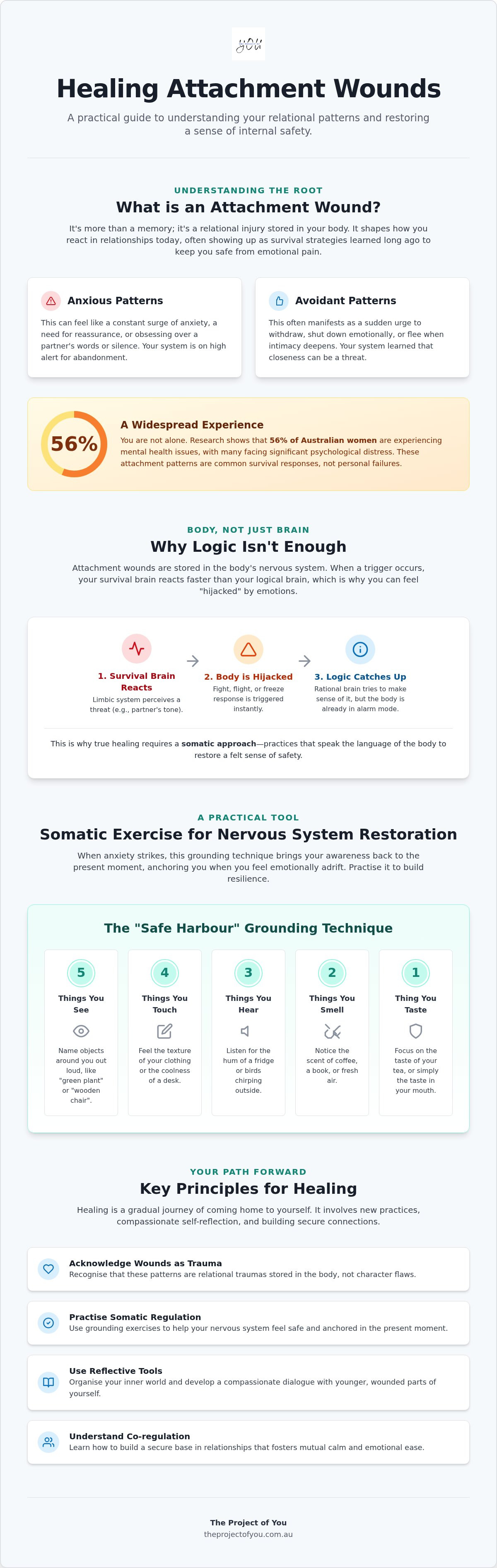
An attachment wound is more than just a difficult memory of a parent or a past partner. It's a relational injury that settles into the very fabric of your being, influencing how you perceive safety and connection today. Think of it as a bruise on the soul that hasn't quite had the chance to heal. When we talk about attachment wound healing exercises, we're looking at ways to reach those deep-seated places where the body still carries the weight of old hurts. These wounds often show up as "anxious" or "avoidant" behaviours. Perhaps you find yourself constantly checking your phone when a partner is quiet, or maybe you feel a sudden, cold urge to shut down when someone gets too close.
It's vital to realise that these patterns aren't character flaws or signs that you're "bad" at relationships. They are survival strategies. You're certainly not alone in this experience either. Research released in August 2026 shows that 56% of Australian women are experiencing mental health issues, with many facing significant psychological distress. At some point in your history, your nervous system learned that these responses kept you safe from emotional pain or neglect. While your mind might understand that your current partner is trustworthy, your body remembers a different story. This physiological memory is why you might feel "hijacked" by your emotions even when you know, logically, that you're safe.
The Anatomy of a Relational Injury
What distinguishes a simple disagreement from an attachment wound? A conflict is often about a specific event, but a wound is about the relationship's foundation. It's the feeling of being fundamentally unseen, unprotected, or unwanted. Triggers like perceived criticism or a partner's emotional withdrawal can send your system into a tailspin. Take a moment to reflect. When does your body first signal that you're unsafe? Is it a tightening in your chest or a hollowness in your stomach? Recognising these signals is the first step toward change.
Why Traditional Talk Therapy Often Falls Short
Many people spend years in talk therapy, gaining incredible insight into their past, yet they still find themselves reacting in the same old ways. This happens because attachment wounds are stored in the limbic system and the brainstem, areas that don't always respond to logic. When your amygdala perceives a threat to your connection, it triggers a "fight, flight, or freeze" response before your rational brain can even join the conversation. Understanding the "why" is a great start, but true restoration requires a somatic approach. This is why somatic attachment wound healing exercises are so effective; they speak the language of the body. You can explore more about how trauma dysregulates your nervous system on our blog, where we discuss how the body organises itself around past injuries.
Somatic Exercises for Nervous System Restoration
Your nervous system is the silent architect of your relationship security. While thoughts and feelings are the visible decor, the state of your physiology is the foundation. When your system is chronically dysregulated, it's nearly impossible to feel secure with another person. However, through consistent attachment wound healing exercises, you can cultivate what psychologists call "earned secure attachment". This is the process of building a sense of internal safety that you might not have received in childhood. Safety is felt, not just thought. Think of these somatic practices as daily hygiene for your emotional health. Just as you brush your teeth to maintain physical health, these tools keep your nervous system resilient. Remember that these exercises should never feel forced. If at any point you feel overwhelmed, give yourself permission to stop. That is your exit point, and honouring it is a form of self-compassion.
Exercise: The "Safe Harbour" Grounding Technique
When relational anxiety strikes, your focus often narrows to the source of the perceived threat. You might obsess over a partner's tone or a delayed text. Grounding pulls your awareness back to the immediate environment, helping you unhook from the spiral. This adapted sensory technique is designed to anchor you when you feel emotionally adrift.
5 things you see: Look around and name objects out loud, such as a green plant or a wooden chair.
4 things you can touch: Feel the texture of your clothing or the coolness of a desk.
3 things you hear: Listen for the hum of a fridge or birds outside.
2 things you smell: Notice the scent of your coffee or the air in the room.
1 thing you can taste: Sip some water or notice the lingering taste of a mint.
"Grounding is the act of reminding your nervous system that you are here, you are breathing, and you are currently safe."
Vagus Nerve Toning for Emotional Ease
The vagus nerve is a major highway between your brain and your body. It plays a crucial role in the "rest and digest" system. By using your voice, you can send a physical signal to your brain that the "threat" has passed. Try the "voo" breath: take a deep inhale, and on the exhale, make a low, vibrating "voooo" sound. Feel the vibration in your chest and belly. This simple shift can move you out of a fight or flight state and back into a place of social engagement and calm. For those seeking deeper, structured support, exploring professional Nervous System Restoration can provide a more personalised path toward lasting ease.
Healing is rarely a straight line, and having a guide can make the journey feel more manageable. If you find these patterns are difficult to shift on your own, you might consider booking a session to explore these tools in a supported, compassionate environment.
Reflective Exercises to Organise Your Inner World
While somatic work settles the storm in your body, reflective exercises help you understand why the storm started in the first place. It's helpful to think of your mind as a collection of different "parts" that have developed over time. Some parts of you are capable, adult, and wise. Other parts might feel like a younger version of yourself, still reacting to old echoes of neglect, criticism, or inconsistency. In the context of attachment wound healing exercises, we often refer to this as the "Inner Child" or "Younger Self". This isn't just a metaphor; it's a way to describe the neurological pathways formed when you were small and vulnerable. When you feel that familiar sting of rejection, it's often this younger part of you that is speaking. Self-compassion is the essential antidote here. It acts as a soothing balm for the shame that tells you your needs are "too much" or that you are "unloveable". Keeping a dedicated journal allows you to observe these patterns from a distance, turning reactive moments into opportunities for growth.
Exercise: The "Letter to the Protector" Journal Prompt
Many of us have a "Protector" part that either clings tightly to others or pushes them away to avoid being hurt. Instead of fighting this part, try to meet it with curiosity. Grab your journal and write a letter to the part of you that reacts most strongly during relational conflict. Ask it, "What are you trying to protect me from right now?" You might find it's trying to save you from the pain of abandonment or the weight of being controlled. Thank this part for its service. It has worked hard to keep you safe for a long time. Once you've acknowledged its effort, gently remind it that you are an adult now. You have more resources and agency than you did when these wounds first formed. This shifts you from being overwhelmed by the emotion to witnessing it with a sense of calm authority.
Mapping Your Attachment Triggers
A powerful way to organise your inner world is by mapping your triggers. This moves you from a place of confusion to one of clarity. Use a simple "Trigger -> Body Sensation -> Story" framework to deconstruct your reactions. For example, if your partner is late coming home (Trigger), you might notice a tight, cold sensation in your chest (Sensation). Your mind then creates a narrative: "They don't value my time, and this is the beginning of them pulling away" (Story). By naming the story, you can begin to question its accuracy. Is the story a fact, or is it a protective response from your past? For those looking for more structured templates, our Self Love e-books provide a gentle path to help you navigate these reflections with ease.
Interpersonal Exercises for Healing Within Relationships
Healing doesn't happen in a vacuum. While the individual work we've discussed is the bedrock of restoration, attachment is, by its very nature, a relational experience. To truly shift old patterns, we often need a "secure base" in another person, someone who provides the safety needed to explore our vulnerabilities. This is where co-regulation becomes your most valuable tool. Co-regulation is the process by which two people help each other find calm and return to a state of physiological safety. These attachment wound healing exercises are designed to be practised with a partner who is safe, willing, and equally committed to growth. It's about moving from a "you versus me" dynamic to a "us versus the pattern" perspective, allowing the relationship itself to become the container for healing.
Gentle Openings and Connection Rituals
Most relationship conflicts are decided in the first few minutes of a conversation. Using a gentle start-up involves leading with your own feelings and a positive need rather than a criticism. Instead of saying, "You're always late," you might try, "I feel a bit anxious when the schedule changes; could we check in earlier next time?" This approach invites your partner in rather than triggering their defensive "fight or flight" response. Beyond conflict, daily connection rituals are essential for long-term health. Try spending ten minutes each evening in quiet connection, perhaps through undistracted eye contact or gentle touch. These small, consistent moments build "relational capital," a reservoir of goodwill that makes it much easier to navigate the inevitable storms of life.
Exercise: The "Pause and Pivot" for Couples
When a conversation starts to feel like a "spin", where heart rates rise and logic disappears, the most loving thing you can do is stop. The Pause and Pivot is a three-step framework to prevent further injury. First, recognise the spin. Notice when your chest tightens or your partner's voice changes. Second, take a somatic break. Move to different rooms for at least twenty minutes to allow your nervous systems to settle. During this time, use the grounding tools we covered earlier. Third, re-engage with curiosity. Ask, "What was happening for you just then?" rather than "Why did you say that?" It's vital to frame the pause as an act of protection for the relationship, not a withdrawal or abandonment. If you find the "spin" happens too quickly to catch, choosing couples counselling can provide a neutral space to learn these shifts with a professional facilitator.
Navigating Your Path to Secure Attachment
The journey of integrating attachment wound healing exercises into your daily life is, at its heart, a process of coming home to your true self. It's about peeling back the protective layers you've worn for years and discovering that you are fundamentally worthy of safety and belonging. Secure attachment isn't a static destination or a fixed prize you win. Instead, it's a dynamic way of relating that is grounded in internal safety and self-awareness. It's the capacity to remain connected to your own needs even when the people around you are struggling. This shift doesn't happen overnight, but with patience and the right tools, it's entirely possible to move from a place of chronic anxiety or withdrawal toward a life of emotional ease and secure connection.
Azita Abdollahian and the team at The Project of You act as a compassionate partner in this transformation. We understand that healing requires more than just logic; it requires a felt sense of safety in the presence of another. By combining clinical social work with deep, intuitive empathy, we help you navigate the complexities of your history. Our goal is to help you build a internal landscape where you feel supported, heard, and capable of fostering healthy intimacy. Secure attachment is a skill that can be learned, and every step you take toward regulation is a step toward a more fulfilling life.
When to Seek Professional Restoration
While self-guided tools are invaluable, there are times when the path feels too steep to navigate alone. If you find that your nervous system remains in a state of high alert despite your best efforts, it may be time to seek the supported container of a therapeutic relationship. This is particularly true if you're dealing with deep-seated relational trauma that feels overwhelming to process in isolation. Professional restoration can provide the structure and safety needed to unearth and heal these old wounds. For those who feel ready for a more immersive and accelerated experience, our intensive programs offer a focused environment to address attachment at a physiological level. You can learn more about our Private Retreats to see if this dedicated approach is the right fit for your current season of growth.
A Final Note on Self-Compassion
Please be gentle with yourself as you move through this process. Healing happens in layers, and some days will naturally feel more regulated than others. It's helpful to celebrate the small wins, like noticing a trigger before you react or choosing to take a grounding breath when you feel a surge of anxiety. These moments are evidence of your nervous system's incredible capacity for change. Your past does not have to dictate your future, and your survival strategies were only ever an attempt to keep you safe. If you're feeling ready to take the next step in your journey toward secure attachment, we invite you to contact us. Whether you're looking for individual counselling or a group experience, we're here to help you find your way back to ease.
Embracing a Future of Relational Ease
Healing your attachment history is a profound act of self-care that begins with the body. By integrating attachment wound healing exercises into your daily rhythm, you've started the essential work of reorganising your nervous system for safety. You now understand that your reactions are survival strategies, not character flaws, and that co-regulation with a safe partner can serve as a powerful bridge to secure connection. This restoration is possible for everyone, regardless of how long you've felt stuck in old loops. It's a journey of layers, and every moment of regulation is a victory.
At The Project of You, Azita Abdollahian provides the evidence-informed clinical expertise and trauma-informed care needed to support this deep work. We specialise in Nervous System Restoration, offering a compassionate Australian space where you can move through these transitions at your own pace. Whether you're navigating the pain of betrayal or simply seeking deeper intimacy, you don't have to walk this path alone. Professional guidance can provide the steady presence required to transform insight into lasting change.
Begin your journey to relational ease—book a session with Azita today Your nervous system has a remarkable capacity for change and growth. Trust the process, celebrate your small wins of regulation, and know that a more connected, grounded version of yourself is already beginning to emerge with every intentional breath.
Common Questions About Healing Attachment Wounds
Can attachment wounds really be healed in adulthood?
Yes, attachment wounds can absolutely be healed in adulthood through a process known as neuroplasticity. While your early experiences shaped your initial wiring, your brain remains capable of forming new, more secure pathways throughout your life. This is often called "earned secure attachment". By consistently practising attachment wound healing exercises, you can rewire your physiological responses to intimacy, moving from a state of chronic defence to one of genuine safety and connection.
How long does it take to heal an anxious attachment style?
There is no fixed timeline for healing, as every nervous system has its own unique rhythm. For some, significant shifts in emotional regulation can occur within months of dedicated somatic and reflective work. For others, it is a gradual unfolding over years. Healing isn't about reaching a perfect finish line where you never feel anxious again. Instead, it's about developing the capacity to recognise your triggers and return to a state of calm more quickly.
What are the most effective exercises for avoidant attachment?
Effective exercises for avoidant patterns often focus on safely increasing your tolerance for emotional and physical closeness. Somatic tracking is particularly helpful; it involves noticing the subtle shut down signals in your body before you actually withdraw. Practising small, low stakes moments of vulnerability with a trusted person can also help. The goal is to teach your nervous system that intimacy doesn't have to mean a loss of autonomy or a threat to your safety.
Is it possible to heal attachment wounds while single?
You can certainly begin the healing process while single by focusing on your relationship with yourself. This is an ideal time to explore attachment wound healing exercises that build internal security and self-compassion. By learning to regulate your own nervous system and understanding your historical triggers, you create a solid foundation. This preparation ensures that when you do enter a relationship, you are doing so from a place of self-awareness rather than old survival instincts.
How does nervous system regulation help with relationship anxiety?
Relationship anxiety is often a physiological false alarm triggered by the amygdala. Nervous system regulation helps by calming the body's survival response before it spirals into obsessive thoughts or frantic behaviours. When you use tools like vagus nerve toning or grounding, you signal to your brain that you are currently safe. This physiological shift allows your rational mind to stay online, making it much easier to communicate your needs clearly instead of reacting from fear.
What should I do if my partner isn’t willing to do these exercises?
While co-regulation is ideal, you can still make significant progress by focusing on your own internal landscape. When you change how you respond to triggers, you naturally shift the dance of the relationship. Your increased calm can often have a soothing effect on a partner, even if they aren't actively participating in the exercises. If a partner's behaviour is consistently dismissive, it may be helpful to explore individual counselling to clarify your own boundaries and needs.
Can childhood attachment wounds affect my parenting?
Childhood wounds often manifest in parenting as old hurts that influence how you respond to your child's emotions. If you didn't feel seen as a child, you might find it challenging to sit with your child's distress without feeling overwhelmed or reactive. Healing your own attachment history is one of the greatest gifts you can give your children. It allows you to provide the consistent, attuned presence they need to develop their own sense of secure attachment.
How do I know if I am making progress in my healing?
Progress is often seen in the recovery time after a trigger. You might notice that you don't stay upset for as long, or that you can catch a defensive reaction before you act on it. Other signs include a greater sense of ease in your body and an increased ability to set healthy boundaries. When you start to view your struggles with curiosity rather than shame, you'll know you are moving toward a more secure way of being.


Comments