.png)

Psychedelic Assisted Therapy in Australia: Your Questions Answered
- Azita Abdollahian

- 15 hours ago
- 13 min read
What if the emotional walls that have kept you feeling stuck for years aren’t permanent?
For many people, traditional talk therapy can provide valuable insight and support, yet there are times when understanding your past doesn’t necessarily translate into feeling different in your body. You may know exactly where your patterns come from and still find yourself caught in the same cycles of fear, disconnection or chronic stress.
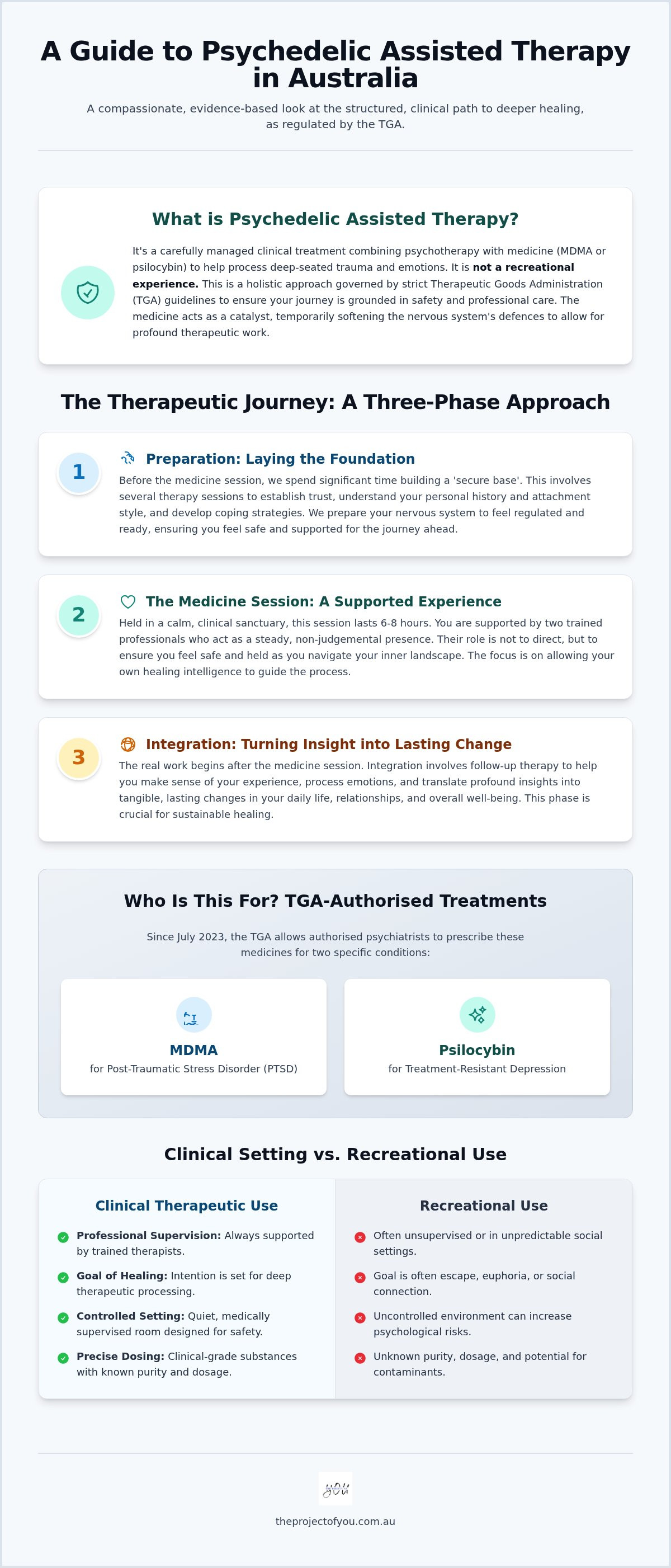
This has led to growing interest in psychedelic-assisted therapy in Australia. Since 1 July 2023, the Therapeutic Goods Administration (TGA) has permitted specifically authorised psychiatrists to access MDMA for post-traumatic stress disorder (PTSD) and psilocybine for treatment-resistant depression under the Authorised Prescriber Scheme. However, these remain unapproved therapeutic goods, and access is subject to strict clinical and regulatory requirements.
As a psychotherapist, trauma expert and founder of The Project Of You, Azita Abdollahian approaches emerging approaches to mental health with a trauma-informed and evidence-informed perspective. The focus is not on psychedelic substances as a quick fix, but on the therapeutic framework surrounding them—including careful assessment, preparation, professional supervision and integration.
In this guide, Azita explores how psychedelic-assisted therapy works in Australia, who may be eligible, what the current TGA framework means, how psychedelic therapy differs from recreational psychedelic use, and the role of nervous system regulation and therapeutic integration in the healing process.
If you feel curious but cautious, that is completely understandable. Any emerging therapeutic approach deserves careful consideration, particularly when it involves powerful psychological experiences. The aim is not to tell you whether psychedelic-assisted therapy is right for you, but to give you the information you need to approach the subject with greater clarity, context and informed awareness.
Deep healing is not about forcing yourself to revisit what hurts. It is about creating the safety, support and capacity to meet your experiences differently.
Table of Contents
What is Psychedelic Assisted Therapy in the Australian Context?
Think of a locked door that you've been trying to open for years. You have the key, but the lock is rusted shut by time and trauma. In this context, Psychedelic therapy acts as the oil that loosens the mechanism, allowing the key to finally turn. In Australia, psychedelic assisted therapy is a carefully managed clinical treatment that combines pharmacological support with intensive psychotherapy. It's a partnership between medicine and mind, governed by strict TGA guidelines to ensure every step you take is grounded in safety. It's about more than just a biological response; it's a holistic approach to reclaiming your sense of self, one that prioritises your emotional stability above all else.
The medicine itself isn't a cure in the traditional sense. It's a catalyst for the real work. Since July 1, 2023, Australia has pioneered this path by reclassifying MDMA for treating PTSD and psilocybin for treatment-resistant depression. These medicines temporarily soften the rigid defences of your nervous system. This opening makes it possible to access and process memories or emotions that usually feel too painful to touch. This happens within a therapeutic container, a professional, nurturing space where your safety is the absolute priority. The medicine opens the door, but the psychedelic assisted therapy is what allows you to walk through it and find your way home.
How it Differs from Recreational Use
Many people wonder how this clinical process differs from what they might have heard about recreational experiences. The difference is found in set and setting. In a clinical environment, your mindset is gently prepared over several weeks, and the setting is a quiet, medically supervised room. We use clinical-grade substances with 100% purity and precise dosing. You're never alone; you're held in a space of professional care where the goal is healing, not escape. This ensures that even if challenging emotions arise, you have the support needed to move through them safely.
The Role of the Therapeutic Alliance
Trust is the most powerful tool in the room. This connection is what allows you to feel safe enough to navigate difficult memories. Your practitioner acts as a compass, staying by your side through every wave of emotion to ensure you stay on course. Choosing a trauma informed counsellor ensures your history is respected and the pace is always right for your nervous system. This alliance is the foundation of your recovery, providing the steady presence you need to explore your inner landscape with confidence and grace.
The Three Phases of the Therapeutic Journey
Healing is rarely a straight line. It's more like a carefully planned expedition where every stage matters. When we talk about psychedelic assisted therapy, it's easy to focus solely on the "medicine day," but that's only one part of a much larger, intentional process. To ensure your safety and the longevity of your recovery, the journey is broken into three distinct phases: preparation, the acute experience, and integration. Skipping any of these is like trying to build a home on sand; without a solid foundation and a finishing roof, the structure simply won't hold against the elements of daily life.
Preparation: Laying the Foundation
Before you ever encounter the medicine, we spend significant time laying the groundwork. This isn't just about logistics. It's about building a "secure base" with your therapists. We look at your unique attachment styles to understand how you might reach out for support when things feel intense. We also develop practical coping strategies for the emotional "weather" that might arise during your session. Think of this as packing your bag with the right tools before a long hike. We want your nervous system to feel regulated and ready. Take a moment to sit with this reflective question: "What is the one thing your heart needs to explore right now?"
The acute experience, or the dosing session, takes place in a calm, clinical sanctuary. You'll usually be in a comfortable room with soft lighting and curated music, supported by two trained professionals. These sessions typically last between six to eight hours. During this time, the therapists aren't there to direct your experience. Instead, they act as a steady, non-judgmental presence, ensuring you remain safe and held as you navigate your inner landscape. Their role is to provide the psychological safety required for you to go deep into your own healing process.
Integration: Bringing the Insights Home
If preparation is the map and the session is the journey, integration is the process of unpacking your bags and deciding where your new realisations belong. This is where the real transformation takes root. We often use somatic practices and nervous system restoration therapy to help your body "digest" the insights gained. It's not enough to have a sudden breakthrough; we need to turn those moments into lasting changes in how you communicate, set boundaries, and relate to those you love.
This final phase can take weeks or even months. It's a slow, beautiful unfolding. By honouring each step, you ensure that the shifts you experience aren't just fleeting feelings, but a permanent part of your emotional landscape. If you feel ready to explore what this structured journey could look like for you, I invite you to book a time for us to talk about your path toward recovery.
Safety, Control, and Your Nervous System
The question I hear most often is simple yet profound: "Will I lose control of myself?" It's a completely natural fear. When we've spent years building emotional walls to keep ourselves safe, the idea of lowering them can feel terrifying. However, in the clinical framework of psychedelic assisted therapy, we aren't looking for a loss of control. We're looking for a supported release. By using carefully measured doses in a secure environment, we create a space where your brain can move beyond its usual rigid patterns. This is where neuroplasticity comes in. It's the brain's remarkable ability to create new pathways, allowing you to bypass those old, painful loops that keep you feeling stuck in the past.
From a biological perspective, this process works within what we call your "Window of Tolerance." This is the space where you can process difficult emotions without becoming overwhelmed or shutting down. Polyvagal theory teaches us that healing happens when the nervous system feels safe enough to venture out of its defensive states. During your session, your physical safety is also a constant priority. A medical professional provides clinical oversight, monitoring your heart rate and blood pressure to ensure your body remains as relaxed as your mind. You're never left to navigate these waters alone; you're held by a team dedicated to both your physical and emotional wellbeing.
Understanding the 'Bad Trip' Myth
We often need to reframe the idea of a "bad trip." In a therapeutic setting, we prefer to call these "challenging experiences." These are moments where difficult emotions or memories surface because they're finally ready to be seen. Instead of running away, your therapist helps you gently walk towards these thoughts. It's in this meeting that the deepest processing occurs. If you're curious about other misconceptions, you might find it helpful to read about psychedelic therapy myths to gain more clarity on the clinical reality.
Nervous System Regulation as a Prerequisite
I believe that regulating your nervous system is an essential first step before even considering this path. Think of it like a stressed-out computer that keeps freezing. You can't run new, complex software until you've cleared the underlying system errors. We use grounding techniques to ensure you have a "reset button" you can rely on. By building these skills early, you ensure that you have the internal resources to stay anchored during and after your session, making the entire experience more effective and deeply restorative.
Is Psychedelic Assisted Therapy Right for You?
Choosing a path for your healing is a deeply personal decision. It requires a balance of quiet hope and careful, clinical consideration. While psychedelic assisted therapy has shown remarkable promise, it's not a one-size-fits-all solution. It's designed for those who have found themselves at a difficult crossroads, where traditional methods haven't quite reached the depths of their pain or provided the lasting ease they seek. If you've been living with the heavy weight of treatment-resistant depression or the persistent, exhausting echoes of PTSD, this clinical approach offers a different way to engage with your story. It's about moving from simply managing your symptoms to addressing the root causes of your distress.
For those facing a terminal illness, this therapy can also offer a profound sense of peace and meaning during a time of significant end-of-life anxiety. However, safety must always be our guiding star. There are certain situations where this treatment isn't suitable, such as a personal or family history of psychosis, specific heart conditions, or during pregnancy. We always conduct a thorough screening process to ensure that your physical and psychological health are protected at every stage of the journey. This isn't about exclusion; it's about ensuring that every step you take is a safe one.
The 'Treatment-Resistant' Label
In the Australian healthcare system, being "treatment-resistant" usually means that at least two different courses of traditional medication or therapy haven't provided the relief you deserve. It can feel like a discouraging label, like a door that refuses to budge no matter how hard you push. We see it differently; it's a signal that your system simply needs a different language for healing. A comprehensive assessment by a qualified psychotherapist is an essential first step. We look past the clinical label to see the person underneath, evaluating your unique history, your attachment style, and your current emotional stability with deep empathy and professional rigour.
The Role of Commitment
It's important to understand that psychedelic assisted therapy is not a "magic pill" that does the work for you. It's more like a doorway; you still have to be the one to walk through it. This path requires active participation, emotional bravery, and a willingness to stay with difficult feelings as they arise. We'll assess your current level of support and stability together to make sure you have the "scaffolding" needed for this deep work. This process isn't just about the medicine sessions; it's about the dedication you bring to the preparation and integration phases. Take a moment to sit with this: "Are you ready to sit with the parts of yourself that have been hidden?"
Moving Forward: How The Project of You Supports Your Journey
At The Project of You, we believe that healing is a deeply personal craft. Azita Abdollahian, our founder and a dedicated Clinical Social Worker, has designed an approach that marries clinical rigour with a profound sense of empathy. We don't see you as a set of symptoms to be fixed; we see you as a whole person with a unique history and a nervous system that is seeking restoration. By integrating psychedelic assisted therapy into our existing trauma-informed care, we provide a structured yet gentle path toward recovery. This isn't just about one breakthrough moment. It's about how that moment ripples out into your life, your body, and your most cherished relationships.
Our work often involves looking at how individual healing impacts the collective. We frequently weave couple counselling into the integration process, helping partners understand and support the profound emotional shifts that can occur. By taking a holistic view of the mind, body, and nervous system, we ensure that the progress you make is sustainable and grounded. Whether you are navigating complex trauma or seeking a way through long-term depression, we are here to walk beside you with patience and expert guidance. We invite you to reach out for a discovery call to explore how we can support your unique path to healing.
A Trauma-Informed Framework
Safety is the foundation of everything we do. We draw upon the wisdom of Gottman and Attachment theories to create a space where you feel truly seen and understood. This is our "cup of tea" philosophy: a belief that the most profound healing happens within the warmth of human connection. We prioritising your emotional safety, ensuring that the pace of therapy always respects your internal boundaries. You are a human being with a story worth telling, not a diagnosis to be managed. Our commitment is to provide a non-judgmental sanctuary where you can explore your inner world with confidence.
Beyond the Session
Growth doesn't stop when you leave the therapy room. To support your ongoing evolution, we offer resources like our Self Love e-Books, which provide practical tools for self-compassion and regulation. For those who find strength in shared experiences, our workshops and retreats offer a chance to connect with a community focused on healing and restoration. These offerings are designed to nurture the seeds of change planted during your psychedelic assisted therapy sessions, helping them grow into a life of greater ease and intimacy. We are here to partner with you at every stage of your development.
Your Path Toward Deep Emotional Restoration
Walking through the complexities of deep emotional healing can feel like navigating a dense forest without a map. We've explored how psychedelic assisted therapy in Australia offers a highly structured, clinical framework designed to help you find your way back to a sense of wholeness. By honouring the three phases of preparation, dosing, and integration, you ensure that the insights gained aren't just fleeting moments, but the beginning of a genuine transformation. It's about creating a safe space where your nervous system can finally let go of the rigid patterns that no longer serve you.
Choosing this path is an act of profound self-compassion. Azita Abdollahian combines her expertise as a qualified Social Worker and Psychotherapist with a deep focus on nervous system restoration to ensure your experience is evidence-based and trauma-informed. You're a human being with a unique story, and your recovery deserves a gentle, expert hand to guide it. You don't have to carry the weight of being "stuck" on your own any longer.
Book a consultation with Azita to explore your healing journey You deserve a life where you feel regulated, connected, and deeply at peace with yourself. We look forward to sitting with you as you begin this next chapter of your growth and restoration.
Frequently Asked Questions
Is psychedelic assisted therapy legal in Australia?
Yes, since July 1, 2023, the Therapeutic Goods Administration (TGA) has reclassified psilocybin and MDMA as Schedule 8 medicines. This means they can be legally prescribed by authorised psychiatrists for specific conditions. MDMA is approved for treating post-traumatic stress disorder (PTSD), while psilocybin is utilised for treatment-resistant depression. Outside of this strictly regulated clinical framework, these substances remain illegal. It is a path designed for those who haven't found relief through traditional treatments.
What does a typical session feel like?
A session feels like a deeply focused, internal journey held within a sanctuary of clinical safety. Unlike a recreational experience, you're supported by two trained therapists who provide a steady, non-judgmental presence throughout. You might wear an eye mask and listen to curated music to help you turn your attention inward. Many describe it as a softening of emotional defences, allowing you to view your life's challenges with more compassion and significantly less fear than usual.
How many sessions will I need to see a difference?
Most clinical protocols involve two or three dosing sessions, but the full journey includes many more preparation and integration meetings. Our approach to psychedelic assisted therapy is not a one-off event; it's a comprehensive process. The real difference is often felt during the integration phase, where you work with your therapist to turn insights into lasting habits. Every nervous system is unique, so the exact number of sessions is tailored to your specific healing pace.
Can I do this therapy if I am already taking antidepressants?
You may need to taper off certain antidepressants before beginning, as they can interfere with how the medicine works. This is a delicate process that must be managed by your prescribing doctor or psychiatrist. We conduct a thorough medical review to understand your current medications and history. Safety is our priority, so we ensure your system is clear and ready to engage with the therapy without any pharmacological complications that could dampen your therapeutic results.
What is the difference between psilocybin and MDMA therapy?
Psilocybin is primarily used for treatment-resistant depression and often facilitates a more visionary, reflective experience. MDMA is authorised for PTSD and typically helps by reducing the fear response in the brain's alarm system, making it easier to process traumatic memories without becoming overwhelmed. Both aim to increase neuroplasticity, but they offer different emotional qualities. We help you explore which path aligns best with your specific therapeutic goals and your history of nervous system regulation.
How do I find a qualified practitioner for PAT in Australia?
You should start by speaking with your GP, who can provide a referral to a psychiatrist approved under the TGA's Authorised Prescriber scheme. It's important to look for professionals who are AHPRA-registered and have specific training in psychedelic assisted therapy. At The Project of You, we work alongside authorised prescribers to provide the essential psychological support and integration, ensuring you have a multidisciplinary team that understands the complexities of trauma and restoration.
What happens if I have a 'bad trip' during the session?
In a clinical setting, we reframe these as "challenging sessions" rather than bad trips. If difficult emotions or memories surface, your therapists are right there to help you stay grounded and safe. They use specific techniques to help you breathe through the intensity and "walk towards" the fear rather than running from it. This supported processing is often where the most significant breakthroughs happen, as you learn that you can navigate hard things safely.
Is this therapy covered by Medicare or private health insurance?
Currently, Medicare does not cover the cost of the medicine itself, though rebates may be available for the psychiatric and psychological consultations involved. Some private health insurers are beginning to explore pilot programs to help subsidise costs, but this varies significantly between providers. Because the treatment requires intensive, multi-hour sessions with two therapists, the out-of-pocket costs remain a significant consideration. We recommend checking with your individual fund for their most current policies and pilot programs.


Comments