.png)

Parenting Support Therapy in Australia: A Compassionate Guide to Restoring Your Capacity
- Azita Abdollahian

- 10 minutes ago
- 12 min read
What if the reason you feel so depleted as a parent isn’t a lack of effort, patience or discipline, but a nervous system that has simply run out of capacity?
Parenting can be deeply rewarding, but it can also push you beyond your emotional and physical limits. When you’re exhausted, overwhelmed and constantly managing the needs of your family, even the smallest challenge can feel impossible. You may find yourself reacting in ways you later regret, followed by guilt and the fear that you’re not being the parent you want to be.
As a psychotherapist and trauma expert, Azita Abdollahian helps parents understand the connection between parental burnout, nervous system regulation, trauma and the parent-child relationship. Rather than focusing only on behavioural strategies, Azita’s trauma-informed approach explores what is happening beneath the behaviour and how restoring your own capacity can transform the way you respond to your child.
This is where parenting support therapy in Australia can offer something deeper than traditional parenting advice. When your nervous system is overwhelmed, knowing what you “should” do isn't always enough. You need practical tools that help you regulate, reconnect and respond from a place of greater emotional capacity.
In this guide, Azita explores how nervous system regulation can support parents through periods of exhaustion and overwhelm, strengthen secure attachment with your child, and help you move from reactive parenting toward calmer, more connected responses.
You don't need to become a perfect parent. You need the support, tools and capacity to become the parent you already want to be.
Table of Contents
What is Parenting Support Therapy in Australia?
Imagine sitting down for a quiet moment where the focus isn't on fixing your child, but on nurturing you. In its truest form, parenting support therapy Australia is a collaborative, non-judgemental space designed to help you explore your own internal landscape. It’s about understanding your triggers and expanding your emotional capacity. Unlike traditional "parent training" which often treats you like a manager, this therapeutic approach prioritises the parent-child relationship and the creation of emotional safety. It recognises that you are a human being first and a parent second.
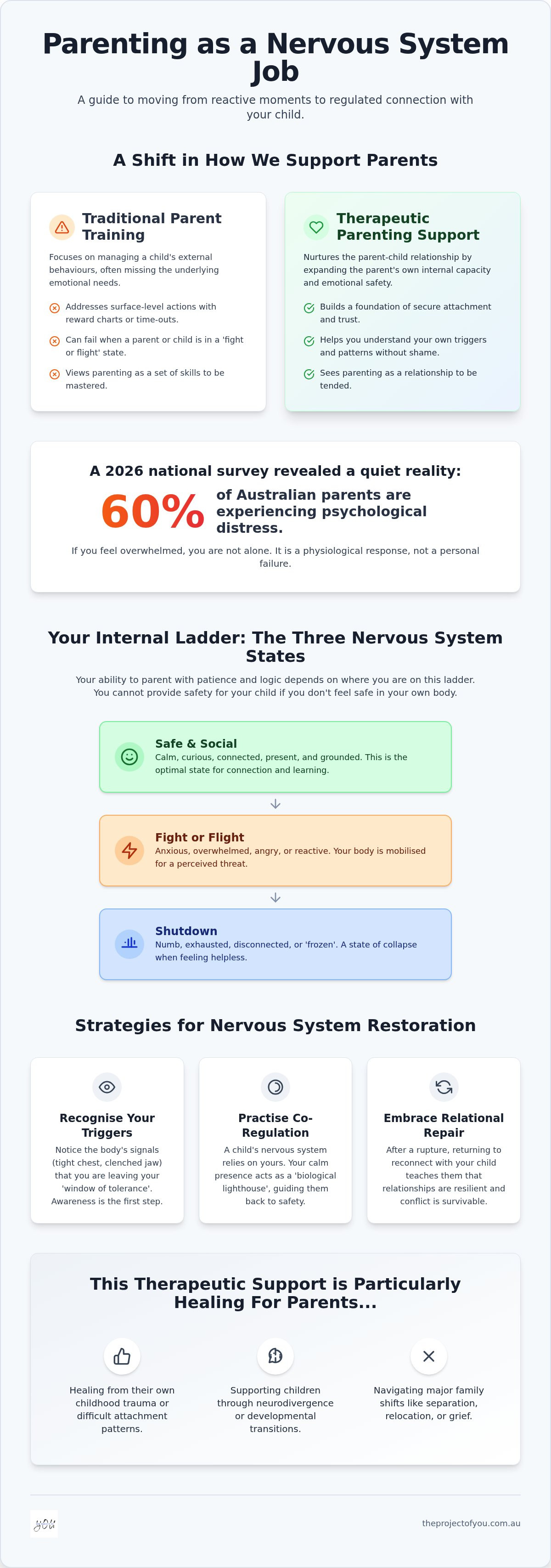
By 2026, the Australian landscape of care has shifted significantly toward trauma-informed and attachment-based models. We've moved away from looking at parenting as a set of skills to be mastered and instead see it as a relationship to be tended. A 2026 national survey of 10,000 Australian parents revealed that almost 60% are experiencing psychological distress. If you feel overwhelmed, you aren't alone. Seeking support is an act of profound courage and love for your family, not a sign of failure. It’s about building a solid foundation for Parenting that lasts a lifetime.
Moving Beyond Behavioural Tips
Why do reward charts or time-outs so often fail when things get heated? It's usually because these tools address the surface level while the nervous system is in a state of "fight or flight." If a child or a parent is dysregulated, no amount of logic will stick. Therapy allows us to look "under the hood" at the emotional needs driving difficult behaviours. It provides a gentle mirror for your parenting style, helping you see patterns without the weight of shame. When we understand the "why" behind the "what," we can respond with intention rather than reacting out of habit.
Who Can Benefit from Parenting Counselling?
You don't need to be in a crisis to reach out. Many parents find themselves in "the fog" of early childhood or navigating the unpredictable storms of adolescence and simply need a steady hand. Whether you are dealing with daily power struggles or deeper systemic issues, parenting support therapy Australia provides the structure needed to find your way back to yourself. This work is particularly healing for those who are:
Healing from their own childhood trauma or "anxious attachment" patterns.
Supporting children through neurodivergence or developmental transitions.
Managing major family shifts like separation, grief, or relocation.
At The Project of You, we see parenting counselling as a partnership. It's a way to move through transitions with more grace and less grit, ensuring you have the capacity to be the parent you truly desire to be.
Parenting as a Nervous System Job
Have you ever noticed that when your child starts to spiral, your own heart begins to race before you've even processed what’s happening? This is because parenting is, at its core, a nervous system job. To understand this, we can look at the "ladder" of our nervous system states, a concept from Polyvagal Theory. At the top of the ladder, we feel safe, curious, and connected. When we're pushed into the middle, we enter a state of "fight or flight," and at the very bottom, we might feel numb, exhausted, or shut down. You simply cannot reason with a child when your own body is stuck in a middle-ladder state of survival.
Nervous System Restoration is the process of returning the body to a state of safety and social engagement.
Recognising Your Own Triggers
What happens in your body when your child screams or ignores you? For many, it starts with a tightening in the chest, a clenched jaw, or a sudden urge to flee the room. These are signals that you've been pushed outside your "window of tolerance," that optimal zone where you can handle stress without becoming overwhelmed. It's vital to normalise the "touched out" feeling many Australian parents experience. This isn't a moral failing or a lack of love. It is a physiological survival response to prolonged sensory and emotional demand.
When you are outside your window of tolerance, your prefrontal cortex, the part of the brain responsible for logic and patience, effectively goes offline. This is why parenting support therapy Australia focuses so heavily on your internal state. If you don't feel safe in your own body, it’s nearly impossible to provide a sense of safety for someone else.
The Power of Co-Regulation
A child’s nervous system is not yet fully capable of calming itself down; it relies on yours to find the way back to peace. In this way, a calm parent acts as a "biological lighthouse" for a distressed child. Even in the middle of a chaotic school morning or a grocery store meltdown, your ability to remain grounded provides the anchor they need. Practical co-regulation in daily life might look like:
Taking a deep, audible breath before responding to a spill.
Lowering your physical height to match theirs when they are upset.
Using a soft, steady tone of voice even when the environment is loud.
While community-based Parenting Support can offer wonderful peer connection, deep healing often involves looking at How Trauma Dysregulates Your Nervous System. If you feel ready to explore these patterns in a safe, guided space, you are welcome to book online to begin your journey of restoration.
Choosing the Right Parenting Support: Public vs. Private
Finding the right path through the Australian support system can feel like trying to navigate without a map. Publicly funded options, including various Australian Government parenting resources, provide a vital safety net for many families. However, there is often a significant trade-off between cost and waiting times. While public services are subsidised, they frequently involve long queues and may focus primarily on short-term behavioural management. For those seeking parenting support therapy Australia that addresses the deeper roots of family distress, private psychotherapy often becomes the preferred choice.
In 2026, many parents utilise a Mental Health Treatment Plan to access Medicare rebates for psychological support. As of 1 July 2026, the rebate for an Accredited Mental Health Social Worker is A$89.50 per session. While this helps, private fees across Australia can range from A$270 to A$295, leaving a "gap" fee. This investment often reflects the depth of care provided. Many families choose this route because they want to move beyond "behaviour-focused" programs, which might use reward charts or time-outs, toward "attachment-focused" models that prioritise emotional safety and nervous system regulation.
When searching for a therapist who can truly support your family's evolution, consider this checklist:
Are they trauma-informed and do they understand Polyvagal Theory?
Do they use evidence-informed practices rooted in attachment theory?
Do they focus on your internal state as much as your child's behaviour?
Do they offer a space that feels psychologically safe and non-judgemental?
When to Call a Helpline
Helplines like Parentline are invaluable for immediate, short-term advice. They act as a wonderful bridge when you're in the middle of a crisis and need a steady voice to help you catch your breath. These services are excellent for quick strategies or finding local referrals. However, a phone call often isn't enough for the depth of healing required to resolve long-standing attachment wounds or chronic parental burnout. If you find yourself calling repeatedly, it may be a sign that your nervous system is asking for more intensive, consistent support.
The Benefits of Private Therapeutic Support
Private support allows for the cultivation of a long-term, trusting relationship with a specific clinician. Building this bond with someone like Azita Abdollahian ensures continuity of care, which is vital when working through complex family dynamics. This consistent partnership provides a safe container for Attachment-Based Therapy in Australia. It helps you navigate the delicate process of healing your own history so it doesn't dictate your child's future. You aren't just another case number; you are a partner in a transformative process of growth.
Your Parenting Resource Kit: Strategies for Restoration
Restoration isn't a luxury you squeeze into the corners of your life; it's the very foundation of your family’s wellbeing. When we engage in parenting support therapy Australia, we aren't just looking for quick fixes. We're building a kit of somatic micro-moments that help you stay anchored when the house is loud and your patience is thin. One of the simplest yet most profound tools is the "exhale breath." By making your exhale significantly longer than your inhale, you send a direct signal to your vagus nerve that the immediate danger has passed. It’s a physiological "all clear" that you can use while standing at the kitchen bench or in the middle of a school-run meltdown.
Self-compassion is another non-negotiable skill in this kit. It involves treating yourself with the same warmth you’d offer a dear friend who is struggling. When you stop berating yourself for "losing it," you actually lower your cortisol levels, making it easier to return to a state of calm. Consider asking yourself these reflective questions during a quiet moment: What was my body trying to tell me in that heated moment? What did I actually need that I didn't get? These inquiries foster curiosity instead of shame.
Somatic Tools for In-the-Moment Calm
Grounding techniques don't need to take twenty minutes. You can press your feet firmly into the floor and notice the texture of the carpet or the coolness of the tiles; this takes less than thirty seconds but pulls you out of a mental spiral and back into your body. We also encourage looking for "glimmers," which are the opposite of triggers. A glimmer might be the way the light hits a gum tree in the backyard or the sound of a child’s genuine laugh. After a difficult parenting moment, try "shaking it off" literally. Shaking your arms and legs helps move the lingering adrenaline through your system so it doesn't get "stuck" as chronic tension.
Reframing the 'Difficult' Child
One of the most transformative shifts in parenting support therapy Australia is moving from the question "Why are they doing this to me?" to "What is their body telling me?" When we view "misbehaviour" as a cry for connection or a sign of a dysregulated nervous system, our response shifts from punishment to support. It’s about looking past the surface level. While Understanding CBT Therapy can help us reframe our thoughts, the somatic approach ensures we are also tending to the physical roots of these reactions.
The "Repair" process is perhaps the most powerful tool for long-term healing. Apologising to your child when you’ve overreacted doesn't undermine your authority; it builds profound psychological safety. It teaches them that relationships can be messy, but they can always be mended. This creates a secure attachment that lasts far beyond the childhood years.
How The Project of You Supports Australian Parents
Azita Abdollahian views parenting support therapy Australia not as a top-down instruction but as a deeply respectful partnership. What if the path to a calmer home isn't about learning more rules, but about feeling more supported? At The Project of You, we combine clinical psychotherapy with the gentle, body-based work of Nervous System Restoration. This dual approach ensures we aren't just talking about the challenges; we are actively shifting the way your body holds the stress of parenting. We work together to create paths toward a more resilient family unit, where every member feels seen and understood.
For families needing a complete reset, we offer immersive experiences like Private Couples Retreats. These intensives allow you to step away from the daily noise and focus entirely on the dynamics of your family system. It is a space to heal together, ensuring that both partners are on the same page when it comes to regulation and attachment. By stepping out of your usual environment, you create the space needed for profound transformation and the ease that comes with supported growth.
A Trauma-Informed Path to Healing
Azita helps you navigate the complex intersection where your own history meets your child’s current needs. Often, our reactions to our children are echoes of how we were once parented, creating cycles that can be difficult to break alone. By prioritising emotional safety, we allow these old patterns to soften. This work is about finding your way back to a place of agency and grace, looking past immediate obstacles to see the inherent potential within your family. To ensure this support is accessible to everyone, we provide online sessions for parents right across Australia. Whether you are in a bustling city or a regional town, you can access the same high-level parenting support therapy Australia from the comfort of your own home.
Ready to Restore Your Inner Peace?
It's never too late to repair a relationship or to start the process of restoration. Even if things feel fractured right now, there is always a path toward healing. You don't have to navigate this journey alone. We invite you to take that first courageous step toward a more peaceful home life by reaching out for a consultation. This is your invitation to move beyond survival mode and into a way of living that feels intentional and grounded. We look forward to walking this path with you.
Creating a Path Toward Lasting Family Ease
Parenting is a journey that requires deep internal capacity. It's completely natural if your well has run dry. We've explored how shifting your focus from simply managing behaviours to nurturing your own nervous system can transform the entire family dynamic. You aren't alone in this struggle. By embracing somatic tools and the profound power of relational repair, you move beyond the exhaustion of survival mode and into a space of genuine connection. Accessing professional parenting support therapy Australia provides the steady, expert guidance needed to navigate these transitions with grace.
With a grounded background in clinical social work and a commitment to evidence-based, trauma-informed care, Azita Abdollahian offers a safe harbour for your transformation. National support is ready to help you reclaim your inner peace. Whether you seek online counselling or an intensive reset, your wellbeing is the priority. This is about building a foundation that lasts.
You don't have to carry the weight of your family's emotional world alone. A brighter, more regulated future for you and your children is waiting. It's never too late to start the process of restoration.
Frequently Asked Questions
What is the difference between parenting counselling and family therapy?
Parenting counselling focuses primarily on the parent's internal state and their specific relationship with the child, whereas family therapy typically involves the whole system working together in the room. Parenting counselling provides a dedicated space for you to explore your own triggers and expand your emotional capacity. It helps you become the "biological lighthouse" for your child by prioritising your own regulation and self-understanding first.
Can I attend parenting support therapy without my child?
Yes, you can and often should attend these sessions without your child present. This allows you to speak freely about your challenges, guilt, and personal history without worrying about your child’s immediate reactions. By focusing on your own nervous system restoration in a private setting, you create a ripple effect of safety that naturally benefits your child when you return to your daily life at home.
How many sessions of parenting therapy will I need?
The number of sessions varies depending on your family's unique history and current level of distress. While some parents find significant clarity in 6 to 10 sessions, others choose longer-term support to heal deep-seated attachment wounds or navigate complex transitions. We generally recommend starting with a few consistent weekly sessions to establish a sense of psychological safety and build a foundation for deeper somatic work.
Is parenting support therapy covered by Medicare in Australia?
Yes, parenting support therapy Australia is often subsidised by Medicare when accessed under a valid Mental Health Treatment Plan. As of 1 July 2026, the rebate for a session with an eligible mental health social worker is A$89.50 for up to 10 individual sessions per calendar year. You will need a referral from your GP, psychiatrist, or paediatrician to claim these rebates for your therapeutic sessions.
What if my partner and I have different parenting styles?
Therapy is an ideal environment to bridge the gap between differing parenting styles without resorting to blame or conflict. We foster curiosity about why each partner leans toward certain methods, often uncovering how our own childhood experiences shape our current reactions. By aligning on a shared goal of emotional safety and co-regulation, you can create a unified approach that feels supportive for both parents and children.
How can I tell if my parenting stress is actually nervous system burnout?
While stress is often situational, nervous system burnout feels like a chronic state of depletion where you feel constantly "touched out" or numb. If you find yourself reacting out of pure exhaustion or feeling unable to access moments of joy, your body may be stuck in a survival state. Recognising this as a physiological response rather than a personal failure is a vital step toward reclaiming your capacity.
Can therapy help with my child's behavioural issues if they aren't in the room?
Absolutely, because a child’s nervous system relies heavily on the parent's state to find its own sense of calm. When you learn to regulate your own reactions and understand the emotional needs driving your child's actions, their behaviour often shifts in response. By changing your internal landscape, you provide the steady, regulated presence your child needs to navigate their own difficult emotions more effectively.
What should I look for in a trauma-informed parenting counsellor?
Look for a clinician who integrates Polyvagal Theory and attachment-based models into their practice. A trauma-informed counsellor will prioritise your felt sense of safety and look beyond surface-level behavioural tips to help you understand the "why" behind your family dynamics. They should act as a compassionate guide, helping you navigate your own history with self-compassion so you can show up fully for your child’s future.


Comments