.png)

Anxious Attachment Counselling: A Compassionate Guide to Healing Your Nervous System
- Azita Abdollahian

- 12 minutes ago
- 12 min read
What if the frantic “what ifs,” constant overthinking and physical panic you feel when a partner pulls away aren’t signs that you’re “too much,” but your nervous system’s attempt to protect you from the fear of abandonment?
Anxious attachment can make relationships feel exhausting. A delayed text can trigger a spiral. Emotional distance can feel like rejection. And the need for constant reassurance can leave you questioning whether something is wrong with you.
As a psychotherapist and relationship expert, Azita Abdollahian helps clients understand the deeper patterns behind anxious attachment, relationship anxiety and fear of abandonment. Through a trauma-informed approach, Azita explores how your attachment history and nervous system can shape the way you experience intimacy, conflict and connection.
If you find yourself overthinking your partner’s behaviour, struggling with uncertainty or feeling consumed by the fear of losing someone you love, anxious attachment counselling can help you understand why these patterns occur and how to change them.
In this guide, Azita explores what anxious attachment actually is, why your nervous system can become activated in relationships, and how you can move from relationship anxiety and hypervigilance toward greater emotional regulation, healthy boundaries and secure connection.
Healing isn't about fixing a flaw in who you are. It's about understanding what your nervous system has learned about love and safety—and creating a new way of relating that allows you to love without living in a constant state of alarm.
Table of Contents
Understanding the Anxious Attachment Spiral as a Survival Response
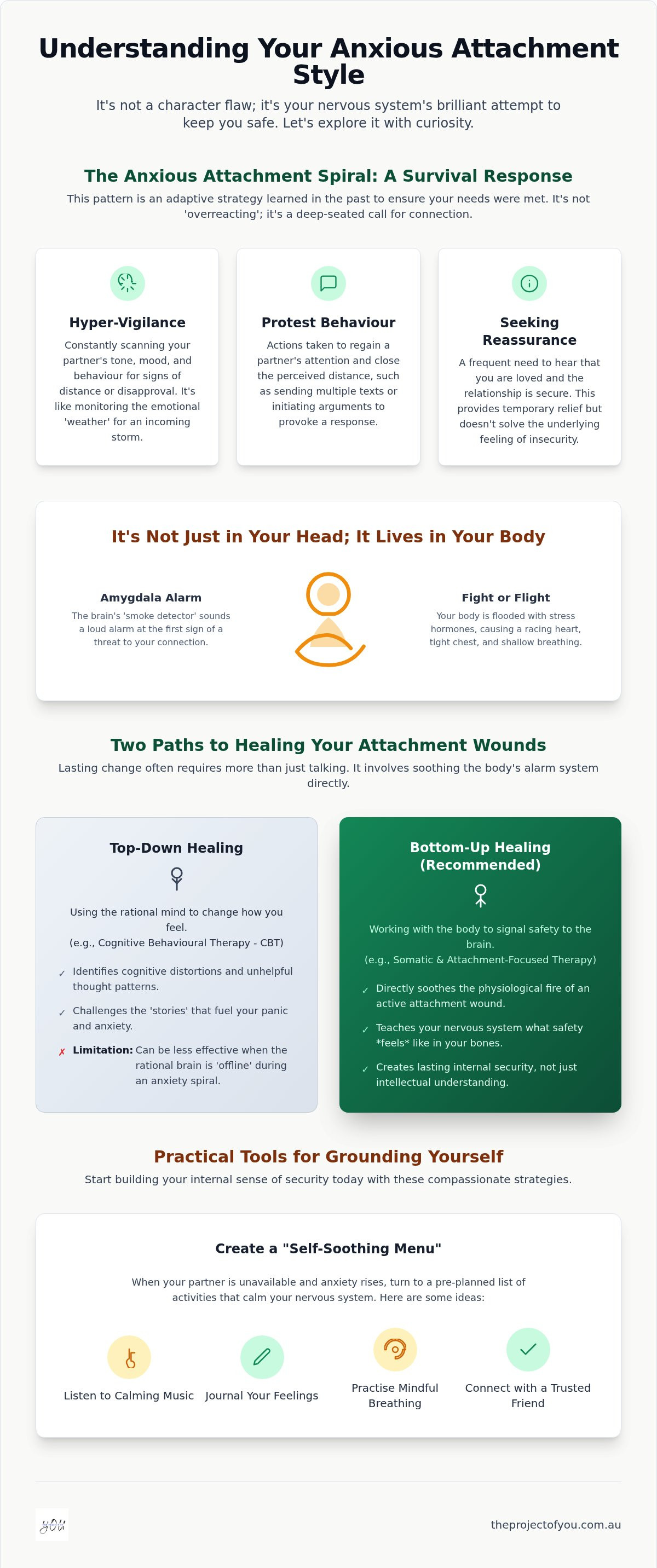
Have you ever wondered why your mind begins to race the moment a partner’s tone shifts slightly? It's common to feel frustrated with yourself for 'overreacting', but what if we looked at this through a different lens? Anxious attachment isn’t a personality defect. It is actually a brilliant, adaptive strategy your younger self developed to seek safety in an unpredictable environment. When caregiving was inconsistent, you learned that staying hyper-vigilant was the only way to ensure your needs were met. You aren't broken; you are simply well-practised at monitoring the 'weather' of your relationships.
This often manifests as what we call 'protest behaviour'. This might look like sending multiple texts when you don't get a reply or seeking constant reassurance about where you stand. These aren't attempts to be difficult. They are desperate bids for connection when your internal alarm system senses a threat to the bond. Validating this anxious spiral as your body’s way of protecting your most important relationships is a vital first step in anxious attachment counselling. When we stop fighting the response, we can start listening to what it's trying to tell us.
The Physicality of Relationship Anxiety
Relationship anxiety isn't just in your head; it lives in your tissues. When you sense a partner pulling away, your amygdala, the brain's smoke detector, sounds a loud alarm. This triggers a 'fight or flight' response that causes your chest to tighten and your heart to hammer against your ribs. The attachment alarm is a biological necessity designed to ensure we remain connected to those who keep us safe. Understanding this physical reality helps us move away from self-blame and toward nervous system regulation. It's much easier to find your way back to calm when you realise your body is simply trying to look out for you.
Moving Beyond the Shame of "Being Needy"
Society often labels the desire for closeness as being 'needy' or 'clingy', which only adds a layer of shame to an already painful experience. In reality, humans are hardwired for co-regulation. We need each other to feel settled. These labels can deepen attachment wounds, making you feel even more isolated and 'wrong'. Through anxious attachment counselling, we focus on self-compassion as a foundational tool. We replace the harsh 'why am I like this?' with a curious 'how did my body learn to protect me this way?'. This shift allows you to start creating paths toward security without the heavy weight of judgement holding you back.
Why Talk Therapy Isn’t Always Enough for Attachment Wounds
Have you ever sat in a therapy session, logically understanding that your partner is loyal and kind, yet still felt a crushing weight in your chest? It’s a profoundly frustrating experience. You can 'know' the truth intellectually, but your body is still screaming that you're in danger. This is where traditional talk therapy often reaches its limit. While understanding your history is helpful, simply talking about the past doesn't always soothe the physiological fire of an active attachment wound. Understanding your story is one thing; healing your body’s reflexive response to that story is another journey entirely.
Most traditional approaches are 'top-down', meaning they focus on using the rational mind to change how we feel. However, when you're in the middle of an anxious spiral, the rational part of your brain effectively goes offline. Your nervous system takes the wheel. To find lasting peace, we need to introduce 'bottom-up' healing. This involves working directly with the body to signal safety to the brain, rather than just trying to argue with your intrusive thoughts. In anxious attachment counselling, we prioritise this somatic restoration to ensure you don't just understand security, but actually feel it in your bones.
Cognitive Behavioural Therapy vs. Somatic Restoration
Many people begin their healing journey with CBT therapy to manage their relationship patterns. It's a wonderful tool for identifying the 'scripts' we run and the cognitive distortions that fuel our panic. Yet, for many, CBT may miss the 'stuck' energy residing in the nervous system. If your heart is racing because of a delayed reply, a logical thought won't immediately slow it down. Nervous system regulation is the essential foundation for lasting cognitive change. We often use neurofeedback to help retrain the brain’s stress response, providing a physiological 'reset' that makes it easier to apply the mental tools you've learned.
The Project of You Approach: A Holistic Blend
At The Project of You, Azita Abdollahian integrates clinical social work with somatic nervous system restoration. This isn't just about managing symptoms; it's about a deep, trauma-informed exploration of how you relate to yourself and others. We move through transitions with a gentle, steady pace that respects your boundaries. By combining evidence-based clinical practices with somatic modalities, we help you create new paths toward intimacy that feel safe. We value curiosity over judgement, helping you navigate the complexities of your human condition with grace and professional guidance. If you feel ready to move beyond the exhaustion of overthinking, you might consider how specialised individual support can help you find your way back to a calm, steady centre.
How Anxious Attachment Counselling Restores Your Nervous System
If your nervous system has spent years in a state of high alert, simply deciding to be 'secure' isn't enough. You need a safe space to practice what security actually feels like. In anxious attachment counselling, the relationship between you and your therapist becomes a 'Safe Base'. This is a gentle, controlled environment where we can explore your responses without the high stakes of a romantic conflict. We start by identifying 'glimmers'-those tiny, often overlooked moments of safety and ease-to help balance the loud 'triggers' of abandonment that usually dominate your experience. It's about slowly recalibrating your internal compass so you can find your way back to a steady centre.
The goal is to move from a reliance on external co-regulation toward a robust capacity for self-regulation. We use somatic tools to down-regulate the sympathetic nervous system, helping you settle the physical 'buzz' of anxiety before it turns into a full-blown spiral. As you become more familiar with the sensation of safety in the therapy room, you'll find it easier to carry that groundedness into your daily life. You're not just learning about attachment; you're building a new internal architecture that supports lasting emotional resilience.
The Role of Polyvagal Theory in Attachment
We often look at relationship dynamics through the lens of Polyvagal Theory to understand why your body reacts the way it does. The 'Ventral Vagal' state is our target; it's the physiological 'green light' that allows for social engagement, intimacy, and trust. When you're stuck in 'Sympathetic Panic', your body is geared for a fight, while 'Dorsal Shutdown' can make you feel numb or hopeless. The vagus nerve acts as a biological bridge, transmitting signals of safety or threat that directly dictate our ability to trust and open up to a partner. Counselling helps you recognise these shifts in real-time, providing you with the maps you need to navigate back to a state of connection.
What to Expect in a Somatic Attachment Session
A session focused on somatic restoration feels quite different from a standard chat. We might pause the narrative to check in with a tightness in your throat or a heaviness in your chest, treating these sensations as valuable messengers rather than obstacles. We work with guided exercises designed to expand your 'Window of Tolerance', which is the space where you can handle emotional stress without becoming overwhelmed or shutting down. By engaging with attachment based therapy Australia, you are effectively creating new neural pathways for intimacy. These pathways allow you to experience closeness as a source of nourishment rather than a source of fear, paving the way for more secure and fulfilling connections.
Practical Strategies for Managing Relationship Anxiety at Home
While anxious attachment counselling provides the map for your journey, the real work often happens in the quiet moments between sessions. When you're at home and that familiar wave of panic begins to rise, having a pre-prepared toolkit can make all the difference. The first and most vital step is the 'Pause and Breathe' technique. Instead of immediately reaching for your phone to check a status or send a frantic message, we invite you to pause for just sixty seconds. This isn't about stopping the feeling; it's about creating a tiny sliver of space between the impulse and the action. In that space, you can begin to offer yourself the reassurance you're seeking from others.
A 'Self-Soothing Menu' is a literal list of activities that help your body feel safe when a partner is unavailable. It might include making a cup of herbal tea, listening to a specific grounding playlist, or wrapping yourself in a weighted blanket. These aren't mere distractions. They are intentional acts of self-regulation. If you're feeling particularly small or vulnerable, this is the ideal time for 'Inner Child' work. You might imagine that younger version of you who felt unseen and tell them, 'I am here now, and we are safe.' This simple act of internal witnessing can often settle a racing heart faster than external validation.
Building Your Regulation Toolkit
Grounding exercises are your anchor when the anxious spiral feels like a storm. The 5-4-3-2-1 method is a classic, but we add an attachment twist: as you name five things you see or four things you can touch, focus on textures that feel soothing or colours that feel warm. Self-touch, such as placing a firm hand on your heart, signals to your brain that you're supported. Mindfulness helps you observe the 'urge to check' as if it's a passing cloud. You can see the urge without having to jump on board and let it carry you away into a cycle of overthinking.
Communicating with Your Partner
Talking to your partner about your needs doesn't have to feel like an admission of being 'broken'. You can explain your attachment style as a piece of your history that occasionally makes your internal alarm sensitive. Use 'I' statements like, 'I’m feeling a bit anxious right now, and a quick check-in would really help me settle,' rather than blaming them for your distress. Before you send that follow-up text, ask yourself: 'Am I seeking connection, or am I trying to escape a feeling?'. This clarity helps you set boundaries that protect your peace while keeping the door to intimacy open.
Finding Your Path to Secure Attachment with The Project of You
Healing from anxious attachment isn't always a linear path. While weekly anxious attachment counselling offers a vital rhythm of support, some patterns are so deeply etched into our nervous system that they require a more immersive approach to shift. At The Project of You, we look beyond the traditional therapy hour to offer transformative experiences that fast-track your journey toward security. Reaching out for this level of support is not a sign of failure. It's a profound act of self-love that acknowledges your worth and your desire for a life defined by ease rather than anxiety.
By focusing on Nervous System Restoration, we address the 'control centre' of your attachment style. This foundation is essential for long-term relationship health, ensuring that your body can finally sustain the sense of safety your mind has been longing for. When we restore the nervous system, we aren't just managing symptoms; we're creating a new internal environment where trust can naturally take root and flourish.
Immersive Healing Experiences
Sometimes, a concentrated period of work can achieve what months of talking cannot. Our intensive couples retreats are designed to break through the years of anxious-avoidant loops that keep partners stuck in a cycle of hurt and withdrawal. For those seeking deep-seated repair on an individual level, a private retreat provides a sanctuary for focused, somatic healing. We also offer 'The Healing Feminine' workshops, providing a space for women to explore their attachment wounds within a supportive community. For those ready to explore the frontiers of healing, psychedelic-assisted therapy offers unique potential for shifting rigid attachment patterns by opening new windows into the subconscious and the body's stored wisdom.
Taking Healing into Your Own Hands
Your growth doesn't have to pause when you leave the therapy room. We provide a range of resources to keep you connected to your path, such as our Self-Love E-books, which offer practical wisdom you can access at any time. The Project of You podcast serves as a regular source of insight, helping you stay grounded in the principles of somatic restoration and secure connection even during your daily commute. Secure attachment is a skill, not a fixed trait you're born with. It can be learned and nurtured at any age. With the right guidance and a compassionate approach, you can move from the exhaustion of a racing heart toward the calm, steady presence you've always deserved.
Moving Toward a Life of Secure Connection
You don't have to stay trapped in the exhaustion of the anxious spiral. Healing is possible when we stop trying to 'fix' our thoughts and start tending to our nervous systems instead. By understanding your body's survival responses and learning practical somatic tools, you're building a foundation for relationships that feel safe rather than stressful. Secure attachment is a skill that can be nurtured at any age, allowing you to move from a place of constant hyper-vigilance toward a grounded, steady way of being.
Specialised anxious attachment counselling offers a structured, compassionate way to navigate this transition with the guidance of an expert who understands the complexities of the human condition. Led by Azita Abdollahian, a Clinical Social Worker and Psychotherapist, The Project of You provides Australia-wide support for individuals and couples. Through a focus on Polyvagal Theory and Nervous System Restoration, we help you find the steady ground you've been searching for. It's time to trade the physical panic of overthinking for the quiet confidence of a regulated heart.
You deserve to love and be loved with a heart that feels at rest. The path to security is open, and you don't have to walk it alone.
Frequently Asked Questions
How long does it take to heal an anxious attachment style through counselling?
Healing is a journey rather than a destination, and the timeline varies for everyone based on their unique history. Most people start to feel a shift in their nervous system within three to six months of consistent anxious attachment counselling. However, deep-seated repair often requires longer-term support to truly rewire the body's survival responses. It's about steady progress as you slowly build a new internal architecture of safety.
Can I change my attachment style from anxious to secure?
Yes, you can absolutely move toward what psychologists call 'earned secure attachment' through intentional work and self-compassion. While your history remains the same, your body can learn to respond to intimacy with ease rather than panic. Through specialised support, you develop the somatic tools and emotional intelligence needed to regulate your own heart rate and mind, eventually finding a steady sense of internal security.
Is anxious attachment counselling covered by Medicare in Australia?
Mental health support in Australia is often accessed via a Mental Health Care Plan, but it's important to check specific provider eligibility first. At The Project of You, we don't offer Medicare Bulk Billing, as our specialised somatic and intensive services operate outside that specific framework. We recommend contacting your private health insurer to see if clinical social work or psychotherapy sessions are included in your extras cover.
What is the difference between relationship coaching and attachment counselling?
Relationship coaching typically focuses on future goals and communication strategies, whereas attachment counselling dives deeper into the physiological 'why' behind your patterns. Counselling, especially when it's trauma-informed, addresses the nervous system's survival loops and early childhood wounds. It provides a clinical, evidence-based framework for healing the root causes of distress rather than just managing the surface-level behaviours that show up in your partnerships.
Can anxious attachment survive a relationship with an avoidant partner?
Anxious-avoidant dynamics can be incredibly painful, but they can survive and even thrive if both partners are willing to look at their own responses. When you learn to regulate your own anxiety, you stop 'chasing', which often gives an avoidant partner the space they need to feel safe. Healing your own attachment style is the most powerful way to change the 'dance' of the relationship.
What happens if my partner refuses to go to couples counselling with me?
If your partner isn't ready for couples work, you can still make significant progress by focusing on your own individual healing. Your nervous system is one half of the relationship's 'circuit'; when you become more regulated and secure, the entire dynamic inevitably shifts. Many people find that their individual growth eventually inspires their partner to engage or helps them set healthier boundaries for themselves.
How do I know if I have anxious attachment or just "normal" relationship anxiety?
Normal relationship anxiety is usually tied to a specific event, while anxious attachment is a persistent, physical pattern of feeling unsafe. If you frequently experience a racing heart, a 'gut punch' feeling when a partner is away, or an obsessive need for reassurance, it's likely an attachment response. Anxious attachment counselling helps you distinguish between a temporary worry and a deep-seated survival loop.
What is the first step to booking a session with The Project of You?
The simplest way to begin your journey is to visit our website and book an initial consultation through our online portal. This first session is a gentle opportunity for us to sit together, explore your needs, and see if our somatic approach feels like the right fit for you. Whether you're interested in individual sessions or an intensive retreat, we're here to guide you.


Comments