.png)

Burnout Recovery Therapy Australia: A Path Back to Your True Self
- Azita Abdollahian

- 6 hours ago
- 13 min read
What if the exhaustion you're feeling isn't a sign of weakness or a lack of resilience, but your body's response to prolonged stress and a life that has demanded too much for too long?
Burnout can leave you feeling physically and emotionally depleted. You may feel constantly “wired but tired”, struggle to switch off, wake up exhausted despite getting enough sleep, or find that even simple tasks require more energy than they once did. Over time, chronic stress can also affect your concentration, mood, relationships and sense of connection to yourself.
This is where burnout recovery therapy in Australia can offer more than simply telling you to rest, take a holiday or manage your time better.
As a psychotherapist, trauma expert and founder of The Project Of You, Azita Abdollahian takes a trauma-informed approach to understanding burnout and chronic stress. Her work explores the connection between emotional exhaustion, the nervous system, past experiences, relationship patterns and the pressures that can leave people feeling stuck in a prolonged state of overwhelm.
Burnout recovery isn't simply about removing stress for a few days. While rest is important, meaningful recovery can also involve understanding the patterns that contributed to your exhaustion and developing practical strategies to support nervous system regulation, emotional wellbeing and sustainable change.
In this guide, Azita explores the signs and symptoms of burnout, the connection between chronic stress and nervous system activation, and the therapeutic approaches that can support recovery. You'll discover practical ways to restore your capacity, improve emotional regulation and begin reconnecting with the parts of your life that chronic exhaustion may have pushed aside.
Whether burnout is affecting your work, relationships or ability to enjoy everyday life, recovery begins with recognising that exhaustion is not something you simply need to push through.
You don't have to earn your rest by reaching breaking point. Sometimes, healing begins when you stop asking yourself to keep going and start giving yourself the support and tools to recover.
Table of Contents
Beyond the Exhaustion: What Burnout Recovery Therapy in Australia Really Looks Like
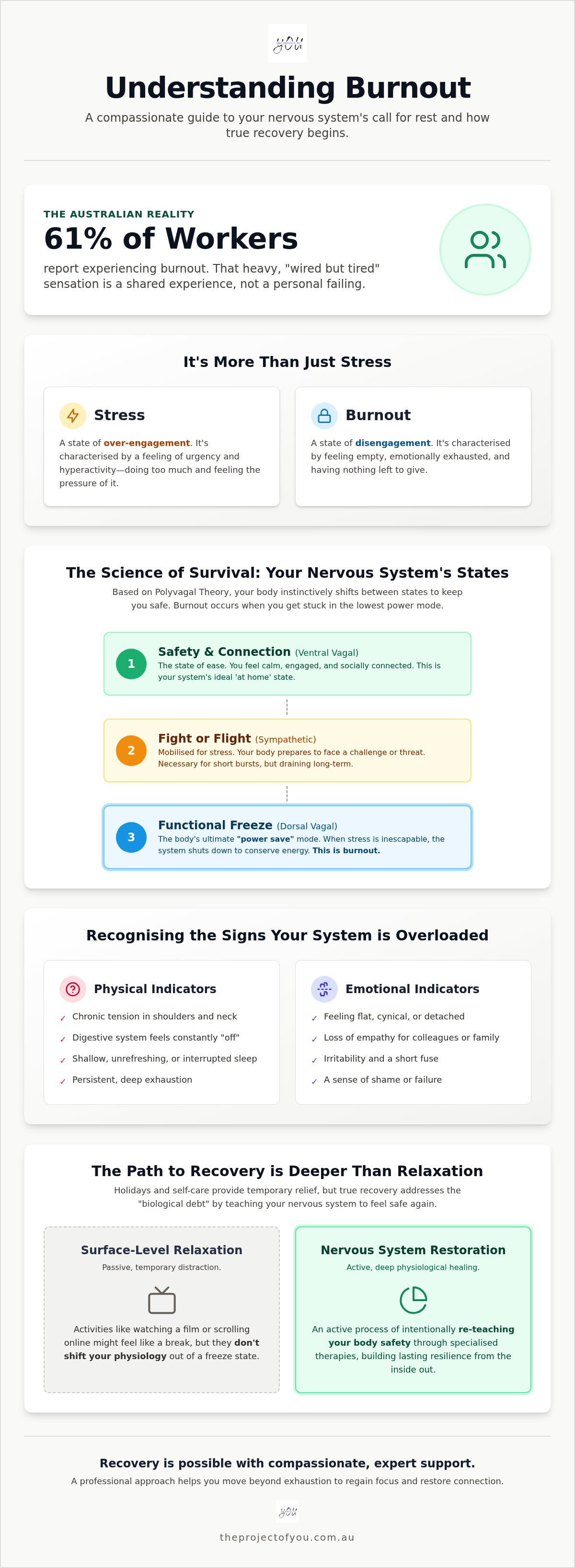
Have you ever felt like you're running on an empty tank, yet your mind won't stop racing? While many Australians dismiss their exhaustion as just a busy week, true burnout is far more than temporary tiredness. It is a state of physiological collapse, often described as a functional freeze. This occurs when your nervous system, overwhelmed by prolonged stress, decides the only way to protect you is to power down. Occupational burnout is now recognised globally as a complex phenomenon, but here in Australia, we often push through until the biological debt becomes impossible to ignore. Our "she'll be right" culture is a wonderful trait, but it can sometimes mask the early warning signs of a system in distress.
Seeking burnout recovery therapy Australia based means moving beyond surface-level fixes. It involves a deep, compassionate look at how your system has been forced to adapt. We often see clients who feel a profound sense of shame or irritability, wondering why they can't just "snap out of it". The truth is that your body has simply reached its limit. It isn't a failure of character; it's a survival strategy that has stayed active for too long.
Recognising the Signs Your System is Overloaded
When you're in the thick of burnout, your usual ways of resting don't seem to touch the sides. You might take a long weekend or sleep for ten hours, only to wake up feeling just as heavy as before. This is because your system is no longer just tired; it's dysregulated. Physical indicators often include chronic tension in your shoulders, a digestive system that feels constantly off, or sleep that is shallow and interrupted. Emotionally, you might find yourself feeling flat or cynical. The empathy you once had for your colleagues or family might feel like a dry well. These aren't signs that you've become a different person. They are signals that your internal resources are depleted.
The Difference Between Stress and Burnout
It helps to think of stress as a state of over-engagement. When you're stressed, you're doing too much, and you feel the pressure of it. Burnout is different. It is a state of disengagement. In burnout, you don't feel too much; you feel like you have nothing left to give. High-functioning anxiety often masks this transition. You might still be hitting your targets at work and showing up for school runs, but internally, the lights have dimmed. Recognising this shift is the first step toward restoration. Understanding that you are approaching a point of no return allows us to begin the gentle work of nervous system regulation, creating a path back to the person you remember being.
The Science of Survival: Why Your Nervous System Holds the Key to Recovery
What if your constant exhaustion is actually a sophisticated form of protection? To understand why your body feels so heavy, we look to Polyvagal Theory. This framework explains that our nervous system operates in a hierarchy of states. When we feel safe, we are in a state of connection and ease. When we face stress, we move into "fight or flight". However, when stress becomes chronic and inescapable, our system defaults to a "Dorsal Vagal" state. This is the body's ultimate "power save" mode. It is a functional freeze where your system shuts down non-essential processes to conserve energy. This is why burnout feels like more than just being tired; it is a physiological collapse designed for survival.
Your system is also constantly performing "Neuroception", a subconscious scanning of your environment for signs of threat or safety. After years of high-pressure work or personal strain, your internal radar can become stuck on high alert. Even when you are at home or on holiday, your body might still believe it is in a danger zone. This chronic state of alert rewires your brain to stay guarded, making it difficult to find your way back to true rest without intentional support. When seeking burnout recovery therapy Australia, it's vital to look for approaches that address this biological foundation rather than just the symptoms of your stress.
Understanding Nervous System Restoration
There is a significant difference between "relaxing" and "restoring". Relaxing is often passive, like watching a film or scrolling through a phone. While these activities might feel like a break, they don't necessarily shift your physiology out of a freeze state. Restoration is an active process of teaching your system that it is safe to come out of hiding. It involves somatic awareness, which is the practice of noticing where tension is stored in your body. By gently building "vagal tone", we can increase your resilience. This allows you to handle life's challenges without your system immediately dropping into a state of collapse. Knowing how to spot and take action on burnout through these physiological markers is the first step toward reclaiming your vitality.
Moving from "Freeze" Back to Flow
Many people find that traditional talk therapy feels overwhelming when they are deeply burnt out. This is because "just talking about it" can sometimes re-trigger the stress response in a dysregulated system. A more effective path often involves providing a physiological anchor first. Our approach to Nervous System Restoration focuses on gentle, body-based techniques that signal safety to the brain. The ultimate goal is to help you return to a "Ventral Vagal" state. This is the place where you feel genuinely connected to yourself and others, and where your professional focus can return without sacrificing your health. If you feel ready to explore how this somatic approach can support your journey, you might like to view our available session times to begin your restoration.
Navigating the Path: Why Professional Therapy Outperforms Self-Care
What if the very things we've been told will fix us, such as the weekend getaways or the quiet bubble baths, are only scratching the surface? While these moments of self-care are lovely, they rarely reach the deep-seated "biological debt" that chronic exhaustion creates. Seeking professional burnout recovery therapy Australia offers a different path. It moves beyond temporary relief to address the underlying patterns that led you here in the first place. According to the Australian Psychological Society on burnout, recovery requires more than just a break from work; it necessitates a fundamental shift in how we manage stress and engage with our lives.
Burnout is rarely just a workplace issue. It is a relational one. When you are "wired but tired", you aren't just less productive at your desk. You are likely less present at the dinner table. You might find your patience wearing thin with your children or feel a growing emotional distance from your partner. This often stems from the "High-Achiever" trap, where your sense of identity has become inextricably tied to your productivity. It’s a cycle that feels impossible to break because stopping feels like losing a part of who you are.
Attachment Styles and Burnout Susceptibility
Our early relationships often dictate how we respond to pressure as adults. If you grew up feeling that your worth was based on your achievements, you might have developed "anxious" or "avoidant" attachment patterns that now manifest as over-working. In therapy, we use the concept of co-regulation. This is where the steady, calm presence of a therapist helps your nervous system learn what safety feels like again. We also explore the "Wounded Feminine", a state where high-achieving women feel they must constantly "do" and "provide", losing touch with their innate ability to simply "be" and receive support.
The Power of Immersive Restoration
Sometimes, an hour-long session once a week isn't enough to break the momentum of a collapsing system. This is where creating a "circuit breaker" becomes essential. Immersive experiences, such as intensive retreats, provide a sacred space away from daily triggers. By removing the constant demands of your "normal" life, your system finally has the permission it needs to truly reset. Group workshops also play a vital role here. There is a quiet, universal healing power in realising you aren't alone. Sharing the journey with others who truly understand the weight of your exhaustion can dissolve the shame that often keeps burnout locked in place. It allows you to move from isolation back into a state of shared humanity and ease.
Practical Strategies to Organise Your Recovery Journey
When you're in the thick of exhaustion, being told to "just get more sleep" or "start an exercise regime" can feel like another heavy item on an already impossible to-do list. Recovery isn't about adding more tasks to your schedule. It's about shifting how you relate to your energy and your environment. Choosing to engage with burnout recovery therapy Australia provides you with a structured map to navigate these changes, ensuring you aren't just doing more, but actually becoming more present. Here is how you can begin to organise your path back to yourself.
Conduct a Nervous System Audit: Spend a few days noticing your "energy leaks". These are the moments where you feel your chest tighten or your breath become shallow. Is it a specific notification on your phone? A certain tone of voice? Identifying these triggers is the first step in creating a sanctuary for your system.
Prioritise Micro-Restoration: You don't always need a week away to begin healing. A 60-second nervous system reset, such as feeling the weight of your feet on the floor, can signal to your brain that you are safe in this moment.
Establish Boundaries Between Doing and Being: For many high-achievers, "being" feels like "wasting time". You might practise setting a firm end to your professional day. This isn't just about stopping work; it's about giving yourself permission to exist without a goal.
Seek Trauma-Informed Support: Addressing the underlying "why" behind your drive to overwork is essential. Often, our need to be productive is a survival strategy from our past.
Integrate Somatic Practices: Use grounding and breath-work to communicate directly with your body. These practices bypass the analytical mind and speak the language of the nervous system.
Reflective Questions for Your Recovery
Sometimes the most profound shifts begin with a simple, curious question. Take a moment to sit with these inquiries, perhaps with a cup of tea, and see what arises without judgement.
What would it feel like to be "safe" in my body right now?
Who am I when I am not being "productive"?
What is my body trying to tell me through this exhaustion?
Evidence-Informed Tools You Can Use Today
We use specific techniques grounded in Polyvagal and Somatic theories to help you shift states. The "Voo" breath is a powerful tool for calming the sympathetic nervous system. By making a low-frequency "voo" sound on a long exhale, you create a vibration that stimulates the vagus nerve, gently nudging your system toward calm. You can also practise finding "glimmers". While triggers are cues of danger, glimmers are tiny micro-moments of safety or joy, like the warmth of the sun on your skin or the sound of a bird. These small signals help rewire your brain to recognise that safety is possible.
Healing with The Project of You: A Compassionate Approach to Restoration
At The Project of You, we believe that healing is a partnership, not a cold clinical procedure. Led by Azita Abdollahian, our approach acknowledges that your burnout is a signal from a system that needs gentle, intentional care. We don't see you as a list of symptoms to be fixed. Instead, we see an individual whose inherent potential is temporarily masked by a state of physiological collapse. By choosing burnout recovery therapy Australia through our practice, you are entering a space designed for psychological safety and profound restoration. It's a place where your story is heard with curiosity rather than judgement.
Our work is grounded in the understanding that true change happens when we address both the mind and the body. We combine traditional Cognitive Behavioural Therapy (CBT) with advanced Nervous System Restoration and, where appropriate, Psychedelic Assisted Therapy. This multi-layered approach ensures that we aren't just talking about your stress, but actively helping your physiology shift back into a state of flow and connection. It is a trauma-informed, shame-free process that prioritises your agency and emotional resonance at every step. We act as a steady presence, guiding you through the transitions of your life with professional authority and deep, intuitive empathy.
Our Range of Restorative Services
Because burnout often ripples out into our most cherished relationships, we offer Couples Counselling to help partners navigate the emotional distance that exhaustion can create. For those seeking a deeper circuit-breaker, our Psychedelic Assisted Therapy provides a unique opportunity for deep emotional breakthroughs in a supported, clinical environment. We also facilitate immersive workshops and retreats designed to help you reclaim your essence. These experiences provide the necessary space to move from a state of constant "doing" back into a vibrant state of "being", allowing your energy to return naturally.
Your Journey Starts Here
Taking the first step toward restoration can feel daunting when your energy is low. We've made the process as gentle as possible. When you book a session, your initial consultation feels less like an interview and more like a warm conversation over a cup of tea. It's a chance for us to get curious about your experience and for you to feel into whether our approach resonates with your needs. There is no pressure, only a steady presence to help you find your way. Recovery isn't just a possibility; it's a path back to your true self. You deserve to feel at home in your body again, and we are here to walk that path with you.
Your Path Back to Vitality and Connection
Burnout is more than a demanding schedule; it is a profound physiological signal that your system needs a sanctuary to heal. We've explored how understanding your nervous system and addressing deep-seated attachment patterns can shift you from a state of "functional freeze" back into a life of flow. By prioritising restoration over simple relaxation, you give yourself the chance to feel at home in your body once more. Choosing specialised burnout recovery therapy Australia based through The Project of You means you're no longer navigating this transition in isolation.
Led by Azita Abdollahian, a Clinical Social Worker and Psychotherapist, our practice offers an evidence-based approach rooted in Polyvagal and Attachment theories. We provide trauma-informed care that always prioritises your emotional safety, ensuring you feel supported at every step of your journey. It's time to move past the shame of exhaustion and embrace the possibility of a more vibrant, connected future.
Begin your journey to restoration with Azita and The Project of You today. You have the inherent potential to regain your focus and warmth. We're here to help you find your way back to the person you've always been, with the added grace of supported growth.
Frequently Asked Questions
Is burnout a clinical diagnosis in Australia?
Burnout is currently classified by the World Health Organisation as an occupational phenomenon rather than a medical condition. In Australia, this means it's viewed through the lens of workplace stress that hasn't been successfully managed. While it isn't a stand-alone clinical diagnosis, its physical and emotional impacts are very real. Many people find that seeking burnout recovery therapy Australia wide helps them address the underlying nervous system dysregulation that often accompanies this state.
Can I recover from burnout while I am still working?
You can certainly begin your recovery while remaining in the workforce, though it often requires a structured approach to boundaries. Recovery isn't just about stopping work; it's about changing how your system responds to stress. By implementing micro-restoration moments and learning nervous system regulation during your workday, you can start to pay back your biological debt. This process helps you stay engaged with your professional goals without continuing to sacrifice your health.
How long does burnout recovery therapy usually take?
The duration of recovery is deeply individual because it depends on how long your system has been in a state of collapse. For some, a few months of intensive support provides a significant shift, while others may require a longer period of integration. We focus on restoration rather than a "quick fix" because your body needs time to relearn safety. It's about building a sustainable path back to yourself rather than rushing toward a finish line.
Will my therapy sessions be covered by Medicare or private health?
To access Medicare rebates for psychological support in Australia, you'll need a Mental Health Treatment Plan from your GP. As of July 2026, these rebates can help offset the cost of up to ten individual sessions per calendar year. Many private health funds also provide coverage for counselling, though the amount depends on your specific policy. It's always best to check with your provider to see how they support your journey toward restoration.
What is the difference between burnout and clinical depression?
While they share similar symptoms like fatigue and low mood, burnout is specifically tied to your environment and chronic stress. Depression tends to be more pervasive, affecting all areas of life regardless of the context. Burnout often feels like being "stuck" or disengaged from a specific role, whereas depression can feel like a heavy blanket over everything. Understanding this distinction helps us tailor your burnout recovery therapy Australia sessions to your unique needs.
How do I know if I need a retreat or just regular therapy?
Regular therapy is wonderful for ongoing support and integration, but a retreat acts as a vital circuit breaker. If you feel like you're in a "functional freeze" and can't find a moment of peace at home, a retreat provides the sacred space needed for deep restoration. It removes you from daily triggers, allowing your nervous system to reset in a way that weekly sessions sometimes can't achieve on their own.
Can burnout recovery therapy help my relationship with my partner?
Burnout often ripples into our homes, leading to irritability and emotional distance from those we love. When you're constantly "wired but tired", you don't have the capacity for the patience and intimacy that healthy relationships require. Therapy helps by teaching you how to co-regulate with your partner. As you heal your own nervous system, you'll likely find that your ability to connect and communicate with your loved ones begins to flourish again.
What is Somatic Therapy and how does it help with burnout?
Somatic Therapy is a body-based approach that focuses on the physical sensations of stress rather than just your thoughts. Since burnout is a physiological state of collapse, "talking it out" isn't always enough. Somatic techniques help you identify where tension is stored and use gentle movement or breath-work to signal safety to your brain. This helps move your system out of a freeze state and back into a state of flow and ease.


Comments