

Somatic Experiencing Therapy in Australia: Understand Your Options

What is somatic therapy, and how can body-based approaches support people experiencing trauma, chronic stress or emotional overwhelm? If you’re exploring somatic therapy in Australia, you may have come across terms such as Somatic Experiencing, Sensorimotor Psychotherapy and body-oriented trauma therapy. Although these approaches share an interest in the relationship between the body and emotional experiences, they are not interchangeable. You may also wonder whether somatic therapy means revisiting painful memories or experiencing intense emotions. A trauma-informed approach should prioritise your sense of safety, consent and choice, allowing you to explore at a pace that feels manageable.
As a psychotherapist, Clinical Social Worker and trauma specialist, Azita Abdollahian understands the importance of choosing a therapeutic approach that respects your individual needs and experiences. Somatic therapy is an umbrella term for approaches that incorporate awareness of bodily sensations and responses into therapeutic work, while Somatic Experiencing is a specific approach developed to address trauma-related stress responses. Depending on your circumstances, body awareness may be used alongside talking therapy and other forms of psychological support.
In this guide, Azita explains what somatic therapy involves, how Somatic Experiencing differs from other body-based approaches, and what to consider when looking for somatic therapy in Australia. We’ll explore the potential role of body awareness in trauma support, why pacing and collaboration matter, and what current research can tell us about these approaches. Understanding the differences can help you ask informed questions, explore your options and decide what kind of support may be appropriate for you.
Table of Contents
What is somatic therapy, and what does Somatic Experiencing mean?
Somatic therapy is a broad term for therapeutic approaches that pay attention to the body and a person’s present-moment experience. A therapist may invite you to notice sensations, posture, movement or breathing alongside what you’re thinking and feeling. Somatic Experiencing, often shortened to SE, is one named approach within this wider field. The terms aren’t interchangeable: not every somatic-informed therapy follows the Somatic Experiencing approach.
In somatic therapy Australia, body awareness can be one source of information to explore together, not a diagnostic test or a guaranteed route to change. A sensation may offer a clue about what’s happening for you, but it doesn’t have one fixed meaning. Consider it in context, including your thoughts, emotions, relationships and what’s happening in your life.
What does ‘somatic’ mean in a therapy setting?
In plain English, somatic means relating to the body and lived physical experience. In a session, a therapist might ask what you notice in your shoulders as you talk, whether your breathing has changed, or how it feels to sit in the chair. You can describe a sensation in your own words, or say you’re not sure. There’s no need to interpret it perfectly.
Imagine you’re describing a difficult conversation with someone you care about. You notice your jaw tightening as you remember a particular moment. That tension might be explored gently alongside your thoughts about the exchange and the emotions it brings up. It doesn’t prove what you felt or what the other person intended. It’s one part of your experience that may help guide the conversation.
Noticing your body doesn’t require you to share every detail of your life or relive past events. You can choose what to talk about, and body-focused attention can be adjusted to what feels manageable. It may be more comfortable to stay with the story, look around the room or talk about your emotions. Your experience and preferences matter.
Is Somatic Experiencing the same as somatic therapy?
No. Somatic therapy describes a broad family of ways of working that include bodily experience; Somatic Experiencing is a specific, named approach. It was developed by Peter A. Levine and has its own concepts and methods. For a general overview of Somatic Experiencing (SE), you can read more about its background and approach.
Therapy may be informed by body awareness without using Somatic Experiencing as a formal method. The name alone doesn’t tell you exactly what a session will involve, so it’s reasonable to ask what a therapist means by “somatic” and how they’ll work with your goals and comfort. At The Project of You, Somatic Therapy is part of a broader trauma-informed practice focused on nervous system regulation and restoration.
How can somatic therapy work with body awareness and emotions?
In somatic therapy, body awareness may offer another way to notice what’s happening in the present, alongside your thoughts, feelings and circumstances. A therapist might invite you to pause, notice a sensation, describe it tentatively and decide together whether to explore it further. You remain the authority on your own experience. A bodily cue can be worth being curious about, but it doesn’t prove a particular memory, emotion or cause.
What might body awareness look like in a session?
Illustrative example: You’re talking about an upcoming family gathering and notice your stomach feels tight. The therapist might ask, “What do you notice right now?” You could say it feels knotted, unsettling or difficult to describe. Together, you might consider what’s on your mind about the gathering, how you feel about the people involved and whether anything else could be contributing to the sensation.
There’s no requirement to keep focusing on it. You might choose to pause, look around the room, shift your attention to your feet on the floor or return to the conversation. A therapist can invite curiosity without deciding what a sensation means for you. In somatic therapy Australia, approaches and session experiences can differ between practitioners and clients.
How do nervous system regulation and trauma-informed care fit?
“Regulation” describes how someone responds to stress and settles after being activated. In therapy, the aim isn’t for a therapist to control your nervous system. Instead, you and the therapist can notice what feels manageable, consider what helps you feel present and adjust the pace. Trauma-informed care supports this through collaboration, choice, attention to emotional safety and respect for boundaries. You can say when an exercise doesn’t feel right.
Some body-oriented approaches draw on ideas about how people respond to safety and threat. Polyvagal Theory is one framework used to discuss these responses, but it shouldn’t be treated as a settled explanation for every bodily reaction. A theory can help organise questions for exploration; it isn’t a way to diagnose what a sensation means.
Research also needs careful interpretation. A peer-reviewed review by Payne, Levine and Crane describes the proposed role of body awareness in Somatic Experiencing; a description of a model is not, on its own, proof of every proposed mechanism. For a foundational overview of the approach, Somatic Experiencing® International provides information about SE. Somatic approaches vary, and outcomes can’t be guaranteed.
If you’re considering support, an initial conversation can help you explore what feels comfortable and what you’d like help with. You can book a conversation about support without committing to a particular technique or outcome.
Somatic Experiencing, Sensorimotor Psychotherapy and Hakomi: what differs?
Somatic Experiencing, Sensorimotor Psychotherapy and Hakomi are distinct approaches within the broader body-oriented therapy field. They share an interest in present experience, but differ in the concepts and practices they emphasise. The comparison below is a broad summary, not a complete account of clinical practice or a guide to predicting outcomes.
How do the named approaches describe their focus?
Descriptions from professional organisations explain how each approach understands its own work. They’re useful for learning the language of a method, but they aren’t the same as independent evidence that it produces a particular clinical outcome for every client.
How can someone compare approaches without oversimplifying?
These distinctions can help you understand what a modality name points towards, but they don’t tell you exactly what will happen in an individual session. Practitioners have different training and ways of working, and the therapeutic relationship, your needs and your preferences all shape the experience. The same approach may feel different with different therapists.
Rather than looking for a single “best” method, consider what matters to you. Would you prefer a session that includes mindfulness, attention to movement, or a focus on noticing sensations gradually? How much space would you like for talking about relationships and life circumstances? These are useful questions to explore together, not a test you need to pass before beginning therapy.
Somatic therapy Australia includes varied approaches, and no modality can promise the same outcome for everyone. Comparing their focus can offer a starting point, while an open conversation about your goals, comfort and preferred pace can help you decide what feels appropriate to explore.
How can body-based therapy feel safer and more manageable?
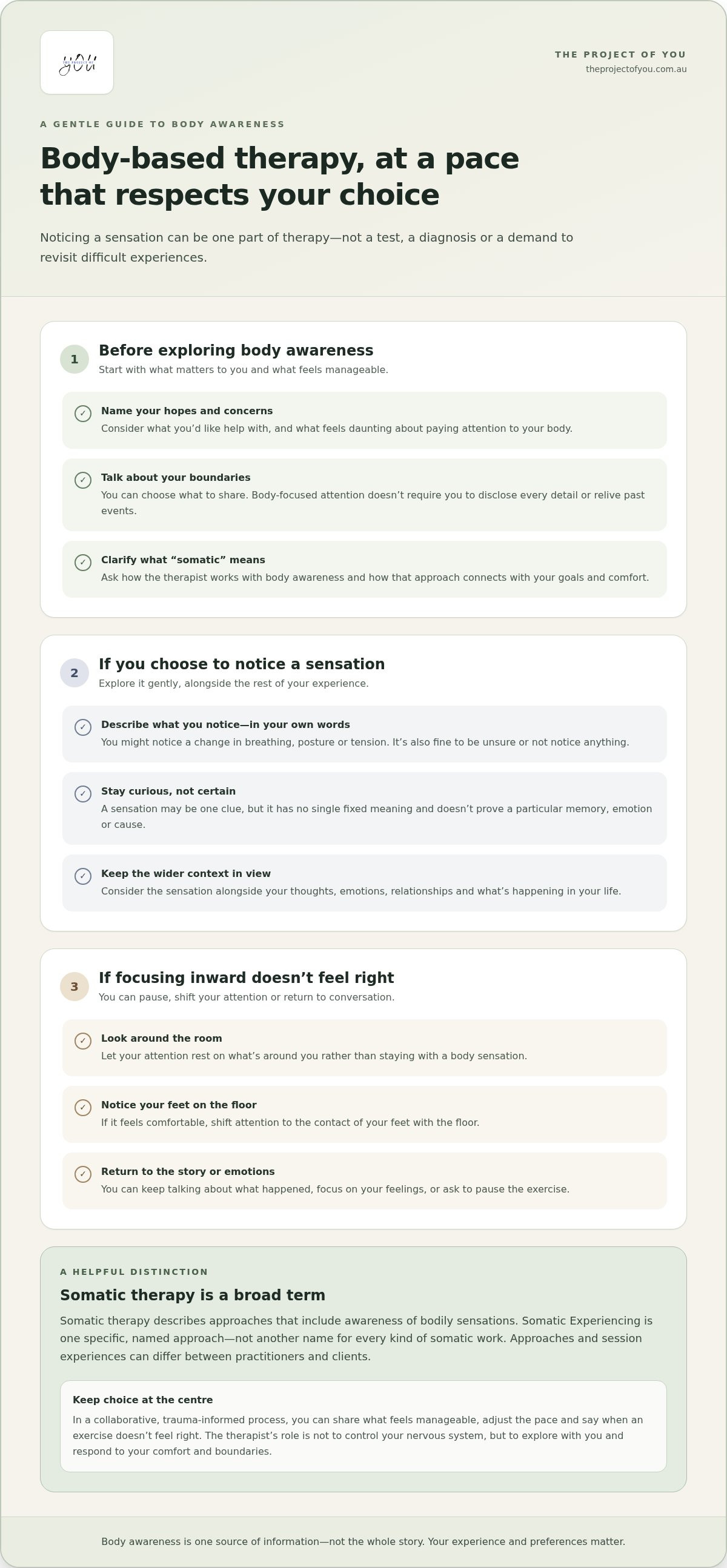
Body-focused work should leave room for your choice, not ask you to push through distress to prove you’re making progress. Before a session, consider what you hope to explore, what concerns you have, which boundaries matter to you and how you’ll recognise that you need a pause. You don’t need a perfect plan. A few words or thoughts can give you a starting point for a collaborative conversation.
Consent is ongoing. Agreeing to try an exercise doesn’t mean you have to continue if it stops feeling right. You can ask to keep your attention on the room, return to talking, change the subject or stop the exercise altogether. Discomfort isn’t proof that therapy is working; it’s information to share and respond to with care.
What can you do if body-focused attention feels uncomfortable?
You might say, “I’m feeling a bit overwhelmed,” “Can we slow down?” or simply, “I’d rather talk about this.” Ordinary language is enough. If it feels comfortable, you could shift your attention outwards by noticing a colour in the room, listening to a sound or feeling your feet against the floor. These are options, not rules. If focusing on a sensation doesn’t feel supportive, choosing not to do so is a valid boundary.
It can also help to notice what tends to feel steadying for you outside therapy. Perhaps you prefer a clear explanation before trying something new, a moment to gather your thoughts, or more conversation and less inward focus. Naming these preferences helps your therapist understand how to work with you, rather than assuming one pace or exercise will suit everyone.
What questions help clarify therapeutic fit?
You could ask how you’ll decide together whether to focus on body sensations, how you can signal that you want to pause, and what alternatives are available if an exercise feels uncomfortable. You might also share what you’d prefer to avoid for now. A supportive conversation makes space for questions without treating your boundaries as resistance.
If trauma has shaped how your body responds to stress, you may find it useful to read this guide to trauma and nervous system responses. It can offer context, though your own responses are personal and shouldn’t be interpreted from a checklist. Azita Abdollahian is a Clinical Social Worker and Psychotherapist, and the founder of The Project of You.
If you’re exploring somatic therapy Australia, a first step can be a conversation about your hopes, concerns and what helps you feel emotionally safe. You don’t need to know which method is right or agree to a particular exercise in advance.
Exploring somatic therapy with The Project of You
At The Project of You, Somatic Therapy is part of a broader, trauma-informed practice focused on nervous system regulation and restoration. Body awareness can be one part of exploring your experience, alongside conversation and reflection about what’s happening in your life, what matters to you and what kind of support feels appropriate.
How does somatic therapy sit within a broader counselling approach?
Noticing a bodily response may help you become curious about your experience, but it doesn’t define what you’re feeling or what should happen next. A session might include talking through a concern, reflecting on patterns and, where it feels useful, bringing gentle attention to present-moment experience. Emotional safety, self-awareness and your sense of choice remain important. There’s no single combination of approaches that suits everyone.
The Project of You also offers counselling and CBT, which can support different kinds of therapeutic work. CBT, or cognitive behavioural therapy, explores how thoughts, feelings and actions can influence one another. Bringing it together with trauma-informed care doesn’t mean every client receives the same combination of methods. The focus is on what’s relevant to the person and their goals, rather than assuming one approach fits every situation.
What is a gentle next step if you are curious?
You don’t need a polished goal before beginning. You might simply want to understand why certain situations feel difficult, notice how stress affects you or find a space to reflect on what you need. It’s also fine to arrive with questions, uncertainty or a preference to focus on conversation. These are all useful things to bring into an initial discussion.
If you’re considering somatic therapy Australia, an initial conversation is an opportunity to talk about what you hope to understand or change and how body awareness might fit into your counselling. It isn’t a commitment to a specific technique or a promised outcome. You can take the next step at a pace that feels right for you.
Take your next step at a pace that feels right
You don’t need to settle on a particular therapy name or arrive with everything worked out before seeking support. You might begin with a question, a hope or simply a sense that you’d like to understand yourself differently. In a conversation about somatic therapy Australia, you can explore what matters to you and what kind of support feels comfortable, one step at a time.
Azita Abdollahian’s work brings Somatic Therapy into a broader, trauma-informed counselling context. Exploring support with her can be a chance to discuss your needs collaboratively, without assuming one approach or outcome in advance.
Explore a counselling session There’s no need to rush your decision. Let curiosity, your values and your sense of readiness help guide what comes next.
Frequently Asked Questions
Can somatic therapy help if I struggle to put feelings into words?
Difficulty finding words doesn’t prevent you from exploring therapy. You might begin with simple descriptions such as “heavy”, “restless” or “numb”, or talk about a recent moment that felt hard to explain. You can also take time to think, write something down beforehand or focus on the situation rather than naming an emotion. Somatic therapy Australia may include body awareness, but it doesn’t require you to interpret sensations or speak fluently about feelings.
Do I need to have experienced trauma to explore somatic therapy?
No. You don’t need to identify as having experienced trauma to be curious about body-based therapy. You might want to understand how everyday pressure affects you, feel more connected to your needs or reflect on patterns in relationships. You’re not required to prove that your experiences were difficult enough. A therapist can learn what brings you to counselling and discuss whether body awareness feels relevant to your hopes.
What if I notice very little when I try to tune into my body?
Not noticing much is a valid experience, not a sign that you’re doing it incorrectly. Attention may be clearer on some days than others, and you don’t need to search for a sensation. You could instead describe what you can observe, such as feeling neutral, distracted or unsure. If inward attention feels unhelpful, tell your therapist; you can use conversation or another way of exploring what’s going on.
Can somatic therapy be combined with CBT?
Yes, body awareness and CBT can be considered within a broader counselling approach. CBT looks at links between thoughts, feelings and actions, while somatic work may invite attention to present physical experience. For example, you might reflect on a recurring worry and also notice what happens in your body when it arises. The combination isn’t automatic or identical for everyone; a therapist can discuss what seems relevant to your goals.
How can I prepare for an initial conversation about somatic therapy?
You can prepare by noting what prompted you to seek support, what you’d like to understand and anything you feel cautious about. A short example, such as a recent situation that left you tense or unsettled, may help you explain your concerns. You don’t need to share your whole history at once. It’s also reasonable to ask how you can signal that you want to slow down or change focus.
How many somatic therapy sessions will I need?
There isn’t a set number that applies to everyone. The length of counselling can depend on what you’re seeking support with, your circumstances and how you feel about the work as it progresses. You can discuss what you hope to focus on and revisit whether the process feels useful over time. It’s reasonable to review your goals and make decisions collaboratively, rather than treating a fixed session count as a promise.
Is somatic therapy supported by research?
Research into somatic approaches is developing, but the evidence varies between modalities and is not as extensive as research for some established trauma-focused treatments. A review by Payne, Levine and Crane in Frontiers in Psychology discusses Somatic Experiencing’s proposed use of interoception and proprioception; a review of a model doesn’t establish that every claim or outcome is proven. Evidence should be considered alongside your needs and other available support.



Comments