

How to Trust Your Partner Again: What Rebuilding Takes

Rebuilding trust in a relationship can take weeks, months or even years, depending on what happened, the impact of the betrayal and how both partners approach repair. If you’re wondering how to trust your partner again after lying, infidelity or another breach of trust, it’s important to understand that trust cannot be rushed or restored through apologies alone. It develops through consistent honesty, accountability and actions that demonstrate a genuine commitment to change.
If you find yourself replaying what happened, seeking reassurance or questioning whether your relationship can recover, your feelings are understandable. When trust is broken, emotional safety can be difficult to regain. In this article, Azita Abdollahian, psychotherapist and Clinical Social Worker, explores how long rebuilding trust can take, what influences the healing process and how couples can begin repairing their relationship through open communication, clear boundaries and consistent behaviour. You’ll also learn how attachment patterns and past experiences can influence trust, and how therapy can help you navigate the process without pressure to forgive, move on or make decisions before you’re ready.
Do you like this personality?
Table of Contents
1. How long does it take to rebuild trust after a betrayal?
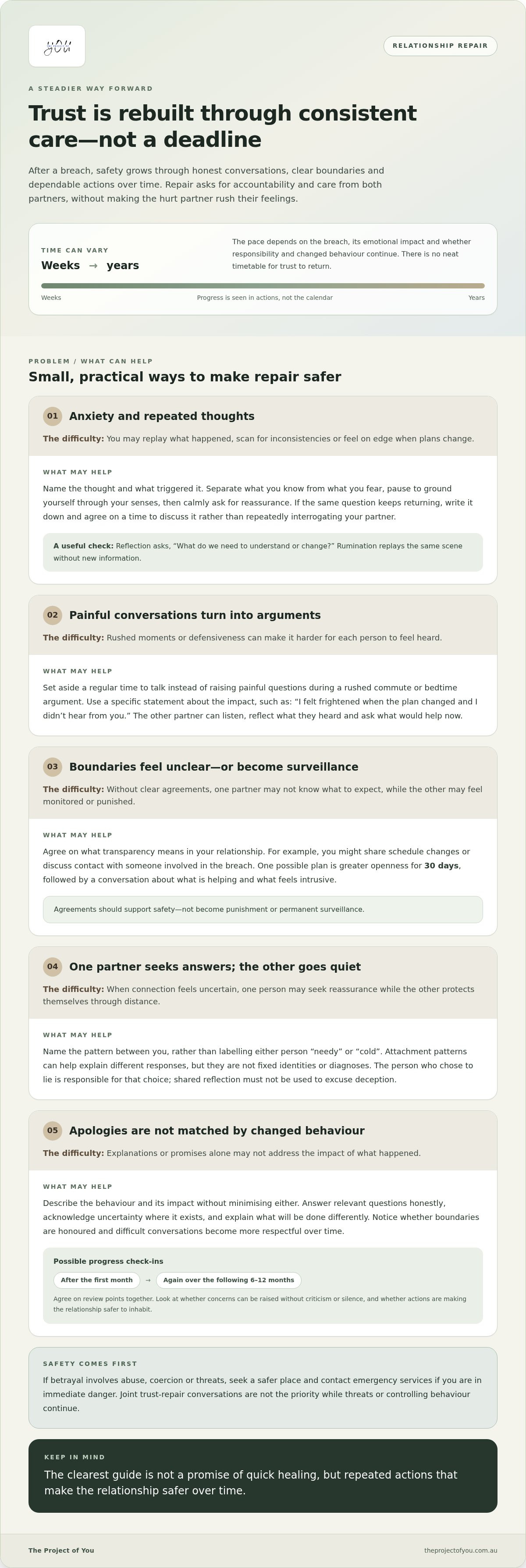
Rebuilding trust can take weeks to years, depending on the betrayal and its emotional impact. A lie about an important issue may need a different kind of repair from repeated deception or a pattern of broken promises. The calendar matters less than what happens during that time: whether the hurt is heard, responsibility is taken and behaviour changes consistently.
Communication needs room for both facts and feelings. Set aside a regular time to talk instead of raising painful questions during a rushed commute or bedtime argument. One partner might say, “I felt frightened when the plan changed and I didn’t hear from you.” The other can listen, reflect what they heard and ask what would help now.
Boundaries make that conversation practical. Agree on what transparency means for this relationship, such as sharing schedule changes or discussing contact with someone involved in the breach. A short plan might include greater openness for 30 days, followed by a conversation about what is helping and what feels intrusive. These agreements should support safety, not become punishment or permanent surveillance.
How do you cope with anxiety and intrusive thoughts while rebuilding trust? Name the thought, note what triggered it, and separate what you know from what you fear may be happening. Pause briefly, ground yourself through your senses, then calmly ask for reassurance. This can help you respond thoughtfully rather than react from alarm.
Try to distinguish reflection from rumination. Reflection asks, “What do we need to understand or change?” and leads to a conversation or boundary. Rumination replays the same scene without new information, often intensifying distress. If thoughts return, write down the unanswered question and agree on a time to discuss it rather than repeatedly interrogating your partner.
Vulnerability can feel risky after a breach, but specific, honest statements give your partner a clearer way to respond. For example, “I want to reconnect, and I’m scared you’ll dismiss me” shares both the wish and the fear. The partner who caused harm can respond without defensiveness, acknowledge the impact and show honesty through everyday actions, not explanations alone.
Review progress at agreed points, such as after the first month and again over the following 6-12 months. Notice whether difficult conversations become more respectful, whether boundaries are honoured, and whether both partners can raise concerns without criticism or silence. For someone wondering how to trust your partner again, the clearest guide is not a promise of quick healing, but repeated actions that make the relationship safer to inhabit.
2. How do attachment styles affect trust recovery?
Attachment describes how people seek closeness and respond when connection feels uncertain. Psychologists Mario Mikulincer and Phillip Shaver have synthesised research linking attachment patterns with different ways of managing relationship distress. After betrayal, someone who fears abandonment may seek reassurance, while someone who protects themselves through distance may go quiet. These responses can collide: one partner pursues answers as the other withdraws.
These patterns are not fixed identities or proof that either partner cannot change. A delayed reply, for example, might stir fear in one person and feel like pressure to another. Naming the cycle can help you talk about what happens between you rather than labelling someone “needy” or “cold”. Mikulincer and Shaver’s work offers a framework for understanding these differing responses, not a diagnosis of either partner.
A lie can unsettle a person’s sense of what is predictable in the relationship. The hurt partner may replay details, scan for inconsistencies or feel on edge around ordinary changes. Attachment research helps explain why uncertainty can prompt a stronger need for reassurance or distance, but it doesn’t determine how any individual will respond. Present actions and the relationship context matter too.
Taking responsibility begins with describing the behaviour and its impact without minimising either. “I hid the message, and that left you questioning what else I’ve concealed” is different from “I lied because you get upset”. The first acknowledges a choice and its effect; the second shifts attention away from the injury.
The partner who caused harm can listen to the hurt partner’s account without arguing about whether they should feel that way. They can answer relevant questions honestly, acknowledge uncertainty where it exists and explain what they’ll do differently. An apology becomes more meaningful when changed behaviour continues during uncomfortable moments, not only in a calm conversation.
Shared responsibility does not mean equal responsibility for a betrayal. The person who chose to lie owns that choice. Separately, both partners can examine conditions that leave concerns unspoken, such as avoiding conflict or dismissing bids for connection. That reflection may help the relationship change, but it must never be used to excuse deception.
What should you do if betrayal involves abuse, coercion or threats in Australia? Put safety first: seek a safer place and contact emergency services if you’re in immediate danger. Don’t make joint trust-repair conversations the priority while threats or controlling behaviour continue.
If both partners are safe and willing to take responsibility, guided support can help slow the cycle of pursuing and withdrawing. You can book a session to explore how those attachment responses shape your conversations and repair efforts.
3. How do you repair trust that has been broken?
Begin by slowing the conversation when either person feels overwhelmed. Take a short break, agree when you’ll return, then discuss one incident rather than every past conflict at once. If cheating is the breach, for example, the hurt partner might describe what feels hardest today. The other can listen without correcting their feelings or demanding quick forgiveness.
A useful conversation separates what happened, its impact and what needs to change. The partner who lied can describe their actions plainly, acknowledge the hurt and offer a specific plan to prevent a repeat. “I’ll tell you if plans change” is more useful than “You need to trust me”. Trust grows through honest behaviour repeated in everyday situations, not explanations alone.
Individual therapy can give each partner space to understand personal triggers, shame, past wounds or beliefs that intensify present hurt. It may be a helpful starting point when someone feels overwhelmed or cannot speak freely in joint sessions. One possible plan is weekly individual therapy for three months, tailored to that person’s concerns and goals.
Couples therapy focuses on the relationship itself: how partners communicate, manage conflict and rebuild emotional safety. Research reviews by Lebow, Chambers, Christensen and Johnson, and by Wiebe and Johnson on Emotionally Focused Therapy, examine evidence for different approaches to couple distress. A therapist can help partners slow a difficult exchange, describe their feelings and listen before responding. This work supports repair; it doesn’t replace honest effort between sessions.
Individual and couples therapy can complement each other. One partner might use individual sessions to understand why a delayed reply triggers panic, while joint sessions help them ask for reassurance without accusation. The partner who caused harm can practise accountability in the room, then show it through consistent actions outside it. Therapy offers a structured space for this work, while each person remains responsible for their choices.
How can you find an accredited couples counsellor in Australia? Ask about their couples-therapy training, experience with betrayal and the professional body that recognises their credentials. Contact that body to check their membership or accreditation, and ask the counsellor to explain their approach to relationship repair.
Progress might look like fewer circular arguments, clearer requests or a shared ability to pause before reacting. If you’re considering support, look for a therapist who can explain how sessions will address your situation. A useful first step is agreeing on one goal, such as discussing a difficult memory without blame or leaving the conversation unresolved.
4. Rebuilding trust through connection and new agreements
After infidelity, rebuilding trust takes shared effort and agreements that make care visible. Start with a conversation about what each partner needs to feel safer, rather than assuming the other can read their mind. One person might need a clear update if plans change; the other might need difficult questions asked calmly. Both partners can agree on a goal, such as honest communication without punishment or avoidance.
What boundaries and agreements can help rebuild trust in a relationship? Couples might agree to discuss contact with someone involved in the betrayal, share schedule changes or use a shared calendar temporarily. Choose measures together, explain their purpose and review whether they support safety or create pressure. Agreements should be specific, respectful and open to change through discussion, not imposed as ongoing surveillance.
Make expectations observable. For example, agree to respond about schedule changes within 24 hours, or to let each other know when a conversation needs a pause. If one partner feels anxious after a late change of plans, a brief message can prevent uncertainty from becoming a night of guessing. The partner receiving the request can say what they can realistically do, then follow through.
Regular check-ins help couples notice what’s working before frustration builds. Set weekly time to ask: “What helped us feel connected?”, “What felt difficult?”, and “Is an agreement still useful?” Checkpoints at 30, 60 and 90 days can offer chances to review and adjust commitments. These conversations aren’t tests of whether the hurt partner has healed; they help both people stay engaged with the repair.
Consistency matters more than a grand gesture. If someone promises openness but becomes defensive whenever a concern arises, the agreement loses meaning. If they acknowledge the impact, answer honestly and act in line with their words, they offer new experiences the hurt partner can gradually assess. A documented 90-day accountability plan can help clarify actions and progress, provided both partners agree it feels appropriate.
Connection also needs room for ordinary moments, not only discussions about the breach. A couple might protect a shared meal, take a walk after work or check in briefly each day. These gestures don’t erase betrayal. They create opportunities to experience warmth and reliability alongside difficult conversations, helping the relationship hold more than the injury.
Moving forward means noticing whether both partners are still working towards the same goal. If one person repeatedly avoids agreed actions or the other feels pressured to accept repair prematurely, revisit the terms together. A marriage can’t be rebuilt through one partner’s effort alone. Honest agreements should protect dignity, make care visible and give each person a clear way to raise concerns.
5. Exploring deeper emotional and attachment issues
A breach can stir feelings that reach beyond the present situation. If a partner hides a purchase, for example, the hurt may connect with an earlier experience of being misled or left out. Ask yourself, “What happened now, and what older fear has this brought forward?” Separating those threads can help you respond to today’s behaviour without dismissing deeper emotional pain.
Attachment theory offers one way to understand how earlier experiences shape expectations of closeness and safety. Research reviews by Mario Mikulincer and Phillip Shaver describe how attachment patterns can influence responses to relationship distress. This framework isn’t a diagnosis or a fixed explanation for your actions. It can prompt useful questions about what you learned to expect from people and what feels threatening now.
A late message, for instance, may bring up fear of being forgotten, while a partner’s request for space may feel like rejection. Notice the sequence between the event and your response: what did you assume, what did you feel, and what did you do next? This pause can help distinguish an old pattern from information about the present relationship, while recognising that both may matter.
Anger may sometimes sit alongside more vulnerable feelings, such as fear, sadness or embarrassment. Rather than treating anger as the whole story, try identifying one feeling beneath it: “I’m scared I’ll be blindsided again.” This gives a partner a clearer way to understand your experience. It doesn’t excuse the breach or remove the need for accountability.
Look carefully at the source of mistrust. Is there a present action, such as repeated secrecy, that needs a boundary? Or does an ordinary inconsistency echo an earlier betrayal? It may be both. Write down the event, your interpretation and what you know, then consider what question could clarify the situation without treating a fear as proof.
Past hurt can also shape expectations in a new relationship. If a former partner was unfaithful, a delayed reply from someone new may bring old alarm into the present. You can explain what gets activated and ask for reasonable reassurance, while avoiding loyalty tests or treating every small mistake as evidence of danger. Healthy trust leaves room for care and ordinary human imperfection.
Self-reflection isn’t a request to blame yourself for someone else’s choices. It means noticing what you need, what you fear and which patterns you want to change. Ask, “What would help me feel emotionally safe without controlling my partner?” If these questions are hard to untangle, book a session to explore emotional patterns and consider what support may help.
The Project of You | Trauma, Couples & Relationship Therapy Australia: Nervous System Regulation & Restoration
The Project of You | Trauma, Couples & Relationship Therapy Australia offers Nervous System Regulation & Restoration for people who feel overwhelmed or on edge while navigating relationship repair. This work can help you notice your responses and find ways to settle before difficult conversations, so you can approach them with greater awareness.
If betrayal has stirred older hurt or anxiety, Individual Counselling offers space to explore what you’re feeling and what support may help. You don’t need every answer before seeking support; you can begin with the part that feels hardest to carry right now.
Contact The Project of You to explore a next step that feels right for you.
Choose a next step that honours what you need
Trust doesn’t return because you tell yourself to move on. It takes shape through choices that respect your feelings, your boundaries and the kind of relationship you want to build. You can stay curious about your partner while also listening to what your own sense of safety is telling you.
If you’re weighing how to trust your partner again, consider one small next step: name the question you’re carrying, decide what support would help, or make space to reflect before your next conversation. The Healing Feminine Workshops and Self Love e-Books offer ways to engage with personal reflection alongside the work of relationship repair.
Seeking support doesn’t mean you’ve failed to manage things alone. It can give you space to understand what you need and choose your path with care.
Whatever you decide about the relationship, you deserve to move forward with clarity, dignity and compassion for yourself.
Frequently Asked Questions
How long does it take to rebuild trust after a betrayal?
There’s no single timetable for trust to return; it can take weeks to years. Progress may feel uneven: a calm conversation can be followed by a difficult anniversary, reminder or unexpected discovery. Rather than measuring recovery by whether you feel upset, notice whether you can raise concerns more safely and whether your partner’s choices remain dependable in ordinary, stressful moments.
How do attachment styles affect trust recovery?
Attachment patterns can shape what each partner does when closeness feels uncertain. One person might seek frequent contact, while the other needs space to think. Describe the pattern without turning it into an identity: “I reach out more when I’m unsure, and you go quiet.” Then agree how to stay connected during a pause, such as sending a message about when you’ll return to the conversation.
How do you repair trust that has been broken?
Start by agreeing what repair means in everyday terms, not only emotionally. If shared finances were affected, for example, decide how you’ll make upcoming spending visible and how either person can raise a concern. Keep the agreement focused on the injury, and review whether it feels respectful. If conversations repeatedly become hostile or confusing, couples counselling can help slow them down and clarify what each person needs.
What role do passive-aggressive behaviours or the silent treatment play?
When is it time to walk away?
Consider stepping away when your partner repeatedly refuses responsibility, continues behaviour that harms you or makes no effort to repair the relationship. You don’t need to prove the situation is “bad enough” before taking your wellbeing seriously. If there are threats, coercion or abuse, prioritise safety and seek support from someone you trust or an appropriate service rather than relying on relationship-repair conversations.
Will my trust issues ever go away?
Trust concerns can become less consuming as you process what happened and experience safety in your relationships. A trigger, such as an unanswered message, may still bring up old feelings without meaning you’ve lost progress. Notice whether you can pause, check the present facts and choose a response that reflects your values. Individual counselling can help if past experiences continue to shape your sense of safety.
What are the steps to rebuild trust with a partner after betrayal?
Begin with shared willingness to address the breach, then agree what needs to change and how you’ll communicate about setbacks. Follow the agreements in daily life and make space to review them together. If a plan changes, for example, discuss what happened and whether the agreement worked. Keep the focus on observable behaviour and mutual understanding rather than expecting one conversation to settle every doubt.
How can you tell whether your partner is genuinely remorseful and trustworthy?
Look for whether your partner can describe the harm without blaming you, answer questions honestly and respect the time you need. Remorse is more credible when actions match words, including when the topic is uncomfortable or inconvenient. Notice how they respond to a reasonable boundary: do they engage with it or pressure you to drop it? Trustworthiness becomes clearer through consistent conduct over time.



Comments