

Marriage counseling retreats in Australia: costs and inclusions

What if the first question about marriage counselling retreats Australia isn’t whether a retreat will fix everything, but whether you’ll feel safe enough to speak honestly? Privacy matters, and as retreat facilitator and relationship counsellor Azita Abdollahian explains, a retreat setting alone doesn’t explain how confidentiality is handled. Before deciding, it’s reasonable to understand how sessions work and what the experience involves. Retreats differ in format, location and inclusions, so costs depend on the package rather than one standard rate.
It’s understandable to want clarity before setting aside time and money, especially when you’re deciding together. A retreat may create focused time for conversations that are difficult to make room for in everyday life, while remaining one part of a broader relationship journey.
This guide explains who can attend, what couples may work on, where retreats run and what packages can include, from counselling to accommodation and meals. It also explores how costs are shaped and what to consider when looking into private health rebates. You’ll have a clearer sense of which questions matter as you decide whether a retreat feels like a supportive next step for your relationship.
Table of Contents
Is this only for married couples?
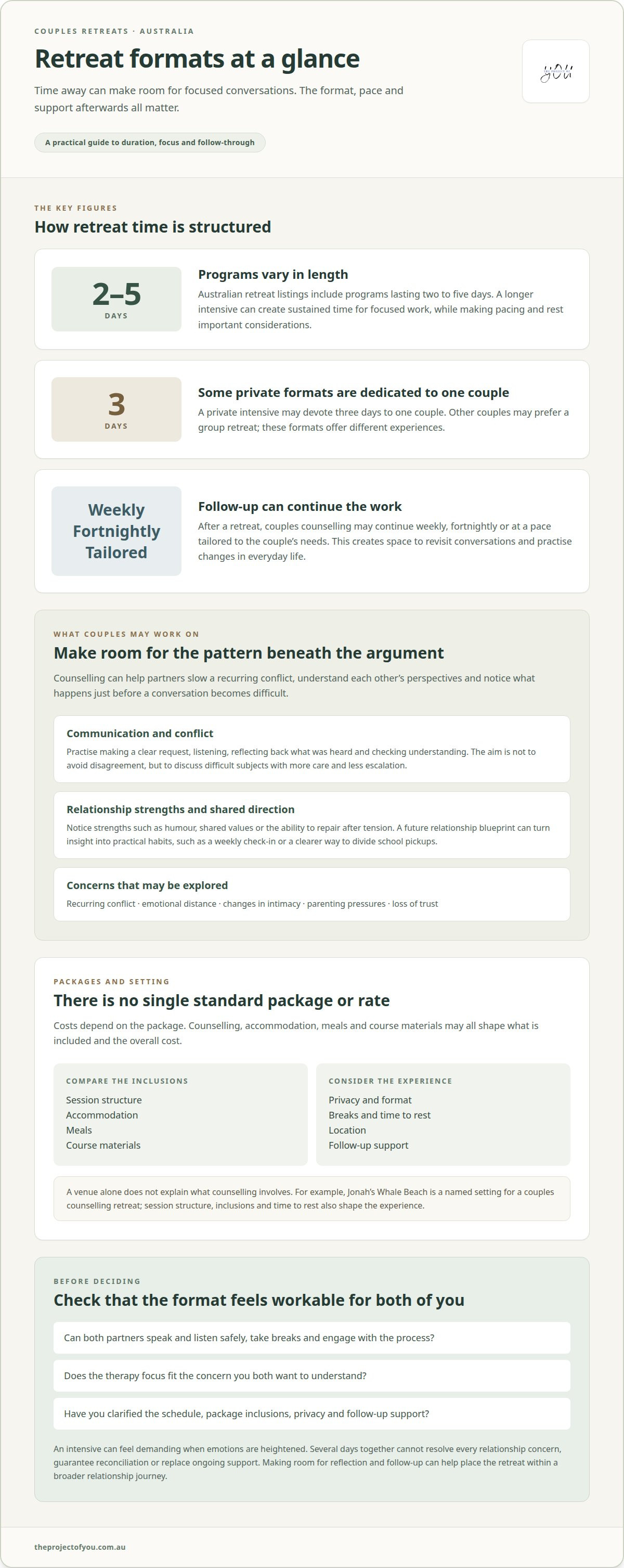
Marriage counselling retreats in Australia aren’t necessarily limited to legally married couples. The word “marriage” often describes the relationship focus, while couples may seek support at different stages. For example, partners who live together might want help with recurring disagreements, emotional distance or rebuilding intimacy. The practical question is whether the format fits both people’s needs and whether both are willing to take part.
A relationship in crisis isn’t automatically suited to an intensive retreat. Focused sessions can offer time to slow down and explore a difficult pattern, such as one partner withdrawing while the other presses for answers. But a concentrated program can also feel demanding when emotions are heightened. Consider whether both partners can speak and listen safely, take breaks and engage with the process. A retreat doesn’t guarantee reconciliation or replace support that continues afterwards.
Jonah’s Whale Beach is a named setting for a couples counselling retreat. The name may help couples picture a coastal retreat, but the venue alone doesn’t explain what the counselling involves. Session structure, accommodation, meals and time to rest all shape the experience. For example, a couple wanting privacy may prioritise a format dedicated to one couple, while another may prefer a group retreat. These are different experiences, so the setting should fit the purpose.
Intensive couples therapy may suit partners who can identify a shared goal, even if they disagree about how to reach it. One couple might want to understand recurring conflict; another may be seeking a new perspective after trust has been strained. Australian retreat listings include programs lasting two to five days. Some private formats devote three days to one couple, creating more sustained time for focused work. Longer sessions can bring difficult feelings into view, so energy, pacing and space between conversations matter.
Couples can choose a suitable retreat by agreeing on the main issue, then matching it to the format, location and level of privacy. Before booking, clarify the session schedule, package inclusions, breaks and follow-up support. These details help couples compare a coastal retreat such as Jonah’s Whale Beach with other Australian formats without assuming every program offers the same experience.
Intensive counselling has limits: several days together cannot resolve every relationship concern, and concentrated conversations may leave partners tired or emotionally stirred. A retreat also doesn’t provide the same ongoing rhythm as regular couples counselling. Consider whether you can make room for reflection and follow-up after returning to everyday routines.
Continuing couples counselling after a retreat can help partners revisit what they discussed and practise changes in daily life. Follow-up sessions may be weekly, fortnightly or tailored to the couple’s needs. For example, a later session could revisit a difficult conversation that felt unfinished during the retreat. Planning that next step gives the retreat a place within a broader process, rather than treating it as a complete solution.
Communication, conflict and relationship strengths
A therapy retreat can help couples slow recurring conflict and notice what happens just before conversations become difficult. The work can also identify relationship strengths, such as humour, shared values or the ability to repair after tension.
Communication and Conflict Work
Communication work may help each partner describe an experience without turning it into blame. For example, “I felt alone when we made that decision” offers a clearer starting point than “You never listen”. Couples can practise listening, reflecting back what they heard and checking their understanding. Look for a retreat that makes room for both partners’ perspectives, not just a quick agreement.
A focused intensive can also map the sequence of an argument. One partner might raise a concern about household tasks, the other may hear criticism, and both may become defensive. Naming the pattern helps couples pause and choose a different response. The aim isn’t to avoid disagreement, but to discuss difficult subjects with more care and less escalation.
A personalised future relationship blueprint can turn insight into shared direction. Each partner might name what they want more of, such as affection, teamwork or unhurried time together. They can then agree on practical habits, like a weekly check-in or a clearer way to divide school pickups. The blueprint works best as a living guide, with room to revise it as circumstances change.
Relationship Issues Addressed
Retreats may address recurring conflict, emotional distance, changes in intimacy, parenting pressures or loss of trust. For example, new work hours can leave a couple coordinating calendars but rarely reconnecting. The useful question is whether the retreat’s therapy focus fits the issue both partners want to understand, rather than assuming one program covers every relationship concern.
A therapy-focused relationship retreat differs from a general wellbeing break because counselling conversations are central. Couples can explore what each person brings to a difficult moment, including expectations, boundaries and ways of seeking closeness. Understanding these responses can build perspective without making either partner the problem.
Relationship skills are most useful when they translate into everyday actions. Partners might practise making a clear request, pausing before responding or returning to a conversation after a break. Intended outcomes can include better understanding, more constructive discussions and renewed connection, but they depend on what each couple is ready to work on. A retreat can help set a direction; applying new skills at home takes continued attention.
If you’d like support identifying a helpful focus for couples therapy, you can book a conversation and explore what kind of work may suit your relationship.
Cost, accommodation, meals and course materials
A couples therapy retreat package may combine counselling sessions with practical arrangements, but inclusions differ. Separate the therapy component from accommodation, meals and activities to understand what the overall package covers.
Accommodation and Meals
Accommodation can shape how much time couples have to rest between sessions. A retreat in a hotel, lodge or private setting may feel different from counselling arranged around local accommodation. Meals may be provided, partly included or left for couples to arrange. For example, a package that includes dinner may reduce planning during an intensive day, while self-catering gives couples more choice.
Consider practical details alongside the setting: whether the package covers overnight stays, which meals are included and whether refreshments are available during sessions. A quiet break between counselling and dinner can matter after an emotionally demanding conversation. These details affect comfort and planning, but they’re separate from the therapeutic work.
Package Inclusions
Inclusions may bring together counselling sessions, accommodation, meals, workbooks and retreat activities. A workbook, for instance, can give couples prompts to revisit after a session, while a guided activity may create space for reflection outside the counselling room. Each item serves a different purpose, so the package description should make clear what’s included.
Costs vary according to factors such as duration, privacy, accommodation, number of sessions and included activities. A private format focused on one couple differs from a group program with shared activities. Rather than comparing only the total, consider how much time is dedicated to therapy and whether the setting and inclusions match your needs.
Course materials can help translate a conversation into a practical step at home. For example, a prompt about listening might support a weekly check-in, while a shared exercise could help partners name what they want to practise. Materials are most useful when they connect directly to the sessions, rather than adding activities without a clear purpose.
Therapeutic approaches also differ. A retreat may describe its work as structured couples therapy or use another therapeutic framework; the label alone doesn’t explain how sessions are organised. Consider how the approach relates to your goals, such as handling recurring disagreements or rebuilding closeness, and whether planned activities leave room for rest.
To make a clear comparison, group the package details into three parts:
Therapy: sessions, format and any preparation or follow-up.
Stay: accommodation, meals and refreshments.
Activities and materials: workbooks, guided exercises and other included experiences.
This simple breakdown helps couples see what a package supports, what they’ll need to organise separately and whether its balance of therapy and downtime feels workable.
Retreat locations in South East Queensland and across Australia
Australian couples retreats run in coastal, regional and urban settings. Location can shape travel, privacy and the space available for emotional conversations.
Locations Across Australia
Retreat settings named across Australia include Crestmead and Redcliffe in Queensland, Katoomba and Upper Burringbar in New South Wales, and Tasmania. Other examples include Sydney’s Northern Beaches and Northern New South Wales. These places involve different travel considerations, from reaching a regional retreat to arranging accommodation near an urban venue.
South East Queensland options include a private couples retreat in Crestmead and a location in Redcliffe. Brisbane also appears in intensive couples therapy listings. Before settling on a place, consider travel time, transport, overnight arrangements and whether the setting offers the privacy you want. A familiar, accessible location may feel more manageable than a long journey during a demanding period.
2027 Dates and Location
For a 2027 retreat, treat the scheduled dates and venue as a pair. A location such as Redcliffe, Crestmead or Katoomba affects travel planning, while the dates shape work leave, childcare and accommodation arrangements. A couples retreat is easier to plan when both partners can protect time before travelling and allow room to settle afterwards.
Retreat calendars differ by venue and format, so a date alone doesn’t describe the experience. Consider where sessions take place, how much travel is involved and whether accommodation is near the venue. For example, a couple travelling to Katoomba may plan differently from partners attending in Brisbane.
Queensland offers several location choices for couples seeking focused time together. Crestmead is identified as a private couples weekend retreat location, while Redcliffe is another option. Brisbane provides an urban setting for intensive couples work. The practical fit depends on where you’re travelling from and how you’ll manage the journey alongside emotionally focused sessions.
Across New South Wales, retreat locations include Katoomba, Upper Burringbar, Northern New South Wales and Sydney’s Northern Beaches. A regional setting may create distance from everyday routines; an urban venue can make travel simpler for couples living nearby. The setting doesn’t determine the quality of the conversations, but it can influence rest, privacy and how couples experience time away together.
When comparing locations, plan the journey alongside the retreat schedule. For example, a couple travelling from outside Queensland might need to coordinate transport, overnight accommodation and time away from work. Partners based nearby may prioritise an easy arrival and a calm return home. These details can help protect your attention for the connection and relationship work that brings couples to an intensive.
Package costs and possible private health rebates
A retreat package price reflects more than counselling time. Format, session schedule, facilitator arrangements, accommodation and included activities can all shape the total. The price depends on the individual arrangement and is provided after a quote request; factors include duration, privacy, accommodation and inclusions.
Private counselling and weekly therapy spread sessions across everyday routines. A weekend retreat brings more focused conversations into a shorter period, while online therapy avoids travel and accommodation. Each format has trade-offs: a retreat can create concentrated time together, whereas regular sessions allow couples to practise changes between appointments.
Private health rebates may apply differently to counselling services and retreat packages. Don’t assume a package is eligible simply because it includes therapy sessions. Relevant details include the service being claimed, the practitioner and the terms of your specific policy. Ask your insurer how it treats couples counselling and non-therapy inclusions, such as accommodation or meals.
Retreat dates and pricing can be arranged privately rather than through a set public weekend schedule. This allows couples to discuss a suitable format and practical package details together. The amount depends on what’s included, such as the retreat length, session time, accommodation and activities. A quote should make those components clear so you can understand what you’re paying for.
Some intensive formats involve two facilitators and one couple at a time. This structure may offer more than one professional perspective during sessions, while keeping the work centred on the couple. It also differs from weekly therapy with one practitioner. The format itself doesn’t determine whether it suits you; consider the issue you want to work through, your preferred pace and the time you can set aside.
Confidentiality matters in private counselling, particularly when partners discuss sensitive experiences. Ask how the retreat handles session information, records and communication outside the room. A private setting describes who attends the work, but not every privacy arrangement. Clear information about confidentiality can help both partners understand the boundaries before difficult conversations begin.
Compare retreat and non-retreat formats by separating therapy from travel costs. For example, a couple choosing an in-person weekend may need to budget for transport, meals or extra accommodation if these aren’t included. Online therapy removes the retreat venue from the plan, while ongoing sessions require a different time commitment. These practical differences can help you decide which structure feels manageable.
The Project of You | Trauma, Couples & Relationship Therapy Australia: Marriage Counselling
The Project of You | Trauma, Couples & Relationship Therapy Australia offers Marriage Counselling for partners seeking support with relationship concerns, including attachment patterns, infidelity and difficult conversations. Its trauma-informed approach can help couples explore how past experiences shape present interactions, without placing blame on either partner.
If intense emotions make it hard to stay present in conversations, Nervous System Regulation & Restoration may also be relevant. The focus is on understanding your needs and each other’s perspectives, then finding practical ways forward. Couples can seek support when caught in recurring conflict, feeling distant or wanting to strengthen their connection.
If you’d like to explore whether this support fits your relationship, contact The Project of You | Trauma, Couples & Relationship Therapy Australia.
Choose a next step that feels right for your relationship
Choosing marriage counselling retreats in Australia is one way to make space for your relationship, but the pace and setting should feel workable for both partners. You might begin by naming what you hope could change: more honest conversations, greater closeness or a clearer understanding of a recurring pattern. That shared intention can guide your next step without requiring you to have every answer today.
If a retreat doesn’t feel like the right fit just now, support can take other forms. The Healing Feminine Workshops and Self Love e-Books offer additional ways to explore personal growth and self-understanding. A conversation with a therapist can also help you consider what kind of support matches your needs, whether you’re moving through conflict or hoping to strengthen your connection.
There’s no need to have the perfect words before reaching out. A small, considered step can help you begin finding a path forward together.
Frequently Asked Questions
Is it completely confidential?
Confidentiality is important in therapy, but don’t assume every retreat uses identical privacy arrangements. Before sessions begin, clarify how personal information is handled, whether anything is shared outside sessions, and how joint and individual conversations are treated. For example, if one partner wants to speak privately, both should understand how that information will be managed before deciding what to share.
What does it involve?
A retreat involves guided conversations with a therapist about what’s happening in the relationship and what each partner wants to understand. Couples may reflect on the questions they want help exploring, then use sessions to hear each other with support. For instance, partners could bring one recurring disagreement and describe what each experiences, rather than trying to resolve every concern at once.
What marriage counselling retreats are available in Australia?
Australian couples can find private and group retreat formats, including programs centred on counselling and retreats that combine therapy with other activities. These options differ in how sessions are arranged and how much of the experience is shared with other participants. A useful starting point is deciding whether you’d feel more at ease working privately or in a group setting.
Where are couples counselling retreats located in Australia?
Couples retreats operate across Australia in metropolitan, regional and coastal settings. The venue can affect accessibility and the feel of time away, so consider practical needs such as mobility, transport connections and how far you’re comfortable travelling. A retreat close to home may make arrival simpler; travelling further may create more distance from familiar routines.
How much do marriage counselling retreats in Australia cost?
There is no single price for every retreat. Before committing, ask for a written breakdown showing whether the quoted amount is per couple or per person, what payment schedule applies, and how changes or cancellations are handled. This helps prevent surprises and makes it easier to plan the full commitment, including travel and arrangements outside the retreat package.
What is included in the price of an Australian couples retreat?
Inclusions depend on the individual package. Check whether the quoted amount covers all scheduled sessions, any preparation or follow-up, and planned activities, rather than assuming every part of the retreat is bundled together. If an activity is optional or an item must be arranged separately, knowing this beforehand can help you plan your time, energy and budget.
How long do marriage counselling retreats usually last?
Retreats can run from a brief intensive to a multi-day program, depending on the format. The number of days doesn’t show how demanding the schedule will feel, so consider the time between sessions and whether the program allows room to rest. For example, arranging a lighter day after returning home can give you and your partner time to settle back into routine.
Are Australian marriage counsellors and retreat providers accredited?
Accreditation varies, so a retreat’s name or venue alone doesn’t establish a counsellor’s professional standing. Ask who will conduct the sessions, what professional qualification they hold, and which professional body or registration applies. Retreat providers and individual counsellors may have different credentials; the key is understanding who is responsible for the therapeutic work and what their role involves.
Comments