

Deep Questions for Couples to Reconnect Through Better Conversations

What if feeling closer began with asking a different kind of question? Deep questions for couples to reconnect can open space to talk about what everyday routines often leave unsaid: whether you feel supported, emotionally safe, intimate and understood. Even couples who have shared years together can drift into conversations about tasks rather than each other.
If that sounds familiar, it doesn’t mean either of you has failed. Work, parenting, stress and past hurts can make it harder to stay curious, even when you still care for each other. A thoughtful question won’t solve everything, but it can create a gentler path towards hearing what matters to each of you. Azita Abdollahian is a relationship expert and psychotherapist, with hundreds of couples coming to her monthly retreats. Today, she shares her expertise with us.
Here, you’ll find questions about intimacy, support and safety, as well as shared activities and the future you want to build together. You’ll also learn how to use them without turning the conversation into an interview: choose a relaxed time, ask one question at a time and listen with curiosity. Small, intentional conversations can help you notice one another again and start reconnecting with each other.
Table of Contents
1. What Happens When Couples Stop Asking Questions?
When partners stop asking about each other, conversation can narrow to schedules, chores and who’s picking up dinner. That shift doesn’t prove a relationship has lost its care. Distance can develop after six months together or during a relationship lasting 15 years. Questions help couples notice what’s happening beneath everyday routines.
Shared memories offer a practical place to begin. Ask, “What do you remember about our first weekend away?” or “Which moment from our early years still makes you smile?” Then pause for the details: the nervous laughter, the wrong turn or the café you both loved. These memories can remind you how the relationship began and what you enjoyed creating together.
Milestones aren’t only anniversaries or major achievements. A partner might remember being comforted after a difficult workday, celebrating a small success or managing a family change together. Try asking, “Which ordinary moment made you feel closest to me?” The answer may reveal meaningful turning points that weren’t marked on a calendar.
Asking about needs can make appreciation more specific. Rather than assume a kind gesture landed as intended, ask, “What did I do recently that helped you feel cared for?” You might hear that a cup of tea after a late shift mattered more than a grand plan. Naming what works gives both partners something clear to recognise and continue.
Emotional intimacy grows through small, regular check-ins, not only serious conversations during conflict. Set aside a calm moment and ask, “What’s been taking up most of your thoughts this week?” Follow with, “Is there something you’d like more support with?” These questions make room for changing needs and show that your partner’s inner life still matters.
Appreciation also means noticing what the relationship already does well. Each partner could name one quality they value and one shared habit they want to protect. For example, you might both appreciate humour at dinner or the way you divide school drop-offs. Concrete details help balance problem-solving with recognition of the connection you’ve built.
During a sensitive conversation, avoid questions that accuse, shame or demand an immediate answer, such as “Why are you always like this?” or “Do you even care?” They can leave a partner defending themselves instead of sharing honestly. Ask about a specific moment, speak calmly and allow time for a response.
Couples who’ve been married for 30 years and people newly dating can both use questions to understand one another. Try a simple check-in: recall one shared memory, ask what it means now, then name one thing you appreciate. That sequence can turn a familiar story into a fresh conversation about who you are together today.
2. Discussing intimacy and the couple’s love life
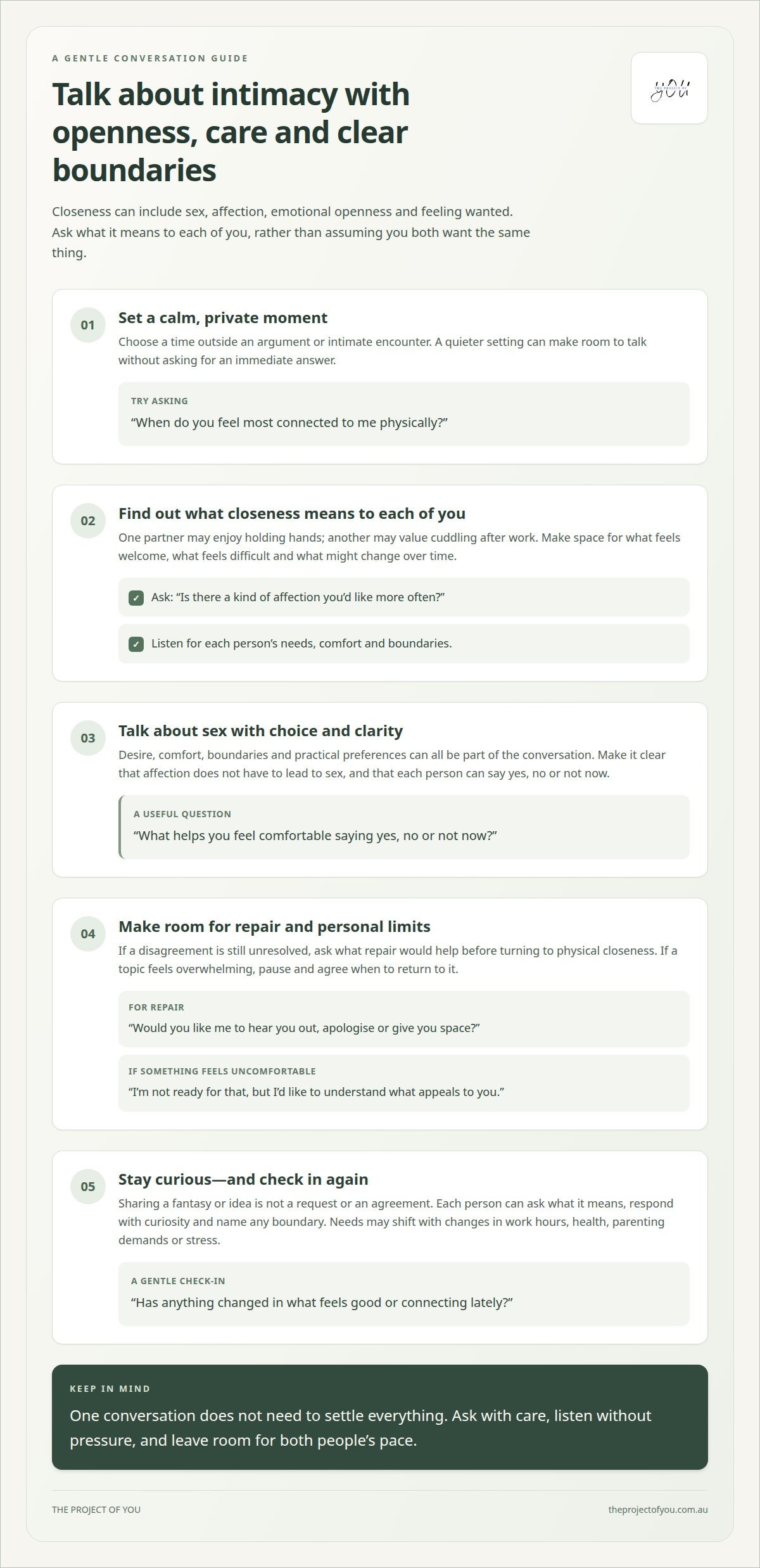
Intimacy includes sex, affection, emotional openness and feeling wanted. A couple might enjoy holding hands but feel unsure about initiating sex. Another may value cuddling after work more than a planned date. A meaningful conversation starts by asking what closeness looks like for each partner, rather than assuming you both want the same thing.
Choose a calm, private moment, not the middle of an argument or an intimate encounter. Ask, “When do you feel most connected to me physically?” or “Is there a kind of affection you’d like more often?” These questions invite detail without demanding a particular answer. Listen for what feels welcome, what feels difficult and what might change over time.
Clear communication about sex can include desire, comfort, boundaries and practical preferences. One partner, for example, might want more time to relax before physical touch, while the other may need reassurance that affection doesn’t always lead to sex. Ask, “What helps you feel comfortable saying yes, no or not now?” Respecting each answer supports choice and emotional safety.
Conflict can affect intimacy, especially when a disagreement remains unresolved or either person feels criticised. Rather than using sex to smooth things over, ask what repair would help first. “Would you like me to hear you out, apologise or give you space?” separates emotional repair from physical closeness and makes room for both partners’ pace.
Talking about fantasies can feel vulnerable, particularly when shame or fear of rejection is present. Begin gently: “Is there something you’ve been curious about discussing, without any pressure to act on it?” Sharing an idea isn’t a request or an agreement. Each partner can respond with curiosity, ask what it means and clearly name any boundary.
If a suggestion feels uncomfortable, try, “I’m not ready for that, but I’d like to understand what appeals to you.” This keeps the conversation open without abandoning personal limits. If either partner becomes overwhelmed, pause and agree on when to return to the topic. Coming back to it shows care while leaving room for reflection.
Keep asking instead of treating one conversation as a permanent answer. After changes in work hours, health, parenting demands or stress, a couple’s needs may shift. A brief check-in could be, “Has anything changed in what feels good or connecting lately?” Specific questions help partners talk about intimacy together, rather than interpreting silence as rejection.
If these conversations repeatedly become painful or shut down, structured support can help partners speak and listen with greater care. Explore booking couple counselling when you’d like help approaching these discussions with support.
3. Learning what makes a partner feel supported and safe
Support can look different for each person, even in a long marriage. One partner may want practical help before a family event; another may need reassurance or quiet company. Ask, “What would help you feel steadier today?” Then let the answer guide your response instead of assuming the support you prefer is what your partner needs.
Stress is often easier to discuss through a specific example. A partner might say, “I’m tense about presenting at work tomorrow, and I keep replaying what could go wrong.” You could ask, “Would you like help preparing, a distraction or space to talk it through?” Naming options makes it easier to express a need without expecting the other person to guess.
Try a simple turn-taking exercise around one current stressor. One person talks about what’s weighing on them while the other listens, then reflects what they understood. For instance: “You’re worried about the meeting, and you’re not sure your manager will back you.” The speaker can clarify or add detail before you swap roles.
Are there evidence-based couples conversation exercises recommended by relationship therapists? Therapists may use structured listening exercises, but a prompt shouldn’t be called evidence-based without research supporting that method. Treat turn-taking as a practical way to organise a conversation, not as a proven treatment in itself.
Acts of service can show care when they match the need. If a partner is overloaded by household tasks, ask whether taking over the grocery shop would help. If they’d rather decide together, agree on a short list before heading out. A specific offer is often easier to answer than “Let me know if you need anything.”
Feeling safe also depends on how mental health concerns are received. If someone describes feeling low or anxious, avoid quick fixes such as “Just look on the bright side.” You might say, “I want to understand what this has been like for you.” Ask whether they’d like company, practical support or help thinking about next steps.
A difficult memory can make a present-day conversation feel more charged. If your partner becomes tense while discussing a family visit, pause and ask, “Would you like to keep talking, take a break or come back to this later?” Offering a choice respects their pace without deciding what their reaction means.
Couples counselling may help partners notice recurring patterns, such as one person seeking reassurance while the other withdraws under pressure. A counsellor can guide each person to describe what they feel and need without assigning blame. It may be worth considering when conversations repeatedly stall, or when dating or married partners struggle to discuss sensitive topics safely.
4. Reintroducing loving habits and shared activities
Closeness can return through ordinary moments, not only special occasions. Ask your partner, “What’s one thing we used to enjoy that you’d like to bring back?” You might remember cooking dinner together, walking after work or choosing music for a drive. The aim isn’t to recreate the past exactly, but to find a shared activity that feels welcoming now.
Reminiscing can also uncover what made those experiences meaningful. Think of a camping trip, a favourite local café or a difficult move you managed together. Ask, “What do you remember most about that time?” and “What did we bring out in each other?” Specific answers can reveal qualities, such as humour or teamwork, that you might invite into your life now.
Make appreciation concrete. Instead of saying only, “You’re great,” name an action: “I appreciated you making dinner when I had a long day.” Then ask, “What’s something I do that helps you feel we’re a team?” Honest recognition helps partners notice the care already present and gives each person a clearer sense of what matters.
Shared habits work best when both partners have a say. Each person can suggest a small activity, then choose something that suits both schedules and energy. It might be a favourite board game after dinner or a short walk before the weekend gets busy. If an idea doesn’t fit, adjust it together instead of treating that as rejection.
Playfulness can make connection feel less like another task. Try choosing a song for each other, sharing a silly memory or having a brief hug, if it feels comfortable for both. Notice whether the gesture is welcome. A warm habit needs consent and flexibility; affection shouldn’t become a test either partner has to pass.
Couples may need to protect time together deliberately. For example, partners might decide to try weekly date nights and see how they feel over time. This can prompt a useful question: “What regular time could we make ours?” It needn’t involve an elaborate outing. A shared meal at home can make room for conversation without phones or competing chores.
Questions that help build a shared life can look beyond routines. Ask, “What would you like us to make more room for this season?” or “What’s something new we could learn together?” One partner might suggest gardening while the other wants to visit a new walking track. Explore the answers, then choose a next step that respects both preferences.
Start with one habit rather than changing everything at once. Decide together what you’ll try, when it might happen and how you’ll check whether it feels connecting. If weekly dinner becomes stressful, try a different activity. Staying curious lets shared rituals evolve with your relationship instead of turning into obligations.
5. Intentional communication and reconnecting
Intentional communication is less about finding perfect words and more about making room for an honest exchange. Choose a relaxed moment when neither partner is rushing, then put phones aside. Start with a question or two rather than working through a long list. A short pause can help each person notice their thoughts before answering.
Meaningful deep questions for couples to reconnect might include, “What helps you feel close to me lately?” or “What would you like us to make more room for?” These invite reflection without implying something is wrong. A future-focused question could be, “What might help our relationship stay loving over the next 10 years?”
To use conversation prompts without creating an interview, take turns asking and answering. Let one partner speak in detail while the other listens without interrupting or correcting. Then swap roles and share your own response. Rather than firing off another question, respond with a gentle reflection, such as, “It sounds like that mattered to you.”
If your partner feels distant, try asking, “What’s been on your mind lately?” or “Is there a small way I could feel closer to you today?” These questions leave room for an answer that might be tiredness, stress or a need for space. Listen to what’s said, and don’t treat one quiet moment as the whole story.
Start with 20 minutes of focused, distraction-free conversation if setting aside time feels difficult. One partner might ask, “What would you do with two uninterrupted hours alone?” The answer could reveal a need for rest, creativity or time together. You can then ask what support would make that preference easier to honour.
Turning towards each other can be as simple as responding when a partner shares a small thought. If your partner mentions a favourite song during the morning commute, ask what they like about it. That brief exchange shows interest and gives the conversation a natural path, without requiring either person to deliver a polished or profound answer.
For a more intentional check-in, each partner can name one thing they’re carrying, one thing they appreciate and one thing they’d like to discuss. Keep the focus on understanding, not winning. If an answer surprises or hurts, take a breath and ask, “Could you tell me more about what you mean?” Curiosity can make room for clarity.
Try this approach during a quiet meal or a walk, then notice what helped the discussion feel easier. If either partner becomes overwhelmed, pause and agree on when to return to the subject. Reconnection grows through repeated acts of attention, not one conversation that has to resolve everything.
The Project of You | Trauma, Couples & Relationship Therapy Australia
The Project of You | Trauma, Couples & Relationship Therapy Australia offers Individual Counselling for people who want to understand their part in difficult relationship conversations. It can provide space to explore what happens when you feel unheard, shut down or unsure how to express a need. This personal reflection may help you approach future conversations with greater awareness of your feelings, boundaries and communication patterns.
The practice also offers Nervous System Regulation & Restoration, which may be relevant if stress makes it difficult to stay present during emotionally charged discussions. Support can help when attempts to reconnect keep turning into conflict or when you want to understand your own responses before deciding what comes next.
If you’d like to explore support, you’re welcome to contact The Project of You.
Make room for the next honest conversation
Reconnection doesn’t need to begin with a major decision or a perfectly phrased question. It can start with a willingness to stay curious, even when your partner’s perspective differs from yours. Deep questions for couples to reconnect can help you understand each other, but what matters is how you meet the answer: with patience, respect and care for each person’s boundaries.
You might find that conversation feels easier in a quiet moment, or that certain topics need more time and support. Let that information guide your next step. There’s no need to force closeness or settle every concern at once. Keep choosing honesty and small moments of attention, while allowing each partner to move at a manageable pace.
If you’d like support finding a way forward, you can choose to book a conversation.
Whatever you choose, approaching each other with openness can support a more thoughtful conversation.
Frequently Asked Questions
What Happens When Couples Stop Asking Questions?
Couples can start relying on assumptions instead of checking what each person thinks or needs. Everyday decisions, such as how to spend a weekend, may then feel frustrating because each partner expects the other to understand without being asked. Curiosity can reopen communication. Try asking, “What would make this weekend feel restful for you?” and share your own answer, too.
What questions help couples rebuild emotional intimacy and trust?
Questions that invite honesty, accountability and understanding can support conversations about trust. For example, ask, “What helps you feel that my words and actions match?” or “What would you like me to understand about how this affected you?” Deep questions for couples to reconnect can open discussion, but trust is also shaped by what happens afterwards: follow-through, openness and respect for agreed boundaries.
What are good questions for couples to discuss their relationship needs and values?
Ask questions that connect personal values with everyday choices. “What does being a team look like to you?” can reveal whether shared responsibility, affection or time together matters most. You could also ask, “Which part of our life would you like us to protect when things get busy?” Compare your answers without treating differences as a problem to solve immediately.
What questions can couples ask to improve communication and resolve conflict?
During conflict, ask questions that clarify each person’s experience rather than assign blame. Try, “What did you hear me saying?” or “What do you think I may have misunderstood?” Once the immediate tension has eased, ask, “What would help us handle this differently next time?” These prompts can shift the discussion towards understanding while leaving room to disagree about the issue itself.



Comments