

How to choose a couples therapist by approach, training and experience

What if choosing a couples therapist is less about finding someone with the “right” answer and more about finding someone who can understand the patterns you share? Knowing how to choose a couples therapist can feel difficult when you’re already carrying hurt, uncertainty or different hopes for what therapy might change. That's why at The Project Of You, couples counsellor and relationship expert Azita Abdollahian makes the process easier than ever for her clients.
It makes sense to look for someone both of you can feel safe with, while also wanting confidence in their training and experience. A warm connection matters, but so does the therapist’s ability to work with relationship dynamics, conflict and the concerns that brought you to counselling.
This guide will help you compare therapy approaches, understand what to look for in a counsellor’s qualifications and experience, and ask useful questions before deciding. You’ll also find ways to assess whether the therapist’s style feels respectful and balanced for both partners. The aim isn’t to find a perfect fit on paper, but to choose a thoughtful starting point for the work ahead.
Table of Contents
1. Couples therapy approaches
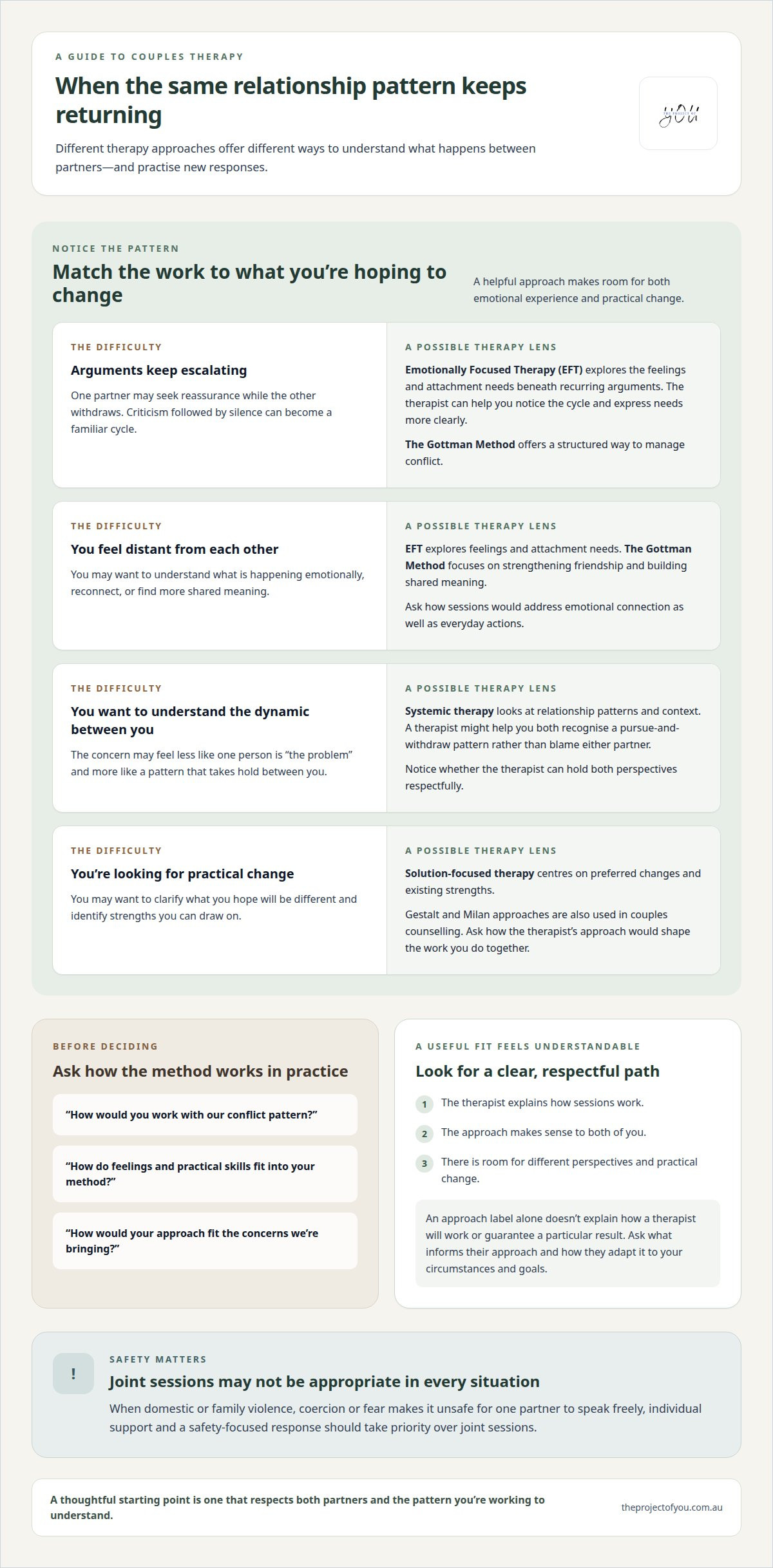
Couples therapy isn’t one fixed method. Different approaches offer ways to understand what happens between partners and practise new responses. For example, one partner may seek reassurance during conflict while the other withdraws. A therapist might help both notice this pattern, rather than treating either person as the problem. The approach should make room for emotions and practical change.
Emotionally Focused Therapy (EFT) explores the feelings and attachment needs beneath recurring arguments. A therapist helps partners recognise cycles, such as criticism followed by silence, and express their needs more clearly. The Gottman Method offers a structured way to strengthen friendship, manage conflict and build shared meaning. Other frameworks include systemic therapy, which looks at relationship patterns and context, and solution-focused therapy, which focuses on preferred changes and existing strengths. Gestalt and Milan approaches are also used in couples counselling.
Evidence-informed couples therapy draws on research while taking a couple’s circumstances and goals into account. The label doesn’t guarantee a particular result or explain how a therapist will work in practice. Ask what informs their approach and how they adapt it to your concerns. This helps you understand how the method’s ideas will shape the work you do together.
To choose an approach, start with what you hope to understand or change. If arguments keep escalating, ask how the therapist helps partners slow the cycle and listen differently. If you feel distant, ask how sessions address emotional connection and shared meaning. For example, a couple caught in a pursue-and-withdraw pattern may explore the feelings beneath it while practising clearer ways to respond. A useful method should address both emotional experience and everyday actions.
Couples therapy may not be appropriate when domestic or family violence, coercion or fear makes it unsafe for one partner to speak freely. In that situation, individual support and a safety-focused response should take priority over joint sessions.
When comparing methods, ask the therapist to explain how a session works and how their approach fits your concerns. You might ask, “How would you work with our conflict pattern?” or “How do feelings and practical skills fit into your method?” Notice whether the explanation makes sense to both of you and leaves room for different perspectives. The right approach isn’t simply the one with a familiar name; it’s one that offers a clear, respectful path for the work you want to do.
2. Specialised training and supervision in couples therapy
A mental health qualification provides a foundation, but couples work calls for specific skills. The therapist needs to listen to two perspectives, notice patterns between partners and help difficult conversations stay constructive. Experience in individual therapy alone doesn’t show how someone works with relationship dynamics. Ask about training in couples counselling, couples therapy or a recognised relationship framework.
Further study can deepen that expertise. Relevant frameworks include Gottman, Imago, the Developmental Model and Systemic Framework. Each offers a way to understand relationship patterns and guide therapeutic work. Ask what the training involved and how the therapist applies it in sessions. For example, if one partner shuts down during conflict, ask how the therapist would help you both understand and respond to that pattern.
Supervision is another important part of professional practice. Membership in a clinical association may indicate that a couples counsellor has met supervision and client-hour requirements. Ask which professional association they belong to, what supervision they receive and how they use it to reflect on their work. A clear answer should explain how supervision supports ethical practice, sound judgement and ongoing development, without sharing another client’s private information.
Look beyond a list of credentials when checking experience and training. Ask how much of the therapist’s work involves couples, which relationship concerns they commonly address and whether their training fits your situation. If you’re seeking support after a breach of trust, for instance, ask about their experience with rebuilding safety and working through its impact. If intimacy or communication is the main concern, ask how those themes shape the treatment plan.
Training: Which couples-specific qualifications or frameworks have you completed?
Supervision: How do you reflect on your couples work with a supervisor?
Experience: What relationship concerns do you regularly work with?
Application: How might your approach address the pattern we’re experiencing?
These questions connect a therapist’s qualifications to the work you need. Further study may show focused learning, while ongoing supervision supports reflection as practice develops. Neither alone tells you whether the therapist can respond thoughtfully to your particular relationship, so consider the examples and explanations they offer.
Training should also help the therapist recognise when relationship difficulties overlap with individual mental health concerns, trauma or differences in emotional safety. Ask how they adapt their work when these factors affect communication or intimacy. Their response can show whether they consider both the relationship and each partner’s individual experience. If you’d like to explore whether this approach fits your needs, you can arrange a conversation about couples counselling.
3. How do you find the right couples counsellor?
Start with the relationship concerns you want help with, then look for a counsellor whose experience matches them. If arguments escalate quickly, seek someone experienced in conflict and communication. If you’re rebuilding trust after infidelity, look for relevant relationship expertise. A general mental health background matters, but specific couples experience helps a therapist work with both partners and the patterns between them.
To find an accredited couples therapist near you in Australia, search online directories and professional association listings for clinical-level membership and couples-work expertise. Then check the counsellor’s qualifications, relationship experience and relevant training, rather than relying on the title “couples counsellor” alone.
Directories can help narrow your search by location, session format and areas of focus. Use terms that reflect your needs, such as “relationship counselling”, “conflict resolution” or “affair recovery”. Read profiles for specific examples of the concerns addressed. A description that mentions communication and emotional intimacy may be more relevant than a broad list of unrelated specialties.
Feeling understood also depends on whether a therapist can work respectfully with your identities and values. Consider culture, faith, sexuality, gender, disability, language and family structure. Ask how the counsellor makes space for these experiences in sessions. For example, if family expectations shape a disagreement, a culturally affirming therapist should be curious about that context, not assume one partner’s values are the problem.
Focus: Does the counsellor regularly work with couples and your concerns?
Approach: Can they explain how they support both partners without taking sides?
Inclusion: Do their words and questions show respect for your identities and values?
Practical fit: Can you attend in person or online in a way that suits both partners?
A recommendation from a trusted friend, family member or doctor can be a useful starting point. Still, a therapist who suited someone else may not suit your relationship. Consider speaking with a few counsellors if you’re unsure. Notice whether each explains their approach clearly and whether both partners feel able to speak openly.
Cost and access can shape your decision, too. Ask about fees and payment arrangements before beginning; private health insurance or an employer’s Employee Assistance Program may help with costs. Some therapists offer sliding fees. Also consider travel, availability and online sessions, especially if you live outside a major centre. These practical details can make ongoing attendance easier to manage.
4. Questions to ask a prospective therapist
A consultation gives you and your partner a chance to understand how the therapist works before beginning. It may be a brief phone or video conversation. You don’t need to explain every detail of your relationship straight away. Use this first discussion to learn whether the therapist’s approach, experience and communication style feel suitable for both of you.
Ask questions that connect the therapist’s training to your relationship concerns. If you’re struggling to reconnect after repeated conflict, ask how they help partners understand patterns and rebuild communication. If sexual challenges are part of your concerns, ask about their experience with couples therapy and sexual challenges. A clear answer should describe the therapist’s approach without promising a particular outcome.
Approach: Which frameworks guide your work with couples, and how do you decide what fits?
Experience: What proportion of your work involves couples, and what relationship concerns do you work with?
Plan: How do you structure sessions, assessment, treatment ending and follow-up?
Progress: How do you help partners recognise whether therapy is moving towards their goals?
Practicalities: What are the session length, format and arrangements for confidentiality and boundaries?
Listen for a thoughtful explanation, not a polished guarantee. A therapist might describe how they first learn about your shared concerns, then agree on goals and review progress together. Ask what happens if one partner feels misunderstood or finds an exercise unhelpful. A good response welcomes feedback and explains how the therapist can adjust their work.
You can also ask whether the therapist guides the conversation or expects partners to lead it. Some couples want help slowing down an argument; others need room to speak without interruption. Consider whether the therapist can balance structure with space for both perspectives. Neither partner should feel cast as the problem or pressured to agree before feeling heard.
Both partners should be able to raise doubts about the therapeutic relationship. Feeling uncertain or uncomfortable at times can happen, so ask how the therapist handles concerns about the work itself. They should welcome an open conversation and explain how they maintain professional boundaries. Therapists should also disclose conflicts of interest and decline work when they can’t treat a couple ethically.
You can assess whether a couples therapist is a good fit by noticing whether both partners feel listened to, respected and able to speak honestly. During the consultation and early sessions, notice whether the therapist stays balanced, explains their plan clearly and responds constructively to questions. If either partner feels overlooked, raise that concern and observe how the therapist responds.
5. Clinical experience and complex relationship needs
Some relationship concerns involve more than communication habits. Infidelity, trauma, grief, parenting pressures or thoughts of divorce can affect trust, emotional safety and each partner’s ability to engage. A therapist needs to understand how these experiences shape the relationship without reducing either partner to a diagnosis or a role in the conflict.
Ask about direct experience with the issue you’re facing. After an affair, for example, one partner may seek details while the other feels overwhelmed or ashamed. A therapist with relevant experience can make space for different reactions, set a careful pace and clarify what each person needs from the work. Ask how they balance the relationship’s needs with each partner’s emotional wellbeing.
Complexity can also arise when one partner is managing anxiety, trauma or significant stress outside the relationship. These experiences may influence sleep, patience, intimacy and everyday communication. Ask how the therapist recognises when an individual concern is affecting joint sessions, and how they decide what to address together. Their explanation should show care for both partners, rather than assuming every difficulty has one cause.
Relevant experience: What relationship concerns like ours have you worked with?
Individual needs: How do you respond when trauma or mental health concerns affect sessions?
Safety and pace: How do you help partners stay engaged during difficult conversations?
Progress: How will we revisit our goals if our needs change?
Clinical experience is about more than how long someone has practised. Look for a therapist who can describe their role, explain why they would take a particular approach and remain open to feedback. If conversations repeatedly escalate, for instance, ask how they would help you pause, understand the pattern and return to the discussion. A thoughtful answer connects professional judgement with a practical next step.
It can be tempting to wait until conflict feels unmanageable before seeking help. You don’t need to reach a breaking point to discuss what’s happening. If separation is being considered, ask whether the therapist can help you explore the decision without steering you towards staying together or separating. Their role is to support a careful conversation about each partner’s needs, values and options.
Choose someone whose experience fits your concerns and whose approach respects both partners’ agency. If the relationship involves layered needs, ask how the therapist will keep the work focused while making room for what each person brings. Clear answers can help you decide whether their clinical judgement feels relevant to the path ahead.
The Project of You | Trauma, Couples & Relationship Therapy Australia
The Project of You | Trauma, Couples & Relationship Therapy Australia can help you consider whether a therapist’s approach, training and experience fit your relationship needs. Azita Abdollahian is a Clinical Social Worker, Psychotherapist and Couples Therapist. Her work recognises that conflict can involve both shared relationship patterns and each person’s individual experiences.
If you’re unsure where to begin, a conversation can help clarify what you hope to change, what matters to both partners and whether couples counselling is a suitable next step. Individual Counselling can also provide space to explore personal concerns alongside relationship work. The aim is to make an informed choice that respects your circumstances, not to promise a particular outcome.
Take a thoughtful next step together
Knowing how to choose a couples therapist becomes more manageable when you treat it as a shared decision, rather than a test you must get right immediately. You and your partner can notice what matters most: feeling heard, understanding recurring patterns or finding a steadier way through difficult conversations. Your first step can simply be a conversation about what you each hope to make possible.
The Project of You | Trauma, Couples & Relationship Therapy Australia offers support that includes Nervous System Regulation & Restoration, The Healing Feminine Workshops and Self Love e-Books. These resources can sit alongside your own reflection as you consider what kind of support feels appropriate for you.
You don’t need to have every answer before reaching out. You can begin by exploring what might help you move forward.
Choosing support is a meaningful step towards a more considered way of relating, whatever the next chapter holds.
Frequently asked questions
How do you find the right couples counsellor?
Look for someone whose experience matches the concern bringing you to therapy, then consider whether both of you can speak openly with them. To decide how to choose a couples therapist, first think about what you need help with: parenting disagreements, rebuilding trust or feeling more connected. A brief consultation can help you notice whether the counsellor listens carefully, explains their process clearly and makes room for each partner’s perspective.
What does couples therapy cost?
Fees vary between therapists and depend on their session arrangements, so ask about the cost before booking. You can also clarify session length, cancellation terms and whether an initial consultation is charged. If cost affects your decision, ask about payment options or lower-fee arrangements. A clear explanation helps you understand the financial commitment before starting, without sharing more personal information than you’re comfortable discussing at that stage.
What if no one is available in your area?
Online couples sessions may give you more options if local appointments are limited or travel is difficult. Before choosing this format, consider whether both partners can join from a private space with a reliable connection. Ask how the therapist manages turn-taking and sensitive conversations online. If one of you feels less comfortable speaking on screen, raise that early so you can discuss what would make participation easier.
What type of counsellor is best for marriage?
A counsellor with specific couples-work experience is often a more relevant starting point than someone whose practice focuses mainly on individual concerns. The best fit depends on what you want help with, such as recurring arguments, emotional distance or relationship decisions. Ask how the therapist works with both partners and whether their approach supports your shared goals without assuming that staying together is the only acceptable outcome.
What qualifications should a couples therapist have in Australia?
Look for relevant professional qualifications alongside specific training and experience in couples therapy. Ask what their original qualification covered, whether they’ve completed further learning in relationship work and how supervision informs their practice. Professional association membership can also offer useful context about a therapist’s professional standing. Credentials matter, but they’re only part of the picture: ask how the therapist applies their learning to concerns like yours.
How do I compare a psychologist, counsellor and family therapist for couples counselling?
These titles reflect different professional pathways, but none alone tells you how much couples work someone does. A psychologist has psychology training, while counsellors and family therapists may bring other professional backgrounds and relationship frameworks. Compare their couples-specific experience, further training and the concerns they regularly address. If family dynamics affect your relationship, for example, ask how they include that context while keeping both partners’ needs in view.
What questions should we ask a couples therapist before booking?
Ask which concerns they work with, how they structure sessions and what happens if one partner feels unheard. You can also clarify fees, session format and confidentiality. If you’re considering therapy after a breach of trust, ask how they approach conversations where partners have different needs for information or space. Notice whether the therapist answers directly and invites both partners to ask questions, rather than directing the discussion to just one person.
What therapy approaches are used for couples counselling, and how do they differ?
Approaches differ in their focus and how they guide conversations. Emotionally Focused Therapy explores the feelings and attachment needs beneath recurring patterns, while the Gottman Method offers structured ways to work on conflict and connection. Systemic therapy considers how patterns and context shape the relationship; solution-focused therapy emphasises preferred changes and existing strengths. Ask the therapist to explain how their method relates to your goals.

Comments