

Individual counseling after infidelity: what to expect

What are the signs of an unhealthy response to infidelity, and how can individual counselling help after being cheated on? Unacceptable responses include minimising your pain, blaming you for your partner’s affair, pressuring you to forgive or using threats, control or isolation. If you’ve experienced infidelity, individual counselling can provide a safe, supportive space to process what happened, understand your emotional responses and explore what you need to move forward. Taking responsibility for your own healing does not mean you have to stay in the relationship or choose reconciliation.
Being cheated on can leave you feeling angry, heartbroken, confused or torn between wanting to repair the relationship and needing to walk away. You may struggle to trust your own judgement or feel pressured to make a decision before you’re ready. These reactions are understandable, and you deserve support that respects your feelings, boundaries and choices.
In this article, Azita Abdollahian, psychotherapist and Clinical Social Worker, explores the emotional impact of infidelity, the difference between genuine accountability and harmful responses, and how individual counselling can help you navigate the aftermath of betrayal. You’ll learn how therapy can support you in rebuilding self-trust, establishing boundaries and considering your options, whether that means working towards relationship repair or preparing to leave. We’ll also explore how individual counselling differs from couples therapy and how to decide which type of support may best meet your needs.
Table of Contents
Deciding whether to rebuild the relationship or leave
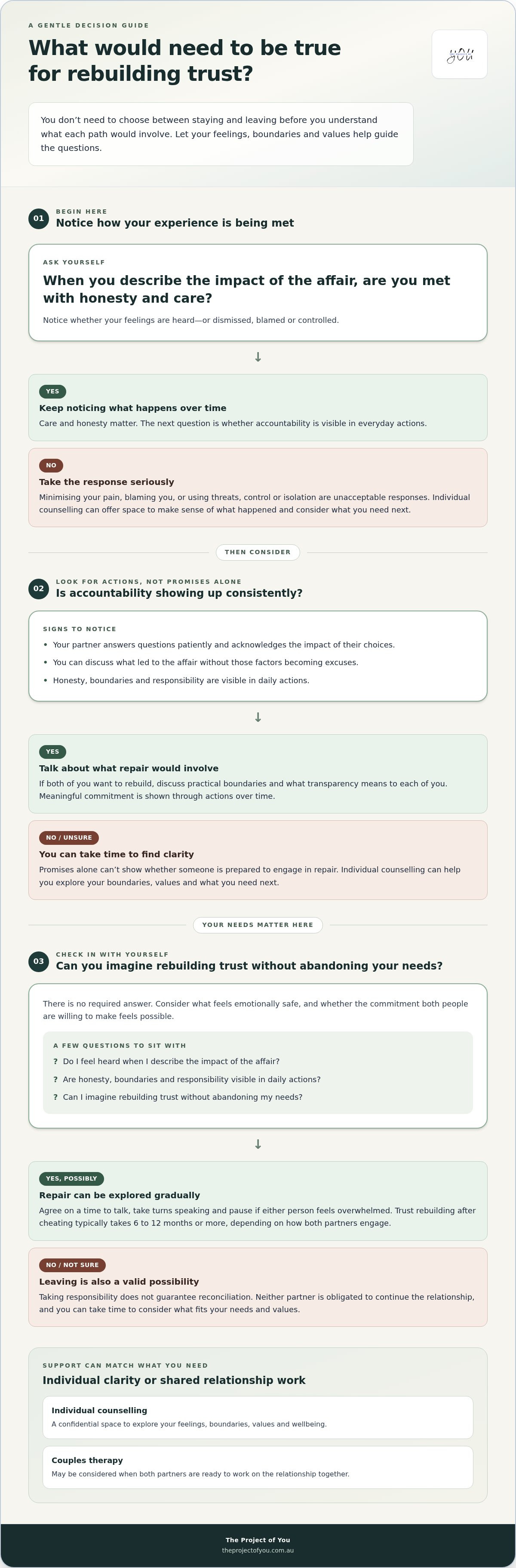
You don’t need to choose between staying and leaving before you understand what each path would involve. Individual counselling can help you explore your feelings, boundaries and values as you consider what feels emotionally safe.
Rebuilding trust and honesty
Rebuilding trust means restoring a sense of reliability through honest, consistent communication and accountable actions. It matters because promises alone can’t show whether your partner is prepared to engage in repair. Notice whether they answer questions patiently, acknowledge the impact of their choices and discuss what led to the affair without making those factors excuses. Active trust rebuilding after cheating typically takes couples 6 to 12 months or more, depending on how both partners engage.
Exploring underlying issues can help you understand the relationship’s history, but it doesn’t transfer responsibility for the affair. You might discuss emotional distance or unmet needs, for example, while recognising that the person who chose to be unfaithful is responsible for that decision. If both partners want to rebuild, discuss practical boundaries and what transparency means to each of you. Meaningful commitment is shown through actions over time.
Communication and intimacy may need to develop gradually. Agree on a time to talk, take turns speaking and pause if either person feels overwhelmed. A partner might say, “I’m listening; I won’t try to correct your feelings.” Sexual intimacy also deserves open discussion. You can set the pace, name what feels comfortable and revisit that boundary as your needs change.
Strengthening self-worth and confidence
Self-worth means knowing your value doesn’t depend on your partner’s choices or the outcome of the relationship. Strengthening it can help you decide according to your values, rather than shame, fear or pressure. In counselling, you might identify self-blaming thoughts and consider what the facts support. Your partner’s affair does not define your attractiveness, judgement or capacity for future connection.
Rebuilding confidence can also mean restoring parts of daily life that feel like yours. You might reconnect with a trusted friend, return to a familiar activity or write down the qualities you want in a respectful relationship. These steps aren’t a test of whether you should stay. They can help you notice what supports your wellbeing, whatever you decide.
To consider your options, reflect on these questions:
Do I feel heard when I describe the impact of the affair?
Are honesty, boundaries and responsibility visible in daily actions?
Can I imagine rebuilding trust without abandoning my needs?
A counsellor can help you examine your answers and identify what might need to change for repair to feel possible. Taking responsibility doesn’t guarantee reconciliation, and neither partner is obligated to continue the relationship. Your decision can take shape as you gain clarity about safety, respect and the commitment both people are willing to make.
Emotional and physical effects of infidelity
If you’re thinking about suicide or self-harm, or can’t keep yourself safe, seek urgent help now through emergency services or an emergency department. These are signs to act on promptly, not experiences you need to manage alone.
Discovering that a partner was unfaithful can bring shock, anger, sadness, disbelief or numbness. You might replay conversations, search for missing details or find it hard to focus at work. These reactions can shift throughout the day. Feeling calm at breakfast and overwhelmed by an unanswered message later doesn’t mean you’re responding incorrectly.
Your body can respond too. You may notice disrupted sleep, changes in appetite, tension or difficulty settling after a reminder. Seeing a familiar notification or passing a place linked with the affair, for example, might bring a sudden wave of distress. These experiences can be part of a stress response; on their own, they don’t establish a mental health diagnosis.
An emotional affair can hurt deeply, even without sexual contact. Secrecy, private disclosures and closeness with another person may leave you questioning what was shared and what your relationship meant. Couples define infidelity differently, so naming the specific breach can help you explain why a particular message or hidden conversation affected you.
Some people describe betrayal as traumatic because it can unsettle their sense of safety and make ordinary reminders feel charged. Healing doesn’t follow a neat sequence of stages. You might move between wanting answers, needing distance and missing familiar routines. Noticing these shifts can help you respond to your needs rather than judge yourself for having mixed feelings.
When a trigger appears, try a short, concrete grounding practice:
Name what you can see and hear in the room, then feel your feet against the floor.
Write down the reminder, the thought it brought up and what you need in that moment.
Choose one manageable next step, such as drinking water, taking a walk or contacting someone you trust.
These steps can help you pause and identify what’s happening. If distress keeps disrupting sleep, eating, work or daily care, tell someone you trust and consider professional support. Individual counselling after being cheated on can provide a confidential space to explore triggers and self-blame at a manageable pace.
If you’d like support to make sense of these reactions, you can book an individual counselling session.
Mindfulness-based therapy can support present-moment awareness and acceptance, helping you manage emotional distress and reduce self-blame. Individual therapy can also help you work with triggers and negative thought patterns.
How can you identify unacceptable responses to infidelity?
Infidelity can involve a romantic, emotional or sexual relationship outside an agreed relationship, often alongside secrecy. Couples define boundaries differently: one person may view hidden intimate messages as a breach, while another may focus on sexual contact. Naming the specific agreement that was crossed helps you describe what happened without arguing over a universal definition.
Pay attention to how each person responds to the impact, not just what they say about their intentions. A partner who takes responsibility can answer questions honestly, reflect on their choices and acknowledge your feelings without turning the conversation into a defence. For example, “I understand why that message hurt you” recognises impact; “You’re too sensitive” dismisses it.
Explanations can help make sense of the context, but they don’t remove responsibility. Someone might have felt lonely, attracted to another person, unhappy or unsure about the relationship. You can explore those feelings without making them your fault. Self-understanding means noticing your own needs and reactions, not looking for a way to justify someone else’s decision.
Unacceptable responses include physical or emotional abuse, controlling your movements, isolating you from supportive people, or threatening to disclose private information without your consent. These actions don’t become acceptable because an affair occurred. If a conversation turns intimidating, you can pause it, move to a safer setting and tell someone you trust what is happening.
Stress, shame, anxiety or low mood can affect either partner after infidelity. A person who was unfaithful may feel guilt or fear, but those feelings don’t entitle them to demand silence or immediate forgiveness. If persistent low mood concerns you, a qualified clinician can help assess whether depression may be involved, without treating a single feeling as a diagnosis.
To help clarify what you need, write down the specific behaviour and its effect before discussing it. For instance: “You denied the messages, then I saw them. I now need honest answers before discussing repair.” This separates an observable event from assumptions and helps you identify what you need to feel respected.
Consider these signs of a more accountable response:
The person answers relevant questions truthfully rather than changing the story.
They listen to your feelings without blaming you or insisting you move on.
They reflect on their decisions and accept that trust may take time to rebuild.
They respect your privacy, personal boundaries and connection with supportive people.
Personal growth after betrayal can include recognising what safety, honesty and mutual respect mean to you. You might ask, “Can I speak openly without being punished?” or “Are actions matching words?” A qualified counsellor can help you consider these questions and manage stress, without deciding the relationship’s future for you.
Addressing relationship problems without excusing the affair
Relationship difficulties can be explored alongside the affair, but they are separate issues. Keeping that distinction clear can help both partners discuss patterns in the relationship without treating them as a reason the affair happened.
Relationship problems and responsibility
This means examining how the relationship functioned while recognising that each person is responsible for their own choices. It matters because discussing a recurring pattern, such as avoiding difficult conversations, can be useful without making either partner responsible for the affair.
Try naming the pattern neutrally: “We often stop talking when we disagree,” rather than “You made this happen.” Then consider what each person could do differently, such as asking for a pause and agreeing when to resume the discussion. This turns a broad complaint into a specific topic for change.
Choosing whether to stay or leave
Choosing a direction can involve identifying what you want your relationship to stand for, rather than reacting only to the latest argument. Values such as respect, honesty and emotional safety can give you a clearer reference point while the situation remains difficult.
Write down what you would need to see in everyday life for those values to feel present. If respectful communication matters, for example, consider whether both people can speak during disagreements without insults or intimidation. These observations can help you understand what the relationship is like in practice, rather than relying only on apologies or hopes.
If children are part of your family, keep them out of adult disagreements. Don’t ask them to carry messages, take sides or keep secrets. You could say, “We’re working through an adult problem, and it isn’t your fault,” without sharing private details. Maintaining familiar routines, such as school and mealtimes, can give children some continuity while adults work through change.
A shared goal can make the next conversation more manageable, even if you don’t yet agree about the relationship’s future. You might focus on communicating calmly about parenting or creating space for each person to reflect. A practical goal describes what you’ll do next; it doesn’t require either partner to promise reconciliation.
A therapist can help you decide whether to stay in or leave a relationship after infidelity, but the decision is yours.
Couples therapy versus individual counselling after an affair
Individual therapy focuses on your wellbeing and choices; couples therapy works with both partners on communication and relationship repair. Which is more helpful depends on what you need now and whether both partners are ready to participate.
Space, responsibility and boundaries
Space, responsibility and boundaries can make room for difficult conversations without avoiding accountability. You can take time before discussing the affair, especially if either partner feels overwhelmed. If you’re considering reconciliation, ending contact with the affair partner is a practical part of addressing the breach. The person who had the affair can take responsibility by answering questions honestly and respecting communication boundaries.
For example, agree to postpone a conversation until both of you can speak without shouting. You might also decide what contact is acceptable, if any, and what information you need to feel informed. Discuss these agreements plainly. A boundary describes what you need and what you will do if it is crossed.
Structuring conversations about the affair
A structured conversation gives each partner a clear turn to speak, listen and respond. This can help keep conflict from becoming a rapid exchange of accusations and defences. Choose one topic, such as what happened or what support is needed now, rather than trying to resolve every concern in one discussion.
Agree on a time and place, and pause if either person becomes too distressed to continue constructively. The listening partner can reflect back what they heard before responding. Individual counselling can help you prepare questions and identify limits; couples therapy may be useful when both partners are committed to working on the relationship.
Choosing a qualified counsellor
In Australia, psychologists, counsellors and psychotherapists have different training pathways and professional frameworks. Ask about qualifications, relevant professional registration or membership, and experience supporting people after infidelity. A helpful counsellor should explain their approach clearly and make space for your goals, whether you’re weighing repair or separation.
To prepare, write down what feels most urgent, what you hope to understand and any boundaries you want respected. You can bring notes to your first appointment; you don’t need a complete account of the affair before you begin.
How do I choose between a psychologist, counsellor and psychotherapist in Australia? Compare their training, relevant registration or membership, and experience with infidelity and trauma-informed care.
Can Medicare cover counselling or therapy after infidelity in Australia? Medicare coverage depends on the practitioner, service and eligibility; counselling isn’t automatically covered.
How much does individual counselling cost in Australia? Fees depend on the practitioner, appointment length and format, and are provided after a quote request.
How do I find a qualified individual counsellor in Australia? Look for relevant qualifications, professional membership or registration, and experience supporting people after betrayal.
What should I expect in the first counselling session after being cheated on? You can discuss what brings you in, what feels difficult now and what you’d like support with; you set the pace.
How can I prepare for individual counselling after infidelity? Note key concerns, questions and boundaries, such as wanting help with intrusive thoughts or deciding what comes next.
[Book an individual counselling appointment](https://www.theprojectofyou.com.au/book-online)
The Project of You | Trauma, Couples & Relationship Therapy Australia: Nervous System Regulation & Restoration
The Project of You | Trauma, Couples & Relationship Therapy Australia offers Individual Counselling and Nervous System Regulation & Restoration for people seeking support after betrayal. Individual sessions can give you space to explore emotional responses, clarify boundaries and consider what you need, whether you’re weighing relationship repair or leaving.
Support can also help you notice how stress affects your body and explore ways to feel more grounded during difficult conversations. You can bring questions about trust, self-worth or next steps without having made a decision before you begin. The work can focus on your experiences and priorities.
If you’d like to explore whether this support fits your situation, you’re welcome to contact The Project of You.
Let your next step reflect what matters to you
After betrayal, your next step doesn’t need to settle the whole future of your relationship. Individual counselling after being cheated on can help you make room for your perspective, notice what supports your wellbeing and choose a manageable focus for now. That might mean finding words for a boundary, understanding a reaction or considering what you want from a conversation.
The Project of You offers support through individual counselling and Nervous System Regulation & Restoration. The Healing Feminine Workshops and Self Love e-Books provide other learning and reflection options. These supports can fit around your own pace and priorities, rather than dictate what you should decide.
Reaching out can begin a conversation about what would feel useful, even if your direction is still taking shape.
[Book an individual counselling session](https://www.theprojectofyou.com.au/book-online)
You can move forward one considered step at a time, keeping your needs and values in view.
Frequently Asked Questions
How can individual counselling help after being cheated on?
Individual counselling offers a dedicated space to explore what you’re experiencing and what you want support with. You might use a session to identify which parts of daily life feel hardest, such as concentrating at work or managing conversations at home. A counsellor can help you set a personal focus, whether that’s understanding your reactions, clarifying your values or preparing for a decision.
What types of therapy help people recover from infidelity?
Approaches to discuss include cognitive behavioural therapy (CBT), trauma-informed therapy and mindfulness practices. CBT looks at connections between thoughts, feelings and actions; mindfulness involves noticing present-moment experiences. These descriptions don’t determine which approach suits you. Ask a prospective counsellor how they would work with your concerns, what a session might involve and how you can review whether the approach remains useful for your goals.
How long does recovery from infidelity take with counselling?
There’s no single timetable for recovery; the process depends on your needs, circumstances and goals. One person may focus on feeling steadier in daily life, while another may be considering relationship decisions or rebuilding a sense of identity. You can discuss these aims with your counsellor and revisit them as your situation changes. Counselling can support reflection, but it can’t guarantee when you’ll feel better.



Comments