

How to Heal Avoidant Attachment Through Self-Regulation and Support

Can someone with dismissive-avoidant attachment fall in love? Yes. Having an avoidant attachment style does not mean you are incapable of love, emotional connection or a healthy relationship. However, emotional vulnerability, depending on others and navigating intimacy can feel uncomfortable, sometimes leading you to withdraw just when a relationship starts to deepen. Learning how to heal avoidant attachment begins with recognising these patterns, understanding what they may be protecting you from and gradually developing healthier ways to experience closeness.
If you tend to keep your emotions at a distance, struggle to communicate your needs or feel unexpectedly overwhelmed after a breakup, you may be trying to make sense of responses that seem contradictory. These patterns do not make you cold or uncaring. They can be influenced by earlier experiences and learned ways of managing emotional safety, and they can change over time with greater self-awareness and support.
In this article, Azita Abdollahian, psychotherapist and Clinical Social Worker, explores how dismissive-avoidant attachment can develop, how it affects romantic relationships and how to begin healing through emotional regulation, gradual vulnerability and clearer communication. You’ll also learn how to navigate a breakup when you tend to suppress your feelings, and how therapy can help you understand your attachment patterns and build more secure, fulfilling connections.
Table of Contents
What is self-regulation?
Self-regulation means noticing an emotional response and choosing how to respond, rather than automatically withdrawing or suppressing what you feel. In Australia, eligible people may be able to claim Medicare benefits for some mental health services with a GP referral and Mental Health Treatment Plan; Services Australia explains eligibility and claiming. A plan doesn’t make every therapy service eligible for a rebate.
Notice triggers around intimacy and independence
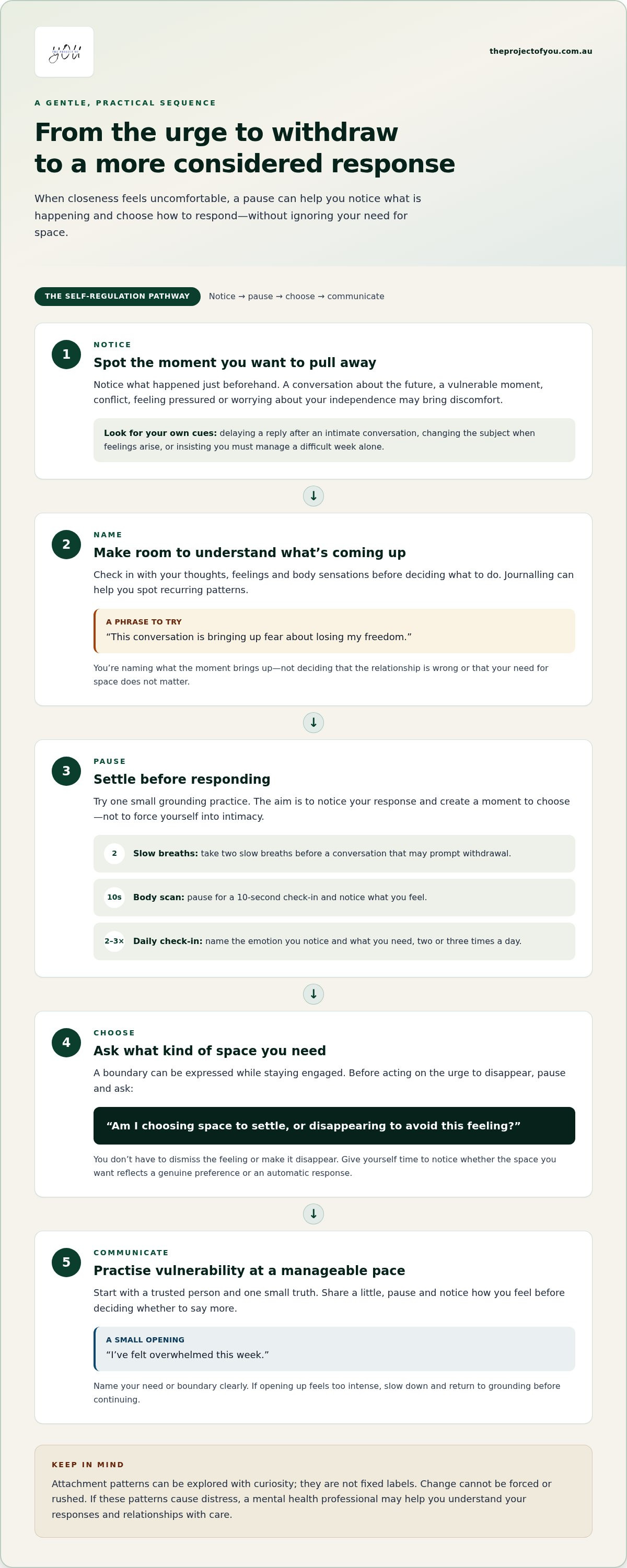
Notice when you feel the urge to create distance, then consider what happened just beforehand. A partner asking about the future, sharing a vulnerable feeling or wanting more time together may bring discomfort. So can feeling rejected, criticised or pressured. Notice whether emotional demands or perceived threats to your independence prompt you to shut down. Don’t assume the feeling means the relationship is wrong. First, check what the moment brought up for you.
For example, if a partner asks where the relationship is heading and you feel trapped, pause and name the trigger: “This conversation is bringing up fear about losing my freedom.” That doesn’t dismiss your need for space. It helps you distinguish a boundary you want to express from an automatic response shaped by fear. Journal about the situation, your thoughts, body sensations and what you did next to spot recurring patterns.
Recognise distancing and hyper-independence
Track what you do when closeness feels uncomfortable, including small shifts that are easy to miss. You might delay replying after an intimate conversation, change the subject when feelings arise or insist you can manage a difficult week alone. These responses can create distance even when you care about the other person. Ask whether your choice reflects a genuine preference or an attempt to avoid needing, trusting or relying on someone.
Try a brief check-in two or three times daily: name the emotion you notice and what you need. Before a conversation that may trigger withdrawal, take two slow breaths or do a 10-second body scan. Ask yourself, “Am I choosing space to settle, or disappearing to avoid this feeling?” That question leaves room to express a boundary while staying engaged. Hyper-independence isn’t proof of strength or failure; it’s a pattern you can examine with curiosity.
Practise mindfulness and emotional tolerance
Choose one manageable way to stay with emotional discomfort instead of trying to make it disappear. Sit quietly and notice your breathing, your feet on the floor and the feeling you’d usually suppress. Journalling can help: write what happened, what you felt, what you feared and what you did next. For instance, after receiving a caring message, note whether you felt warmth, suspicion or an urge to delay replying.
Build vulnerability gradually, starting with a trusted person and a small truth, such as, “I’ve felt overwhelmed this week.” Share a little, pause and notice your response before deciding whether to say more. Mindfulness doesn’t mean forcing intimacy or ignoring boundaries. It gives you a moment to choose how to respond. If opening up feels too intense, slow down and return to grounding before continuing.
How does avoidant / dismissive attachment develop in childhood?
An attachment style describes how someone tends to respond to closeness, trust and support. Childhood experiences can shape these responses, but they don’t determine every adult relationship or make a person’s pattern permanent.
Explore how the pattern may have helped you cope. When a child’s emotional needs are repeatedly overlooked or met with rejection, they may learn to hide distress or rely on themselves. Emotional unavailability from caregivers can influence how safe it feels to seek comfort later. A 2012 article, “The neurobiology of attachment to nurturing and abusive caregivers,” discusses attachment in the context of caregiving experiences. Such patterns aren’t proof of blame or a diagnosis. Consider what happened when you sought comfort, while remembering that one memory cannot explain a whole childhood.
Notice what you expect from closeness now. Ask yourself what you anticipate when you express a need: understanding, criticism, rejection or pressure? For instance, you might value a partner yet find it difficult to ask for reassurance after a stressful day. Another person may feel anxious about being left, then withdraw to avoid possible rejection. Attachment styles are useful ways to reflect on patterns, not fixed labels. Notice what happens in your current relationships, including whether your expectations match the other person’s actions.
Consider therapy if these patterns cause distress. Therapy can provide a space to examine relationship beliefs, emotional responses and the ways you approach trust. An attachment-informed therapist may explore closeness and emotional regulation; CBT can help examine thoughts and beliefs affecting behaviour. Individual therapy centres your own experience, while couples therapy can address interaction patterns between partners. How long change takes varies with personal history, current circumstances and the support available. There’s no reliable timetable that applies to everyone, so focus on changes that matter in your daily relationships.
Seek professional support when difficulties affect your wellbeing. Avoidant responses alone don’t establish trauma or another mental health condition. Consider talking with a mental health professional if distressing memories, persistent fear or relationship difficulties affect daily life, sleep or work. They can help explore what may be contributing without assuming a diagnosis. If withdrawal, loneliness or recurring conflict feels hard to shift, support can help you understand your options and identify a pace that feels manageable. You can arrange a therapy conversation to explore what support may suit your needs.
Building a support network and practising vulnerability
Trust can grow through repeated, manageable experiences of being known and respected. Try these steps to build connection without abandoning your needs.
Build trust and set personal boundaries
Choose one relationship where respect has been consistent, then notice how trust develops through actions. For example, a friend who keeps a confidence may feel safer to approach than someone who dismisses your feelings. State a clear boundary, such as needing time alone after work, and notice whether it’s respected. Healthy closeness includes choice. Don’t treat every request for space as a failure.
Practise vulnerability with a support network
Start with a trusted friend or family member and share one small fact about your inner state for one or two minutes. You might say, “I’ve been feeling uncertain about this change.” Practise twice a week, then notice whether you feel understood, overwhelmed or ready to share more. A supportive circle can include trusted people and professionals, rather than relying on one partner for every need.
Map your support network before you need it. Write down who you could contact for different kinds of support: a friend for a walk, a relative for practical help or a professional to explore recurring relationship patterns. This makes reaching out more specific than a general appeal for help. If asking feels uncomfortable, try a small request, such as, “Could you listen while I talk this through?” Accepting support is a way to practise interdependence, not a demand that someone solve everything.
Notice your responses after moments of connection. After a conversation, take a moment to record what you shared, how the other person responded and what you felt afterwards. For example, you may feel relieved after being honest, followed by an urge to minimise what you said. Recognising this pattern can help you distinguish the discomfort of being seen from evidence that the relationship is unsafe. Keep the pace manageable: vulnerability is a choice, and you can pause, clarify a boundary or return to the conversation later.
Communicating needs and taking breaks during conflict
Clear communication makes space for connection and autonomy. Practise these steps when you and your partner are calm, so they’re easier to use during tension.
Communicate needs, boundaries and fears
Choose one need and express it plainly, without turning it into a criticism. For example, say, “I need quiet time after work, and I’d like to reconnect after dinner.” If fear sits beneath the boundary, name it gently: “I’m worried I’ll feel pressured if we decide right now.” Check that your request describes what you need rather than assuming what your partner intends.
Practise open communication with a partner
Raise sensitive topics when you’re both calm, and focus on one issue at a time. If your partner tends to withdraw, try an invitation instead of an accusation: “Could we talk about this when you’re ready?” An avoidant response may reflect overwhelm, not a lack of care, but you still deserve to express what matters. Agree on a time to return to the topic, so neither of you is left unsure.
Take breaks during conflict
Ask for a pause when you notice yourself shutting down or struggling to listen. Say, “I want to work this through; I need a little time, then I’ll come back.” Use the break to settle, not to rehearse blame or punish your partner with silence. Agree on when you’ll resume, and return as promised. A clear pause protects your space while keeping the conversation open.
Set a routine for difficult conversations. Suggest a brief relationship check-in lasting 10-15 minutes, rather than waiting until resentment builds. Each person can share one concern, one feeling and one request. For example, “I felt alone when plans changed; could you let me know earlier next time?” Listen to understand before responding. If either of you becomes overwhelmed, pause and agree on a time to continue.
Repair the conversation after tension. Once you’re both settled, describe what happened without labelling either person. You might say, “I went quiet when the conversation became intense, and I can see that left you uncertain.” Then ask what your partner experienced and explain what might help next time. If the same situations repeatedly lead to withdrawal or conflict, counselling can help you understand the pattern and practise new ways to respond together.
Attachment avoidance and breakup coping
A breakup can bring grief into view, even if you first feel relief or focus on practical tasks. Take these steps to make room for your feelings without giving up the independence that matters to you.
Name the response you’re having. After a relationship ends, notice whether you feel sadness, anger, numbness, relief or a mix. Writing “I feel relieved, and I miss our morning chats” makes room for two truths at once. Don’t use an early sense of calm as proof that the relationship meant nothing. Emotional distance can feel familiar, while grief may surface later through memories, loneliness or changes in routine.
Make space for grief in manageable ways. Choose a short daily period to write, reflect or sit with what you miss. A 5-10-minute anchor practice can help you notice feelings without demanding that they disappear. For example, write about one memory, then note what you need today. If you feel overwhelmed, pause and ground yourself in your surroundings. You can return to the reflection when you feel more settled.
Keep supportive routines while allowing emotion. Plan nourishing activities, such as going for a walk, preparing a meal or seeing a trusted friend. These aren’t ways to avoid grief. They can give your day structure while feelings shift. Notice whether staying constantly busy leaves no space to process the breakup. Balance a practical task with an activity that offers comfort, and give yourself permission to change the plan as your needs change.
Reflect on the relationship without turning it into a verdict on yourself. When you feel ready, write down what helped you feel close and what led you to withdraw. Include specific situations, such as avoiding a conversation about future plans or finding it hard to ask for reassurance. Ask what you might want to express differently in a future relationship. The purpose is to learn, not to decide you alone were responsible for the relationship ending.
Reach for support instead of retreating completely. Choose someone you trust and tell them what would help, such as company on a walk or listening without advice. If the breakup continues to affect your everyday life, counselling can offer space to explore grief and relationship patterns. Progress may mean noticing feelings sooner or choosing connection when you’d usually isolate. If old habits return, treat that as a cue to revisit what supports you.
[Explore support for breakup recovery](https://www.theprojectofyou.com.au/book-online)
The Project of You | Trauma, Couples & Relationship Therapy Australia: Nervous System Regulation & Restoration
The Project of You | Trauma, Couples & Relationship Therapy Australia offers Nervous System Regulation & Restoration for people exploring how stress and relationship patterns affect their capacity for connection.
If you find it difficult to recognise what you feel, trust support or stay present during emotional conversations, Individual Counselling can provide space to explore these experiences at your pace. The work can focus on noticing your responses, understanding what feels safe and practising ways to express your needs. Self Love e-Books offer another resource for personal reflection between conversations.
Support may help when distancing or relationship distress feels difficult to shift alone. You don’t need to wait until things feel overwhelming to seek a thoughtful space for reflection.
If you’d like to explore support, contact The Project of You.
Choose a next step that honours your pace
Learning how to heal avoidant attachment isn’t about changing who you are. It’s about understanding the responses that once helped you cope and deciding which ones still fit the relationships you want. You can value independence and still make room for trust, care and emotional closeness.
Change may feel uneven. If old reactions return, treat them as information, not proof that you’ve failed. Pause and ask what would help you feel safe enough to take one small, honest step. That might mean reflecting on a pattern, speaking with someone you trust or seeking professional support when relationship distress feels difficult to manage alone.
The Healing Feminine Workshops can offer a space for personal reflection as you continue exploring your needs and relationships. Choose support that feels right for you, without rushing the process.
[Explore booking a supportive conversation](https://www.theprojectofyou.com.au/book-online)
Your capacity for connection can grow while you remain true to yourself. Each thoughtful step counts.
Frequently Asked Questions
Can a Dismissive-Avoidant Fall in Love?
Yes. A person with dismissive-avoidant tendencies can fall in love and care deeply about a partner. They might show love by making room in their routine, remembering what matters to you or staying dependable during a difficult period. If you’re unsure how they feel, look at the pattern of care over time and discuss what affection means to each of you. Different expressions of love can coexist with a need for independence.
So…How Can I Heal From Avoidant Attachment Style?
Begin by choosing one relationship situation you want to handle differently, rather than trying to change every part of yourself at once. For example, if you usually cancel plans after a tense day, ask whether you’d prefer a shorter visit instead. Afterwards, note what felt manageable and what didn’t. This turns a broad wish for change into a personal experiment and helps you decide what connection and independence should look like in your life.
What is avoidant attachment and how can I recognise it in myself?
Avoidant attachment is a tendency to protect yourself from perceived relationship risk by keeping emotional reliance low. You might notice discomfort when someone offers practical help, a strong preference for making decisions alone or irritation when a loved one asks for reassurance. One moment doesn’t define your attachment style. Look for repeated responses across relationships, and ask whether they reflect what you genuinely want or a rule you feel compelled to follow.
Can avoidant attachment change, and what does healing typically involve?
Attachment responses can shift as people gain new experiences of trust, care and mutual respect. Change might look like staying engaged when a partner shares good news instead of changing the subject, or accepting comfort without immediately minimising a problem. The aim isn’t to become dependent or give up solitude. It’s to have more choice in how you relate and notice which ways of connecting fit your values.
What practical steps help someone with avoidant attachment build emotional closeness?
Try sharing an opinion that matters to you during an everyday decision, such as choosing how to spend a free afternoon. Explain why you prefer that option, then stay curious about your partner’s preference too. This creates a small exchange of personal meaning, not just logistics. You can also notice whether you let a kind gesture land before moving on. Closeness often grows through these ordinary moments of being known.
How can a partner support someone with avoidant attachment without pressuring them?
Ask what support would be useful in a specific situation, rather than guessing. For example, after a demanding workday, your partner might prefer quiet company instead of questions. Respecting that preference can reduce misunderstandings, while sharing your own needs helps keep the relationship mutual. Avoid treating withdrawal as proof of indifference or taking responsibility for changing the other person. Each partner remains responsible for their own choices and wellbeing.
How can I communicate needs and boundaries when working on avoidant attachment?
Choose a format that helps you speak clearly. If face-to-face conversations feel difficult, write down your main point beforehand and use the note to guide the discussion. Keep the request specific: “I’d like us to decide about the weekend plans by Thursday.” You can also say what you’re not ready to discuss yet. A boundary gives useful information about your limits; it doesn’t require a long defence.



Comments