.png)

How Trauma Dysregulates Your Nervous System (And How to Heal It)
- Azita Abdollahian

- 12 hours ago
- 12 min read
Why do you feel “wired but tired,” constantly on edge or emotionally disconnected even when you know you are safe?
Often, these responses aren't a personal failing. They can be signs that your nervous system is dysregulated after prolonged stress or trauma. When the body's alarm system remains activated long after a threat has passed, you may experience anxiety, exhaustion, irritability, emotional numbness, hypervigilance or difficulty feeling present in your life and relationships.
At The Project Of You, psychotherapist and trauma expert Azita Abdollahian takes a trauma-informed approach to helping people understand the connection between trauma, the body and emotional wellbeing. Rather than simply talking about what happened, this approach explores how trauma can continue to affect the nervous system and how body-based therapeutic approaches can support regulation and recovery.
In this guide, we explore what nervous system dysregulation is, why trauma can keep the body in survival mode, and how nervous system regulation therapy can help you move towards greater safety, emotional balance and lasting healing.
Table of Contents
What is Nervous System Restoration Therapy?
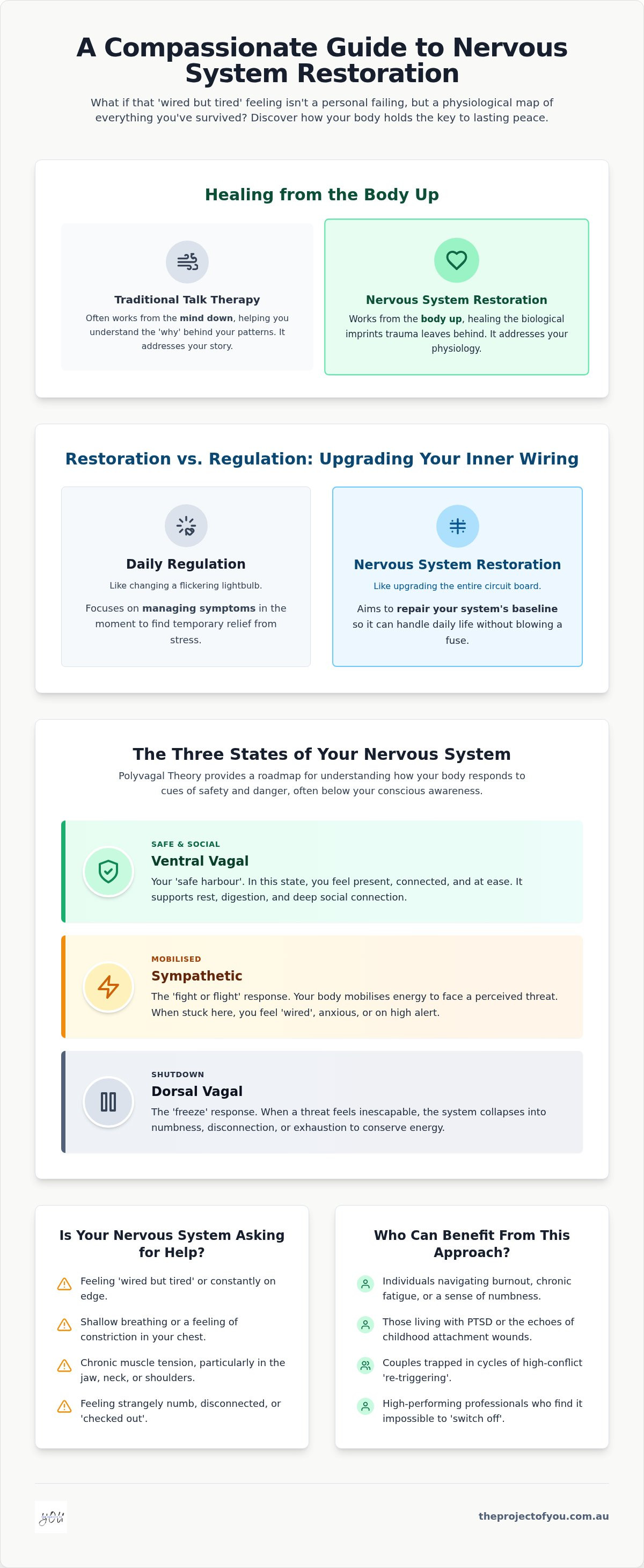
Have you ever felt like you're doing all the "right" things, yet your body still feels like it's on high alert? You might have spent years in traditional counselling, understanding the "why" behind your patterns, but finding that your heart still races or your breath stays shallow when life gets loud. This is where the distinction between understanding and healing becomes vital. Nervous system restoration therapy isn't just about learning to cope; it's a somatic-led journey that focuses on the physiological roots of your distress by healing the autonomic nervous system directly.
Think of your nervous system like the electrical wiring in an old house. Managing symptoms is like changing a lightbulb when it flickers. Restoration, however, is about upgrading the entire circuit board so the system can handle the flow of daily life without blowing a fuse. We aren't just trying to "calm down" in the moment; we're working to shift your baseline so that peace becomes your natural home, not a fleeting visitor. At its core, nervous system restoration is a clinical process of returning the body to a state of "social engagement" or safety.
Because trauma is stored in the primitive parts of the brain and the tissues of the body, talking often misses the target. You can't argue your way out of a panic attack or reason yourself into feeling safe if your body is convinced a threat is present. This approach works from the body up, rather than the mind down, to release the tension that talk therapy alone cannot reach.
The Shift from Survival to Safety
When we live in a state of fight, flight, or freeze, our body holds onto a "body-memory" of that stress. It stays stuck in the past. In our sessions, and during our nervous system retreats, I act as a co-regulator. I use a calm, steady presence to help your system remember what safety feels like. We slowly guide the body out of survival mode and back into a state of regulation where you can think clearly and connect deeply with others.
Who Can Benefit from This Approach?
This path is particularly supportive for those who feel they've hit a wall with traditional methods. Our early childhood experiences often set the "default" for our nervous system; if safety was inconsistent back then, your system might need help learning how to finally stand down. This therapy is ideal for:
Individuals navigating burnout, chronic fatigue, or a sense of "numbness".
Those living with PTSD or the echoes of childhood attachment wounds.
Couples trapped in cycles of high-conflict "re-triggering" where logic seems to fail.
High-performing professionals in high-stress roles who find it impossible to "switch off".
The Science of Healing: Polyvagal Theory and Beyond
Imagine your body has an internal information superhighway that never sleeps. This is the Vagus nerve. It's the longest nerve in your autonomic nervous system, stretching from your brainstem down to your abdomen, constantly whispering updates about your internal state to your brain. In the context of nervous system restoration therapy, we view this nerve as the key to unlocking your body's natural ability to heal from the inside out.
Modern science, particularly Polyvagal Theory, has transformed how we understand trauma. It teaches us that our bodies are equipped with a sophisticated radar system called "neuroception." This process happens entirely below your conscious awareness. Your body is scanning the environment, the people around you, and even your internal sensations for signs of danger or safety. When neuroception detects a threat, it shifts your physiology into a survival state before you've even had a chance to think about it. In Australian clinical practice, staying evidence-informed means we respect this biological reality rather than just treating the thoughts that follow it.
Understanding the Three States of the Nervous System
We can think of the nervous system as having three primary "gears" that dictate how we experience the world:
Ventral Vagal: This is the state of connection and social engagement. It's our "safe harbour" where we can rest, digest, and feel truly present with those we love.
Sympathetic: This is the mobilisation of energy for fight or flight. It's a necessary response to stress, but when we get stuck here, we feel "wired" and perpetually anxious.
Dorsal Vagal: The "shutdown" or freeze state. If a threat feels too big to fight or escape, the system may collapse into a state of numbness or exhaustion, a common marker of chronic burnout.
The Impact of Attachment on Biological Safety
Our early experiences with caregivers act as a biological blueprint for how our "radar" functions today. If your early environment felt unpredictable or unsafe, your nervous system might have been programmed to stay in a state of high alert as a way to protect you. This is why attachment based therapy Australia is such a vital component of the work we do at The Project of You. By addressing both the mind's stories and the body's biological responses simultaneously, we can begin to update those old survival programmes. Healing isn't just about changing your thoughts; it's about helping your body learn that it's finally safe to stand down. If you're ready to start exploring how your history is showing up in your body today, you can book a session online to begin this gentle process of restoration.
Nervous System Restoration vs. Regulation
It's common to hear the term "regulation" used in wellness spaces, but there's a significant difference between managing a moment of stress and healing the system that produces it. If you've ever felt like your grounding exercises are just a band-aid on a deep wound, you aren't alone. We often mistake the ability to calm down for the ability to stay calm. While regulation is the "triage" for immediate distress, nervous system restoration therapy is the "reconstruction" of the system's capacity to navigate life's challenges with grace.
When a system is chronically depleted or stuck in a high-tone state of dysregulation, simply trying to "breathe through it" can feel like an impossible task. It's like trying to steer a car with a broken axle; no matter how much you turn the wheel, the vehicle won't respond because the underlying structure is compromised. This is why professional intervention is so important. We need to move beyond temporary relief to create lasting physiological change that stays with you long after the session ends.
Regulation: The Daily Tools for Balance
Regulation involves the skills we use to navigate the highs and lows of a typical day. These might include intentional breathwork, physical grounding exercises, or mindfulness practices that help us stay present in the moment. These tools are incredibly valuable for maintaining balance, but they have their limitations. If your system is perpetually in a state of "high tone" dysregulation, these techniques might only provide a few minutes of calm before the anxiety returns. To help you build these daily skills, The Project of You podcast offers various episodes dedicated to practical grounding techniques you can use anywhere.
Restoration: Rebuilding Your Window of Tolerance
Restoration is about expanding your "Window of Tolerance," which is the zone where you can handle life's challenges without becoming overwhelmed or shutting down. Through nervous system restoration therapy, we use specialised methods like somatic experiencing and neurofeedback to actually rebuild the system's resilience. This work goes deeper than daily maintenance; it's about changing the biological default of your body so you don't have to work so hard just to feel okay. Because this process requires deep focus and a profound sense of safety, restoration often happens most effectively in immersive environments. Our nervous system retreat provides the dedicated space and professional guidance needed to step out of the noise and begin this profound reconstruction.
Recognising the Signs: Is Your Nervous System Asking for Help?
Does your body feel like it's perpetually waiting for the other shoe to drop? Perhaps you've noticed that you no longer have the "bounce back" you once did. When a nervous system loses its natural flexibility, it becomes stuck in a rigid pattern of response. This isn't a character flaw or a lack of willpower; it's your biology trying to protect you with the only tools it has left. Recognising these subtle red flags is the first step toward understanding why nervous system restoration therapy might be the missing piece in your healing journey.
Physically, a dysregulated system often speaks through the gut and the breath. You might experience persistent digestive issues, shallow breathing that never quite reaches your belly, or chronic muscle tension in your jaw and shoulders that won't release, even after a massage. Emotionally, this can manifest as a persistent sense of impending doom or a "flat" feeling where joy seems out of reach. You might find yourself snapping at loved ones over minor inconveniences, driven by a baseline of irritability that you can't quite explain. For many, this internal turbulence shows up in adult relationships as anxious attachment, where the fear of disconnection keeps the body in a state of high alert.
The Physical Toll of Chronic Dysregulation
Living in a state of "always on" creates what clinicians call allostatic load. This is the cumulative wear and tear on your body's systems when stress hormones like cortisol never fully recede. Over time, this exhaustion can lead to nervous system burnout, leaving you feeling "wired but tired" and unable to truly rest. Through chronic stress therapy, we work to lower this load by teaching your body that the crisis is over. Nervous system restoration therapy targets these physical markers directly, helping to soften the chronic tension and restore a sense of ease to your internal landscape.
Impact on Intimacy and Connection
It's incredibly difficult to feel close to someone when your body is scanning for threats. In many relationships, what looks like a communication problem is actually a clash of two dysregulated nervous systems. You might find yourselves trapped in a "pursue-withdraw" cycle; one partner's anxious energy triggers the other's need to shut down and protect themselves. Our approach to couples counselling integrates restoration techniques to help both partners feel safe enough to lower their guards. When your body feels safe, intimacy becomes a natural extension of that security rather than a source of stress.
Beginning Your Restoration Journey at The Project of You
What if you didn't have to carry the weight of your stress alone? At The Project of You, we believe that healing begins the moment you feel truly seen and understood. When you step into our space, whether virtually or in person, it feels less like a clinical appointment and more like a gentle conversation over a cup of tea. Azita Abdollahian, our founder and a dedicated Clinical Social Worker, has spent years refining an approach that honours both the scientific rigour of clinical practice and the intuitive wisdom of the body. By blending traditional psychotherapy with nervous system restoration therapy, we create a sanctuary where your biology can finally begin to soften.
In your first session, you won't be met with a cold checklist or a rigid diagnosis. Instead, we lead with curiosity. We want to understand how your body has navigated its journey and where it might be feeling stuck in those old survival loops we explored in previous sections. It's a space designed for psychological safety, allowing you to explore your experiences without the burden of shame or the pressure to "fix" yourself overnight. This is about partnership, not performance, as we work together to map out your unique path toward ease.
A Tailored Path to Healing
Every nervous system is as unique as a fingerprint, which is why your path to restoration should be just as personalised. Some find their rhythm through one-on-one individual counselling, while others thrive in the shared energy of our workshops or the deep immersion of our nervous system retreats. Central to this journey is somatic nervous system healing, a process that helps you reconnect with your body's internal cues and release stored tension. To support you between our sessions, we also offer digital resources like our self-love e-books, providing gentle guidance as you navigate your day-to-day life and reinforce new patterns of safety.
Take the Next Step Toward Restoration
Your body has been working incredibly hard to keep you safe, and perhaps it's finally time to listen to its call for rest and repair. Reclaiming your sense of agency isn't about forced change; it's about allowing your system the space it needs to return to its natural state of balance. Transformation is entirely possible when we stop fighting our biology and start working with it. If you feel a quiet "yes" in your body right now, we invite you to book an online session to begin this gentle, transformative process. You don't have to find your way back to yourself all on your own.
Finding Your Way Back to Stillness
We've explored how trauma isn't merely a story held in the mind, but a physiological state etched into the body's wiring. Understanding that your "wired but tired" feeling is a biological response, not a personal flaw, is the first step toward reclaiming your agency. By moving beyond temporary regulation and into nervous system restoration therapy, you allow your body to update its old survival programmes and return to a state of genuine safety. What if the ease you’ve been searching for is simply waiting for the right conditions to emerge?
Azita Abdollahian, a Clinical Social Worker and Psychotherapist, provides a compassionate, national service for individuals and couples throughout Australia. Her evidence-informed approach is deeply rooted in Polyvagal and Attachment theories, ensuring you are supported by both clinical expertise and profound empathy. You deserve a life where you feel at home in your own skin once more.
Your journey toward healing is a path we can walk together, one gentle step at a time. There is always hope for transformation when we listen to the wisdom of the body and lead with kindness.
Frequently Asked Questions
What is the difference between nervous system restoration and regular therapy?
Traditional talk therapy primarily focuses on the cognitive mind to understand your history and patterns. In contrast, nervous system restoration therapy works from the body up. While understanding your "why" is helpful, this approach repairs the physiological "circuitry" of your stress response. It addresses the biological imprints of trauma that logic cannot reach, helping your body return to a baseline state of safety and social engagement.
How many sessions of restoration therapy will I need to feel better?
Every nervous system is unique, so there isn't a single "one size fits all" number. Some individuals begin to notice a subtle softening in their stress levels within six to ten sessions. For those navigating deep-seated trauma or chronic burnout, the process of recalibrating the system's baseline often requires longer-term support. We focus on sustainable, lasting change rather than temporary relief, allowing your body the time it needs to truly stand down.
Can I do nervous system restoration exercises at home?
You can certainly practice daily regulation skills like grounding, gentle movement, and breathwork at home to maintain balance. These are vital tools for your "triage" kit. However, nervous system restoration therapy often requires the presence of a professional co-regulator. A trained therapist helps you navigate deep survival states that might feel too overwhelming to face alone, ensuring you stay within your Window of Tolerance while doing the deeper work of repair.
Is nervous system restoration therapy suitable for children or teenagers?
Yes, this approach is incredibly supportive for younger people. Because children and teenagers have highly plastic nervous systems, they often respond very well to somatic-led healing. Helping a young person expand their Window of Tolerance early on can prevent survival patterns from becoming deeply entrenched. It provides them with a foundational sense of safety that supports their emotional development and relationship patterns as they move into adulthood.
How do I know if my nervous system is actually dysregulated?
Common signs include feeling "wired but tired," persistent irritability, or a sense of "numbness" and disconnection from your body. You might also notice physical markers like chronic jaw tension, digestive issues, or shallow breathing that never quite settles. If you find it nearly impossible to relax even when you are safe and your environment is calm, it's a strong indicator that your system is stuck in a survival loop.
What is the 'Window of Tolerance' and why does it matter for my healing?
The Window of Tolerance is the zone where you can handle life's ups and downs without becoming overwhelmed or shutting down. When your system is dysregulated, this window becomes very narrow, meaning even minor stresses can flip you into a panic or a "freeze" state. Restoration therapy focuses on expanding this window. As your capacity grows, you'll find you can stay present, connected, and calm even during challenging moments.
Can this therapy help with physical conditions like chronic fatigue or fibromyalgia?
Many individuals with chronic pain or fatigue find significant relief through this approach. These conditions are often linked to a high allostatic load, where the body has been "always on" for too long. By helping the nervous system move out of a perpetual threat response, we can lower the physiological stress on your tissues and organs. This often leads to a reduction in physical symptoms as the body finally enters a state of rest and repair.
Is this approach evidence-based and recognised in Australia?
Yes, our work is grounded in internationally recognised frameworks including Polyvagal Theory, Attachment Theory, and somatic psychotherapy. In Australia, these approaches are increasingly integrated into trauma-informed clinical practice. As a Clinical Social Worker and Psychotherapist, Azita Abdollahian ensures that all restoration work meets high professional standards. We prioritise evidence-informed care that respects the complex interplay between your biology, your history, and your current mental health.


Comments