.png)

Understanding CBT Therapy: A Compassionate Guide to Cognitive Behavioural Therapy
- Azita Abdollahian

- 8 hours ago
- 12 min read
What is CBT therapy, and how can it help with anxiety, negative thinking and emotional overwhelm?
When racing thoughts, anxiety and repetitive negative thinking begin affecting your sleep, relationships and everyday life, it can feel impossible to switch your mind off. You may understand that your thoughts aren't always facts, yet still feel caught in patterns of worry, self-criticism or emotional reactivity.
Cognitive Behavioural Therapy (CBT) is an evidence-based form of psychotherapy that helps you understand the connection between your thoughts, emotions and behaviours, and develop practical strategies for changing unhelpful patterns.
At The Project Of You, psychotherapist and trauma expert Azita Abdollahian uses a compassionate, trauma-informed approach to help people understand the patterns influencing their emotional wellbeing, relationships and behaviour.
In this guide, we'll explore what CBT therapy is, how CBT works, and how cognitive behavioural techniques can help you manage negative thoughts, anxiety and emotional responses while developing healthier ways of thinking, communicating and relating.
Table of Contents
What is CBT Therapy and How Does it Support Healing?
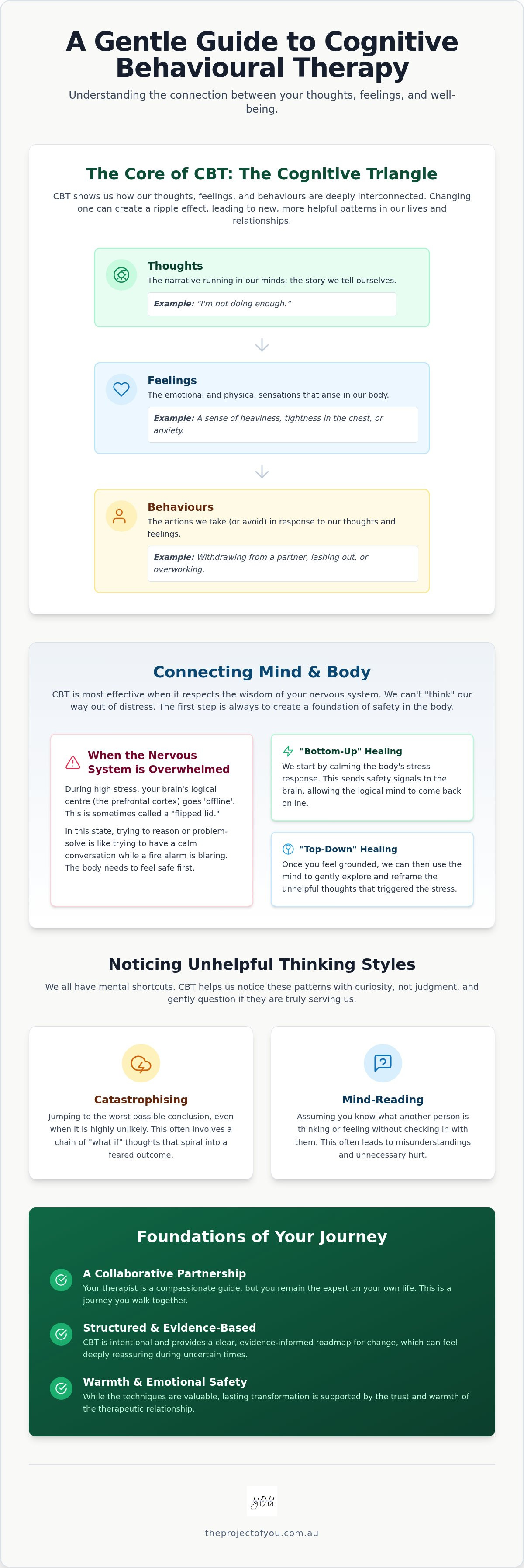
Have you ever noticed how a single critical thought can ripple through your entire day, colouring your interactions and leaving you feeling physically drained? This is where Cognitive behavioral therapy, or cbt therapy, offers a gentle yet structured way forward. Rather than getting lost in the distant past, this approach focuses on the present moment. It is a collaborative partnership where we work together to understand the intricate dance between your thoughts, your emotions, and your actions. This relationship is often called the "Cognitive Triangle."
When we look at this triangle, we see that our thoughts aren't just random whispers; they are the architects of our emotional experience. If you think, "I'm not doing enough," your body might respond with a sense of heaviness or anxiety, leading you to withdraw from your partner or overwork yourself. Cbt therapy isn't about forced positivity or "looking on the bright side." Instead, it's about seeing clearly. It's about developing the clarity to distinguish between a fear-based narrative and the reality of your situation, creating a foundation of psychological safety within your own mind.
The Core Principles of Cognitive Behavioural Therapy
One of the most empowering aspects of this journey is learning to identify "unhelpful" thought patterns, sometimes called cognitive distortions, without any hint of self-judgment. We all have them. Perhaps you tend to "catastrophise," imagining the worst possible outcome, or you "mind-read," assuming you know what others are thinking of you. In our sessions, we develop practical skills to test these worries. What if you could pause and ask, "Is there another way to look at this?" By understanding how your beliefs about the world were formed, often in response to earlier life transitions, you gain the agency to create new, more supportive paths for your future self.
Why CBT is a Preferred Evidence-Based Approach
There is a reason why this approach is so highly regarded by clinicians across Australia. It is deeply evidence-informed, showing consistent success in helping individuals navigate anxiety, depression, and the complexities of trauma. Unlike some forms of talk therapy that can feel aimless, CBT is intentional and structured. Each session has a purpose, providing you with a clear roadmap for change. This structured nature makes it particularly effective when integrated into a broader PTSD Therapy Australia pillar of care, where restoring a sense of order and safety is paramount for healing. It serves as a steady anchor, helping you find your way back to a regulated and hopeful state of being.
Connecting the Mind and Body: CBT and the Nervous System
Have you ever tried to "think" your way out of a panic attack, only to find that your mind feels like a locked room? While traditional approaches often treat the mind and body as separate entities, we believe that cbt therapy is most effective when it respects the wisdom of your nervous system. For many, the struggle isn't just in the mind; it's a physiological experience that requires a compassionate, integrated response.
When you are in a state of high distress, your brain's "logical" centre, the prefrontal cortex, can effectively go offline. This is often described as a "flipped lid." In this dysregulated state, trying to engage in complex cognitive work is like trying to repair a car while the engine is still racing at full speed. This is why establishing a sense of safety is our first priority. Once the body feels secure, we can harness neuroplasticity, which is the brain’s remarkable ability to forge new, calmer paths by reorganising its neural connections in response to supportive experiences.
How Thoughts Trigger the Stress Response
It often begins with a single, fleeting thought: "What if I fail?" Almost instantly, your brain signals the adrenal glands, your heart rate climbs, and your breath becomes shallow. This cycle happens so quickly that it can feel like your body is panicking for no reason. In our work together, we learn to "catch" these thoughts before they send the nervous system into a tailspin. We utilise both "top-down" healing, which uses the mind to influence the body, and "bottom-up" strategies that calm the physical self to clear the way for clearer thinking. Understanding what to expect in a CBT session involves recognising that we don't just talk about your worries; we learn to listen to what your racing heart is trying to communicate.
The Project of You Approach to Integrated Healing
At The Project of You, we don't believe in a one-size-fits-all model. We intentionally combine the practical tools of cbt therapy with Nervous System Restoration to ensure you feel supported on every level. Our goal is to help you move out of a chronic state of survival, where everything feels like a threat, and into a state of connection and ease. By inviting curiosity into your physical sensations rather than fear, you begin to understand the language of your own body. If you feel ready to explore how this integrated path can support your evolution, booking a session to start your journey can be a powerful act of self-compassion.
What to Expect in a CBT Session: A Gentle Walkthrough
Walking into your first session of cbt therapy shouldn't feel like walking into a clinical exam or a rigid business meeting. Instead, imagine it as sitting down in a quiet, safe space where your story is held with the utmost respect. The initial phase is purely about connection. We take the time to ensure you feel secure and understood before we even begin looking at the mechanics of your thoughts. This is a non-judgmental sanctuary where your privacy is sacred, allowing you to speak the truths that often feel too heavy to carry alone.
One of the most beautiful aspects of this work is its collaborative heart. While I bring the clinical framework, you remain the absolute expert on your own life. We sit as partners, curious about the patterns that have kept you feeling stuck. As the American Psychological Association explains, this partnership is essential for identifying the specific challenges you face and developing a tailored plan to navigate them. You aren't a passive recipient of care; you are an active participant in your own evolution.
You might have heard about "homework" in the context of cbt therapy. In our space, we think of this as gentle invitations to practice. Healing doesn't just happen within the four walls of a therapy room; it happens in the small moments of your daily life. These exercises are simply ways to bring the ease we find in session out into the real world. We might suggest trying a new way of responding to a partner or pausing for a breath when anxiety peaks. It’s about testing new skills in a way that feels manageable, grounded, and safe.
The Four Key Steps of the CBT Process
While every journey is unique, the process typically follows a steady, intentional rhythm to help you find clarity:
Step 1: Identifying the specific situations, life transitions, or health conditions that are currently causing you distress.
Step 2: Becoming aware of the "automatic" thoughts and underlying beliefs you hold about these problems.
Step 3: Gently identifying which of these patterns are negative, inaccurate, or perhaps no longer serving your growth.
Step 4: Reshaping your perspective by looking at the evidence and applying deep self-compassion to create a more balanced view.
Practical Tools You Might Learn
During our time together, we build a toolkit of strategies that you can rely on whenever life feels overwhelming. These aren't just abstract concepts; they are practical ways to navigate your world with more grace. You might explore thought records, which help you organise and externalise internal chatter so it feels less all-consuming. We may also use gentle exposure exercises to help you face fears in a controlled, safe way, or behavioural activation to help you take small, nourishing steps back toward the activities that once brought you joy.
Is CBT Right for You? Applications in Relationships and Trauma
While often viewed as a solo journey for managing individual anxiety, cbt therapy is a profoundly effective tool for navigating the intricate world of human connection. It offers a structured way to look at how our internal narratives influence our external bonds. Whether you're struggling with a sense of distance from your partner or trying to heal from deep wounds, these tools provide a bridge back to intimacy. We often use these techniques to challenge the painful "I am not enough" narrative that stems from insecure attachment styles, helping you rewrite the story of your worthiness with clarity and kindness.
For those navigating the complexities of parenting, these strategies help break generational cycles. By becoming curious about our triggers, we can respond to our children from a place of presence rather than past pain. This work naturally extends into couples counselling, where we foster a culture of curiosity rather than blame. It's about understanding the "why" behind our reactivity so we can choose a different, more connected path forward. It allows you to see your partner’s struggles through a lens of empathy while maintaining your own emotional boundaries.
CBT for Anxiety and Everyday Stress
Do you find yourself caught in a loop of "what if" thoughts as soon as your head hits the pillow? Everyday stress often feels like a constant background hum that never quite fades. In our sessions, we build a practical toolkit to manage workplace pressure and social anxiety. We focus on developing clear communication patterns and firm boundaries, allowing you to navigate your professional and social life without feeling perpetually drained. It’s about learning to catch the racing thoughts before they dictate your day, giving you the space to breathe and respond with intention.
Healing from Betrayal and Relationship Trauma
Navigating the aftermath of an affair is one of the most challenging transitions a person can face. Betrayal trauma often brings intrusive thoughts and a shattered sense of safety that feels deeply physical. Within the Couple Counselling process, cbt therapy helps manage these distressing mental loops. We work together to process the grief and shame that follow infidelity, slowly rebuilding trust through evidence-based transparency and self-compassion. This isn't about ignoring the pain; it's about finding the resilience to move through it toward a future of genuine emotional safety and restored self-worth.
Taking the Next Step Toward Your Personal Evolution
While cbt therapy provides a robust architectural plan for your mind, the true magic of healing happens within the safety of a compassionate relationship. It is one thing to understand a technique; it is quite another to feel truly seen and held by a steady mentor. If you are feeling stuck in old patterns, please know that your current struggle is not your final destination. Transformation is a continuous journey, and even the smallest shift in perspective can create a profound ripple effect in your daily life. Change is possible, even when it feels like a distant shore you haven't yet reached.
We invite you to imagine a life where your thoughts are no longer the drivers of your distress, but instead serve as helpful guides. This evolution doesn't happen overnight, but it does happen with intentionality and support. Whether you are seeking to repair a relationship or find peace within your own mind, the tools we have discussed are the building blocks of a more resilient self. You don't have to navigate this path alone; having a wise partner to help you map out the terrain makes all the difference.
Finding the Right Support in Australia
Choosing a therapist who resonates with your unique story is the most important decision you will make in this process. In the Australian landscape, it is essential to look for a practitioner who works through a trauma-informed lens. This ensures that your nervous system is respected and that you are never pushed beyond what you can safely process. Lasting change requires a foundation of emotional safety, not just clinical strategies. Take a moment to pause and consider: what would your life feel like if you were no longer at the mercy of your thoughts?
Connecting with The Project of You
At The Project of You, Azita Abdollahian brings her deep expertise as a clinical social worker and psychotherapist to every conversation. She specialises in weaving together cbt therapy with nervous system healing to support individuals and couples in their personal evolution. This integrated approach ensures that we are looking at the whole person, not just a list of symptoms. For those who feel ready for a deeper immersion into their healing, we also offer workshops and retreats designed to foster profound connection and restoration.
If you feel a quiet pull toward a different way of living, we invite you to reach out for a compassionate, expert-led conversation. You can easily find a time that works for you through our online portal. We are committed to providing a nurturing, evidence-based journey that honours your pace and your potential. Your path toward ease and clarity is waiting, and we would be honoured to walk it with you.
Embracing a Future of Emotional Ease and Clarity
What if you could move through your day with a sense of quiet confidence instead of constant worry? We've seen how cbt therapy serves as more than just a clinical tool; it is a way to navigate the complexities of the human condition with intention. By integrating cognitive work with nervous system restoration, you can begin to create a life that feels safe and expansive. Our trauma-informed and evidence-based approach, led by an experienced Clinical Social Worker and Psychotherapist, provides nationwide Australian support for those ready to heal. You aren't just managing symptoms; you are building a foundation for lasting growth by rewriting old narratives and fostering deeper relationship connections.
Your journey toward a calmer, more intentional way of being starts with a single step. We are here to walk beside you as you discover the inherent potential within yourself to find ease and find your way back to who you truly are. Change is possible, and you don't have to find the path alone.
Frequently Asked Questions
Is CBT therapy just about "positive thinking"?
No, this approach is definitely not about "positive thinking"; it's about finding accuracy and clarity in your perspective. Instead of forcing you to look at the bright side, we work together to look at the evidence. If a thought like "I'm a failure" isn't supported by the facts of your life, we find a more balanced, realistic narrative. This process helps you see your world more clearly, allowing for genuine emotional ease.
How many sessions of CBT will I need before I feel better?
The number of sessions you might need depends entirely on your unique journey and the complexity of your challenges. Many people find that 6 to 20 weekly sessions provide a solid foundation for lasting change. While some feel a sense of relief after just a few meetings, others prefer longer-term support to navigate deeper trauma. We always move at a pace that feels safe and sustainable for your nervous system.
Can CBT help with relationship problems and infidelity?
Yes, cbt therapy is an incredibly powerful tool for navigating relationship distress and the aftermath of infidelity. It helps partners manage the intrusive thoughts and physical anxiety that often follow a betrayal. By identifying the negative cycles in your communication, you can begin to rebuild trust. We focus on fostering curiosity about each other's experiences rather than falling into the trap of blame or withdrawal.
What is the difference between CBT and traditional talk therapy?
While traditional talk therapy often focuses on exploring your past in an open-ended way, CBT is more structured and goal-oriented. It focuses on the "here and now," giving you practical strategies to manage your current distress. You aren't just talking about your problems; you are actively learning new skills to change your relationship with your thoughts. It's a collaborative partnership where we work toward specific outcomes together.
Do I need a mental health diagnosis to benefit from CBT?
You don't need a formal diagnosis to benefit from the tools we share in our sessions. Many people seek support to manage everyday stress, navigate life transitions, or improve their relationship communication. Whether you are dealing with a specific condition or simply feel stuck in a negative loop, these evidence-based strategies offer a clear path toward personal evolution and a more regulated, peaceful life.
Is CBT effective for treating trauma and PTSD?
It is highly effective, particularly when delivered through a trauma-informed lens that respects your nervous system. For those living with PTSD, these tools help you process triggers and manage the intense physical sensations of fear. We work to gently untangle the "survival" responses your brain has developed, helping you feel more present and secure in your body. It is about reclaiming your sense of safety.
What happens if I find it hard to talk about my feelings during a session?
It's perfectly normal to feel hesitant or find it difficult to put your emotions into words initially. Because our approach is collaborative, we don't force you into deep emotional territory before you feel ready. We might start by looking at your thoughts or daily actions, which often feels more manageable. As we build a sense of psychological safety together, the words for your feelings will naturally begin to find their way.
How can I access CBT therapy in Australia?
Accessing cbt therapy in Australia often begins with a visit to your GP to discuss a Mental Health Treatment Plan. This plan allows you to access Medicare rebates for up to 10 individual sessions per calendar year, helping to make professional support more accessible. You can also choose to see a private practitioner directly. At The Project of You, we provide nationwide support, ensuring you can connect with expert care from anywhere in the country.


Comments