.png)

Psychedelic-Assisted Therapy in Australia: Benefits, Risks & Who It’s Right For
- Azita Abdollahian

- 8 hours ago
- 16 min read
Could psychedelic-assisted therapy offer a new pathway for people living with PTSD, treatment-resistant depression or complex trauma?
For some people, traditional therapy can provide valuable insight without creating the lasting change they hoped for. You may understand your trauma, recognise your patterns and have spent years talking through your experiences, yet still feel as though something is keeping you stuck.
This is a common experience for people navigating trauma, PTSD, depression, anxiety and long-term emotional distress.
As a psychotherapist, trauma expert and founder of The Project Of You, Azita Abdollahian believes that meaningful mental health treatment requires us to look beyond symptoms and understand the deeper emotional, psychological and nervous system patterns influencing how we think, feel and behave.
One emerging area receiving significant attention is psychedelic-assisted therapy in Australia.
With changes to Australia's regulatory framework, psychedelic-assisted psychotherapy has become an increasingly discussed treatment option for specific mental health conditions. But what exactly is psychedelic-assisted therapy, who can access it, and what does treatment actually involve?
This guide explores the current landscape and what Australians need to know before considering psychedelic-assisted therapy.
What Is Psychedelic-Assisted Therapy?
Psychedelic-assisted therapy is a therapeutic approach that combines carefully supervised psychedelic medicine with structured psychological support and psychotherapy.
Importantly, the medicine itself is not the therapy.
The therapeutic process can include clinical assessment, preparation, supported treatment sessions and integration work. The intention is to provide a carefully controlled environment in which a person can explore difficult emotional experiences with appropriate clinical and psychological support.
At The Project Of You, Azita Abdollahian takes a trauma-informed approach to mental health and psychotherapy, recognising that lasting change often requires more than simply understanding what has happened to you.
It can require creating enough psychological and physiological safety to process experiences differently.
Is Psychedelic-Assisted Therapy Legal in Australia?
Psychedelic-assisted therapy is a developing and highly regulated area of mental health treatment in Australia.
The Therapeutic Goods Administration (TGA) currently allows specifically authorised psychiatrists to access MDMA and psilocybine as unapproved therapeutic goods through the Authorised Prescriber Scheme.
Under this pathway, MDMA may be accessed for PTSD and psilocybine may be accessed for treatment-resistant depression, subject to strict regulatory requirements.
This means psychedelic-assisted therapy is not a treatment that can simply be accessed by anyone, and psychedelic medicines should not be used outside an appropriate medical and therapeutic framework.
Anyone considering this form of treatment should seek advice from an appropriately qualified and authorised medical professional.
Can Psychedelic-Assisted Therapy Help With PTSD?
PTSD can affect far more than someone's thoughts.
Trauma can influence the nervous system, emotional regulation, relationships, sleep, sense of safety and the way a person responds to everyday situations.
This is why trauma-informed therapy looks beyond the event itself and considers how the experience continues to affect the person in the present.
MDMA-assisted psychotherapy has received significant clinical and research interest in relation to PTSD, and Australia's current regulatory pathway permits authorised psychiatrists to prescribe MDMA for PTSD under specific conditions.
For someone who has experienced chronic trauma or PTSD, the question isn't simply whether a particular treatment is effective.
It's whether that treatment is appropriate, safe and clinically indicated for the individual.
What About Psilocybine Therapy for Depression?
Psilocybine is another psychedelic medicine receiving significant attention in mental health research.
In Australia, the TGA's current Authorised Prescriber pathway permits appropriately authorised psychiatrists to access psilocybine for treatment-resistant depression.
Treatment-resistant depression can be particularly challenging. Some people experience ongoing symptoms despite trying multiple conventional treatments, including psychotherapy and antidepressant medication.
For these individuals, emerging treatment approaches can represent an important area of research and clinical discussion.
However, psychedelic-assisted therapy is not appropriate for everyone, and eligibility must be determined through an individual clinical assessment.
How Does Psychedelic-Assisted Psychotherapy Work?
One of the biggest misconceptions about psychedelic therapy is that the medicine is responsible for the entire therapeutic process.
In reality, the therapeutic environment, preparation, professional support and integration are all important components of the experience.
A psychedelic-assisted psychotherapy program may involve:
Assessment A thorough assessment determines whether the treatment may be clinically appropriate.
Preparation Patients are supported in understanding the process, establishing therapeutic goals and preparing psychologically for the experience.
Supported treatment The psychedelic medicine is administered within a controlled clinical environment with appropriate medical and therapeutic supervision.
Integration After the experience, therapeutic work can help the person process what emerged and consider how insights or changes can be integrated into everyday life.
This distinction between the medicine and the therapy is critical.
Psychedelic-assisted psychotherapy is not simply taking a substance and hoping for a breakthrough. It is a structured therapeutic process that requires appropriate clinical oversight.
Trauma, the Nervous System and Mental Health
Azita Abdollahian's work at The Project Of You focuses heavily on understanding the relationship between trauma, emotional wellbeing, relationships and the nervous system.
When the nervous system has been shaped by chronic stress or traumatic experiences, a person may continue responding to present-day situations through patterns developed during earlier experiences.
This can affect:
Emotional regulation
Anxiety and hypervigilance
Relationships and attachment
Self-worth and confidence
Communication
Stress and burnout
Depression
Sense of safety
Reactions to conflict and perceived rejection
Understanding these patterns can be an important part of psychological healing.
Whether someone is exploring traditional psychotherapy or learning about emerging treatments such as psychedelic-assisted therapy, the goal should always be the same: safe, ethical and individualised care that supports meaningful and sustainable change.
Is Psychedelic-Assisted Therapy Right for You?
Psychedelic-assisted therapy is an exciting and rapidly developing area of mental health treatment, but it isn't a universal solution.
There are important considerations around medical history, psychological health, current medications, previous treatment, individual risk factors and clinical suitability.
If you are considering psychedelic-assisted therapy in Australia, it is important to speak with an appropriately qualified healthcare professional rather than attempting to access psychedelic medicines independently.
At The Project Of You, Azita Abdollahian provides trauma-informed psychotherapy and mental health support that focuses on understanding the deeper patterns influencing a person's emotional wellbeing, relationships and life.
For some people, traditional psychotherapy may be an appropriate pathway. For others, emerging treatment approaches may warrant further clinical discussion.
The right treatment is not about following the latest trend.
It's about understanding you.
Understanding Your Options Is the First Step
The mental health landscape is changing.
As research into trauma, the nervous system and psychedelic-assisted psychotherapy continues to develop, Australians have more conversations to have about how we understand and treat complex mental health conditions.
But new doesn't automatically mean better—and psychedelic doesn't automatically mean appropriate.
Good mental healthcare starts with informed, individualised and ethical decision-making.
If you're struggling with trauma, PTSD, depression, anxiety, relationship difficulties or feeling stuck despite years of trying to change, understanding the different therapeutic approaches available to you can be the beginning of something different.
Azita Abdollahian and The Project Of You are committed to helping people move beyond simply managing their symptoms and toward a deeper understanding of themselves, their experiences and the patterns shaping their lives.
If you're ready to explore your mental health and understand what support may be right for you, The Project Of You offers psychotherapy and trauma-informed support in Sydney and online.
Table of Contents
Understanding Psychedelic Assisted Therapy in the Australian Context
What does it actually mean to step into the world of psychedelic assisted therapy Australia? For many, the idea feels both promising and perhaps a little daunting. It's helpful to think of this approach not as a "magic pill", but as a deeply supported therapeutic process. In this clinical model, specific medicines are used to help you access parts of your inner world that might usually feel too painful or guarded to reach. This isn't a recreational experience; it's a TGA-regulated medical treatment that prioritises your psychological safety and emotional containment at every step. By combining the biological effects of the medicine with professional psychotherapy, we create a space where genuine transformation can begin to take root.
The Legal Landscape: What Changed in Australia?
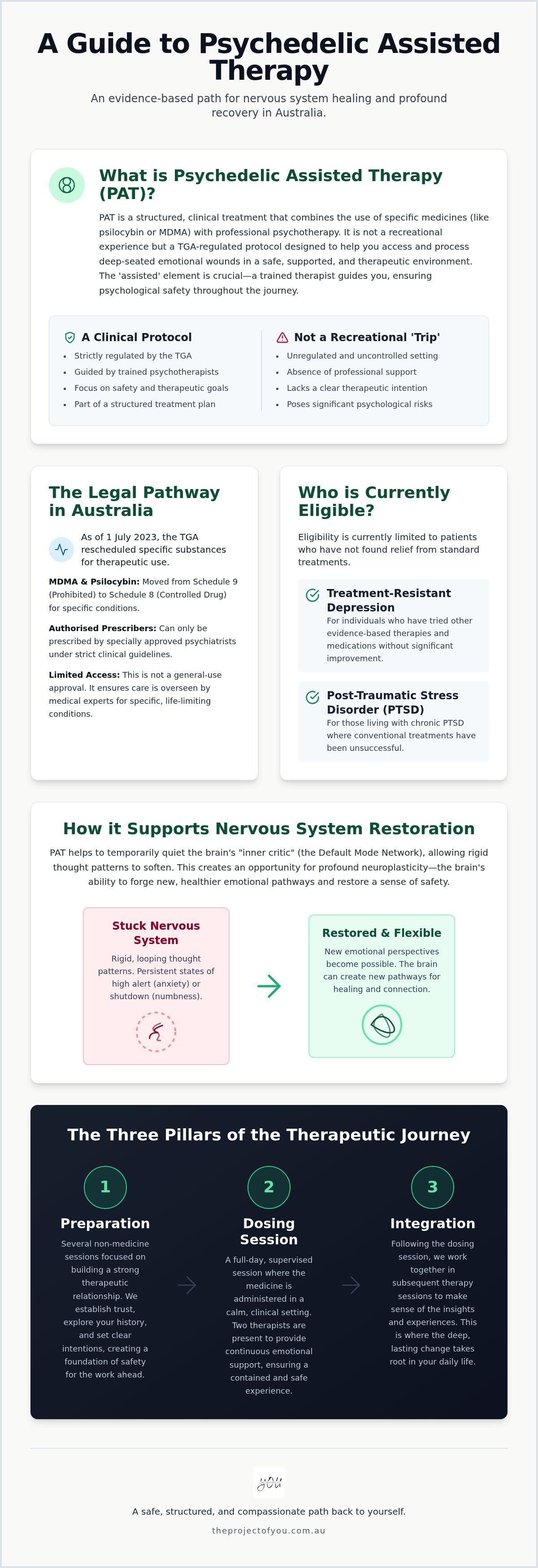
On 1 July 2023, the Therapeutic Goods Administration (TGA) made a landmark decision to reschedule MDMA and psilocybin. These substances shifted from Schedule 9 (Prohibited Substances) to Schedule 8 (Controlled Drugs) specifically for the treatment of PTSD and treatment-resistant depression. This doesn't mean these substances are available for general use. Instead, they are only accessible through an Authorised Prescriber. As of 2026, the Authorised Prescriber Scheme is the regulatory pathway that permits approved psychiatrists to provide these unapproved medicines to patients with specific, life-limiting conditions under strict clinical guidelines. This structure ensures that your care is overseen by medical experts who understand both the potential and the responsibility of this work.
Why It Is Not 'Just a Drug': The Assisted Element
If you've felt stuck in traditional talk therapy, you might worry that this is just another "drug" to manage symptoms. It's quite the opposite. In Psychedelic therapy, the medicine acts as a key that opens a heavy door, but the therapist is the guide who walks through that door with you. There's a profound difference between a recreational "trip" and a therapeutic session. In a clinical setting, every moment is designed to foster a sense of safety and curiosity. Your therapist provides the emotional scaffolding needed to process difficult memories or insights that may emerge. We focus on psychedelic assisted therapy because the real healing happens in the relationship and the integration that follows. It's about helping you find your way back to a sense of wholeness with professional, trauma-informed support.
How Psychedelic Therapy Supports Nervous System Restoration
Imagine your nervous system as a wide, flowing river. When we are healthy and grounded, we can navigate the occasional rapids of life with relative ease. Trauma, however, acts like a persistent drought, narrowing this "Window of Tolerance" until even a small ripple feels like an overwhelming flood. You might find yourself trapped in a state of high alert, unable to relax, or perhaps you feel completely numb and disconnected from the world around you. The true intention of psychedelic assisted therapy Australia is to facilitate deep Nervous System Restoration. It's about helping your body remember how to feel safe again, expanding that window so you can handle life's ebbs and flows without being swept away.
This restoration is made possible through neuroplasticity, which is your brain's remarkable ability to forge new pathways. When we struggle with chronic depression or PTSD, our minds often get stuck in deep, rigid ruts of thought and feeling. The medicine helps to "soften" the soil of the mind, making it possible to step out of those old, painful tracks and create new, healthier emotional trails. As we navigate the evolving regulatory and policy matters in Australia, the focus remains firmly on how these biological shifts can be harnessed within a safe, clinical container to produce lasting change.
Quieting the Inner Critic: The Default Mode Network
You can think of the Default Mode Network (DMN) as your brain's "habitual self" or your persistent inner critic. It's the system responsible for rumination, self-criticism, and the rigid stories we tell ourselves about who we are. During a therapeutic session, the DMN temporarily quiets down. This "reset" allows the rigid boundaries of your identity to soften, creating a rare window of mental flexibility. In this space, the heavy fog of shame or hopelessness often lifts, allowing you to see your life and your challenges from a fresh, more compassionate perspective.
Attachment Theory and Emotional Safety
Healing is rarely a solitary pursuit; it happens through connection. For those carrying the weight of attachment trauma, the presence of a compassionate, steady therapist is the most essential ingredient of the process. While the medicine helps lower the defensive barriers you've built to survive, your therapist provides the emotional scaffolding needed to explore what's underneath. This relational healing fosters a profound sense of emotional safety. It allows you to move from a place of self-protection to one of self-connection, replacing old patterns of isolation with a newfound capacity for intimacy and trust. If you feel called to explore these new possibilities for your own wellbeing, you're welcome to book a time to chat about your needs.
Eligibility and Conditions: Who Can Access PAT in Australia?
If you've been on a long journey with your mental health, you might be wondering if this is finally the path that leads home. While the possibilities of psychedelic assisted therapy Australia are expansive, the current clinical gateway is quite specific. At this stage, the Therapeutic Goods Administration (TGA) has approved these treatments as a specialised option rather than a first-line response. This means it's generally reserved for those who haven't found relief through traditional avenues like standard counselling or common medications. It's a path for those who feel they've exhausted the usual maps and need a different way to navigate their recovery.
To be eligible, a person must be diagnosed with either Treatment-Resistant Depression (for psilocybin) or PTSD (for MDMA). In a clinical sense, "treatment-resistant" usually means you've tried at least two standard treatments, such as different classes of antidepressants or evidence-based talk therapies, without experiencing significant or lasting improvement. This requirement ensures that PAT is used as a targeted intervention for those in greatest need. Safety is our absolute priority, which is why the screening process is so thorough. For instance, individuals with a personal or strong family history of psychosis or certain types of bipolar disorder are generally not candidates for this therapy, as the medicine could potentially trigger a difficult psychological episode.
MDMA-Assisted Therapy for PTSD
For those living with PTSD, the world can often feel like a minefield of triggers. MDMA works by gently reducing the fear response in the amygdala, the part of your brain that sounds the alarm when it senses danger. This creates a unique window where you can process traumatic memories without being overwhelmed by "flooding" or the intense physical distress that usually accompanies them. MDMA fosters the pro-social feelings of safety and connection that are essential for doing the heavy lifting of trauma work, allowing you to look at your past with a sense of calm and self-compassion that might have previously felt impossible.
Psilocybin-Assisted Therapy for Depression
Psilocybin offers a different kind of opening for those stuck in the heavy, grey fog of depression. It often facilitates what people describe as "mystical" or "meaning-making" experiences, helping to break the repetitive cycles of rumination that keep you stuck in the same dark thoughts. By quieting the brain's habitual self-critic, psilocybin allows for a profound sense of connection to yourself and the world around you. Many find that the benefits of a few intentional sessions are far more long-term than daily medication, as the experience helps you shift your fundamental perspective on life's challenges. If you'd like to learn more about how I work with these themes, you can read more about Azita and our trauma-informed approach.
The Three Pillars of the Journey: Preparation, Dosing, and Integration
If you are considering psychedelic assisted therapy Australia, it is helpful to view the process as a steady, intentional arc rather than a single event. Many people feel a mix of curiosity and natural apprehension about the "dosing" session itself. However, the medicine session is actually only one small part of a much larger therapeutic commitment. A full course of treatment typically involves several weeks of dedicated work, ensuring you are never alone in your experience. This journey is built upon three essential pillars that provide the psychological scaffolding needed for deep, lasting change.
During the dosing sessions, your safety is held by a dedicated therapy team, usually consisting of two qualified practitioners. This dual-therapist model is a key safety requirement in the Australian clinical framework. It ensures that you have constant, attentive support as you navigate the inner landscape of your mind. Their role is not to direct your experience, but to provide a grounded presence, helping you feel contained and supported as you move through whatever emotions or memories may emerge.
Preparation: Building the Container
Before any medicine is introduced, we spend significant time building a "container" of trust and safety. This preparation phase is about more than just logistics; it is about "set and setting." We work together to explore your history, address your fears, and clarify your intentions. Rather than setting rigid expectations for what "should" happen, we focus on creating a sense of openness and curiosity. This phase also includes rigorous physical and psychological screening to ensure that your nervous system is ready for the work ahead, allowing you to step into the experience with a sense of informed confidence.
Integration: Where the Real Healing Happens
While the dosing session can offer profound insights, the days and weeks that follow are the truly fertile ground for transformation. We call this "Integration." It is the vital process of weaving the symbols, feelings, and realisations from your session into the fabric of your daily life. Without this step, even the most powerful experience can remain just a memory rather than a catalyst for growth. Practical strategies such as journaling, somatic movement, and mindfulness are used to help "ground" your insights. Azita Abdollahian's approach prioritises this long-term support, ensuring you have a steady guide to help you translate your inner discoveries into tangible changes in your relationships and your sense of self.
Finding a Safe and Ethical Path Forward in Australia
Stepping toward a new form of healing requires both courage and discernment. If you feel ready to explore psychedelic assisted therapy Australia, the most grounded way to begin is by having an open conversation with your GP or current psychiatrist. Because this is a highly regulated clinical pathway, you will need a formal diagnosis and a referral to a psychiatrist who is an Authorised Prescriber. It's a collaborative process, one where your existing medical team works alongside specialists to ensure your nervous system is well-supported throughout the entire journey.
When you meet with a potential provider, don't be afraid to ask direct questions about their specific training, their experience with complex trauma, and their ethical framework. You might ask: "How do you manage the integration phase?" or "What is your process for ensuring emotional safety during a session?" It's vital to choose a therapist who prioritises a trauma-informed approach. While "underground" or unregulated options might seem more accessible, they often lack the clinical oversight and emergency protocols necessary for those navigating deep-seated trauma or treatment-resistant conditions. Your safety and long-term stability are worth the patience it takes to find a regulated, professional path.
Evaluating a Therapeutic Fit
Beyond the clinical qualifications, the most important factor is the "human" connection. Do you feel truly "felt" and understood by your therapist? Deep emotional work requires a foundation of psychological safety that only a genuine, non-judgemental relationship can provide. Many people find that practitioners with backgrounds in clinical social work and psychotherapy offer a unique depth of empathy and a holistic understanding of the human condition. This professional foundation ensures that you are seen as a whole person, not just a set of symptoms, allowing for a more curious and compassionate exploration of your inner world. You can learn more about this philosophy on our about page.
Taking the First Step
It's natural to feel a sense of trepidation after years of struggling with persistent symptoms. However, the emerging landscape of psychedelic assisted therapy Australia offers a genuine sense of hope for those who thought they had run out of options. Transformation is possible. If you'd like to explore whether this path aligns with your needs, I invite you to reach out for a consultation. We can sit with your questions and look toward the future together. As you reflect on what you've read, I invite you to consider this: what might your life look like if you felt truly at home in your own body?
Embracing a New Chapter in Your Healing Journey
Choosing to explore a different way of living takes immense courage, especially when traditional paths have left you feeling stuck or exhausted. You don't have to carry the weight of chronic symptoms in isolation any longer. We've explored how psychedelic assisted therapy Australia serves as a vital catalyst for nervous system restoration when it's held within a safe, evidence-based, and clinical container. This process is deeply intentional, honouring the three pillars of preparation, dosing, and integration to ensure your insights become lasting changes.
As a qualified clinical social worker, Azita Abdollahian provides the trauma-informed protocols and compassionate guidance needed to navigate these transitions with grace. Real recovery isn't about pushing through your pain. It's about finding the right partnership to help your body remember its natural capacity for ease and connection.
You deserve a life where you feel truly at home in your own skin. While the road to recovery can feel daunting, these new clinical pathways offer a steady hand and a sense of genuine possibility. We are here to walk beside you as you find your way back to wholeness.
Frequently Asked Questions
Is psychedelic-assisted therapy legal in Australia right now?
Yes, psychedelic-assisted therapy is legal for specific, restricted clinical uses under the Authorised Prescriber Scheme. Since 1 July 2023, the TGA has permitted approved psychiatrists to prescribe MDMA for the treatment of PTSD and psilocybin for treatment-resistant depression. Outside of these two specific diagnoses and the strict clinical framework, these substances remain prohibited for recreational or general therapeutic use.
How much does psychedelic-assisted therapy cost in Australia?
The cost for a full course of treatment is significant due to the intensive level of professional clinical supervision required for your safety. Industry data from 2026 indicates that a complete program, including preparation, dosing sessions with two practitioners, and integration, typically ranges between $15,000 and $30,000 AUD. These costs reflect the specialised environment and the high ratio of practitioners to patients required by the TGA.
Can I get a Medicare rebate for psychedelic therapy?
Medicare does not currently cover the cost of the psychedelic medicine itself or the full dosing sessions. You may be able to claim rebates for some of the associated psychiatric assessments and standard therapy sessions that form part of the preparation and integration phases. Some private health insurers have also begun pilot programs to help with these costs, so it's a good idea to check with your individual provider.
What is the difference between psilocybin and 'magic mushrooms'?
The psilocybin used in psychedelic assisted therapy Australia is a pharmaceutical-grade, synthetic compound that is precisely dosed for clinical safety. While "magic mushrooms" contain psilocybin, their potency can vary significantly between individual fungi, making it impossible to ensure a predictable therapeutic experience. Using a standardised medicine allows your therapy team to focus entirely on your emotional journey without worrying about variable strength or contaminants.
Do I have to stop taking my current antidepressants before PAT?
Many patients do need to carefully taper off certain medications, such as SSRIs, because they can interfere with how the medicine works in your brain. This is not something you should ever do alone or suddenly. Any changes to your current medication must be managed through a structured plan created and supervised by your prescribing psychiatrist to ensure your nervous system remains stable throughout the transition.
What happens if I have a 'bad trip' during the session?
We prefer to look at difficult moments as "challenging experiences" that often hold the keys to your deepest healing. Your two therapists are in the room specifically to provide a "safe container," helping you navigate intense emotions or memories with grounding techniques and compassionate presence. You are never left alone to manage the intensity; our role is to help you move through the challenge rather than turning away from it.
How many sessions of psychedelic therapy are usually required?
A standard clinical protocol is a long-term commitment that typically spans several months. This usually includes approximately 6 to 8 preparation sessions, followed by 2 or 3 dosing sessions, and at least 10 integration sessions to weave your insights into daily life. The goal is to provide enough time for your nervous system to process and integrate the changes, rather than rushing the recovery process.
Can I access this therapy for anxiety or eating disorders?
No, the TGA has not yet approved these medicines for anxiety, eating disorders, or other mental health conditions outside of clinical trials. Currently, the legal pathway is strictly limited to MDMA for PTSD and psilocybin for treatment-resistant depression. While research into other areas is promising and ongoing, these treatments remain unavailable for other diagnoses in the standard Australian healthcare system for now.


Comments