.png)

Intensive Couples Retreat Australia: 2026 Guide
- Azita Abdollahian

- 3 hours ago
- 15 min read
What is a couples retreat Australia, and can it really help a struggling relationship?
A couples retreat is an immersive relationship experience designed to help partners step away from everyday stress, understand the deeper patterns affecting their connection, and learn practical tools to rebuild trust, intimacy and emotional safety.
At The Project Of You, founded by psychotherapist and trauma expert Azita Abdollahian, couples retreats are designed around the understanding that relationship struggles are often connected to deeper emotional patterns, unresolved wounds and nervous system responses—not simply a lack of communication.
When couples experience ongoing conflict, emotional distance or betrayal, the problem is often not a lack of love. Instead, both partners may be operating from stress responses, emotional exhaustion and unresolved experiences that make connection feel difficult.
You may find yourselves stuck in cycles of:
Repeating the same arguments without resolution
Feeling misunderstood, unheard or emotionally disconnected
Becoming defensive instead of compassionate
Struggling to rebuild trust after betrayal or infidelity
Wanting closeness but feeling unable to access it
This doesn't mean your relationship is broken. It may mean your nervous systems are overwhelmed and no longer feel safe enough to connect.
Why Traditional Couples Therapy Isn't Always Enough
Weekly couples counselling can be incredibly valuable, but for some couples, the pace can feel too slow when they are facing deep disconnection, relationship trauma or the aftermath of betrayal.
This is why Azita Abdollahian created an intensive couples retreat experience through The Project Of You—to provide couples with dedicated time, space and guidance to move beyond surface-level conversations and address the deeper patterns affecting their relationship.
A couples intensive retreat allows partners to step away from the distractions of everyday life and immerse themselves in focused therapeutic work designed to create meaningful shifts.
Rather than simply discussing problems, couples learn how to recognise their emotional patterns, understand their triggers and practise new ways of connecting in real time.
How Nervous System Regulation Can Transform Relationships
Healthy communication is not just about learning the right words.
It requires both partners to feel emotionally safe enough to listen, understand and respond with compassion.
Through her trauma-informed approach, Azita Abdollahian helps couples understand how the nervous system influences relationships, conflict and emotional connection.
When the body is stuck in survival mode, it becomes much harder to access empathy, vulnerability and intimacy. Couples may find themselves reacting from fear, hurt or past experiences rather than responding from love and understanding.
A trauma-informed couples retreat focuses on helping couples:
Understand their emotional triggers and reactions
Recognise unconscious relationship patterns
Regulate stress responses during conflict
Communicate with greater compassion and clarity
Rebuild emotional safety and trust
Create deeper intimacy and connection
Healing Relationship Trauma and Rebuilding Trust
One of the most painful experiences a relationship can face is betrayal.
Whether caused by infidelity, emotional disconnection or years of unresolved conflict, relationship wounds can leave couples feeling uncertain about whether trust can ever be restored.
Azita Abdollahian’s approach focuses on looking beneath the behaviour to understand the deeper emotional drivers, attachment patterns and unresolved experiences that contribute to relationship breakdown.
Healing is not about ignoring what happened.
It is about creating the understanding, safety and tools needed to move forward differently.
A New Path Forward for Your Relationship
A relationship can heal when both partners feel safe enough to be seen, heard and understood.
A trauma-informed couples retreat in Australia with The Project Of You provides couples with the opportunity to step away from old patterns and enter a supportive environment where meaningful change can begin.
With the right guidance, tools and commitment, couples can move beyond surviving conflict and rediscover the trust, intimacy and connection they once thought was lost.
Through compassionate, evidence-informed therapeutic practices, Azita Abdollahian and The Project Of You help couples create relationships that are not only restored—but transformed.
Table of Contents
What is an Intensive Couples Retreat? The 'Circuit Breaker' Concept
Beyond Talk Therapy: Why Nervous System Restoration is the Missing Piece
The Practical Benefits of a Relationship Intensive in Australia
How to Choose the Best Intensive Retreat for Your Relationship
Preparing for Your Journey: What to Expect from a Private Intensive
What is an Intensive Couples Retreat? The 'Circuit Breaker' Concept
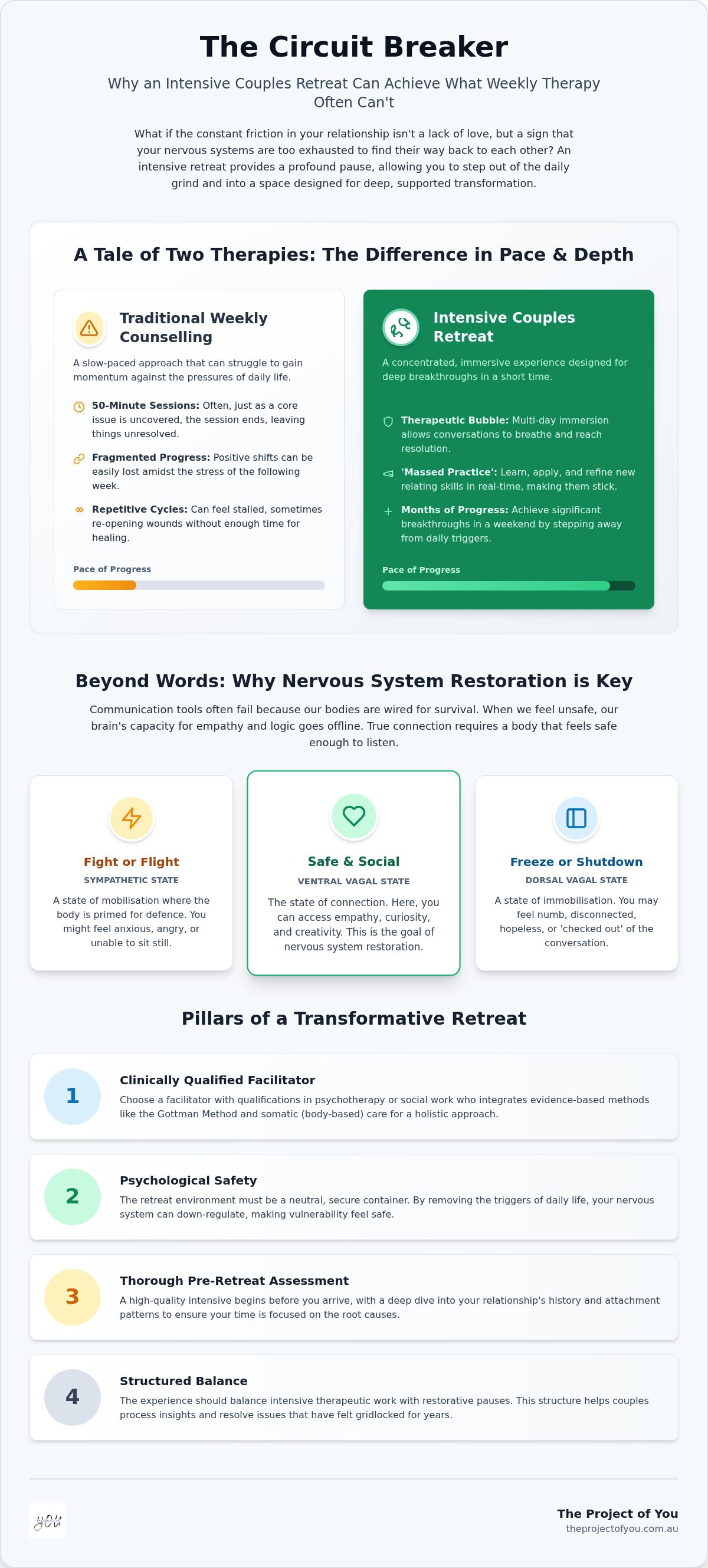
Imagine for a moment that your relationship is an electrical circuit that has become overloaded. The constant sparks of conflict, the heat of resentment, and the exhaustion of repetitive arguments have pushed the system to its limit. An intensive couples retreat Australia acts as a vital circuit breaker. It provides a deliberate pause, stopping the daily grind of domestic life so you can focus entirely on the foundation of your partnership. Unlike a standard holiday where the underlying tension often travels with you, a private couples retreat is a multi-day, immersive therapeutic experience designed to address deep-seated issues in a concentrated timeframe.
This approach utilises what we call 'massed practice'. Instead of learning a communication tool on a Tuesday and forgetting to use it by Friday, you learn, apply, and refine new ways of relating in real-time. It moves beyond the surface level of what is couples therapy? by creating a dedicated space where the work isn't interrupted by the school run or work emails. It's a transition from simply surviving your days to actively constructing a new path together with professional guidance.
Why Weekly Counselling Isn't Always Enough
Traditional therapy typically happens in 50-minute increments. Just as you begin to touch on a core wound or a significant betrayal, the clock runs out. You're then forced to gather your emotions and head back into the world of chores and responsibilities. For many, this cycle can feel stalled or even re-traumatising, as sensitive topics are opened but never quite resolved before you're back in the car. Staying in a 'therapeutic bubble' for two or three consecutive days allows the conversation to breathe. You have the time to move through the peak of the distress and find a sense of resolution before the day ends, ensuring that progress isn't lost in the shuffle of daily life.
The Role of Psychological Safety in Intensives
When we feel under threat, our nervous systems naturally shift into defensive states like fight, flight, or freeze. In the heat of a home environment, these defences are often on high alert. An immersive, neutral space helps lower these barriers. By removing the familiar triggers of your everyday surroundings, your body begins to recognise that it's safe to be vulnerable. This professional environment provides a secure container where high-stakes emotional work can be held with grace and clinical precision. It's about creating a sanctuary where the focus isn't on who is right, but on how you can both feel safe again. By providing a dedicated physical and emotional boundary, an intensive couples retreat Australia creates a protected container that allows couples to explore their most difficult vulnerabilities without the fear of the conversation collapsing under the weight of external stress.
Beyond Talk Therapy: Why Nervous System Restoration is the Missing Piece
Have you ever wondered why the most well intentioned communication tools seem to evaporate the moment a real conflict starts? You might have the perfect script for an "I" statement, yet when your partner's tone shifts, your heart races and your mind goes blank. This happens because our bodies are biologically wired to prioritise survival over sophisticated conversation. In an intensive couples retreat Australia, we look past the words being spoken and focus on the physiological state of each person. This is where Polyvagal Theory becomes a practical map for your relationship.
Our nervous systems are constantly scanning the environment for cues of safety or danger. When we feel threatened, we move into a state of "mobilisation" (fight or flight) or "immobilisation" (shutting down). If you or your partner are in one of these survival states, the part of your brain responsible for empathy and logic effectively goes offline. Research on the effectiveness of couples therapy suggests that lasting change is difficult to achieve if we only address the thoughts and ignore the underlying bodily responses. Nervous System Restoration is about teaching the body that it's safe to come home to the relationship.
Your attachment style, whether it's secure, anxious, or avoidant, is essentially your nervous system's learned strategy for seeking safety. When these styles clash, it often leads to a cycle of chronic "survival mode" where neither partner feels heard. By understanding these physiological patterns, we can move away from the frustration of repetitive arguments and toward a place of genuine, felt safety.
Regulating the Body to Repair the Bond
Healing doesn't happen in isolation; it happens through co-regulation. This is the beautiful process where one partner's calm nervous system helps to soothe the other's distress. During an intensive, we use somatic tools and neurofeedback to help you recognise these physiological shifts before they turn into a full blown argument. By learning to anchor yourselves in a state of safety, you can begin to repair the bond from the inside out. Learn more about our approach to Nervous System Restoration and how it can help you find your way back to a sense of ease.
Trauma-Informed Care in a Retreat Setting
A trauma informed approach shifts the focus from "What is wrong with my partner?" to "What happened to us?". This curiosity is essential, especially when dealing with betrayal trauma. The physiological impact of an affair can leave the betrayed partner's system in a state of chronic hyper vigilance, making it nearly impossible to "just move on" without addressing the body's need for safety. In our intensive couples retreat Australia, we create a space where these wounds are acknowledged with deep compassion. You can explore more about healing from infidelity and rebuilding trust through our clinical resources. If you feel ready to start this journey, you might like to book a time to chat about your specific needs.
The Practical Benefits of a Relationship Intensive in Australia
Many couples arrive at our doors feeling weary from the slow pace of traditional change. They might have tried the occasional date night or a generic wellness weekend, but the underlying tension usually follows them home. An intensive couples retreat Australia offers a level of clinical depth that a standard holiday simply cannot reach. By dedicating several days to your partnership, you move beyond surface level fixes and begin the work of structural repair. This focused environment provides the luxury of time, allowing us to explore the deeper 'why' behind your habitual reactions rather than just managing the 'what' of your daily disagreements.
Safety is the foundation of this process. In the heat of a high emotion moment at home, it's easy for a conversation to spiral into a familiar cycle of blame or withdrawal. During an intensive, you have constant professional support to navigate these difficult transitions. We act as a steady anchor, ensuring that even when the work feels challenging, you both remain within your window of tolerance. This dedicated container allows you to stay with the difficult feelings long enough to find resolution, rather than cutting the conversation short when it feels too uncomfortable.
Efficiency and the 'Massed Practice' Effect
Concentrated time allows for a type of neurological rewiring that rarely happens in 50 minute increments. In clinical terms, this is known as massed practice. When you spend consecutive days immersed in new ways of relating, your nervous system begins to recognise these patterns as a new 'baseline' of safety. This momentum prevents the common 'one step forward, two steps back' cycle that often plagues weekly therapy. While a year of weekly sessions has its own merits, the efficiency of a weekend intensive can jumpstart your progress in a way that feels both profound and sustainable. It's an investment in your future that respects the urgency of your need for connection.
Customised Care vs. Group Dynamics
Choosing the right format is an essential part of your journey. A private retreat is often considered the gold standard for bespoke healing, as every moment is tailored to your unique relationship dance and specific history. This allows for an uncompromising focus on your attachment wounds and personal goals. Alternatively, group workshops offer the powerful benefit of shared humanity. Realising that other couples face similar fears and frustrations can significantly reduce the shame that often keeps us isolated in our struggles. Whether you prefer the intimacy of a one on one setting or the collective wisdom of a group, explore our Private Couples Retreat options to discover which path aligns with your current needs.
How to Choose the Best Intensive Retreat for Your Relationship
Choosing an intensive couples retreat Australia is a deeply personal investment in the future of your partnership. It's not merely about finding a beautiful location; it's about ensuring you're placing your relationship in safe, capable hands. Because the titles of 'counsellor' and 'therapist' remain largely unregulated in Australia, it's vital to look past the marketing and assess the clinical foundations of your facilitator. Seek out professionals with backgrounds in Psychotherapy or Social Work, as these practitioners are typically grounded in the rigorous National Standards for Counsellors and Psychotherapists released in 2025. You want to ensure your guide is equipped with evidence based modalities like the Gottman Method, CBT, and somatic therapies that address the body's stress response as well as the mind's narrative.
The physical environment also plays a role in your healing journey. Does the setting feel like a cold, clinical office, or is it a restorative space designed to help your nervous system settle? Beyond the physical space, consider the longevity of the work. A truly effective retreat shouldn't end when you drive away from the venue. Ask about the aftercare plan; how will the breakthroughs you achieve be supported and maintained once you return to the realities of household chores and work commitments? A structured path forward is what turns a weekend of insight into a lifetime of change.
Key Questions to Ask a Potential Facilitator
Before committing your time and energy, it's helpful to have a direct, curious conversation with your potential facilitator. You might ask about their approach to high conflict moments during the intensive and how they integrate nervous system regulation into the sessions. It's also wise to enquire about the pre-retreat assessment they provide. A thorough assessment phase ensures that you are both emotionally ready for this depth of work and that the programme can be tailored to your specific history. These questions help you gauge if their style feels like a secure fit for your unique relationship dance.
Identifying Your Primary Goal
Your specific needs will dictate the type of intensive that serves you best. Are you seeking 'Affair Recovery' to mend a profound breach of trust, or is your focus on 'Relationship Enrichment' to deepen an already solid bond? Some couples find they need 'Nervous System Restoration' specifically to address the exhaustion that comes from years of high stress living or parenting. Understanding your primary objective ensures you choose a path designed for your situation. You can explore more about choosing the right path to restoration in 2026 through our clinical resources to help clarify your next steps.
Preparing for Your Journey: What to Expect from a Private Intensive
Deciding to attend an intensive couples retreat Australia is a significant act of courage. It marks the moment you stop waiting for things to change on their own and start actively creating a new path. This isn't a passive experience; it's a deeply supported journey into the heart of your partnership. Before you even arrive, we begin the process of understanding your unique relationship landscape through a comprehensive assessment. This phase is essential because it allows us to identify the core attachment wounds that might be driving your current conflict, ensuring our time together is focussed and intentional.
What does a typical day look like? It's a carefully paced balance of deep therapeutic work and restorative pauses. You might spend the morning unravelling a long-standing pattern, followed by a break designed to help your nervous system settle. This rhythm is intentional. It ensures you don't become overwhelmed, allowing the new insights to actually land in your body. While this is certainly 'work', it is work done in a safe, non-judgmental container where you are never left to navigate high-emotion moments alone. We want you to leave feeling lighter, not more burdened.
The transition home is perhaps the most important part of the journey. We don't just want you to have a good weekend; we want you to have a different life. Together, we'll create a 're-entry' plan that outlines how to keep these new patterns alive amidst the busyness of home. This might include specific rituals of connection or strategies for co-regulation when stress levels rise, ensuring the momentum you've built remains steady once you return to your daily routine.
The Assessment: Mapping the Relationship
We often use validated tools like the Gottman Relationship Checkup alongside clinical interviews to create a map of your bond. This helps us distinguish between 'solvable problems' that need better tools and 'perpetual problems' that arise from fundamental differences in personality or lifestyle. Understanding this distinction is a relief for many couples; it shifts the focus from trying to 'fix' each other to learning how to manage your differences with grace. You can read more about Azita’s clinical background and approach to see how this evidence-informed framework supports your progress.
Taking the First Step Toward Restoration
If your partner is hesitant about an intensive couples retreat Australia, try using 'we' language. Focus on the relationship as the 'patient' rather than pointing at their flaws. You might ask, "What if we had a space where we could both feel heard without the usual static?" Booking a discovery call is a low-pressure way to ensure the 'fit' feels right for both of you. It's a chance to ask questions and feel the safety of the therapeutic space before you commit. Investing in the 'Project of You' takes bravery, but it's the most profound gift you can give to your future selves.
Finding Your Way Back to Connection
Reclaiming the safety and intimacy that currently feels out of reach is possible when you choose to address the physiological roots of your conflict. By moving beyond the limitations of standard talk therapy and focusing on nervous system regulation, you can finally break the cycle of repetitive arguments. An intensive couples retreat Australia provides the dedicated space and clinical expertise needed to foster immediate breakthroughs and long-term structural repair.
Led by Azita Abdollahian, a Clinical Social Worker and Psychotherapist, these bespoke private intensives offer evidence-informed trauma and attachment care tailored to your unique relationship history. Whether you are navigating the aftermath of betrayal or simply looking to restore a sense of ease, this focused approach ensures you have the support needed to find your way forward together.
It takes immense courage to admit that your partnership needs a different kind of support, but that vulnerability is the first step toward a renewed bond. While the journey of repair requires intentional effort, you don't have to navigate the complexities of your relationship alone. There is a clear path toward healing, and it begins with the decision to prioritise your shared future today.
Frequently Asked Questions
What is a marathon couples therapy session?
Marathon couples therapy is a condensed therapeutic format where you work with a clinician for several hours or days consecutively. This approach bypasses the interruptions of weekly life, allowing you to dive deep into core attachment wounds and long-standing patterns. It's particularly useful for moving through gridlocked conflict that hasn't shifted in traditional 50 minute settings. By staying in the work, you build the momentum needed for new patterns of connection to take root.
Are intensive retreats suitable for couples dealing with infidelity?
Yes, an intensive couples retreat Australia is often the most effective way to address the acute distress and hyper-vigilance caused by infidelity. Betrayal trauma requires a high level of emotional safety and concentrated time to process the impact on both partners. These sessions provide a secure container where you can begin the slow process of rebuilding trust without the distractions of your daily routine. It allows for the deep, focused repair work that affair recovery demands.
How do I know if we need a private retreat or a group workshop?
Private retreats are ideal for couples facing complex trauma, betrayal, or long-standing gridlock who require a bespoke approach tailored to their specific history. If you feel you need 100% of the facilitator's focus to feel safe, this is your path. Group workshops are better suited for relationship enrichment or learning foundational skills. They provide the comfort of shared humanity, helping you realise you aren't alone in your struggles, which can be incredibly healing for many.
Do we need a GP referral or a Mental Health Care Plan for a retreat?
You don't need a GP referral or a Mental Health Care Plan to attend a retreat, as these are typically private services. While Medicare doesn't usually provide rebates for couples therapy or intensives, some private health funds may offer coverage depending on your level of extras. It's always best to check with your provider beforehand. We focus on providing a clinical, trauma-informed experience that prioritises your relationship's health and emotional safety above administrative hurdles.
What happens if we have a major argument during the retreat?
Arguments during an intensive are viewed as valuable opportunities for real-time repair and learning. Your facilitator is there to act as a steady anchor, helping you both stay regulated and curious rather than reactive. Instead of shutting down the conflict, we use it to map your habitual 'dance' and practice new ways of returning to safety. These moments often become the most profound turning points in the entire therapeutic process, as you learn you can survive disagreement.
How much does an intensive couples retreat cost in Australia?
Costs for an intensive couples retreat Australia vary widely based on the clinician's experience, the retreat's duration, and whether the format is private or group-based. While prices differ across the industry, it's helpful to view this as a concentrated investment in your relationship's longevity. By condensing months of work into a few days, you often bypass the 'one step forward, two steps back' cycle of weekly therapy, making it a highly efficient path toward lasting change.
Can nervous system regulation really help our marriage?
Nervous system regulation is often the missing piece in relationship repair because you can't communicate well if your body is in fight-or-flight mode. If your system feels under threat, your brain's capacity for empathy and logic effectively goes offline. By learning to settle your physiological stress response, you create the internal safety needed to actually hear your partner. This shift from 'survival mode' to 'connection mode' is what allows communication tools to finally work.
What is the success rate of intensive relationship therapy?
Research from clinical bodies indicates that intensive formats often lead to significant, lasting improvements in relationship satisfaction compared to standard weekly sessions. While no therapist can guarantee a specific outcome, the 'massed practice' effect of an intensive helps solidify new habits and emotional safety more quickly. Success is often measured by a couple's increased ability to manage conflict, a deeper sense of intimacy, and a clearer, more hopeful path forward together.


Comments