.png)

Therapy for Relationship Trauma: A Compassionate Path to Reclaiming Your Safety
- Azita Abdollahian

- 12 minutes ago
- 13 min read
If you're wondering why you can't "just move on" after gaslighting, emotional abuse, infidelity, or a toxic relationship, the answer is often not a lack of willpower—it's a nervous system that is still trying to protect you. Relationship trauma can keep your brain and body in survival mode long after the relationship has ended, making it difficult to feel safe, trust others, or even trust yourself.
You may experience anxiety, hypervigilance, intrusive thoughts, emotional numbness, difficulty forming new relationships, or a constant feeling that something bad is about to happen. These are common symptoms of relationship trauma and betrayal trauma, not signs that you're "broken." They are your nervous system's natural response to prolonged emotional threat.
At The Project Of You, psychotherapist and trauma specialist Azita Abdollahian helps individuals heal from relationship trauma using a trauma-informed approach grounded in nervous system regulation, attachment theory, and evidence-based psychotherapy. Rather than simply talking about the past, therapy focuses on helping your brain and body recognise that the danger has passed, allowing you to regain emotional safety, build resilience, and develop healthier relationship patterns.
Whether you're recovering from emotional abuse, narcissistic relationships, gaslighting, betrayal, or repeated unhealthy relationship cycles, healing is possible. With the right support, you can regulate your nervous system, rebuild self-trust, develop secure attachments, and create relationships that feel safe, connected, and fulfilling.
In this guide, you'll learn how relationship trauma affects the nervous system, why it can feel impossible to move on, the signs of unresolved attachment wounds, and the practical, evidence-based strategies that can help you heal and reconnect with yourself.
Table of Contents
Understanding Relationship Trauma: Why the Body Stays on High Alert
Many people arrive at my practice feeling a sense of deep confusion. They wonder why, months or even years after a difficult relationship has ended, they still feel like they're living in the middle of a storm. Relationship trauma isn't just about the end of a partnership; it's about the shattering of trust in another person and, often, in yourself. When we look for therapy for relationship trauma, we're addressing a specific type of wound that occurs when the person you relied on for safety becomes the source of your distress.
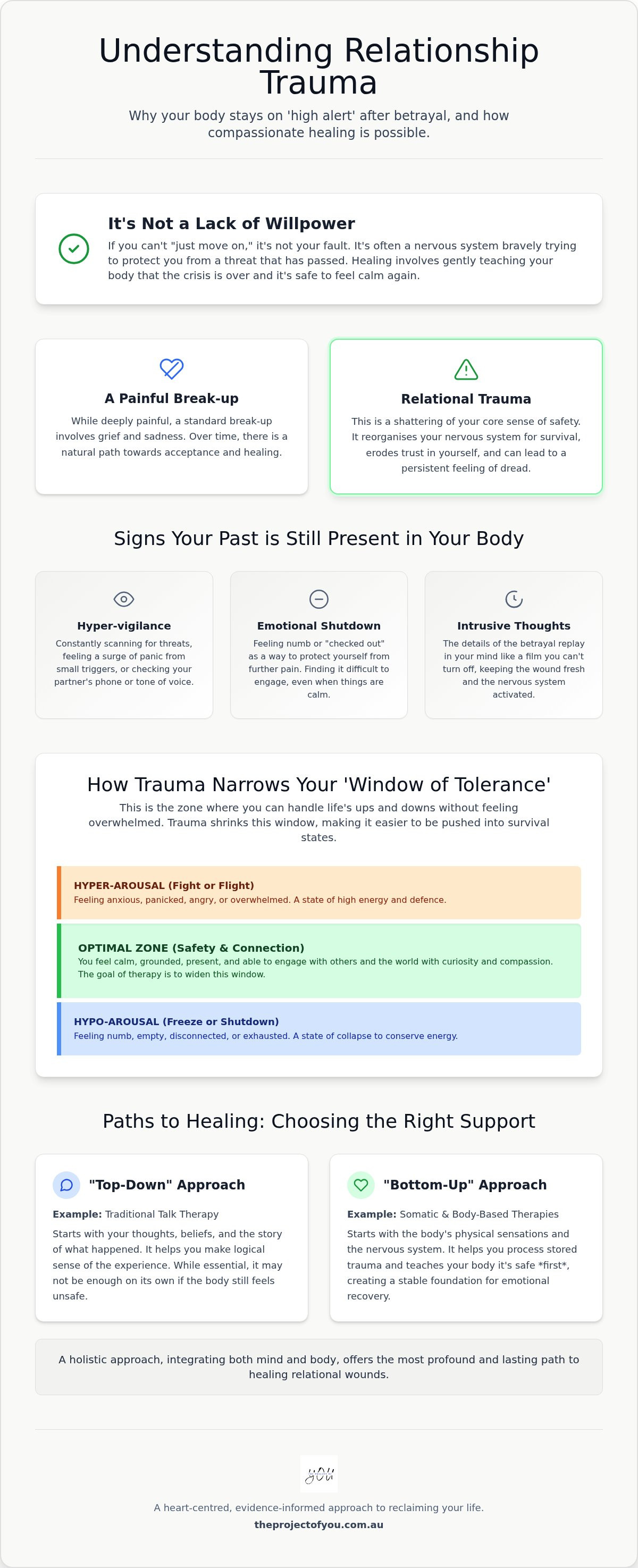
Relationship trauma is a disruption of secure attachment that reorganises the nervous system for survival. Unlike a physical injury, these wounds are often invisible to the outside world, yet they carry a heavy weight. Experiences like gaslighting, where your reality is systematically denied, or the sudden shock of infidelity, can lead to Psychological Trauma that changes how your brain processes information. You aren't just "upset"; your biological alarm system has been recalibrated to stay in a state of constant defence. This is your body's way of trying to ensure you are never blindsided again.
The Difference Between a Bad Break-up and Relational Trauma
A standard break-up is certainly painful, but relational trauma feels fundamentally different. You might notice a persistent sense of dread, as if you're always waiting for the other shoe to drop. This isn't just sadness; it's a profound loss of internal safety. One of the most damaging aspects is how it erodes your ability to trust your own intuition. You might ask yourself, "How did I not see this?" or "Can I ever trust my judgement again?" This internal conflict often breeds a deep sense of shame. At The Project of You, Azita Abdollahian works with clients to recognise that this shame doesn't belong to them. It's a natural byproduct of a nervous system trying to make sense of the unthinkable.
Signs Your Past is Still Present in Your Body
The body often holds onto the memory of betrayal long after the mind has tried to move on. You might find yourself stuck in patterns that feel beyond your control. These signs are often the body's attempt to keep you safe in a world that feels unpredictable. Common experiences include:
Hyper-vigilance: You find yourself constantly scanning your partner's tone of voice or feeling a surge of panic when a phone lights up.
Emotional shutdown: To protect yourself from further pain, you might feel numb or "checked out," finding it difficult to engage even when life is calm.
Intrusive thoughts: The details of the betrayal might loop in your mind, replaying like a film you can't turn off.
Recognising these symptoms is a vital part of the journey. It's not a sign of weakness, but evidence of your body's incredible capacity to adapt and survive. Healing begins when we start to approach these reactions with curiosity rather than judgement.
The Body Remembers: Restoring Your Nervous System After Betrayal
Have you ever wondered why your heart races or your breath catches even when you are logically aware that you're safe? It's because trauma isn't just a story we tell about the past; it's a physiological state that lives in the present. Engaging in therapy for relationship trauma often requires looking beyond the narrative of what happened and focusing on the internal wiring of your nervous system. When betrayal occurs, it acts like a power surge to your internal circuits, often leaving you stuck in a state of high alert or profound exhaustion.
To understand this, we look to Polyvagal Theory. In simple terms, this theory explains how our nervous system scans the world for cues of safety or danger. Relationship trauma disrupts this scanning process. It narrows what clinicians call your "Window of Tolerance," which is the zone where you can handle life's ups and downs without feeling overwhelmed. The American Psychological Association on Trauma notes that these biological responses are survival mechanisms, not signs of personal failure. If we rely solely on "just talking about it," we risk pushing you outside that window and causing re-traumatisation. True healing requires a foundation of physiological safety first.
From Fight-or-Flight to Social Engagement
Your nervous system has two primary modes for dealing with stress: the sympathetic "gas pedal" (fight-or-flight) and the parasympathetic "brake" (rest or, in extreme cases, shutdown). When you've experienced betrayal, you might find yourself toggling between these two extremes. You can't "logic" your way out of a panic attack or a depressive shutdown because the part of your brain responsible for reasoning goes offline when the survival brain takes over. This is where co-regulation becomes vital. In the therapeutic relationship, the steady, calm presence of a therapist helps your nervous system learn that it is safe to downshift from a state of defence into a state of social engagement and connection once again.
Somatic Healing: Working with the Body’s Wisdom
Restoring balance involves working from the "bottom up," starting with the body. Modalities like neurofeedback and somatic experiencing help to gently reset the alarm system that betrayal has left on high. Instead of just understanding that you are safe intellectually, these techniques allow you to feel it at a cellular level. It's about moving from the internal mantra of "I am unsafe" to a grounded sense of "I am safe now." At The Project of You, we view Nervous System Restoration as the essential first step in any recovery journey. By calming the storm within, you create the space necessary for deep, lasting emotional work to take place. If you feel ready to explore this path, you can book a session online to begin your restoration.
Choosing the Right Support: Comparing Modalities for Deep Healing
When you begin your search for therapy for relationship trauma, the options can feel quite overwhelming. Is it better to talk through your thoughts, or should you be focusing on your feelings? The truth is that deep healing often requires a blend of different tools tailored to your unique story. While Cognitive Behavioural Therapy (CBT) is wonderful for untangling the "what if" thought loops and self-blaming patterns that follow a betrayal, attachment-based therapy goes a step further. It explores how your personal history shapes your current need for safety, helping you understand why certain triggers feel so much louder and more persistent than others.
We are also seeing incredible shifts through modern breakthroughs such as Psychedelic Assisted Therapy. This modality offers a way to move past the protective layers of the ego, allowing for a profound sense of connection and emotional release that might take years to reach through traditional talk therapy alone. By bypassing the cognitive mind's tendency to rationalise or minimise pain, these sessions can help you access the root of your relational wounds in a safe, supported environment.
Standard Therapy vs. Intensive Retreats
For many, the traditional 50-minute therapy hour can feel like you've just started to open up when the clock runs out. If you feel "stuck" in your progress, an immersive format might be what your heart is calling for. Private Couples Retreats provide the time and space to go deep into the healing process without the interruptions of daily life. This concentrated focus allows for breakthroughs that often feel impossible in weekly sessions, as it gives your nervous system a chance to truly settle into a new experience of safety. An intensive retreat isn't just a longer therapy session; it's a total recalibration of your environment, allowing you to move from simply surviving the week to genuinely thriving in your own skin.
The Role of Trauma-Informed Care
Choosing the right professional is just as important as the modality itself. When looking for a trauma-informed counsellor, you want someone who understands that your reactions are survival strategies, not character flaws. This "blame-free" approach is essential for relationship recovery, as it fosters curiosity instead of judgement. Research into Couple Therapy for PTSD highlights how specific trauma-focused interventions can help partners navigate the complex aftermath of relational wounds together. Azita Abdollahian’s background as a clinical social worker ensures that the support you receive is grounded in evidence and clinical excellence, while remaining deeply human and compassionate. You deserve a guide who looks past the immediate obstacles to see the inherent potential within you.
Practical Strategies to Reclaim Your Sense of Safety
While professional therapy for relationship trauma provides the structural support for healing, the work of reclaiming safety also happens in the quiet moments of your daily life. It's about building a toolkit of small, manageable actions that remind your body it's no longer in a state of emergency. When a reminder of past betrayal surface, your heart might race or your stomach might knot. In these moments, somatic tools are your best ally. Box breathing helps regulate the vagus nerve by sending a direct signal to the brain that the immediate environment is secure. By focusing on the rhythm of your breath, you give your nervous system a physical anchor to the present moment.
Alongside these physical tools, developing a self-compassion practice is vital for quieting the inner critic. Trauma often leaves us with a legacy of self-blame or the feeling that we should have known better. We can't shame ourselves into healing. Instead, we learn to set boundaries that honour our need for safety. This might mean saying no to certain social events or being clear about your need for transparency in your current environment. Boundaries aren't walls to keep people out; they are the gates that allow you to feel safe enough to let the right people in.
Daily Rituals for Nervous System Regulation
Consistency is key when you're retraining a nervous system that has been primed for danger. You can signal safety to your brain throughout the day by looking for "glimmers." While triggers are cues of danger, glimmers are tiny micro-moments of safety or peace, such as the warmth of the sun on your skin or the scent of fresh coffee. Journaling can also be a powerful way to externalise the internal chaos. By putting your thoughts on paper, you move them out of the "looping" part of your brain and onto a page where they can be observed with more distance. You might find further inspiration for these practices in our upcoming workshops.
Navigating New Relationships with a Trauma History
Entering a new relationship after experiencing betrayal can feel like navigating a minefield. It's helpful to learn the difference between a "red flag" and a "trauma echo." A red flag is an objective sign of unsafety in the other person, whereas an echo is your own past experience projecting onto a current, safe situation. Communicating your history doesn't make you a "burden." In fact, building a "safety plan" with a partner—such as agreeing on how to handle check-ins or difficult conversations—creates a foundation of trust. This transparency allows you to grow together rather than feeling isolated by your past. For more insights on building healthy foundations, you can explore our relationship blog.
A Gentle Way Forward: The Project of You Approach
At The Project of You, we believe that you are the most important project you will ever undertake. Azita Abdollahian founded this practice on a simple yet profound philosophy: you are worth the time, the effort, and the deep care required to heal. When you seek therapy for relationship trauma within our space, you aren't just another appointment in a clinical diary. You are a whole person entering a sanctuary designed for somatic restoration and emotional rebirth. We blend clinical excellence with a soulful, heart-centred approach, ensuring that your recovery isn't just a mental exercise but a full-body experience of returning to safety.
Our work is grounded in the understanding that betrayal and relational wounds require more than just standard talk therapy. We integrate evidence-informed practices with nervous system regulation to help you move beyond the echoes of the past. Whether you are an individual looking to reclaim your spark, a couple trying to navigate the aftermath of an affair, or a parent wanting to break cycles of trauma for your children, we provide a steady, expert hand to guide you through the transition. We support Australians across the country in finding their way back to a life where they can breathe deeply and trust again.
Tailored Healing Pathways
We recognise that the path to recovery is never linear, and what works for one person may not be the right fit for another. This is why we offer a variety of ways to engage with the healing process. For those who prefer a focused, one-on-one environment, Individual Counselling provides a private space to untangle complex emotions and restore your internal boundaries. If you feel a call toward group connection and shared wisdom, our Healing Feminine Workshops offer a nurturing environment to explore personal growth alongside others who truly understand the weight you've been carrying. Getting started is as simple as booking a discovery call to discuss which pathway feels most aligned with your current needs.
A Message of Hope from Azita
Healing is possible, no matter how long you have carried the heavy weight of betrayal or gaslighting. There is no expiry date on your capacity for transformation, and your past does not have the final say in your future. I encourage you to trust your own timing; the fact that you are here, seeking a way forward, is a testament to your inherent resilience. You don't have to carry this burden alone any longer. We invite you to reach out and connect with us when you feel ready to take that first, gentle step toward a lighter version of yourself. You have already survived the hardest part; now, let us help you find the way home to your own sense of peace.
Your Path Toward Lasting Peace
Reclaiming your sense of safety is a journey that requires patience and a gentle, evidence-based approach. We've explored how healing from betrayal isn't just a mental hurdle but a physiological shift that involves somatic restoration and nervous system regulation. By understanding your "Window of Tolerance" and incorporating daily grounding rituals, you can begin to move from a state of hyper-vigilance toward a life of secure, healthy connection.
Choosing therapy for relationship trauma is a profound act of self-compassion that acknowledges your inherent worth. As a qualified Clinical Social Worker and Psychotherapist, Azita Abdollahian provides expert support for infidelity and betrayal trauma using a framework rooted in Polyvagal and Attachment theories. You don't have to navigate these complex waters alone.
The path ahead might feel uncertain at times, but every small step is a building block for a more regulated and hopeful future. You deserve a life defined by peace rather than the echoes of past pain. We're here to walk beside you as you reclaim your safety and rediscover the resilient person you've always been.
Frequently Asked Questions
Can you actually have PTSD from a relationship?
Yes, it's absolutely possible to experience Post-Traumatic Stress Disorder (PTSD) or Complex PTSD as a result of a toxic or abusive partnership. When you've lived through chronic gaslighting, domestic violence, or severe betrayal, your brain can become wired for survival just as it would after a physical accident. This often results in hyper-vigilance, flashbacks, and emotional numbing. Recognising these as legitimate trauma responses is the first step toward reclaiming your sense of self and physiological safety.
How long does it take to heal from relationship trauma?
Healing is a deeply individual process with no fixed timeline, as it depends on the duration of the trauma and the type of support you receive. For some, significant shifts occur within a few months of dedicated work, while for others, the journey of retraining the nervous system may take longer. It's important to remember that recovery isn't about rushing to a finish line. It's about slowly building a foundation of safety that allows you to trust yourself again.
What is the best type of therapy for betrayal trauma?
The most effective therapy for relationship trauma typically integrates somatic, body-based approaches with attachment theory. While traditional counselling focuses on the "what" of a situation, trauma-informed care looks at "how" your body is holding the experience. Modalities like Somatic Experiencing or Gottman-informed therapy help you process betrayal at a physiological level. This ensures you don't just understand the trauma intellectually, but actually feel safe again in your own skin.
How do I know if I need trauma-informed therapy or just regular counselling?
You might consider specialised therapy for relationship trauma if you find that standard talk therapy feels like you're just rehashing the past without finding relief. Regular counselling is excellent for general life transitions or basic communication skills. However, trauma-informed care is essential when you're dealing with triggers, "looping" thoughts, or a nervous system that feels permanently stuck in fight-or-flight mode. It provides the specific tools needed to settle your internal alarm system.
Is it possible to stay in a relationship after significant trauma or infidelity?
Yes, many couples can and do rebuild their bond after significant trauma, provided both partners are committed to the work of restoration. It requires a radical commitment to honesty, transparency, and creating a new foundation of safety that didn't exist before. While the relationship will never be exactly the same as it was, the process of healing together can often lead to a deeper, more resilient connection than you had previously.
What happens during a Nervous System Restoration session?
A Nervous System Restoration session focuses on moving your body out of survival mode and back into a state of physiological calm. Instead of just talking about your problems, we use techniques like neurofeedback or somatic exercises to help "reset" the alarm system triggered by past betrayal. These sessions are designed to be gentle and supportive, ensuring your body feels safe enough to release the tension it has been carrying for so long.
How does psychedelic-assisted therapy help with relationship wounds?
This modality helps by gently lowering the ego's protective defences, allowing you to access and process painful memories without being overwhelmed by them. This supported environment can foster a deep sense of connection and self-forgiveness that might take years to achieve through conversation alone. By viewing your relationship wounds through a lens of profound empathy, you can often find a path toward release and genuine emotional restoration that feels both deep and lasting.
Will I ever be able to trust someone again after being gaslit?
Yes, your capacity for trust can be restored, but the process usually begins with learning to trust your own intuition again. Gaslighting is designed to make you doubt your reality, so healing involves validating your own experiences and feelings. As you settle your nervous system and build self-compassion, you'll find it easier to set boundaries and slowly test the waters of trust in new connections at a pace that feels safe for you.


Comments