.png)

Deep Healing Retreat for Couples: Choosing the Right Path to Restoration in 2026
- Azita Abdollahian

- 1 day ago
- 13 min read
If you're wondering whether a couples retreat is worth it, or why previous holidays haven't improved your relationship, the answer is simple: relaxation alone doesn't heal relationship trauma or unhealthy relationship patterns. While a holiday may provide temporary relief, it doesn't address the emotional wounds, communication difficulties, nervous system dysregulation, or unresolved conflict that keep couples feeling disconnected.
Many couples find themselves returning from a holiday only to fall back into the same arguments, emotional distance, or feelings of loneliness. This happens because relationship challenges are rarely caused by stress alone. When trust has been broken, communication has deteriorated, or one or both partners are living in a constant state of "fight, flight or freeze," the nervous system needs more than rest—it needs intentional healing.
A trauma-informed couples retreat provides the time, space, and professional guidance to address the root causes of relationship distress. Through evidence-based relationship therapy, nervous system regulation, attachment-focused interventions, and experiential workshops, couples can move beyond simply managing conflict to rebuilding emotional safety, trust, intimacy, and genuine connection.
At The Project Of You, our Couples Retreats are facilitated by psychotherapist and relationship expert Azita Abdollahian, combining clinical expertise with immersive therapeutic experiences that create lasting change. Rather than offering a temporary escape, our retreats help couples understand the patterns keeping them stuck, develop healthier ways to communicate, regulate emotional reactions, and reconnect on a deeper level.
In this guide, you'll learn how a couples retreat differs from a holiday or traditional weekly counselling, the science behind trauma-informed relationship healing, the benefits of intensive couples therapy, and how to choose the right retreat to strengthen your relationship and create lasting transformation.
Table of Contents
Beyond the "Holiday High": Why Your Relationship Needs Deep Healing
The Science of Connection: Nervous System Regulation and Attachment
Comparing Couples Retreats: Finding the Right Depth for Your Journey
Navigating the Selection: What to Look for in a Deep Healing Program
Reconnecting with The Project of You: Bespoke Retreats for Lasting Change
Beyond the "Holiday High": Why Your Relationship Needs Deep Healing
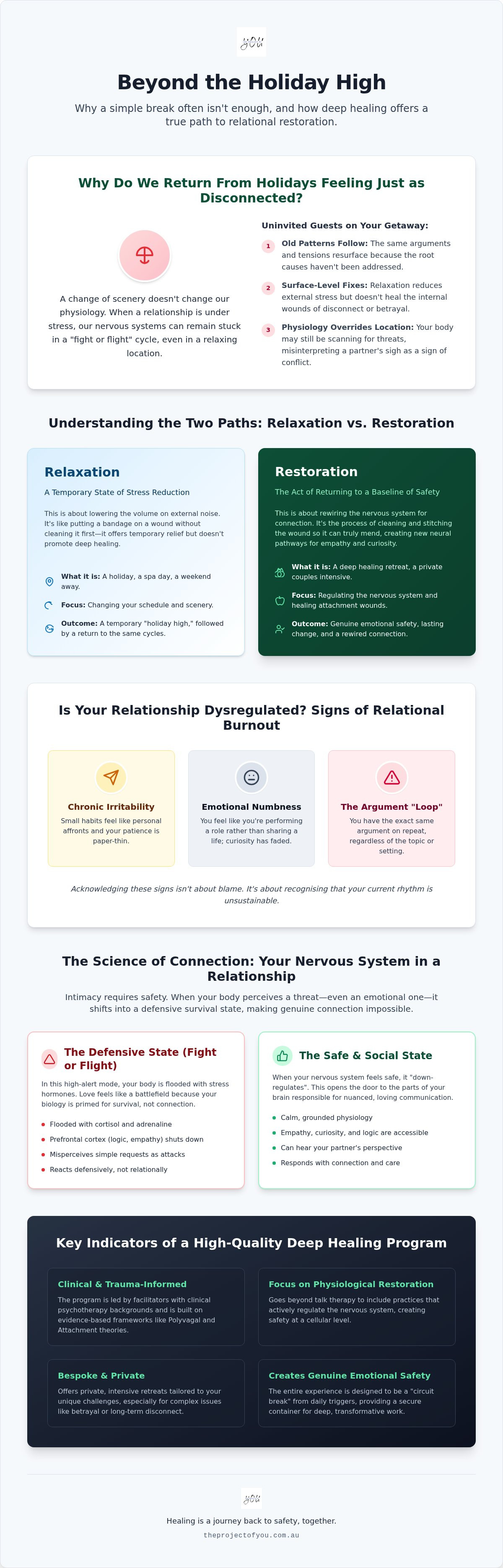
Have you ever returned from a tropical getaway only to find the same tension waiting for you at the baggage carousel? It's a common experience. We often mistake a change of scenery for a change of heart, hoping that a few days of sunshine will magically dissolve months of resentment or the heavy silence of unresolved betrayal. This is because surface-level relaxation addresses our schedule, but it rarely touches our physiology. When a relationship is under stress, our bodies often stay stuck in a "fight or flight" cycle. Even on a sun-drenched beach, your nervous system might still be scanning for threats, perceiving a partner's sigh or a quiet moment as a sign of impending conflict.
Deep healing is a deliberate process of physiological and emotional realignment. It's about moving past the temporary "holiday high" to address the fractures that sit beneath the surface. While traditional Couples therapy usually involves weekly one-hour sessions, a deep healing retreat for couples allows for a more immersive dive into these patterns. Choosing a private couples retreat acts as a vital circuit break. It stops the repetitive electrical surge of conflict before the system completely burns out, providing the space needed to rewire how you relate to one another.
The Difference Between Relaxation and Restoration
Relaxation is often a temporary state of stress reduction. It's about lowering the volume on external noise so you can breathe for a moment. Restoration, however, is the act of returning the nervous system to its baseline of safety. Think of it as the difference between putting a bandage on a wound and actually cleaning and stitching it so it can truly mend. Restoration is essential because it allows for the creation of new neural pathways of connection. When you feel safe at a cellular level, your brain moves out of defensive mode and becomes capable of genuine empathy and curiosity again.
Identifying the Signs of Relational Burnout
Relational burnout doesn't always look like explosive arguments. Often, it's a quiet, eroding force that leaves you feeling depleted. You might notice:
Chronic irritability: Small habits that used to be endearing now feel like personal affronts, and your patience feels paper-thin.
Emotional numbness: You spend time together, but you feel like you're performing a role rather than sharing a life. The curiosity about your partner’s inner world has faded.
The "Loop": You find yourselves having the exact same argument regardless of the setting. Whether you're in the kitchen or at a five-star resort, the script remains the same.
These signs suggest that your relationship isn't just tired; it's dysregulated. Acknowledging this isn't about finding fault. It's about recognising that your current rhythm isn't sustainable and that a deeper path to restoration is required.
The Science of Connection: Nervous System Regulation and Attachment
Why is it that during a disagreement, the person you love most can suddenly feel like an adversary? To understand this, we need to look beneath the surface of your conversations and into the biology of your bodies. Intimacy requires safety. According to Polyvagal Theory, our nervous system is constantly scanning the environment for cues of either danger or connection. When a relationship is strained by trauma or long term disconnect, your body may exist in a state of high alert. In this defensive mode, even a simple request from your partner can be misperceived as a personal attack. This isn't a lack of love; it's a biological survival mechanism.
When you're stuck in these cycles, your body is flooded with cortisol and adrenaline. These "stress hormones" are excellent for helping you escape a physical threat, but they are disastrous for relationship health. They effectively shut down the prefrontal cortex, which is the part of the brain responsible for empathy, logic, and nuanced communication. You literally cannot feel for your partner when your body thinks it's under siege. This is why a deep healing retreat for couples is so effective. By removing you from the familiar triggers of your daily environment, we can begin the work of "down-regulating" your collective nervous system, moving you both from a state of defence to a state of receptivity.
Attachment Styles Under Stress
Our early experiences shape how we seek closeness, often manifesting as anxious or avoidant attachment styles. During a relationship crisis, these patterns don't just appear; they are amplified. An anxious partner might "chase" for reassurance, while an avoidant partner might "withdraw" to find safety. This creates a painful loop where both people feel increasingly alone. In a therapeutic retreat setting, we focus on "co-regulation." This is the process where one person’s calm nervous system helps soothe the other’s. It's a foundational skill for anyone seeking Therapy for Relationship Trauma, as it helps you move from being two individuals in conflict to a team working toward safety.
Moving From Reactive to Responsive
The goal of deep healing is to move your relationship from a "sympathetic" state (fight or flight) or a "dorsal" state (numbness and shutdown) into a "ventral vagal" state. This is the physiological "green light" where social engagement and genuine connection happen. We facilitate this shift through somatic therapy, which focuses on body sensations rather than just words. By noticing where tension lives in your body, you can learn to settle your system before you speak. This process is held within "professional containment," a steady, non-judgmental environment provided by an experienced clinician. This containment acts as a secure fence, allowing you both to explore difficult emotions without the fear of the conversation spiralling out of control. If you feel ready to begin this shift, you might consider how a structured environment can support your journey and explore our available sessions to find the right starting point.
Comparing Couples Retreats: Finding the Right Depth for Your Journey
Not all retreats are built with the same intention. While some offer a beautiful escape, others are designed to facilitate a profound internal shift. When you're searching for a deep healing retreat for couples, it's helpful to categorise your options based on the level of support you actually need. Are you looking for a light refresh to your communication style, or is there a foundational fracture that requires clinical attention? Understanding the difference between a wellness getaway and a therapeutic intensive is the first step toward finding a path that leads to genuine restoration.
The depth of your experience often depends on the facilitator's clinical qualifications. While spiritual or faith-based retreats can offer comfort and a sense of community, they may lack the evidence-informed methodologies required to address complex trauma or deep-seated reactivity. In Australia, seeking out a practitioner with a background in Clinical Social Work or Psychotherapy ensures you are in hands that understand the biological and psychological nuances of relational distress. It's also vital to consider the "follow-up" factor. A truly restorative program doesn't end when you check out; it provides you with practical, sustainable tools to navigate the complexities of your daily life once you return home.
Luxury Spa vs. Clinical Healing Intensives
It’s tempting to choose a retreat based on the thread count of the sheets or the quality of the day spa. However, pampering is often an external comfort that merely masks internal distress. While a supportive, beautiful environment is vital, the core work should focus on Nervous System Restoration. A clinical intensive prioritises somatic work and nervous system regulation over standard massage or facial treatments. This doesn't mean you shouldn't be comfortable. In fact, luxury can support healing when it serves as a safe, quiet container that allows your body to finally let down its guard and focus on the internal work of realignment.
Group Workshops vs. Private Bespoke Retreats
Group settings can be incredibly powerful for certain stages of healing. Participating in a shared experience, such as a group workshop, can reduce the shame and isolation that often accompany relational struggle. It helps you realise that you aren't alone in your challenges. However, when you're navigating the raw aftermath of infidelity recovery or significant betrayal, the vulnerability required often demands total privacy. A bespoke, private retreat allows the clinician to tailor every moment to your specific history and attachment needs. This level of focus is often the most effective way to address deep-seated reactivity and rebuild a sense of shared emotional safety without the distraction of a group dynamic.
Navigating the Selection: What to Look for in a Deep Healing Program
Finding the right space for your relationship to mend requires more than just a quick search for "wellness". It's about ensuring the person holding the space has the expertise to navigate the complex layers of your history. When you're searching for a deep healing retreat for couples, the beautiful surroundings are merely the backdrop. The real medicine lies in the clinical framework used by the facilitators. A trauma-informed approach is non-negotiable. This means the program should be grounded in evidence-based methods such as the Gottman Method, Polyvagal Theory, and Attachment Theory. These aren't just academic terms; they're the maps that help us understand why you feel stuck and how to find your way back to safety.
A quality program doesn't just focus on what you say. It acknowledges how you feel in your body. Look for retreats that integrate somatic tools, such as Neurofeedback or Somatic Experiencing. These methods help address the physical "imprint" of stress, allowing you to move beyond the reactive patterns we discussed earlier. The intake process is another vital clue. Is the provider asking deep questions about your relationship history before you arrive? A personalised assessment ensures that the retreat is tailored to your specific needs rather than being a one-size-fits-all workshop.
Essential Qualifications for Deep Healing
It's vital to distinguish between relationship coaching and clinical therapy. While coaches can offer helpful advice for general growth, they often lack the training to safely manage deep-seated trauma or the intense fallout of betrayal. For these delicate issues, you need a facilitator with a background in Clinical Social Work or Psychotherapy. In Australia, these professionals are held to high ethical standards and rigorous clinical oversight. You might look at Azita Abdollahian’s extensive experience as a benchmark for what to expect. Her background ensures that the process isn't just about talking; it's about creating a structured, safe environment where real transformation can occur.
Questions to Ask Before You Book
Before you commit your time and heart to a program, don't be afraid to ask direct questions. A reputable provider will welcome your curiosity. It’s your relationship, and you deserve to know you’re in capable hands. Consider asking:
How do you handle high-conflict moments if they arise during the retreat?
What specific modalities do you use to help us regulate our nervous systems in real-time?
Is there a pre-retreat assessment to ensure this format is suitable for our current situation?
A clear, confident answer to these questions shows that the facilitator has the professional containment necessary to guide you through the more difficult parts of your journey. It’s about building trust before you even step through the door.
Reconnecting with The Project of You: Bespoke Retreats for Lasting Change
At The Project of You, we believe that true relational restoration isn't found in a brochure or a pre-packaged seminar. It's a deeply personal journey that requires both clinical precision and profound compassion. We understand that while you are a couple, you are also two individuals with distinct nervous systems, separate histories, and unique ways of processing pain. Our approach to a deep healing retreat for couples is designed to honour this complexity. We don't just treat the "relationship" as an abstract concept; we support the two people who make it up, ensuring that each of you feels truly seen, heard, and safe within the therapeutic process.
Imagine a life where the constant hum of anxiety is replaced by a sense of steady connection. This transformation is possible when we stop trying to fix the symptoms and start healing the source. By choosing one of our Private Couples Retreats, you aren't just taking a break. You're stepping into a dedicated container where your specific needs are the sole focus. We move beyond general advice to create a bespoke experience that addresses your unique attachment patterns and relational ecosystem.
Nervous System Restoration and Private Intensives
Our clinical intensives are structured to provide the deep work that weekly sessions can sometimes struggle to reach. We often integrate technology like Neurofeedback alongside traditional talk therapy to help settle the physiological "noise" that prevents clear communication. This is especially powerful when processing the heavy weight of infidelity or betrayal. We provide a dedicated space to unpack these challenges without the rush of the clock, allowing for a thorough and compassionate exploration. Before you leave, we work together to build a tailored roadmap. This ensures you have a clear, actionable plan to maintain your progress and navigate the transitions of your return home.
Integrating Advanced Modalities
For some couples, breaking through long-standing barriers requires a different kind of opening. Where appropriate, we explore advanced options like Psychedelic Assisted Therapy to facilitate deeper emotional shifts. We also recognise the importance of the individual within the couple, which is why our Healing Feminine workshops often serve as a vital support for the relationship's broader ecosystem. These diverse tools allow us to meet you exactly where you are. If you feel ready to move from a place of uncertainty toward a future of renewed intimacy, we invite you to book a discovery call with us today. Let's explore how we can support your path to restoration.
Your Path to Relational Restoration Starts Here
Choosing to step away from the noise of daily life and into a dedicated space of healing is a courageous act of love. We've explored how a deep healing retreat for couples differs from a standard holiday by focusing on physiological safety rather than just temporary relaxation. By prioritising nervous system restoration and evidence-based clinical support, you move beyond the "flight or fight" cycles that keep you feeling stuck in reactive patterns.
Under the guidance of Azita Abdollahian, a qualified Clinical Social Worker and Psychotherapist specialised in infidelity and trauma recovery, you can begin to dismantle old wounds with compassion. This journey is about more than just learning new communication skills; it's about building a foundation of secure attachment where both of you feel truly seen and safe. You deserve a relationship that feels like a sanctuary rather than a source of persistent stress.
The path back to each other is rarely a straight line, but with the right clinical containment and a curious heart, it's a journey well worth taking. We look forward to supporting you as you navigate this transition toward a more connected and peaceful future together.
Frequently Asked Questions
How is a deep healing retreat different from standard marriage counselling?
The primary difference lies in the intensity and the physiological depth of the work. While standard counselling happens in 50-minute weekly increments, a retreat allows you to bypass the "ramping up" and "winding down" time that often limits progress. This immersive format provides the space needed to reach the deeper layers of the nervous system that a single hour simply cannot access.
Can a couples retreat help if there has been recent infidelity or betrayal?
Yes, these intensives are specifically designed to provide the clinical containment required for the raw aftermath of betrayal. When trust is shattered, the body often stays in a state of high alert. We focus on rebuilding safety at a physiological level first, which is a necessary foundation before you can begin the complex work of processing the betrayal and exploring reconciliation.
Do we need to be "in crisis" to attend a deep healing retreat?
You don't need to be in a state of crisis to benefit, though many couples use this as a vital circuit breaker for long-term distress. A deep healing retreat for couples is also a proactive choice for those who feel a growing "numbness" or disconnect. It's about moving from "just functioning" to genuine flourishing before a crisis actually erupts.
How much time should we set aside for a truly restorative retreat?
A truly restorative experience typically requires three to five days of dedicated focus. Research into intensive therapy suggests that the brain and body need time to settle out of daily stressors. While a weekend can offer a helpful reset, a multi-day deep healing retreat for couples allows for the nervous system to fully down-regulate and integrate new, healthier patterns of connection.
What happens if we feel too overwhelmed during the retreat process?
Feeling overwhelmed is a natural part of the healing journey, and our facilitators are trained to help you navigate these moments safely. We use somatic tools and grounding techniques to ensure you stay within your "window of tolerance." The goal isn't to flood you with emotion, but to gently expand your capacity to hold difficult feelings together without spiralling into conflict.
Will we have to share our private issues with other couples?
In our private intensives, your journey is completely confidential and you won't share anything with other couples. While group workshops offer the benefit of shared experience, we prioritise total privacy for those dealing with sensitive relational trauma. You'll work exclusively with your clinician to ensure the environment feels bespoke and emotionally safe for your specific needs.
What is the success rate of intensive retreats for high-conflict couples?
According to 2026 industry data, approximately 98% of couples who undergo counselling rate the help they received as good or excellent. While we don't offer guaranteed outcomes, studies show that over 75% of couples report a significant improvement in their relationship quality following intensive support. Success is often tied to the willingness of both partners to engage with curiosity and self-compassion.
Is a deep healing retreat suitable for couples with different attachment styles?
Yes, these retreats are highly effective for couples with differing attachment styles, such as the common anxious-avoidant dynamic. We focus on understanding how your styles interact under stress rather than pathologising them. By learning co-regulation skills, an anxious partner can find calm and an avoidant partner can find safety, creating a more secure and predictable bond for the future.


Comments