.png)

Attachment-Based Therapy in Australia: Healing Your Relationships and Nervous System
- Azita Abdollahian

- 12 hours ago
- 13 min read
What if the "neediness" you feel in your relationships isn't a personality flaw, but a survival signal from a nervous system that never felt truly safe? It is a heavy burden to carry the fear that early childhood experiences have somehow broken your capacity to love or be loved. If you find yourself trapped in a cycle of chronic relational instability, exploring attachment based therapy Australia offers a gentle path toward understanding these deeply ingrained patterns. This isn't about dwelling on the past to find blame; it's about providing your body with the secure base it has been searching for all along.
We know how exhausting it is to live with the constant hum of relational anxiety or the instinct to withdraw when things get close. You likely want to feel steady and certain, yet your body often reacts before your mind can catch up. This article explains how trauma-informed, nervous system-focused care can lower your reactivity during conflict and help you create lasting, healthy intimacy. We will preview the transformative process of moving from survival mode into secure connection, offering a roadmap for your journey toward emotional ease and a more resilient heart.** is attachment-based therapy, and how can it help you build healthier, more secure relationships?**
If you experience intense fear of rejection, relationship anxiety, difficulty trusting others or a strong urge to withdraw when relationships become emotionally close, these patterns aren't necessarily a personality flaw. They can be connected to attachment patterns, early experiences and the way your nervous system learned to respond to relationships and perceived threats.
At The Project Of You, psychotherapist and trauma expert Azita Abdollahian takes a trauma-informed, nervous system-focused approach to helping people understand the deeper patterns influencing their relationships. Attachment-based therapy can help you recognise these patterns, understand where they come from and develop healthier ways of responding to conflict, intimacy and emotional connection.
In this guide, we explore how attachment-based therapy in Australia can help with relationship anxiety, emotional reactivity and insecure attachment, and how you can move from survival patterns towards greater emotional safety, secure connection and healthier intimacy.
Table of Contents
What is Attachment-Based Therapy?
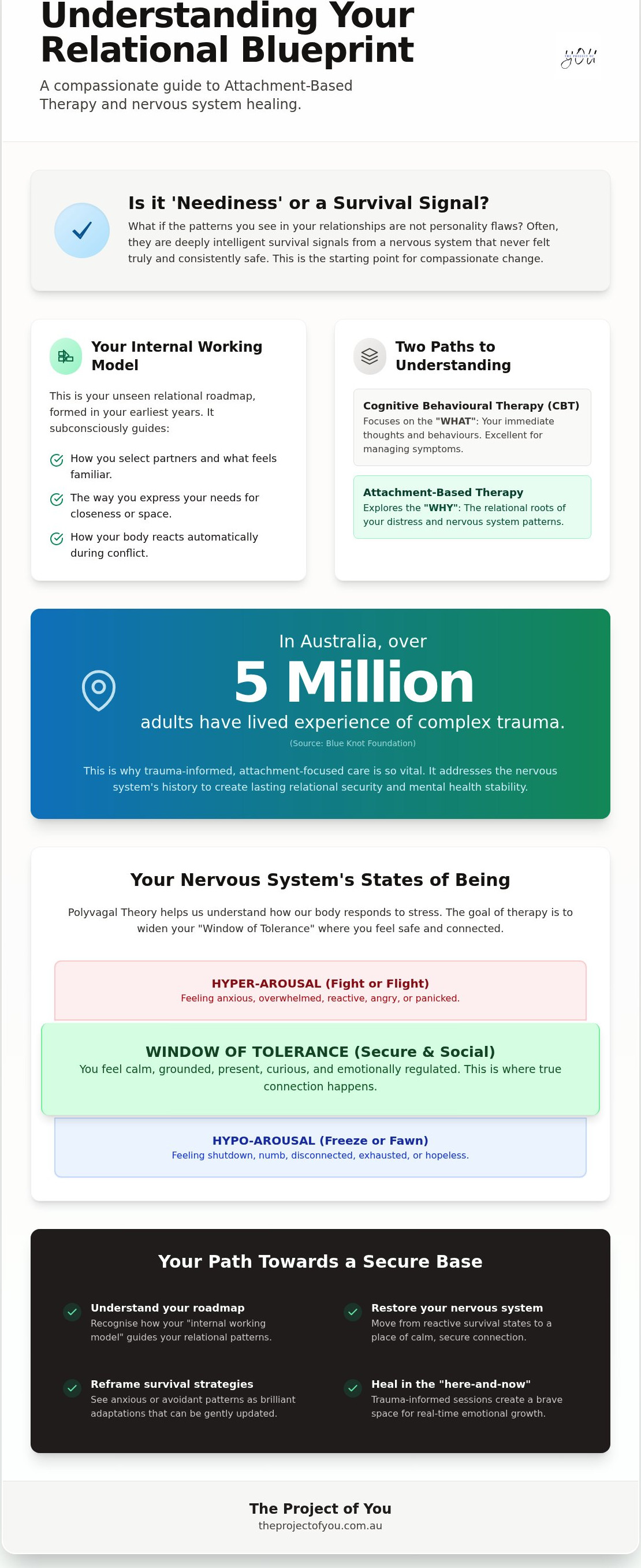
Think of your relationships not as a series of random events, but as a journey guided by a deeply personal roadmap. This is what we call your "internal working model." It's a blueprint formed in your earliest years that subconsciously dictates how you choose your partners, how you express your needs, and how you react when conflict arises. Engaging with attachment based therapy Australia provides a way to examine this map. It helps you understand why you might feel "smothered" by intimacy or "abandoned" during a simple disagreement. While traditional Cognitive Behavioural Therapy (CBT) is excellent for managing the "what", your immediate thoughts and behaviours, attachment therapy dives into the "why." By looking at the relational roots of your distress, we can help you transition from merely surviving your relationships to truly thriving within them. It's about finding the ease that comes with supported growth.
The Core Principles of Attachment Theory
At the heart of this approach is the concept of the "Secure Base." Just as a child needs a safe harbour to return to after exploring the world, adults need to feel that their partner is a reliable source of comfort. When life feels overwhelming, our natural instinct is "proximity seeking", which is the act of reaching out for connection. However, if our early experiences lacked "attunement", the feeling of being truly seen and understood, we might have learned to pull away or cling too tightly instead. This modality focuses on restoring that sense of attunement, building the emotional intelligence required for a secure, lasting bond.
Why Australians are Turning to Attachment-Focused Care
The Australian mental health landscape is evolving. We are moving beyond the outdated stigma that looking at "childhood issues" is about blaming parents. Instead, many are embracing attachment based therapy Australia as a form of relational empowerment. With the Blue Knot Foundation estimating that over five million Australian adults have lived experience of complex trauma, the need for trauma-informed care has never been clearer. This approach supports long-term mental health stability by addressing the nervous system's history. It offers a structured way to navigate the complexities of the human condition with grace. This path ensures you feel like an active participant in your own development, moving from a place of uncertainty toward a sense of clarity and purpose. You can learn more about this approach through Azita Abdollahian's unique methodology.
The Link Between Attachment and Nervous System Regulation
Have you ever noticed how a slight change in your partner's tone can make your heart race or your stomach drop? This isn't just an emotional reaction; it's your "Relational Nervous System" scanning for threat. Exploring attachment based therapy Australia means looking at the body's biological search for safety. For those with insecure attachment, the world often feels precarious because the Vagus nerve, which acts as the body's internal brake system, struggles to settle. This leaves you in a state of chronic dysregulation, where your body is constantly "on guard" even when you are with the person you love most. This is why we view Nervous System Restoration as an essential partner to our work. It allows us to address the physical alarm that sounds before your mind even has a chance to process the situation.
Chronic dysregulation doesn't just feel like stress; it changes the way you perceive your partner's intentions. When your nervous system is stuck in a state of high alert, a partner's need for space can feel like total abandonment, while their need for closeness might feel like a loss of your own autonomy. This physiological mismatch is often what drives the repetitive cycles of conflict that couples find so exhausting. By integrating attachment based therapy Australia with nervous system restoration, we provide you with the tools to settle your own alarm system, allowing you to see your relationship through a lens of clarity rather than one of survival.
Polyvagal Theory and Your Attachment Style
What if your "anxious" or "avoidant" behaviours were actually just the body's best attempt to keep you safe? Polyvagal Theory introduces the "Window of Tolerance." Inside this window, we handle difficult conversations with grace. Outside of it, we might "fawn" by over-pleasing to avoid conflict or "freeze" by shutting down entirely in romantic partnerships. A regulated nervous system provides the physiological foundation upon which secure attachment and deep emotional intimacy are built.
From 'Fight or Flight' to Felt Safety
Healing begins when we move from "fight or flight" into "felt safety." We use somatic therapy techniques to help you notice physical attachment triggers before they escalate into an argument. This process relies on co-regulation. By sitting with a steady, compassionate guide, your nervous system learns to mirror that calmness, re-wiring your response to intimacy. If you feel ready to explore this link, book a session online to begin your restoration.
Identifying Your Attachment Style: Anxious, Avoidant, or Disorganised?
What if the way you love isn't a personality flaw, but a brilliant survival strategy that once kept you safe? We often view attachment styles as rigid labels, yet they are actually adaptive responses to our earliest environments. In the context of attachment based therapy Australia, we move away from clinical judgment and toward a compassionate understanding of why your body reacts the way it does. Many people find themselves caught in the Anxious-Avoidant Trap. This is a painful cycle where one partner's need for closeness triggers the other's need for distance; it's a dance of mismatched nervous systems that feels familiar, even when it's exhausting. It can feel like you're constantly chasing or being chased, leaving both partners feeling misunderstood and alone.
The good news is that your attachment style isn't a life sentence. Through a process known as "Earned Security," you can re-wire these ingrained patterns over time. This involves creating a steady, secure base within yourself, often facilitated by the safe, consistent relationship you build with your therapist. By exploring attachment based therapy Australia, you learn to recognise your triggers and respond to them with kindness rather than reactivity. It's about moving from a place of fear-based protection to one of open, authentic connection. This transition is a journey of small, intentional steps that create a more resilient foundation for your future relationships.
Recognising Anxious Attachment in Adult Life
If you have an anxious style, you might feel a constant, low-level hum of worry about your relationship's stability. Common signs include a deep fear of abandonment, a persistent need for reassurance, and a tendency toward "people-pleasing" to keep the peace. Seeking anxious attachment counselling can help you quiet the inner critic that tells you you're "too much" or "too needy." Take a moment for self-reflection: "Do I feel responsible for my partner's emotional state?" If the answer is yes, your nervous system may be stuck in a state of hyper-vigilance, always scanning for signs of withdrawal.
Navigating Avoidant and Disorganised Patterns
Those with avoidant patterns often value independence above all else, seeing intimacy as a potential threat to their autonomy. They might "shut down" or withdraw during conflict as a way to self-regulate when emotions feel too intense. Disorganised attachment is more complex, often involving an intense "push-pull" dynamic where the person both craves love and fears being hurt by it. This often results in high levels of internal shame and confusion. These patterns are rarely about a lack of love; they are frequently rooted in a protective PTSD-like response from the past. We work to gently peel back these protective layers to find the resilient heart beneath.
What to Expect in Attachment-Based Therapy Sessions
Stepping into a therapy room can feel daunting, especially when you are carrying the weight of relational wounds. What if this space was less like a clinical office and more like a "brave space" designed for your vulnerability? In attachment based therapy Australia, we prioritise creating an environment where you feel seen, heard, and profoundly safe. Think of soft lighting, a comfortable chair, and a steady, calm presence that invites you to breathe deeply. This process often involves "here-and-now" processing. Instead of just talking about what happened last week, we notice what is happening in your body and between us right in the moment. This immediate feedback helps you identify how your nervous system reacts to connection and conflict in real time, turning the therapy room into a laboratory for healthy intimacy.
Your therapist acts as a temporary "secure base." Through this partnership, you learn what healthy, consistent support actually feels like, providing a corrective experience for those who didn't receive it early on. We also integrate CBT techniques to help you challenge the old, painful stories of unworthiness that your mind might repeat. This combination of somatic awareness and cognitive restructuring ensures you are healing both your heart and your mind simultaneously, allowing you to move through transitions with a sense of purpose and clarity.
Individual vs. Couples Attachment Therapy
If you are navigating the complexities of your own internal narrative, individual work allows you to focus on self-soothing and updating your personal roadmap. It's a space to explore how your past influences your present without the immediate pressure of a partner's reaction. However, if you and your partner are caught in repetitive cycles of hurt, couples work using Gottman-informed strategies can help repair the bond. This approach focuses on the "we" of the relationship, building shared meaning and resilience. Choosing the right path depends on your current relationship stage. Sometimes, finding your own feet first is the best way to eventually meet your partner in the middle with a regulated nervous system.
Beyond the Couch: Retreats and Intensives
For some, weekly sessions can feel slow when the pain is deep or the relationship is at a breaking point. This is where intensive retreats offer a powerful alternative for those seeking attachment based therapy Australia. These intensives can often bypass months of traditional talk therapy by providing an immersive environment for deep healing and restoration. Imagine waking up to a day dedicated entirely to your heart, where morning somatic movements help discharge stored stress before you dive into guided relational work. This focused approach is particularly effective for deep-seated attachment trauma, providing the space and time required to truly settle the alarm system and build a new foundation for love.
Finding Your Way Back: The Project of You Approach
Azita Abdollahian leads The Project of You with a philosophy that is as simple as it is profound: you are a person to be understood, not a problem to be solved. This heart-centred methodology is the cornerstone of our work in attachment based therapy Australia. By blending clinical expertise as a qualified Clinical Social Worker with deep, intuitive empathy, Azita provides a steady, compassionate presence that allows you to explore your inner world without fear of judgment. We believe that true healing happens when you feel safe enough to put down your protective shields and look at the "why" behind your relational patterns. It is about finding your way back to your authentic self, supported by a mentor who sees your inherent potential even when you cannot.
Our approach acts as a calm, steady presence in a world that often feels chaotic and disconnected. We don't just focus on the distress you feel today; we look past immediate obstacles to see the resilient individual waiting to emerge. This isn't a clinical process of "fixing" what is broken, but a collaborative journey of discovery. By prioritising human connection and emotional resonance, we help you create a new internal narrative, one where you are the active participant in your own development and growth.
Specialised Modalities for Deep Healing
For those who have found that traditional talk therapy reaches a plateau, we offer specialised paths to bypass cognitive barriers and reach the root of the trauma. We integrate Psychedelic-Assisted Therapy for treatment-resistant trauma, providing a structured, intentional way to access deeper layers of the psyche under professional guidance. Additionally, The Healing Feminine Workshops provide a communal, nurturing space for reclaiming self-worth and navigating the complexities of the human experience alongside others on a similar journey. Our digital resources, including self-love e-books, ensure that your movement toward restoration continues even between your scheduled sessions.
Taking the Next Step Toward Connection
Preparing for your first session with Azita is less about having all the answers and more about bringing an open heart and a willingness to be seen. You don't need to "organise" your thoughts perfectly before you arrive; the therapy room is a safe harbour where we do that work together. Investing in your relational health offers long-term benefits that ripple through every area of your life, from your professional confidence to the way you parent the next generation. It is an act of profound courage to choose a different way of living. If you feel the call toward a more secure, peaceful life, we are here to walk that path with you.
Ready to begin your journey? Book your session online today.
Embracing Your Path to Secure Connection
What if the emotional ease you seek is already within reach, simply waiting for the right map to guide you there? We have explored how understanding your attachment style is the first step in calming a reactive nervous system and building a resilient "secure base" within yourself. By engaging with attachment based therapy Australia, you aren't just managing symptoms; you are fundamentally re-wiring how you relate to those you love. Led by Azita Abdollahian, a qualified Clinical Social Worker and Psychotherapist, our practice offers evidence-informed care that prioritises your humanity over any clinical label. This holistic approach to nervous system restoration ensures you have the steady support needed to navigate life's transitions with grace. You don't have to carry the weight of relational anxiety alone any longer. Your potential for deep, lasting intimacy is inherent, and with the right guidance, you can move from a state of survival into a future defined by secure connection and authentic joy.
The journey toward a more secure, peaceful life begins with a single, courageous step. We look forward to walking this path beside you as you rediscover your capacity for love and connection.
Frequently Asked Questions
Is attachment-based therapy effective for adults?
Yes, attachment-based therapy is profoundly effective for adults because it targets the underlying blueprints that dictate our current relationship choices. While these patterns often form in childhood, they continue to drive our adult nervous system reactions. By working through these ingrained models, adults can develop "Earned Security." This leads to more stable, fulfilling partnerships and a significantly reduced sense of relational anxiety in your day-to-day life.
How long does attachment therapy usually take to see results?
The timeline for healing is deeply personal and depends on your unique history and goals. Some individuals notice a calming of their nervous system reactivity within a few months of consistent work. Deep-seated attachment wounds often require a more sustained commitment to create lasting change. For those seeking faster progress, intensive retreats can often bypass months of traditional weekly sessions, providing a more concentrated space for restoration and growth.
Can I change my attachment style from anxious to secure?
Yes, you absolutely can move from an anxious style to a secure one through the process of "Earned Security." This transformation happens as you build a consistent, safe relationship with your therapist and learn to provide that same security for yourself. Over time, your nervous system learns that it no longer needs to stay in a state of high alert. This allows you to approach intimacy with confidence rather than fear.
Does attachment-based therapy always involve talking about my parents?
While we do explore early caregiving experiences to understand your relational roadmap, the focus remains on how those experiences impact your present-day life. We don't dwell on the past for the sake of blame. Instead, we look at the "why" behind your current reactions so we can update your internal working model. This allows you to navigate your modern relationships with more clarity and less subconscious baggage.
What is the difference between attachment-based therapy and regular counselling?
Traditional counselling often focuses on managing immediate symptoms or changing specific behaviours. In contrast, attachment based therapy Australia looks at the relational bond and the physiological state of your nervous system. It addresses the root cause of your distress by examining how you seek safety and connection. This approach provides a more holistic path to healing, ensuring that changes are integrated into your body as well as your mind.
Can attachment therapy help with infidelity recovery?
Yes, attachment therapy is a vital tool for infidelity recovery as it focuses on repairing the shattered sense of safety within the relationship. Infidelity is often experienced as a profound attachment trauma. We work to understand the underlying vulnerabilities that led to the breach and provide a structured path to re-establish a "secure base." This process helps couples move through the pain toward a more resilient and honest connection.
How do I know if I have an insecure attachment style?
You might have an insecure attachment style if you experience chronic anxiety about your partner's feelings or find yourself constantly shutting down during conflict. Other signs include a persistent need for reassurance, a fear of being smothered, or a push-pull dynamic in your intimacy. If your relationships often feel like a source of stress rather than a safe harbour, exploring your attachment style can provide the clarity you need to begin healing.
Is attachment-based therapy covered by Medicare in Australia?
Medicare rebates are available for sessions with eligible mental health professionals when you have a valid Mental Health Care Plan from your GP. As of 1 July 2026, the Medicare rebate for a standard 60-minute clinical psychology session is A$149.05. While many practitioners of attachment based therapy Australia are registered providers, it's important to confirm your specific therapist's eligibility and any out-of-pocket costs before beginning your journey toward restoration.


Comments